Skip to content

Some evenings in Humble, the hardest part isn’t the legal paperwork. It’s opening the fridge, checking the bank app, and realizing the child support payment still hasn’t arrived. School clothes still need to be bought. Daycare still needs to be paid. The electric bill doesn’t pause because the other parent stopped doing what the court ordered.
That’s where a lot of parents in Humble, Atascocita, Kingwood, and Northeast Houston find themselves. They’re not looking for a fight. They’re trying to keep life steady for their child, and they need to know what can be done when support goes unpaid.
Texas law gives parents real enforcement options. If you’re owed support, the order isn’t just a piece of paper. If you’re the parent being accused of nonpayment, you also have rights, and those rights matter in Harris County court. A good child support enforcement attorney humble tx families can turn to should understand both sides of that reality and help you take the next smart step.
Navigating Unpaid Child Support in Humble and Northeast Houston
Maria lives near Atascocita. Her child’s other parent paid regularly for a while, then payments became unpredictable. One month it was late. The next month it was partial. After that, nothing. She kept hoping things would improve, because court sounded expensive, stressful, and hard to understand.
That kind of story is common across Humble, Kingwood, and Northeast Houston. Parents often wait longer than they should because they don’t want to escalate things. They worry that asking the court for help will make co-parenting worse, or they assume nothing can be done if the other parent changes jobs, ignores calls, or says money is tight.

When unpaid support starts affecting daily life
The strain usually shows up in ordinary places first:
- Groceries get stretched: Families start cutting back on basics to cover what support was supposed to handle.
- School needs pile up: Fees, uniforms, supplies, and activity costs don’t wait for a missed payment to be resolved.
- Stress spills into parenting: It gets harder to stay calm and consistent when every missed payment creates another problem.
- Informal promises replace legal compliance: “I’ll catch up next month” becomes a pattern instead of a solution.
In Harris County, a parent who’s owed support doesn’t have to keep carrying that burden alone. Courts can enforce payment. Income can be withheld. Arrears can be addressed. Judges can require accountability.
Unpaid child support is more than an argument between parents. It affects a child’s routine, stability, and sense of security.
Why local guidance matters
Humble families aren’t dealing with child support in the abstract. They’re dealing with Harris County court procedures, local employer issues, changing work schedules, and the very real cost of raising a child in this area. The practical answer often isn’t “wait and see.” It’s getting organized, understanding your order, and acting before the unpaid amount gets harder to collect.
What a Texas Child Support Order Means for You
A child support order is a court order. That sounds obvious, but a lot of confusion starts here. Parents sometimes treat support like a private agreement that can be adjusted by text message, a handshake, or a temporary side arrangement. It can’t.
If a judge signed an order, both parents are expected to follow it unless the court changes it. That includes the monthly support amount, who provides health insurance if the order says so, and any other support-related duties listed in the paperwork. If one parent stops paying because they’re angry about visitation, that doesn’t cancel the order. If both parents verbally agree to a different amount, that still may not protect either one in court later.
What’s usually inside the order
Most Texas child support orders tell you several important things in plain terms once you know where to look:
Monthly support amount
This is the amount the paying parent must pay under the order.Payment timing
The order typically states when payments are due and how they should be paid.Medical support obligations
The order may assign responsibility for health insurance or unreimbursed medical expenses.Income withholding language
Many orders include language allowing support to come directly from wages.
If you’re reading your order and feel lost, you’re not alone. Many parents focus on the final number and miss the parts that matter later in enforcement.
How Texas calculates guideline support
Texas uses guideline percentages tied to the non-custodial parent’s net monthly income. Under the Texas Family Code, guideline child support is 20% for one child, 25% for two children, 30% for three children, 35% for four children, and 40% for five or more children, and as of September 1, 2025, the cap on net monthly resources increased from $9,200 to $11,700 according to Texas child support guideline updates discussed here.
That matters in two ways. First, it helps explain where your current amount likely came from. Second, it matters if someone claims the number is unfair but hasn’t gone back to court to modify it.
Practical rule: Until a court changes the order, the existing amount usually controls, even if someone’s job or schedule has changed.
Where parents get tripped up
A few misunderstandings come up again and again in Humble-area cases:
- “We agreed to something different.” Private agreements may not override the signed order.
- “I lost my job, so I didn’t have to pay.” Job loss can affect a future modification request, but it doesn’t automatically erase the current obligation.
- “They kept me from seeing my child, so I stopped paying.” Support and possession are separate issues under Texas law.
- “The order is old, so it probably doesn’t matter much now.” Older orders can still be enforced.
Once you understand that the order is binding, the enforcement process starts making a lot more sense.
Texas Child Support Enforcement Tools Explained
When parents hear “enforcement,” they often think only about jail. In reality, Texas uses several tools, and they don’t all work the same way. Some are automatic. Some are pressure tactics. Some are best when the other parent is employed. Others matter more when there are assets, licenses, or repeated refusal to comply.
The most common tool is income withholding
Texas law treats income withholding as the main enforcement mechanism. Under Chapter 158 of the Texas Family Code, support can be deducted directly from wages, and this approach recovers over 70% of arrears in active employment cases according to this discussion of Texas child support enforcement tools.
For many families in Humble and Northeast Houston, this is the cleanest fix because the money is taken from payroll before it reaches the paying parent. If the parent works a regular job, withholding often does more than repeated demands ever could.
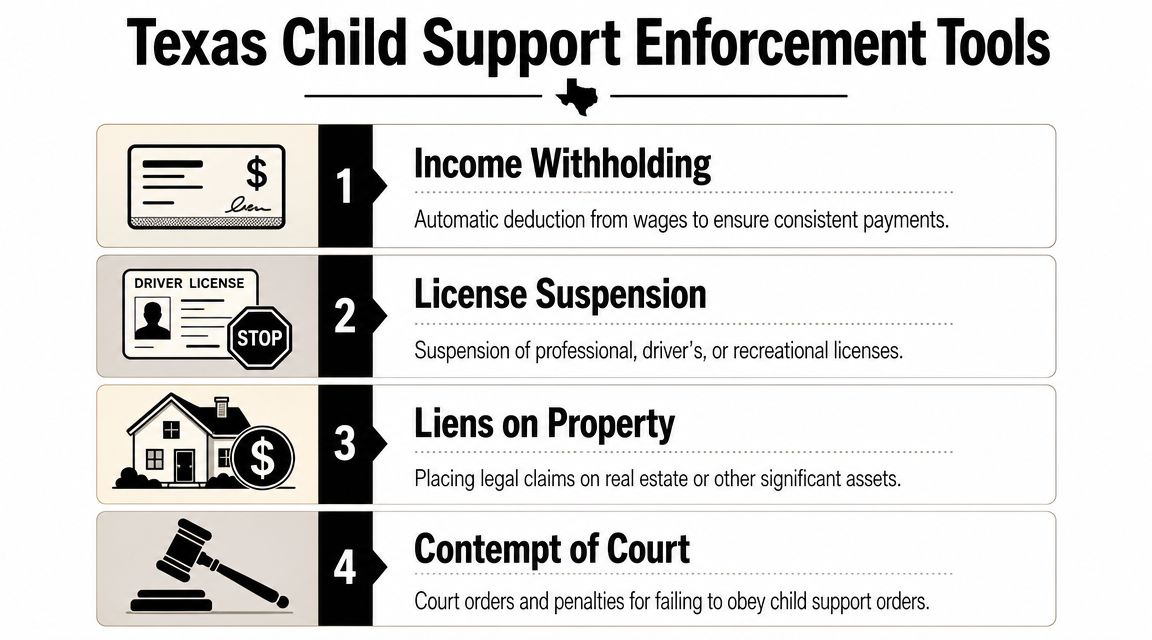
Side by side comparison of enforcement options
| Enforcement Tool | How It Works | Severity | Best For |
|---|---|---|---|
| Income withholding | Support is deducted from wages through payroll | Moderate | A parent with steady employment |
| Contempt of court | Judge can impose penalties for violating the order | High | Repeated nonpayment and willful refusal |
| Liens on property | Legal claim can attach to certain property | High | Cases involving assets instead of regular wages |
| License suspension | State can suspend qualifying licenses | High | Parents ignoring less severe enforcement efforts |
| Passport denial | Limits ability to obtain or renew a passport | High | Significant arrears with ongoing noncompliance |
| Money judgment for arrears | Unpaid support can be reduced to a judgment | Moderate to high | Cases where documentation of missed payments is strong |
How to think about severity
Not every case should start with the harshest remedy. A parent who changed jobs and slipped behind may respond quickly once withholding is put in place. A parent who has ignored the order for a long time may require contempt proceedings or property-based enforcement.
Here’s a simple way to view this:
- Use withholding first when employment is stable
- Use contempt when the problem is repeated defiance
- Use liens when wages aren’t the whole story
- Use license or passport pressure when softer tools have failed
The best enforcement tool is the one that matches the other parent’s actual situation, not the one that sounds toughest on paper.
What these tools look like in real life
In Kingwood, one parent may work for a company with regular payroll. Withholding makes sense. In Atascocita, another parent may be self-employed and keep changing income streams. A paper trail, payment history, and court enforcement request become more important. In Northeast Houston, a parent might own property but claim cash flow problems. That may call for a different strategy.
Parents also ask whether “wage garnishment” is different from income withholding. In everyday conversation, people often use the terms loosely. In child support cases, the important point is that Texas can require support to come directly from earnings through the legal mechanisms available for support enforcement.
What not to do
Parents often make the process harder by relying on informal pressure that doesn’t build a court record.
- Don’t rely on texts alone: Save them, but don’t assume they enforce the order by themselves.
- Don’t accept vague promises as a plan: “I’ll get caught up soon” isn’t legal compliance.
- Don’t stop documenting missed payments: A clean payment history can make enforcement much stronger.
- Don’t wait too long to act: Delay can make collection more complicated.
If you’re choosing between enforcement paths, the key question is simple. What tool will lead to payment or meaningful court action in your specific Harris County case?
Filing for Child Support Enforcement A Step-by-Step Guide
Most parents feel better once they can see the process. Enforcement in Harris County is still serious, but it’s easier to handle when you break it into tasks instead of treating it like one huge legal problem.

Step one is gathering the right paperwork
Start with the documents that tell the court exactly what order exists and exactly how it was violated. Usually that means:
- Your signed child support order
- A payment record or ledger
- Any proof of partial payments
- Employer information if you have it
- Messages or records showing missed obligations
Many cases become stronger or weaker depending on the details presented. Judges need specifics. Dates matter. Amounts matter. Payment history matters.
Step two is deciding how you want to pursue enforcement
In Texas, some parents go through the Attorney General process. Others hire private counsel. Both paths can work, but they serve different needs.
The Attorney General route may fit some families who want to use the state process. Private representation may make sense when the case is disputed, urgent, or tied to other family law issues. If you want a clearer picture of that process, this guide on how to enforce child support in Humble is a helpful next read.
Step three is filing the enforcement request
The usual court filing is a motion for enforcement. That document tells the court what the order required, how the other parent failed to comply, and what relief you’re asking for. In plain language, you’re not just saying “they didn’t pay.” You’re identifying the missed obligations clearly enough for the judge to act.
A strong filing is usually specific about:
- Which order is being enforced
- Which payments were missed
- Whether arrears, withholding, or contempt are being requested
- What documentation supports the claim
Bring order to the facts before you bring the facts to the court.
Step four is preparing for the hearing
After filing, the other parent must be properly notified. Then comes the hearing stage. That doesn’t always mean a dramatic courtroom battle. Sometimes the pressure of an enforcement case leads to negotiations, a payment arrangement, or a withholding setup before the hearing finishes the issue.
For parents who like to learn visually, this short video gives a useful overview of child support enforcement basics:
Step five is asking for the right remedy
The remedy matters as much as the complaint. Some parents only ask the court to confirm the amount owed. Others need stronger relief, such as income withholding or contempt findings. The right request depends on the facts.
A few examples help:
- If the other parent works a regular job, withholding may solve the problem quickly.
- If they’ve ignored prior chances to catch up, contempt may be necessary.
- If assets exist but payments don’t, property-related enforcement may be considered.
What to expect in Harris County
Parents in Humble often worry about whether the court will understand the full story. That’s why preparation matters so much. A judge is looking for a clear order, a clear violation, and a lawful remedy. Emotional frustration is understandable, but enforcement succeeds on documentation and procedure.
If you’re the parent seeking payment, come organized. If you’re the parent responding to an enforcement action, don’t ignore it. Showing up with records and a real plan can matter a great deal.
The Role of a Child Support Enforcement Attorney
You may already know the amount owed down to the penny, yet still feel stuck. One parent is tired of waiting for support that should have helped with groceries, school clothes, or daycare. The other is staring at enforcement papers and worrying that a missed payment history does not tell the whole story. In Harris County, both situations call for more than frustration. They call for a careful legal plan.
A child support enforcement attorney helps turn a stressful problem into something the court can address in a clear, organized way. In plain terms, the lawyer’s job is to connect the paperwork, payment history, deadlines, and requested remedy so the judge can act on facts instead of confusion.
That work often includes reading the existing order line by line, matching it against the payment record, preparing the enforcement pleading with enough detail, arranging proper service, and presenting a remedy that fits the problem. A case involving a steady paycheck may point toward income withholding. A case involving repeated disregard of prior orders may call for stronger court action. On the defense side, an attorney helps separate true arrears from bookkeeping mistakes, credit overlooked payments, and explain changes in employment or health with records the court can use.
Local experience matters for a practical reason. Humble cases usually run through Harris County procedures, and the small details can shape the outcome. Contract work, cash payments, overtime swings, oil-and-gas layoffs, and side-gig income all show up in Northeast Houston families. Those facts do not excuse nonpayment by themselves, but they often affect how arrears are calculated, how payment plans are proposed, and whether an enforcement request is drafted the right way.
Texas lawmakers also continue to adjust family law procedure, and those updates can affect strategy even when parents assume the rules have stayed the same. For example, the 2025 legislative session included House Bill 99, which appears in the official Texas Legislature bill history at the Texas Capitol Online bill page for HB 99. A lawyer should check how any new statutory language, effective dates, and related rule changes apply before asking the court for relief or responding to an enforcement motion. That is one reason families should be cautious about relying on old internet summaries.
Language access can matter too. If payment records, texts, or financial documents are in Spanish, accurate translation helps avoid expensive misunderstandings. In some cases, families also benefit from Expert Spanish Legal Translation Services so the court receives documents in a form that is clear and usable.
Cost is part of the decision, and clients deserve a direct answer. In Humble, fees often depend on how disputed the case is, how many hearings are needed, and whether the lawyer is building an enforcement claim or defending against one. The range can vary widely, especially if the case involves arrears disputes, contempt exposure, or related custody issues.
For parents comparing options, a child support attorney in Humble who handles enforcement matters may be able to address collection efforts, arrears disputes, and related court filings in one place.
The right lawyer is not just filing forms. The right lawyer helps you avoid procedural mistakes, present a clearer story, and ask the court for relief that can be enforced.
Understanding Contempt and Potential Jail Time
Contempt is the part of enforcement that scares people most, and with good reason. When a judge finds that someone violated a court order without a valid legal excuse, the consequences can go beyond collecting money. A contempt case can involve fines, strict court conditions, and in some cases jail.
For the parent owed support, contempt can be the strongest accountability tool the court has. For the parent accused of nonpayment, it can feel overwhelming, especially if missed payments built up during job loss, illness, or personal crisis.
How serious this gets in Texas and Harris County
Texas takes child support enforcement very seriously. Texas has had over 250,000 child support-related incarcerations since 2000, and Harris County accounted for 15% of statewide enforcement actions in 2025, according to this discussion of child support enforcement and incarceration risks.
That doesn’t mean every unpaid case leads to jail. It does mean parents shouldn’t treat an enforcement hearing like something they can ignore. Courts expect attention, preparation, and compliance efforts.
What judges often look for
A contempt issue usually turns on whether the order was clear and whether the parent failed to obey it. In practical terms, the court may focus on questions like these:
- Was there a valid signed order?
- Were payments missed as alleged?
- Did the parent have the ability to comply, or at least some ability to make efforts toward compliance?
- Has the parent ignored prior warnings or opportunities to fix the problem?
If language barriers complicate the paperwork or hearing preparation, families may also need accurate document support. In those situations, Expert Spanish Legal Translation Services can be a useful resource for understanding legal materials more clearly.
A contempt hearing is not the time to “explain it later.” It’s the time to show up prepared with documents, records, and a workable plan.
Can jail be avoided
Sometimes, yes. Courts may consider payment plans, income withholding, or other purge conditions that give a parent a path to compliance. That path depends heavily on whether the parent takes the case seriously and appears ready to address the arrears in a concrete way.
If someone has already been taken into custody in a related enforcement matter, families often need fast information about next steps. This overview of how bail works in Humble-area cases can help loved ones understand the process.
The worst move is silence. If you’re owed support, act before the record gets colder. If you owe support and have been served, respond before the court assumes you won’t.
Common Questions about Humble Child Support Enforcement
A parent in Humble often asks the same question after opening enforcement papers or checking a bank account that still has not seen a support payment. What happens now, here in Harris County, and how much power does the court really have?
That question matters whether you are trying to collect overdue support or you are the one accused of falling behind. Texas uses strong enforcement tools. In local courts, those tools can affect wages, tax refunds, licenses, property, and in some cases personal freedom. The hard part is knowing which problems can be fixed, which ones need a court order, and which mistakes make things worse.
What if the other parent moved out of Texas
A move across state lines usually does not end the case. Child support orders are enforced between states under interstate rules, so the order can still follow the parent who moved.
The practical challenge is location and paperwork. If you know where the parent now lives, works, or banks, that information can save time. A Harris County judge cannot collect money from thin air. The court needs a trail to follow.
Can parents agree to forgive unpaid support
Private side deals are risky.
In many cases, unpaid child support is treated as a debt already owed under the order. Parents may agree on how to handle future conflict, but they usually cannot erase arrears with a handshake, a text message, or an informal promise. If you accept partial payments or discuss a reduced amount, put nothing in writing until a lawyer reviews the effect on the arrears record.
That is one of the most common points of confusion. Parents often treat support like any other family expense. Texas courts do not.
How do newer law changes affect disputed support issues
Recent law changes matter most when a parent says the current support amount no longer matches real income or real parenting time, but enforcement is already underway. That is where people get tripped up. Enforcement asks, “Was the order obeyed?rdquo; Modification asks, “Should the order change?rdquo; Those are related questions, but they are not the same case.
For 2025 and 2026, Texas families should pay close attention to updates coming out of the Legislature and the Office of the Attorney General, especially when local courts are balancing enforcement requests against claims of job loss, reduced income, or shared custody changes. You can track enacted legislation through the Texas Legislature Online bill search at https://capitol.texas.gov/ and review child support program updates from the Texas Attorney General at https://www.texasattorneygeneral.gov/child-support. The safe takeaway is simple. New law may affect how support is calculated or modified going forward, but it usually does not wipe out support that was already due under an existing order.
How long does an enforcement case take in Harris County
There is no single timetable. Some Humble area cases move faster because service is completed quickly and the payment history is clear. Others slow down because the other parent is hard to find, denies the amount owed, or files related requests involving custody or modification.
A case usually moves better when the record is organized. Bring the court order, the payment ledger, bank records, screenshots if payments were discussed electronically, and any notices from the Office of the Attorney General. A judge who sees a clean timeline can usually act faster than a judge who has to sort through missing pieces.
What if I’m the one accused of not paying
Treat the notice seriously and answer it quickly.
If you paid directly, gather proof. If you lost work, collect records showing when income dropped and what efforts you made to find new work. If the amount claimed is wrong, say so with documents, not guesses. Courts in Harris County tend to respond better to a parent who comes in with records, a realistic payment proposal, and a clear explanation than to a parent who shows up angry and empty-handed.
That does not mean every accusation is fair. Some enforcement filings rely on incomplete payment histories or fail to account for changed circumstances. A defense may exist, but it has to be prepared carefully.
Is hiring a lawyer always necessary
No. Some parents handle straightforward arrears issues on their own.
But legal help often makes a real difference when contempt is requested, the arrears are large, the payment record is messy, the other side has counsel, or enforcement overlaps with a needed modification. That is especially true in Harris County, where local procedure, docket settings, and proof problems can shape the result almost as much as the legal rule itself.
If you are dealing with unpaid child support in Humble, Atascocita, Kingwood, or Northeast Houston, or you are facing an enforcement action and need clear guidance fast, schedule a free consultation with the Law Office of Bryan Fagan. Our Humble office helps parents understand their options, prepare for Harris County court, and work toward practical solutions that protect their children and their future.