If you're sitting in Humble or Atascocita refreshing a court search page because someone said a protective-order hearing was set, you're not alone. A lot of people assume those cases will show up on the same track as a divorce, custody case, or criminal charge. In Harris County, that assumption causes confusion fast.
The Harris County 280th District Court protective order docket works differently because the court is built to handle domestic violence matters as their own stream of cases. If you live in Humble, Kingwood, or Northeast Houston, that distinction matters. It affects where the case is filed, what cause number you search, what the public docket shows, and who you need to call when the online record looks incomplete.
I tell clients the same thing at the kitchen table. Don't guess. Protective-order procedure in Harris County is specific, and the 280th has its own rhythm.
What the 280th District Court Handles and Why It Matters
A common Harris County mistake goes like this: someone files for divorce, then asks where the protective-order hearing will show up. They search the family case, see nothing, and assume no setting exists. In the 280th, that assumption gets people in trouble.
The 280th District Court handles domestic-violence protective orders as their own line of cases. In Harris County, an application under Title 4 of the Family Code is filed as a separate case with its own cause number, even when the same people are already fighting over divorce, custody, or support. That rule is laid out in the court's published domestic violence procedures, noted earlier.
The 280th is not just another family court
Generic articles miss this point because they treat every Texas court the same. Harris County does not. The 280th is the county's dedicated domestic violence court, and that changes what lands on its docket and how fast you can find it.
The split starts at intake. Protective-order applications have their own filing path, and the case is styled as applicant versus respondent. It is not folded into a divorce petition or SAPCR pleading just because the parties overlap. If you are in Humble, Atascocita, or Kingwood, that means one family conflict can create two separate court files on the same week, sometimes the same day.
Why that separate-cause-number rule matters
It affects the search, the hearing notice, and the paperwork.
If you pull up only the divorce case, you may miss the protective-order setting entirely. If you search only by party name, you may drown in results and still overlook the right file. The safer move is to treat the protective-order matter as its own case from the start.
That is also why the public record can feel uneven. A protective-order file may show activity that does not appear in the divorce docket, because it is not supposed to.
What usually appears on this docket
The 280th's protective-order docket generally deals with requests for ex parte relief, temporary settings, and final hearings in standalone protective-order cases. The court's procedures also call for specific supporting forms before certain relief is entered, which is one reason these cases often move through more than one checkpoint before a final order is signed.
Here is the practical advice I give clients. Get the protective-order cause number first. Keep it separate from every other case number in the family dispute. That one habit prevents a lot of bad assumptions.
If you are still sorting out whether you need a protective order or some other kind of family-court relief, read this guide on protective order vs. restraining order in Humble TX. The difference matters because the 280th docket is built for protective-order cases, not every family-law emergency.
Searching the Harris County District Clerk Portal the Right Way
You are standing at the kitchen counter with a hearing notice in one hand and your phone in the other, and the clerk portal is giving you three different cases with the same last name. That is the point where people miss the 280th docket.

Start with the Harris County District Clerk's civil or family search. A protective order in the 280th is filed as its own civil-family matter, even when the same people also have a divorce, SAPCR, or custody fight somewhere else. If you search the criminal side first, or camp out in the divorce file, you can waste a lot of time and still miss the setting you need.
The best search term is the protective-order cause number. Use it exactly as it appears on the paperwork.
- Open the District Clerk's civil or family search portal.
- Enter the protective-order cause number exactly.
- Keep the year field if the portal asks for one.
- Filter to the 280th District Court if that option appears.
- Check the filing date and case style before you assume you found the right file.
Name searches are the backup plan, not the first move. In Harris County, common surnames can pull up a stack of unrelated family cases. The 280th's separate-cause-number practice is what makes a cause-number search so much more reliable here than in a generic statewide guide.
Use the Texas Protective Order Registry for a different job. It can help you check whether a final protective order appears active, but it is not the court's working docket and it will not give you the full step-by-step picture inside the case. As noted earlier, its public view is limited and may not show everything you expect.
That is why people get confused. They find one record in the registry, another entry in the clerk portal, and no update in the divorce case. In the 280th, that split is normal because the protective-order file stands on its own.
For business owners and professionals who are used to matching public records across platforms, the mismatch feels familiar. It is the same cleanup problem faced by companies that optimize Google Business Profile and then find old or partial information floating around elsewhere online.
If you're trying to understand the type of matter you're seeing, Protective Orders in Humble addresses protective orders in domestic violence and family safety matters. Use that page for context. Use the District Clerk portal to confirm what was filed, what court has the case, and whether the 280th is the court handling the hearing.
Reading Docket Entries for Ex Parte, Temporary, and Final Orders
You pull up the docket at 9:30 at night and see three lines you do not recognize. One says “Set for Ex Parte Hearing.” Another says “Order to Appear.” A third says “Reset.” That is usually the moment people assume the worst or read too much into too little.
Do not do that in a 280th case. This court handles protective orders as a separate matter, so the docket often reads like a short, stand-alone timeline instead of a long entry buried inside a divorce or SAPCR file. If you read the verbs carefully, you can usually tell whether the judge scheduled something, signed something, or ended something.
The three stages that usually show up
Most 280th protective-order dockets follow a simple path. First comes the emergency request. Then comes a noticed hearing. Then the case either ends in a final order, gets dismissed, or gets reset and carried forward.
Use the entries below for what they are. Clues, not guesses.
| Protective Order Docket Entry Decoder | Stage | What It Means |
|---|---|---|
| Application for Protective Order Filed | Opening | The clerk opened a separate protective-order case |
| Set for Ex Parte Hearing | Emergency review | The court set a short hearing where the applicant may appear without the respondent present |
| Temporary Protective Order Signed | Temporary relief | The judge signed temporary ex parte protection |
| Order to Appear for Protective Order Hearing | Notice and setting | The respondent has to appear for the next hearing |
| ROP or Hearing Set | Contested setting | The court placed the case on the hearing calendar |
| Passed | Delay | The hearing did not finish that day |
| Reset | Rescheduled | The court moved the hearing to a new date |
| Final Protective Order Signed | Final disposition | The court entered a final protective order |
| Dismissed | Ended without final order | The case closed without a final protective order |
| Petition Withdrawn | Ended by applicant | The applicant withdrew the request |
| Motion to Modify | Post-order request | A party is asking the court to change an existing order |
How to read ex parte entries without overreacting
“Ex parte” means the judge can hear from one side first. It does not mean the applicant automatically won. It does not mean the case is over.
What matters is the next action entry. If the docket shows “Application for Protective Order Filed” and then “Set for Ex Parte Hearing,” keep reading until you find whether a temporary order was signed, denied, or followed by an order setting the case for a fuller hearing.
That distinction matters.
A hearing setting is only a calendar event. A signed order is actual relief. If the portal shows the hearing but does not clearly show what the judge signed, call the right office and confirm before you rely on it.
Temporary settings usually point to the real fight
In the 280th, the practical question is often not whether an application was filed, but whether the case has reached the stage where both sides are expected to appear. Entries like “Order to Appear,” “ROP,” “Passed,” and “Reset” usually tell you more about where the case is headed than the initial filing line does.
Service issues matter here. So does timing. A case may be filed quickly, set quickly, and then reset because service was not complete, a witness was unavailable, or the court needed more time for a contested hearing.
Keep protective orders separate from restraining orders in your mind. They are not the same remedy, and they do not move through the same procedure. If you need a clean explanation, this guide on what is a temporary restraining order helps sort out why one emergency order may show up in a family case while a protective-order request appears under its own cause number in the 280th.
Final orders, dismissals, and modifications
A “Final Protective Order Signed” entry means the court reached the stage that carries the longest consequences. Read that entry carefully and get a copy of the signed order, not just the docket line. The docket tells you that something happened. The order tells you what conduct is barred, how long it lasts, and whether there are findings that affect firearms, possession, or later family-court litigation.
A dismissal or withdrawal means the protective-order case ended, but you still need to check whether any related family case, bond condition, or magistrate order is operating somewhere else. In Harris County, that split is common. The 280th's separate-cause-number practice is one reason the docket can look cleaner than the real-world situation is.
Protective-order activity in Harris County is heavy, and the statewide court system's 2024 protective-order report reflects how often these cases move through emergency, temporary, and final stages. That is why I tell clients the same thing every time. Read the docket for procedure, then get the signed order for substance.
Privacy, Sealing, and Why the Docket May Look Incomplete
You pull up the 280th docket, expect to see the whole story, and find three thin lines: a filing date, a setting, and a notation that an order was signed. That is common in this court. It does not mean the case is stale, dismissed, or harmless.
What you may see and what you may not
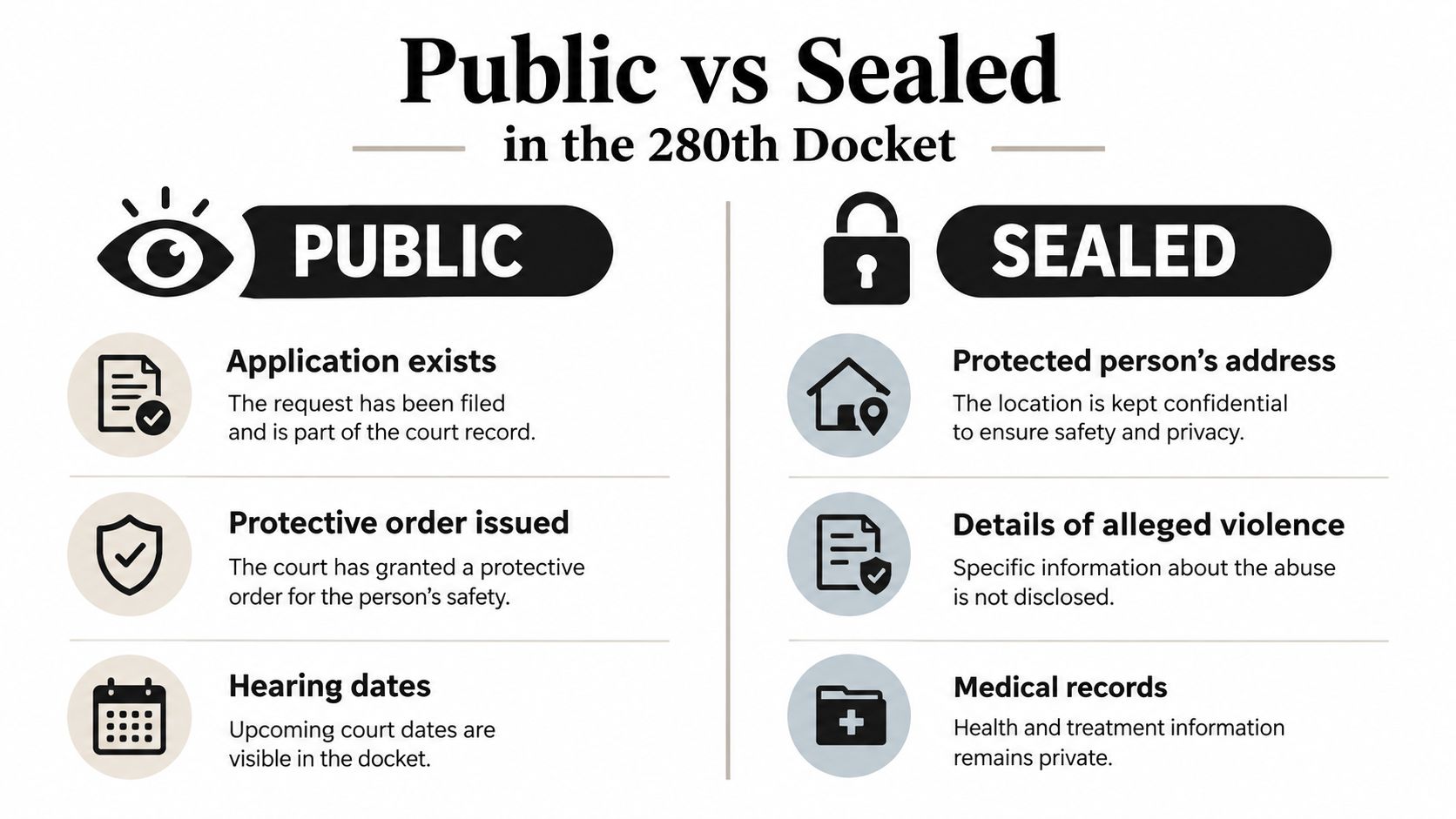
Public portals typically show a cause number, party names, filing date, court number, hearing date, and brief event text such as “Application Filed,” “Ex Parte Protective Order Signed,” or “Final Protective Order Signed.” They often do not show the protected person's address, phone, children's identifying details, attached affidavits, or the full factual allegations. Some documents are redacted. Some are restricted. Some never appear in full on the public-facing side at all.
That matters even more in the 280th because Harris County treats protective orders as their own case track. A family case may be moving in one file while the protective-order case sits under a separate cause number in the 280th. If you search only one path, the docket can look incomplete when the court file is not.
Why a thin docket still deserves respect
Do not treat a short docket as a small problem.
A live protective-order case may show very little text in the District Clerk portal for privacy reasons, clerk coding reasons, or because the key details are in the signed order and underlying application rather than the docket entry itself. The separate intake points in Harris County add to the confusion. Some requests start through channels tied to victim services or prosecutor involvement, while others are filed more directly through the clerk. The result is practical, not theoretical. What appears on the 280th docket may be enough to set a hearing and bind the parties, even if the public screen looks sparse.
If you care about how organizations explain limited public access to records, a plain-language example of data privacy practices can help frame why not every data field belongs on an open page.
If the docket shows a setting or a signed order, act like the case is active until you confirm otherwise with the clerk or the court.
Confirming Hearing Dates and Reaching the Right Office
A Humble resident leaves early, pays to park downtown, rides the elevator up, and learns the hearing is not where the portal seemed to suggest. That happens in protective-order cases more than it should, especially in the 280th.
The reason is practical. Harris County routes protective-order matters through a court with its own docket habits, its own cause numbers, and, at times, inconsistent location details across county pages. A family case setting and a 280th protective-order setting are not interchangeable. Treat them as separate tracks until a clerk confirms otherwise.
Recent Harris County court information says the 280th Protective Order Court is located at 1200 Congress on the first floor, while the county survivor and victim resource page lists protective orders at 1200 Congress on the second floor and gives the Protective Orders Section phone number as 713-274-0212 on the Harris County District Clerk court information page. Call before you go. Do not trust a screenshot, an old reset notice, or a relative's memory of where court was last time.

A better way to confirm a setting
Use a two-step check.
First, pull the cause number and confirm you are looking at the protective-order case, not the divorce, SAPCR, or any related family file. In the 280th, that mistake is common because Harris County treats the protective-order matter as its own proceeding. Second, call the Protective Orders Section at 713-274-0212 and ask three direct questions: the current hearing date, the courtroom location, and whether the matter is still set in the 280th.
On the morning of court, do this in order:
- Refresh the District Clerk portal early
- Search by the protective-order cause number first
- Check that the setting belongs to the 280th, not another family court
- Call if the entry is shortened, vague, or looks old
- Bring filed copies, the notice you received, and photo ID
Who to contact and what to ask
Start with the Protective Orders Section for scheduling and location questions. Keep the call narrow. Ask for logistics, not strategy.
If the problem is a record issue, such as a missing filing or confusion about what appears on the docket, the District Clerk is the right office to contact. Court staff can usually confirm where and when you need to appear. They cannot tell you what to file, whether your evidence is enough, or how the judge is likely to rule.
That distinction saves time.
For someone coming in from Humble, Kingwood, or Atascocita, the smart move is simple. Confirm the setting the same day you plan to appear, confirm the floor, and confirm that you are tracking the protective-order cause number tied to the 280th. In this court, small clerical differences cause real problems fast.
Filing Documents and Appearing Without an Attorney
A Humble parent shows up with a stack of papers, a phone full of screenshots, and the wrong expectation. They assume the clerk or court staff will sort out what belongs in the file. In the 280th, that assumption creates delay fast. Harris County runs protective orders through a court built for these cases, and the paperwork still has to be complete, readable, and filed in the right protective-order matter.
What self-filed people get wrong first
The 280th is Harris County's dedicated domestic violence court. That matters because a protective-order case is usually tracked under its own cause number, separate from a divorce, SAPCR, or other family case. If you file something under the wrong case, or hand over an incomplete packet and hope someone fixes it, you create your own problem.
Clerks accept filings. They do not coach you through the forms or tell you whether your facts are enough. Go in with finished documents, signatures in place, and any supporting papers organized so the court can use them.
What to bring and how to handle yourself in court
If you are appearing in person without a lawyer, bring the basics and keep your presentation tight:
- Photo ID
- Filed or file-stamped copies you already have
- Any service details or paperwork tied to notice
- Your exhibits, printed and organized
- Notes with dates, incidents, and names, kept short
Dress respectfully. Speak plainly. Answer the question the judge asked.
That last part matters more than people think. The 280th hears protective-order matters all the time. Rambling, interrupting, or arguing with the other side wastes your time and hurts your credibility.
Here's a general visual explainer that helps people understand the hearing mindset before they walk in:
Filing by mail or drop box takes more discipline
If you are not handing papers across a counter, be even more careful. Put the protective-order cause number on the submission if one already exists. Label the filing clearly. Include whatever is needed for conformed copies to be returned, and keep a full copy of everything for yourself.
Self-represented filers from Atascocita, Kingwood, and Humble usually do not struggle with the facts. They struggle with procedure. In the 280th, where protective-order cases move on their own track, small filing mistakes can keep an urgent case from landing where it needs to land.
When to Bring in a Local Attorney and Next Steps
You pull up the docket the night before court, see a setting you do not understand, and realize the 280th is not handling your case like a standard family-law matter. That is the point to stop guessing.
The 280th is Harris County's domestic violence court. Protective-order cases there often move on a separate track, and the paperwork can split between intake points before the matter shows up the way people expect on the docket. If you miss what that means, you can walk into court unprepared even when you have the facts on your side.
Hire local counsel if the problem is no longer just telling your story. Hire local counsel when procedure starts deciding the outcome.
Here are the common turning points:
- Your ex parte request was denied or set in a way you do not understand. You need to know what the court saw, what is missing, and what must be fixed before the next setting.
- The docket entry is unclear. Do not make decisions based on a guess about whether a hearing is temporary, final, reset, or tied to service.
- The final hearing will be contested. At that point, exhibits, objections, and witness order matter.
- The other side has a lawyer. That changes the room fast.
- There is a related criminal issue, CPS issue, divorce, or custody fight. A protective-order case in the 280th rarely stays isolated for long.
- You are too drained to prepare cleanly. Exhaustion shows up in court.
Local experience matters here for a concrete reason. A lawyer who handles Harris County protective-order work knows the 280th's habits, the separate cause-number problem that confuses self-represented parties, and the difference between a case that is merely delayed and one that is about to go sideways because service, notice, or filing placement was mishandled.
That is also why the criminal overlap cannot be treated as an afterthought. If the same facts could support an assault allegation, get advice from someone who understands both the family-court and criminal exposure. Start with a lawyer familiar with assault family violence cases in Humble, TX if that issue is in play.
One option for local residents is the Law Office of Bryan Fagan, which handles family-law matters for people in Humble, Atascocita, Kingwood, and Northeast Houston, including protective-order-related issues as part of its family-law practice.
Use a simple rule. If you clearly understand the setting, the relief requested, the service status, and what you need to prove, you may be able to handle the next step yourself. If any one of those points is fuzzy, call a lawyer before the hearing date.
Waiting until after the hearing usually costs more, fixes less, and leaves fewer options.