You're standing in your kitchen in Humble, Atascocita, Kingwood, or Northeast Houston with a notice in your hand. It names a downtown courtroom you've never entered, a judge you've never met, and a date that may conflict with work, school, and the drive into central Houston. Your first questions are practical. Where do you go, who do you call, and does this paper mean your child is facing trial that morning?
Start by separating two things. The assigned court tells you which judge's docket holds the case. The case-specific setting tells you when your family must appear. Confusing a court's regular weekday pattern with your child's hearing date is the most common early mistake, and it's the one this guide to the Harris County 314th and 315th Juvenile District Courts helps you avoid.
Your Court Judge Phone and Docket Days
If your notice names the 314th or the 315th, you're not headed to a Humble municipal court or a neighborhood office in Kingwood or Atascocita. These are Harris County district courts, two of only three juvenile district courts serving the entire county. The third is the 313th. Families from Northeast Houston travel downtown because juvenile cases for the county are concentrated in one building.
Use this table first. Find the court number printed on your notice, then save only that row.
314th and 315th Courts at a Glance
| Court | Judge | Phone | Delinquency days | Location |
|---|---|---|---|---|
| 314th | Thao Costis | (832) 927-8470 | Monday, Tuesday, and Wednesday | Juvenile Justice Center, 5th floor, 1200 Congress, Houston |
| 315th | Leah Shapiro | (832) 927-8480 | Tuesday, first and third Wednesday, and Thursday | Juvenile Justice Center, 1200 Congress, Houston |
The Harris County District Clerk juvenile schedule lists delinquency settings for the 314th on Monday, Tuesday, and Wednesday, while the 315th is listed for Tuesday, the first and third Wednesday of each month, and Thursday. That same schedule shows these courts also handle juvenile delinquency, adoptions, Texas Department of Family and Protective Services matters, and declaratory-judgment proceedings involving unaccompanied minors. Processing runs through the Juvenile Justice Center at 1200 Congress in Houston, not through a general district court workflow, and the 314th courtroom sits on the fifth floor with a general number of (832) 927-8470.
Those weekdays do not carry that meaning. A listed day is the court's recurring calendar pattern. It isn't proof your child is set on the next Monday or Tuesday that appears on the chart. Some matters are listed only as scheduled by court, which means the court sets them individually rather than on a standing day.
Practical rule: Don't take off work, pull your child from school, or book a ride downtown based on a published docket day alone. Confirm the date tied to your cause number first.
How to Confirm Your Actual Setting
Work through these steps in order.
- Circle the court number: Look for 313th, 314th, or 315th on the notice, petition, or detention paperwork. That number, not your home address, tells you which judge has the case.
- Match the phone number: Call (832) 927-8470 for the 314th or the corresponding number for the 315th from the table. Ask staff to confirm courtroom, date, and time for that cause number.
- Name the hearing type: Ask whether the setting is delinquency, CPS, adoption, sealing, or trial. The same court hears different kinds of matters on different calendars.
- Write down who told you: Note the date of your call and the answer you received, then keep it with the notice.
This confirmation step matters more for families outside central Houston. A wasted trip from Humble or Kingwood can cost a day's wages and a morning of school. A two minute call the day before protects both.
If the paperwork is unclear, don't guess. Bring the full notice to a lawyer who can read the court number, cause number, and hearing label together. Circle the court number now and save that row's phone number in your phone. That's your anchor for every later step.
What These Courts Hear and How Cases Are Assigned
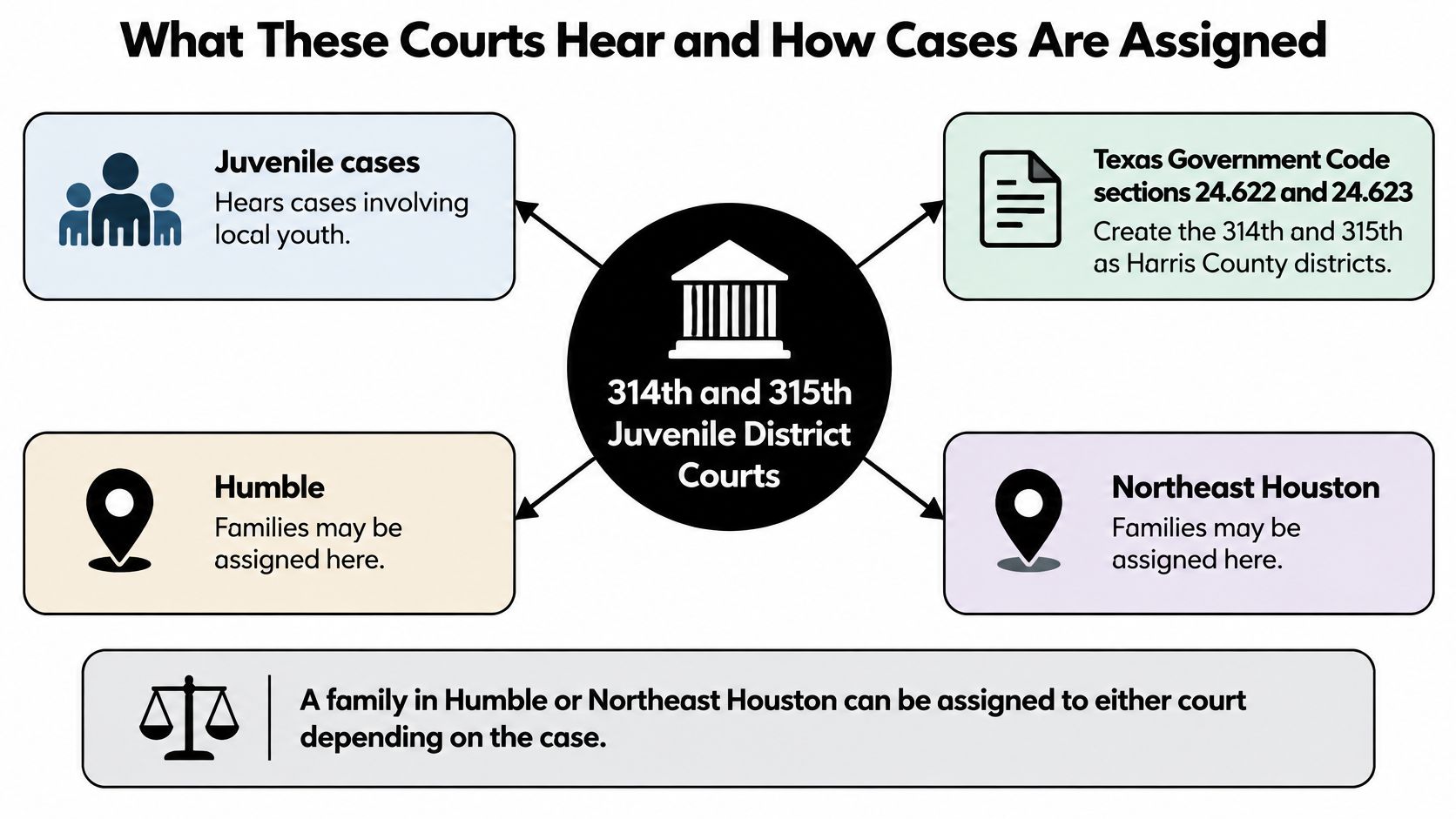
Texas law creates these courts for the county, not for one city. Because of that structure, a family in Humble or Northeast Houston ends up in a Harris County courtroom even when the incident happened close to home, at school, or in a neighborhood store. There's no separate municipal juvenile court for Atascocita or Kingwood handling these filings.
The map below shows how the pieces connect for local families.
The Legal Job of the Juvenile Courts
A judicial profile of the 315th Court describes it as one of only three Harris County district courts handling juvenile delinquency and dependency matters, with delinquency jurisdiction generally covering children ages 10 through 17 accused of criminal offenses. Harris County's 2024 Annual Financial Report identifies Thao Costis as judge of the 314th District Court and Leah Shapiro as judge of the 315th District Court.
Under Texas Family Code section 51.04, a juvenile court holds exclusive original jurisdiction over a child alleged to have engaged in delinquent conduct or conduct indicating a need for supervision, subject to statutory exceptions. In plain terms, these cases start in juvenile court because the law assigns them there. They don't start in adult criminal court just because police were involved.
The same courts also hear Child Protective Services cases, adoptions, record-sealing matters, and some declaratory cases involving unaccompanied minors. That's a different workload from an ordinary family case about divorce or custody. Parents comparing the two systems can review our guide to Harris County family courts to see why a custody dispute and a delinquency petition follow different tracks.
For a concrete example, think about a teen accused of taking merchandise from a store. Parents who want background reading on how lower-level juvenile theft allegations are discussed often turn to juvenile shoplifting articles for general context before they talk with Texas counsel about their own child's petition.
Assignment Is Not a Choice on the Calendar
The filing location is the Juvenile Justice Center, but the assigned court and courtroom come from the clerk's assignment of the filed case. They don't come from whichever weekday looks convenient for your work schedule. Official court information explains docket days, but it doesn't say whether families may request a particular court, and you shouldn't assume you can pick a judge.
CPS settings add another layer. A CPS matter can fall throughout the workweek, including afternoon sessions, even when that court's delinquency days are narrower. That's why two families assigned to the same court can receive very different dates.
Before you call anyone, read your notice for three labels. Find the assigned court, the hearing type, and whether the setting is delinquency, CPS, adoption, sealing, or trial. Those three labels determine where you go and what will happen when you get there.
How a Juvenile Case Moves Through Court
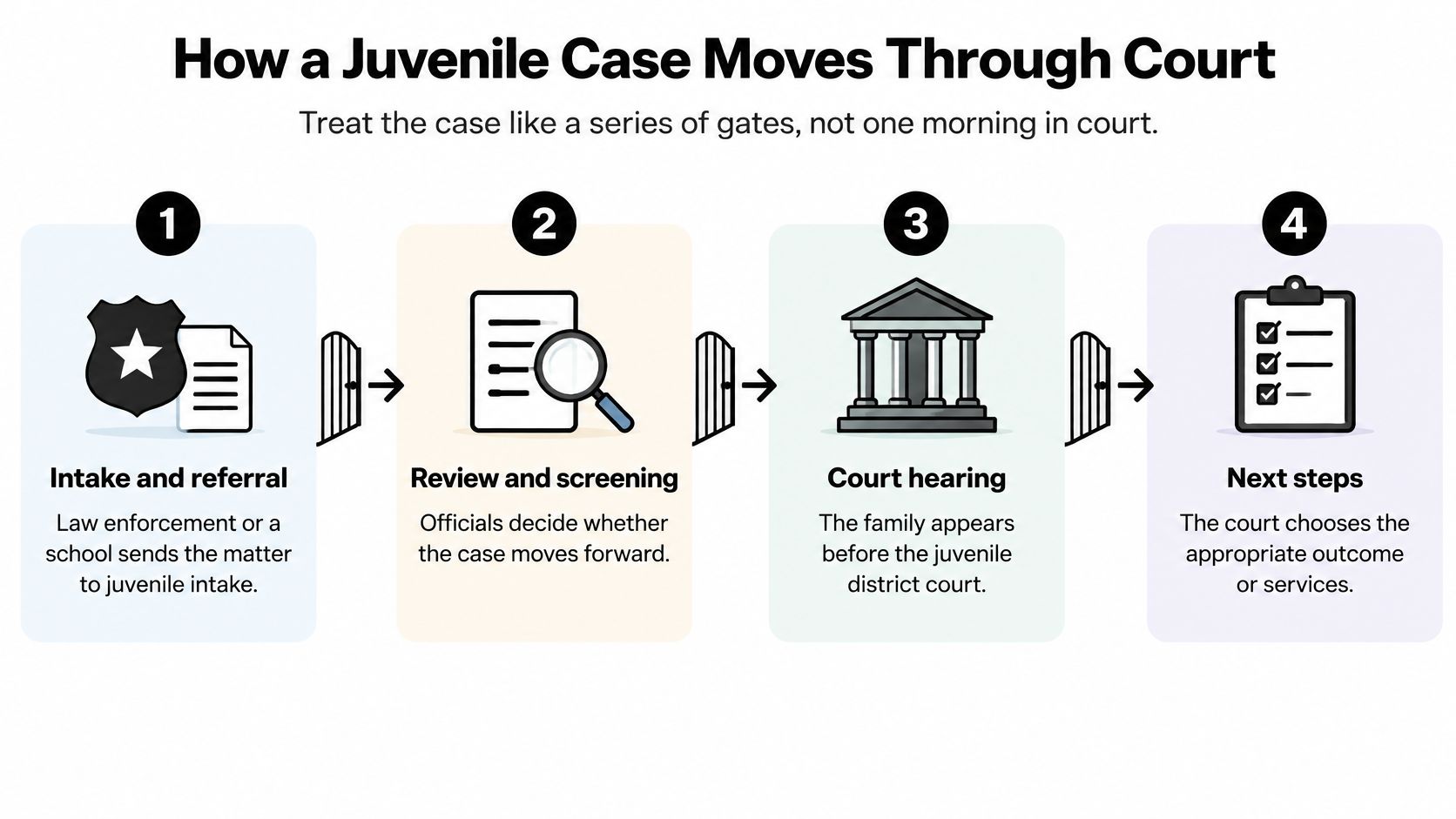
A juvenile case works like a series of gates. Each gate has a different purpose, and many cases resolve or change direction before the last one. You're not walking into one final trial on the first morning unless the notice specifically sets that kind of hearing.
The flow chart below outlines the path in its simplest form.
Six Stages Families Commonly Encounter
- Intake and referral: Law enforcement or a school sends the matter to juvenile probation. Intake and the prosecutor then decide whether to warn, divert, or ask the court to handle a filed petition.
- Detention decision: If the child is held, a detention hearing tests whether secure custody remains necessary. Bring identification and be ready to discuss a safe release plan, including who will supervise the child at home and at school.
- Petition and first setting: A filed petition starts the formal court case. This setting usually addresses counsel, scheduling, and what must happen next, rather than finally deciding the allegations.
- Adjudication: The judge or jury decides whether the state proved delinquent conduct or conduct indicating a need for supervision. Think of this as the juvenile version of a trial, not as an adult criminal conviction.
- Disposition: If the conduct is found true, the court chooses the outcome. Options can range from probation conditions at home to placement outside the home in more serious cases.
- Probation and review: The court and probation check school attendance, curfew, counseling, and other conditions at later settings. Progress, missed requirements, and new concerns can all bring the family back downtown.
Not every case passes through every gate. A diverted case may never reach adjudication. A case that begins as a school referral may end with services and supervision instead of a finding.
Two Forks That Can Change the Path
The 315th offers a treatment oriented fork for qualifying cases. Texas appellate material describing the 315th Court structure explains that Court 360, a Juvenile Mental Health Court presided over by its associate judge, Meredith Carr, links judicial supervision with mental-health-focused case management and compliance monitoring. Eligibility isn't automatic. Counsel can evaluate whether mental health needs make that problem solving model a realistic request.
Transfer is the opposite fork. Texas appellate authority explains that a juvenile court may waive jurisdiction and transfer a child to criminal district court when statutory prerequisites are met, including an alleged felony, the required minimum age, probable cause, and a finding that the offense's seriousness or the child's background makes criminal proceedings necessary for community welfare. Texas Family Code section 54.033 governs that waiver analysis, including age rules such as age 14 for a first-degree felony. A transfer discussion changes the court, the possible consequences, and how public the case can become, so it demands prompt legal review.
CPS issues can run beside delinquency. Families facing removal questions can read about what happens at a CPS removal hearing in the 313th, and those dealing with an investigation may need a CPS Defense Attorney in Humble for defense against CPS investigations for Humble families.
Don't debate the facts in the hallway, in the elevator, or with another family waiting for docket call. Preserve every notice and let counsel test jurisdiction, age, and probable cause in the right setting.
For scheduling questions in the 315th, the court's general number is (832) 927-8480. Use it to confirm which gate you're facing next, not to argue the allegations by phone.
What Typical Cases Look Like for Local Families
Abstract stages are hard to picture when you're worried. Three common scenarios show how the same courthouse can mean very different things depending on the paperwork in your hand.
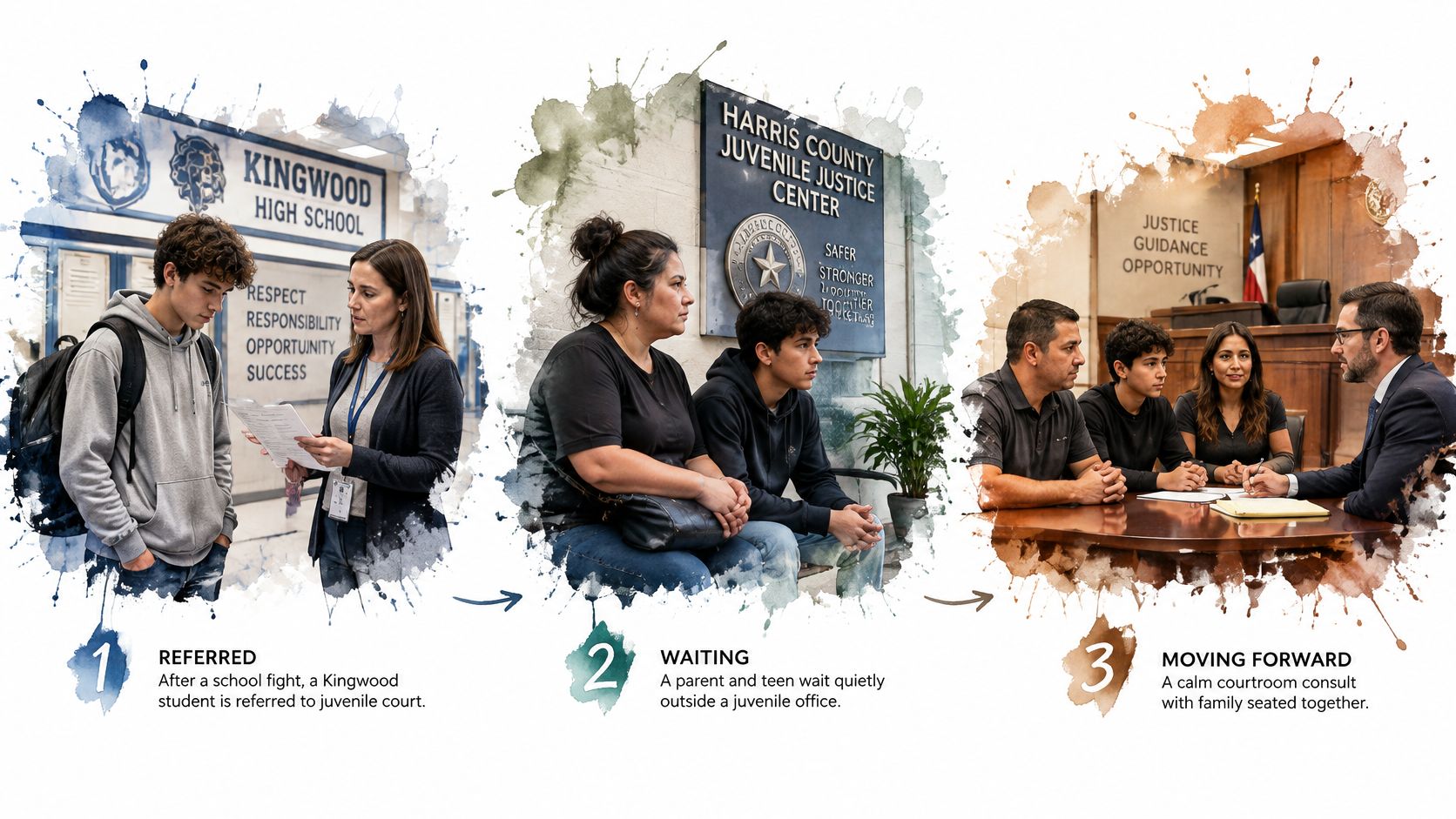
This visual traces how a referral can move a student and parent toward a first consultation.
A School Referral From Kingwood
Say a middle school student is referred after a fight in a hallway. That picture is common in Harris County. An older Harris County juvenile-diversion analysis found that 40% of filed cases originated in schools and identified 81% of referrals as misdemeanors and 19% as felonies.
Those older figures help you keep perspective. Most referrals in that analysis weren't felonies, and school incidents formed a large share of filed cases. Intake may divert a lower-level case, attach conditions, or decline to move forward with a petition. If a petition is filed, though, the family should still expect court settings downtown and school related conditions the judge will monitor.
A Felony Allegation From Atascocita
Now picture an older teen accused of a felony offense. The stakes rise quickly, and counsel must check transfer exposure early rather than waiting until a waiver hearing is set.
The same older analysis reported approximately 11,000 juvenile referrals in each of the three years reviewed and about 8,000 petitions filed annually. At the time, the 314th Juvenile District Court had an estimated docket of 1,631 cases, while the 315th had 1,677 cases, for a combined 3,308 cases. It also estimated that a first court setting occurred roughly six weeks after charging and that each case averaged five court settings, extending the typical timeline to approximately seven or eight months after the underlying incident.
Treat those as older analysis figures, not a promise for your child's dates. They explain why a case can feel slow, why a morning docket runs long, and why a reset doesn't necessarily mean something went wrong.
Families who receive a separate CPS interview notice during a case can prepare by reviewing guidance on the Harris County Children's Assessment Center and CPS interviews in Humble. Keeping the delinquency papers and CPS papers in separate folders prevents confusion when dates overlap.
The video below offers another walkthrough you can review before your next trip downtown.
A CPS, Adoption, or Sealing Matter From Humble
A third family may be in the 314th or 315th with no new delinquency allegation at all. Their case could involve CPS oversight, an adoption, or a request to seal juvenile records after a case ends. The courtroom is the same, but the questions before the judge are entirely different.
Don't assume every juvenile district court appearance signals the worst outcome. Match your paperwork to one of these three pictures first. Families sorting out which legal issue they face can start at our Humble firm homepage and then bring the labeled notice to a consultation.
How to Prepare and Get to Your Hearing
Preparation won't decide the allegations, but it prevents avoidable problems. Judges notice whether a parent arrived on time, brought the right papers, and can describe a realistic plan for school and supervision. Use the day before the hearing to assemble, confirm, and rehearse the basics.
Build One Hearing Folder
Put everything in a single folder and keep copies at home.
- Photo identification: Bring your ID and any identifying information staff told you to bring for your child.
- Hearing notice: Include the paper showing the cause number, assigned court, and setting. Never hand over your only copy.
- Probation papers: Add conditions, appointment cards, and proof of completed classes, counseling, or community service.
- School and treatment records: Bring records you were told to bring, plus current contact information for school staff or providers involved in a release plan.
- Phone list and pen: Carry current numbers for parents, guardians, and supervising adults, and a pen for writing down the next date.
Juvenile cases generate paper quickly. A dated folder lets you answer a judge's question about school attendance or a probation appointment without searching through text messages in the courtroom.
Confirm the Day Before You Travel
The Texas Government Code provisions on Harris County judicial districts establish the 314th and 315th as Harris County districts under sections 24.622 and 24.623, and the District Clerk identifies the Juvenile Justice Center at 1200 Congress Street in Houston as the central location for juvenile court services. Families should confirm the assigned court and courtroom before appearing, keep copies of every filing and notice, and ask the clerk how to obtain the current docket information.
Call the assigned court, state the cause number, and confirm court, hearing type, courtroom, and time. If the answer conflicts with what you inferred from a published weekday, follow the clerk's case-specific answer. The recurring calendar doesn't override your notice.
Before you leave, review what to expect at the Juvenile Justice Center at 1200 Congress. Courthouse hours and parking details aren't in the published court schedule, so check current visitor information separately and allow a full morning for downtown traffic from Humble, Atascocita, Kingwood, or Northeast Houston.
Arrive Ready for Security and Waiting
Arrive early enough for security screening and finding the correct floor. Silence your phone before you enter the courtroom and don't record proceedings. Dress as you would for a job interview, and help your child do the same. Bring water and a quiet activity for younger siblings only if you have no childcare alternative, because dockets can involve waiting while other cases are called.
Plan for the morning, not for a fifteen minute appointment. A case can be called quickly, reset after a short discussion, or held until the judge works through detained cases first.
Know How to Act When the Case Is Called
Stand when the judge enters. Address the court as Judge. Let your lawyer speak about the allegations, evidence, and legal requests. Parents are most helpful when they answer plainly about home routines, school enrollment, work schedules, transportation, and who can supervise the child after school.
Don't interrupt, argue with witnesses, or coach your child from the gallery. If you don't understand a condition, ask your lawyer to clarify it before you leave the courtroom. Misunderstanding curfew, school, or reporting conditions creates violations that have nothing to do with the original allegation.
Protect Rights and Confidentiality
Your child has the right to a lawyer. If you can't afford counsel, ask the court about appointed counsel as early as possible. Your child may decline to answer questions about the offense without counsel, and you shouldn't pressure your child to explain the incident to probation, school staff, relatives, or other parents before getting legal advice.
Juvenile records are more closed than adult files, but confidentiality doesn't stop classmates from repeating what your family posts or says. Keep the allegations off social media and group chats. A transfer to criminal court can also change what becomes public, which is another reason early advice matters.
Stress at home doesn't stop when the hearing ends. Some parents look for structured family guidance alongside legal help, and resources such as Interactive Counselling's family support in Vernon illustrate the kind of family support services people seek when communication breaks down during a difficult case.
Before you walk out, write down the new date, court, courtroom, and any conditions announced by the judge. A missed appearance or missed probation appointment can turn a manageable case into a warrant problem. Check that reset information against your folder while you're still in the building.
Get Clear Guidance Before the Next Hearing
Call a lawyer when the notice names the 314th or 315th and you don't know what kind of hearing is set. Don't wait if your child is detained, the allegation is a felony, someone has mentioned waiver to adult court, or CPS has raised removal. Those are decision points where delay can narrow your options.
Bring three things to the first conversation. Bring the notice, the cause number, and any probation or CPS papers you've received. With those documents, a lawyer can identify whether the next setting is intake follow-up, a detention review, adjudication, disposition, or a transfer hearing, and what preparation that specific hearing requires.
What a Consultation Should Give You
- Confidential review: A private discussion of the paperwork and your child's situation, not a hallway conversation.
- Honest feedback: Clear input on options and possible outcomes under the Texas law that applies to the case.
- Next step: A concrete plan for what to file, bring, confirm, or avoid saying before the hearing date.
The Law Office of Bryan Fagan serves Humble, Atascocita, Kingwood, Northeast Houston, and the rest of Harris County from 414 E Main St, Humble, TX 77338. You can call our office at (281) 817-1827, schedule online, or stop by the Humble location. We offer a free consultation, and our firm has represented hundreds of families across Southeast Texas.
Juvenile court is one piece of a practice that also includes family law, criminal defense, estate planning, and civil matters. That breadth matters when a delinquency case sits next to a custody dispute, a CPS investigation, or a parent's own legal problem. One coordinated conversation keeps those issues from pulling your family in opposite directions.
You don't need to memorize the courthouse before you call. You need to know which court holds the case, what the next hearing will decide, and what your family should do before that morning arrives. Bring the notice and let's answer those questions in order.
If your child's next setting is in the 314th or 315th Juvenile District Court, the Law Office of Bryan Fagan can review your notice, confirm the hearing type, and prepare you for what the judge will decide that day. Schedule a free consultation with our Humble team by visiting Law Office of Bryan Fagan or calling our office before you make the trip downtown.