201 Caroline accepts Harris County civil district filings at Civil Intake, Suite 110, and family filings at Family Intake, Suite 210. Criminal cases are not filed at Civil Intake.
You may be getting ready to leave Humble with a divorce petition, a contractor dispute, or papers you've been told to file downtown. Before you arrange childcare or drive in from Atascocita, Kingwood, or Northeast Houston, make sure the office you need matches the case you have. The right street address doesn't always mean the right filing window.
What Is Filed at 201 Caroline
If you are coming from Humble with a civil lawsuit to file, the courthouse address is Harris County Civil Courthouse, 201 Caroline Street, Houston, Texas 77002, as listed by the Harris County District Courts. The building houses the District Clerk's primary civil filing hub, where Civil Intake is on the first floor in Suite 110, according to the Harris County District Clerk's FAQ.
Civil district courts hear noncriminal disputes such as malpractice, damages, breach of contract, personal injury, and multidistrict litigation. Civil Intake handles paperwork that starts or advances those cases, including petitions, answers, motions, citations, name-change forms, and court and filing fees.
Match the paperwork to the desk
A petition starts a lawsuit by explaining what the filer wants the court to decide. An answer responds to the lawsuit; a motion asks the court to take a particular action in an existing case. An amended pleading changes an earlier filing.
The desk map below focuses on civil district filings handled at Civil Intake.
Civil district filings at 201 Caroline
| Matter | Where it is handled | Court track | Typical documents |
|---|---|---|---|
| Civil district lawsuit, such as contract, injury, damages, or malpractice | Civil Intake, Suite 110, first floor | Harris County civil district courts | Petition or complaint, answer, motions, citation request |
| Name change | Civil Intake, Suite 110 | Civil district intake | Petition and required forms |
| Out-of-county civil transfer into Harris County | Civil Intake, Suite 110 | District Clerk | Transfer papers accepted for Harris County filing |
The organizational map below shows how filing services and record access fit within the courthouse.
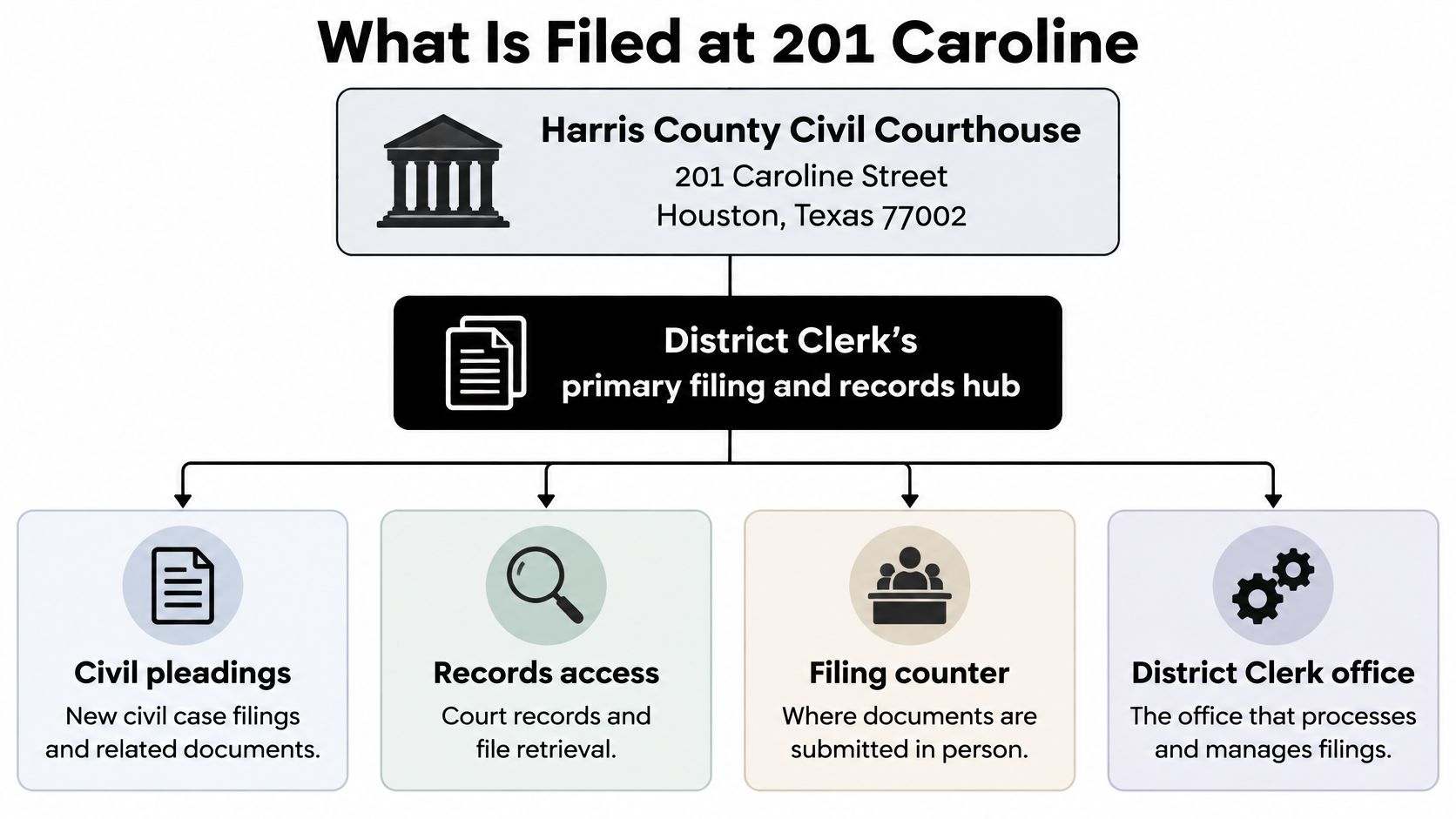
The clerk processes documents and maintains records. A filed motion still needs a judge's decision, and paying a filing fee does not itself give the other party legal notice.
For families comparing procedures across state lines, Kons Law's guide to navigating Connecticut civil courts offers a separate-state reference. Its procedures are for Connecticut, not Harris County.
How Civil Intake Accepts a Filing
Treat a filing like sending a package to a particular recipient. The document needs the correct court, clerk department, and submission method, not merely the courthouse address.
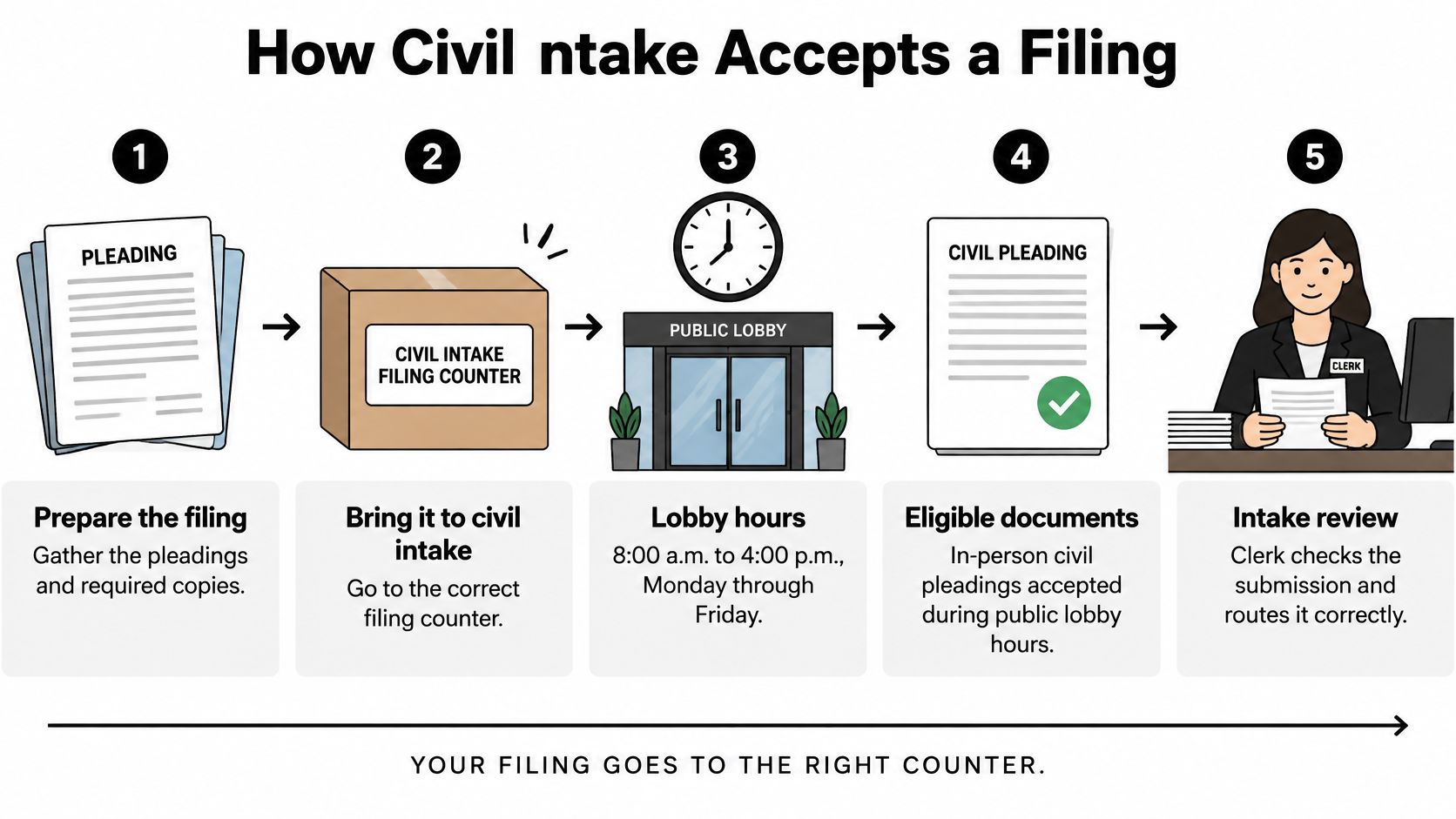
Public-lobby hours for eligible in-person civil pleadings are 8:00 a.m. to 4:00 p.m., Monday through Friday. Eligible paper filings may also be placed in the courthouse drop box after hours. Those options don't create a general right for every filer to submit paper.
Follow the filing sequence
For a new civil district lawsuit, work through these steps in order:
- Confirm the court. Determine whether the dispute belongs in a civil district court or a county court at law before selecting forms.
- Prepare the petition or complaint and the civil case information the clerk requires. Use accurate party names and describe the relief you're seeking.
- Choose the permitted submission method. Use eFileTexas, or an eligible paper method if you're representing yourself.
- Pay the applicable filing and service fees, or obtain guidance about the procedure when you can't afford court costs.
- Request citation or other appropriate service so the other party receives formal notice.
- Save the confirmation. Keep the file-stamped copy, cause number, and submission receipt together.
This visual outlines the intake workflow. Check the method rules before treating an in-person visit as your filing route.
Electronic filing is the ordinary route
The District Clerk's Civil Intake office states that civil courts generally require eFileTexas.gov, that paper generally isn't accepted from filers other than people representing themselves, and that fax or other electronic methods don't replace the designated system. Attorneys representing Northeast Houston clients therefore ordinarily file online rather than drive downtown with pleadings.
Accepted ways to file at Civil Intake
| Who is filing | Method | Accepted | Practical note |
|---|---|---|---|
| Attorney for a client | eFileTexas.gov | Yes | Ordinary path for represented parties in Northeast Houston |
| Person representing themselves | Paper at Civil Intake during lobby hours | Yes for most self-represented filers | Check current public-lobby hours before traveling |
| Eligible paper filer after hours | Courthouse drop box | Yes | Not a substitute for choosing the correct court |
| Any filer | Fax or an electronic method other than eFileTexas | No | The office does not treat these as filings |
| Attorney | Routine in-person paper delivery | Generally no | Represented parties are expected to e-file |
For an additional visual resource, the video below accompanies the filing discussion.
Confirm current filing and service fees with Civil Intake before paying. Check the District Clerk's official site for current phone numbers and hours, especially before arranging time away from work.
Practical rule: A document left at the wrong suite isn't filed simply because it reached the courthouse.
Family Cases at the Same Address
A hospital's emergency entrance and outpatient clinic can share an address while directing patients to different desks. Family and general civil intake work similarly: arriving at the building doesn't identify the correct department.
Say an Atascocita parent wants to file for divorce and establish a workable parenting schedule. The parent sees “Civil Courthouse” on the building and assumes the civil window handles everything that isn't criminal. But divorce, custody, and child support belong on the family-court track, not the general civil intake track.
A family petition typically explains the requested divorce or parenting relief. When children are involved, the filing may also need information relevant to custody, parenting time, and support. Formal service on the other spouse or parent is a separate procedural task, not something accomplished merely by handing the clerk the petition.
A practical family-filing path
Before filing, organize the case around these actions:
- Identify the family issue. Is this a divorce, an initial parenting case, or a request concerning an existing order?
- Use Family Intake or the required electronic filing path for the appropriate family court.
- Arrange proper service. Ask how the other spouse or parent must receive the papers.
- Keep the cause number with every later filing and order.
Temporary orders, possession schedules, and child support are family-court work. A contract or injury dispute follows a different route, even if the same household is dealing with both problems.
Separate filing questions from hearing locations
Families can use The Divorce Process in Humble to understand the local sequence and the Humble child-support guide when establishing, changing, or enforcing support. For representation, Divorce Lawyer in Humble, TX describes divorce services for clients in Humble and Harris County.
A filing office and the location stated on a hearing notice aren't interchangeable. If your paperwork mentions another family-court facility, review the Harris County Family Law Center floor guide and verify your assigned court's instructions before traveling.
Families coordinating matters across states may also encounter Miles Hansford Law Firm's guide to filing for child custody in Cumming. That is a Georgia resource, not a substitute for Texas filing requirements.
Check the department and suite on your paperwork, not just the street address.
Confirm Family Intake's current location with the District Clerk before leaving Kingwood or Humble. For a hearing, follow the court's notice rather than assuming you should return to the filing counter.
Matching Your Problem to the Right Court
A Kingwood contractor waiting on payment for a remodel may have a contract or damages claim. The first question is which court can hear that kind of dispute. The answer determines the filing route, much like choosing the right line at a service counter before handing over paperwork.
The District Clerk's civil-court FAQ distinguishes civil district cases from county civil court-at-law cases. They use different clerk departments, even though the courts are in the same building. A correctly prepared document still needs to reach the right department.
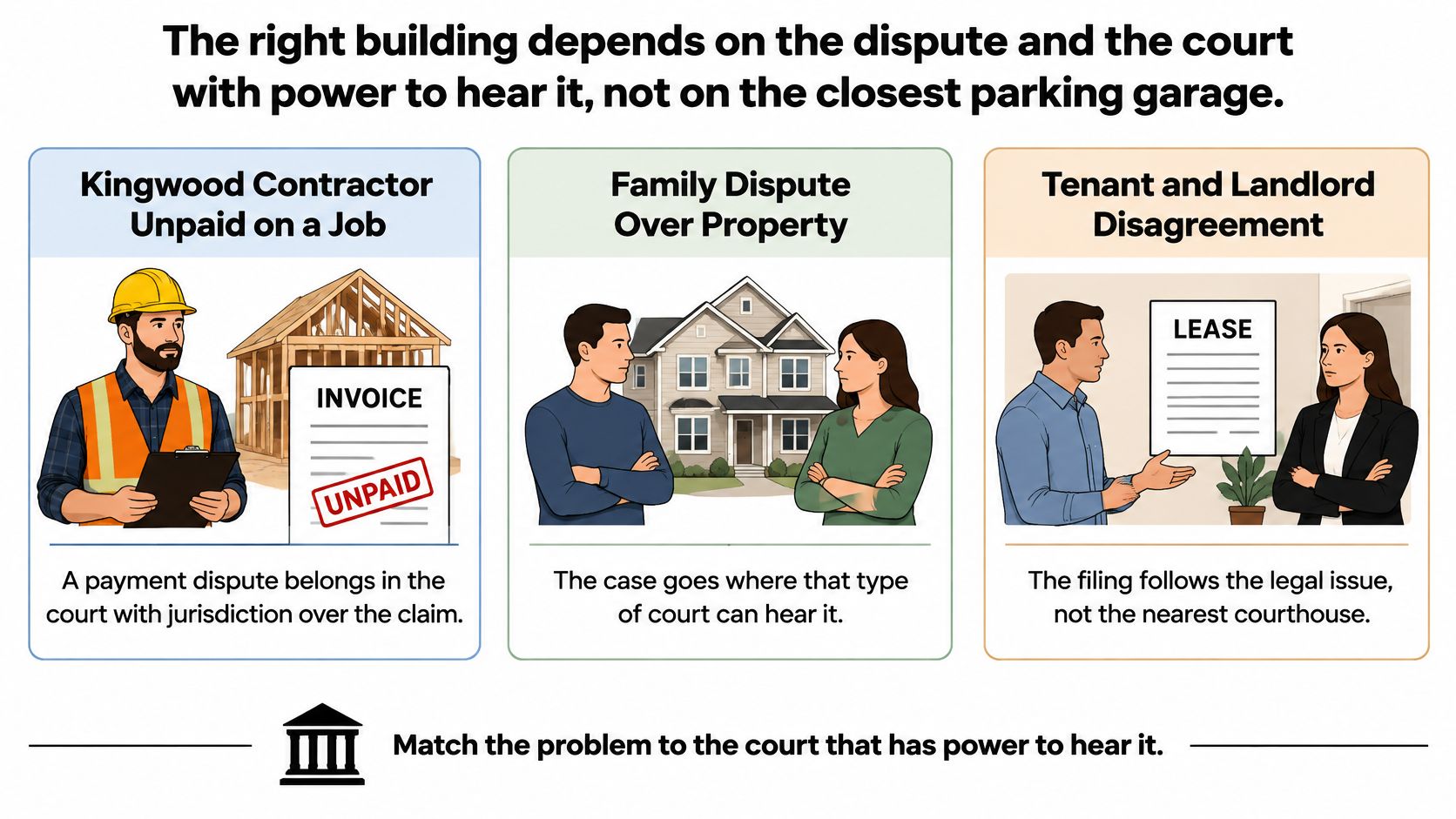
Neighborhood examples with different starting points
A Kingwood contractor hasn't been paid for a remodel. The potential claim may involve breach of contract or damages. If it belongs in civil district court, the first pleading generally goes through District Clerk Civil Intake. The District Clerk's Civil Division handles civil district pleadings, requested service documents, and civil transfers into Harris County.
An Atascocita parent needs a divorce and possession schedule. The matter follows the family-court track, where the parent can seek family orders. A support dispute tied to those orders should be considered in that context.
A Humble driver faces a DWI charge. The driver should keep the charging papers and court notices and consult criminal defense counsel. A criminal charge belongs in the criminal court process, not at Civil Intake.
A Northeast Houston business owner has a modest unpaid invoice. A justice court or county court at law may be the right forum. The amount claimed and the type of relief requested help determine which court can hear the dispute, so check the applicable rules before choosing a form.
Compare the court tracks
Use the table to identify which court system to review. The street address alone does not determine the correct filing desk or process.
Court tracks for Harris County matters
| Matter | Court track to review | What guides the choice |
|---|---|---|
| Civil district lawsuit | District court | The claim and requested relief fall within district-court authority |
| Civil lawsuit suited to a county court at law | County court at law | The claim fits that court's authority rather than the district-court track |
| Small claim or justice-court dispute | Precinct justice court | The amount and type of claim fit justice-court authority |
| Will, probate, or estate administration | Probate court | The matter concerns a probate or estate proceeding |
| Juvenile matter | Juvenile court | The case belongs in the juvenile court process |
For a smaller dispute, the Humble justice-of-the-peace and small-claims precinct guide can help identify the local questions to ask. Confirm the precinct as well as the court type.
Preparing a will or trust is different from opening a probate case. An executor considering probate should gather the will and estate information for legal review before choosing a filing route.
How to Check the Case After Filing
A verbal assurance at the counter isn't a substitute for a traceable record. Keep the cause number, the file-stamped copy, and the exact party names so you can confirm what the clerk accepted.
Harris County budget materials cited in the District Clerk's records information describe approximately 1,000,000 civil case filings each year, in addition to roughly 300,000 criminal filings. Those figures describe filing volume, not necessarily separate new lawsuits, and help explain why precise case identifiers matter.
The District Clerk maintains records across civil, criminal, family, and juvenile district courts, along with county criminal and specialty courts. Most case information and document images are available online, but sealed or confidential records are excluded.
Read the record in a useful order
After receiving your filing confirmation:
- Match the cause number on the online record to the number on the stamped petition.
- Confirm the court assignment, case type, and party names.
- Look for the document you expect. That may be your petition, an answer, an issued citation, or a return of service.
- Note any hearing or other setting, then compare it with the court's notice.
- If the online record and stamped copy disagree, contact the appropriate clerk with both documents available.
The Harris County District Clerk and JIMS family-case lookup guide can help local families understand the search process. Don't assume that a missing public image means the document was never filed, especially when confidentiality restrictions may apply.
Distinguish filing from service
A citation appearing in the record doesn't, by itself, establish that the other party was served. A return of service is a different document recording the service activity.
Likewise, the absence of an answer doesn't tell you, without further review, whether a response deadline has passed. Ask counsel to evaluate service and deadlines rather than calculate them from a search result alone.
Recordkeeping habit: Save the stamped pleading, acceptance confirmation, and service records in the same case folder.
Your filing follow-up isn't complete until you can verify acceptance through the public record or the clerk's record. If the public system doesn't show what you expect, resolve the discrepancy instead of submitting duplicate papers without guidance.
Confirm the Desk Before You Leave Humble
A Humble resident with divorce papers in hand may need a family intake desk, while someone handling a business dispute may need civil intake. 201 Caroline is one address, but the street number alone does not identify the right desk, court system, or filing method. Confirm the route before arranging a downtown trip, and keep any filing deadline in view.
Call Civil Intake or Family Intake with your cause number and a one-sentence description of the issue. If you don't have a cause number, describe the matter and ask which office can direct you. That can prevent an unnecessary trip, a missed workday, or confusion between a civil matter and a criminal case.
Make a pre-trip checklist
Before you leave, confirm the practical details that can affect your visit:
- Identification: Bring identification and the notices or orders relevant to your question.
- Payment: Check what payment information or method you'll need for the filing.
- Service details: Have accurate service information available if it applies to your matter.
- Legal review: Consider getting legal help when children, a shared home, criminal charges, or estate responsibilities are involved.
For estate planning, list your property, intended beneficiaries, and the people you'd trust to carry out your wishes. If you're handling an estate after a death, keep the original will and existing court papers together.
Bring the question and the paperwork
A useful consultation starts with the documents you already have, even if they're incomplete. Bring the envelope or service papers, any court notice, and a short timeline explaining what happened and what you need next.
For divorce and support questions, local guides can help you organize questions before meeting with counsel. You don't need to master court terminology first.
Families in Humble, Atascocita, Kingwood, and Northeast Houston can ask for help identifying whether their matter involves family law, criminal defense, estate planning, or probate. A short description of the issue helps direct the question to the right desk.
Go once the route is confirmed. If it remains unclear, seek guidance promptly, especially when a deadline is approaching.
The Law Office of Bryan Fagan offers help with divorce, custody, support, criminal defense, wills, trusts, and probate, including determining whether your matter belongs at 201 Caroline. Schedule a free consultation with our downtown Humble office, and bring your notices or draft papers so we can help map the next filing before you stand in a lobby line.