1200 Congress is Harris County's hub for juvenile detention of youth ages 10 to 17, juvenile district courts, probation supervision, and records. A notice to appear there does not by itself mean your child will stay in detention.
The advice to treat every trip to this address as a trip to jail misses what families need to know. Your notice might concern a hearing, a program decision, a probation appointment, or documents your lawyer needs.
For parents in Humble, Atascocita, Kingwood, and Northeast Houston, the useful starting point isn't guessing what the building means. It's identifying who asked you to come, what the appointment concerns, and whether your child is currently in custody.
What Happens Inside 1200 Congress
The Harris County Juvenile Justice Center combines court proceedings and juvenile services, so families arrive for different reasons and follow different paths inside. The Harris County District Clerk's juvenile court directory identifies the complex and its juvenile court operations, including the 313th, 314th, and 315th District Courts.
Read the heading on your paperwork before you make travel plans. A detention hearing notice means something different from a probation appointment or a request to pick up records.
What families encounter at 1200 Congress
| What can happen | Usual trigger | What the family should expect |
|---|---|---|
| Secure detention | A youth age 10 to 17 is taken into custody and held | Housing at the detention center; visits only by appointment during scheduled weekday, weekend, and holiday periods |
| Detention hearing | The child remains detained | A non-jury hearing generally by the second working day; probation directs families to arrive by 9 a.m. |
| Juvenile district court | A delinquency case is set for hearing | Matters in the 313th, 314th, or 315th District Courts at this complex, not at one shared counter |
| Diversion or community supervision | A referral is handled without secure confinement | Probation and program decisions administered from the same address |
| Records or document copies | A parent or lawyer needs a filing or copy | In-person request with identification; delinquency information isn't given by telephone |
The type of appointment matters more than the address. A parent accompanying a child to a scheduled court appearance shouldn't assume the child has already been ordered into detention. A parent visiting a detained child shouldn't assume that visitation includes access to the courtroom or a meeting with the judge.
Match your paperwork to the right person
Look for the court name, case number, probation officer, coordinator, or records contact. Keep the envelope and any voicemail, too, because the person who contacted you may be the quickest route to clarifying an incomplete notice.
An Atascocita parent gets a message asking the family to report downtown. Before discussing the underlying incident, the parent can ask whether this is a court setting, intake interview, supervision meeting, or visit. That single answer tells the parent what to bring and whether counsel needs to attend.
Before leaving home: Confirm the assigned court, appointment time, and office or floor. The building's street address alone isn't a complete set of directions.
A delinquency case is a response to an allegation that a young person violated the law, and it runs separately from custody disputes and child-protection proceedings, even when families encounter overlapping court names in the same complex.
One Building for Court Detention and Probation
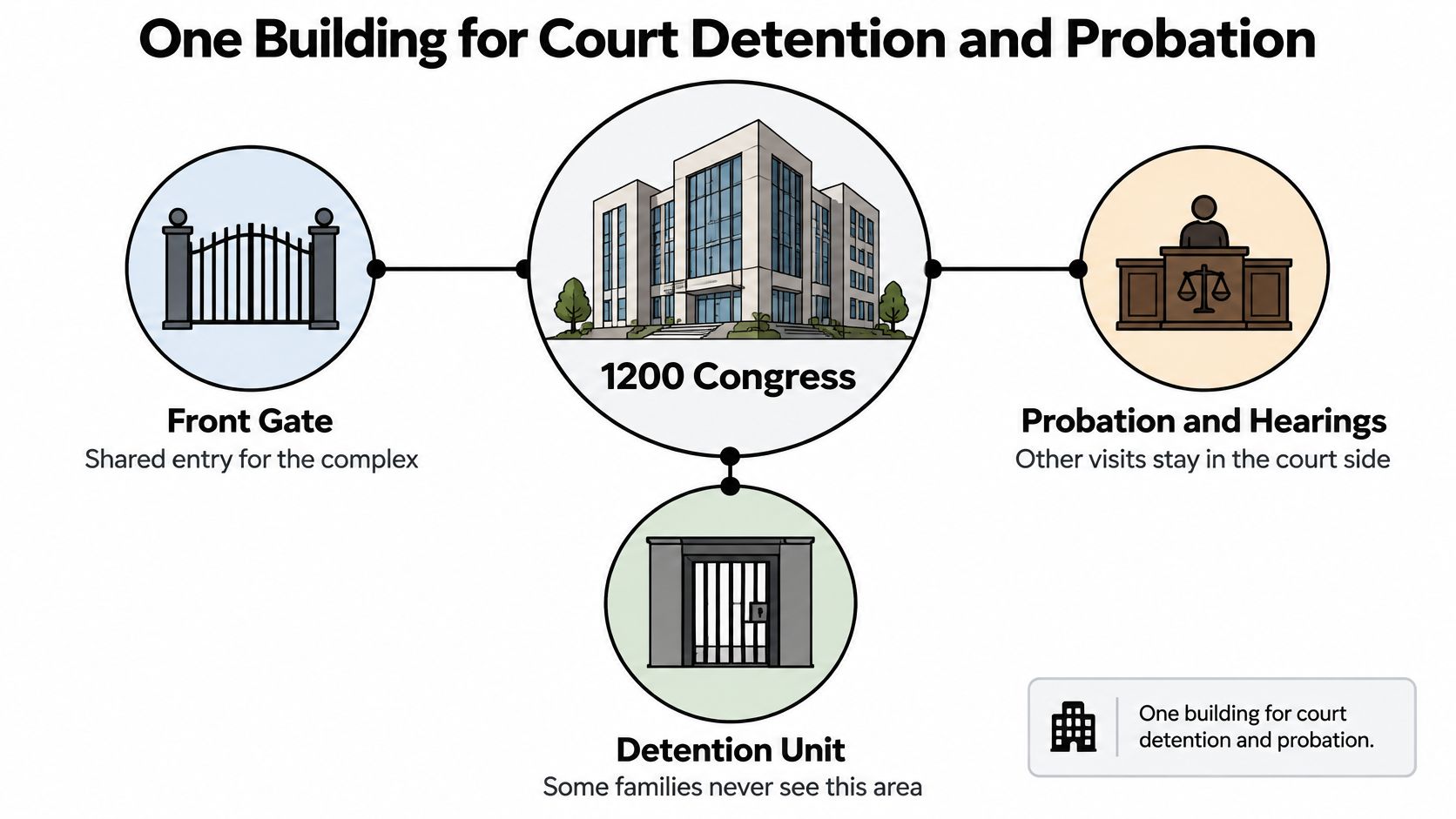
Think of the complex like a school campus with separate functions behind a shared front gate. A family may attend a hearing without seeing the detention unit, while another family comes only for an approved visit.
The Harris County Juvenile Probation Department's records information places detention, supervision, and records functions at this address and lists in-person records service on weekdays from 8:30 a.m. to 4:30 p.m. Those separate functions explain why a message from juvenile probation doesn't, by itself, tell you what will happen when you arrive.
The diagram separates the building's main purposes.
Follow the decision, not just the address
Consider a hypothetical Humble family contacted after a school-related police referral. Juvenile probation's intake staff assess the referral and the child's immediate circumstances. A referral can lead toward release with conditions, consideration for diversion, or detention and judicial review.
Those aren't interchangeable outcomes. An intake recommendation isn't a final ruling on whether the child committed an offense, and a judge reviews continued detention when a child remains held.
A practical way to understand the people involved is to separate their jobs:
- Intake staff gather information and help determine the initial handling of a referral.
- The judge makes judicial decisions, including whether continued detention is appropriate.
- Supervision staff monitor conditions and communicate about compliance.
- Records staff handle document requests within confidentiality and access rules.
A probation appointment needs its own preparation
If the message concerns supervision, take the written conditions and a calendar showing completed appointments. Bring documentation of counseling attendance, school participation, or other obligations that the officer has asked you to verify.
Don't assume an appointment about a missed requirement is routine, but don't assume it means detention either. Ask what concern prompted the meeting and share the notice with counsel before offering a detailed explanation.
Families dealing with an alleged breach of conditions can use this Humble probation-violation legal resource to prepare questions for an attorney. Be clear that the matter involves a juvenile, because the child's case needs advice specific to that setting.
How the Detention Hearing Clock Works
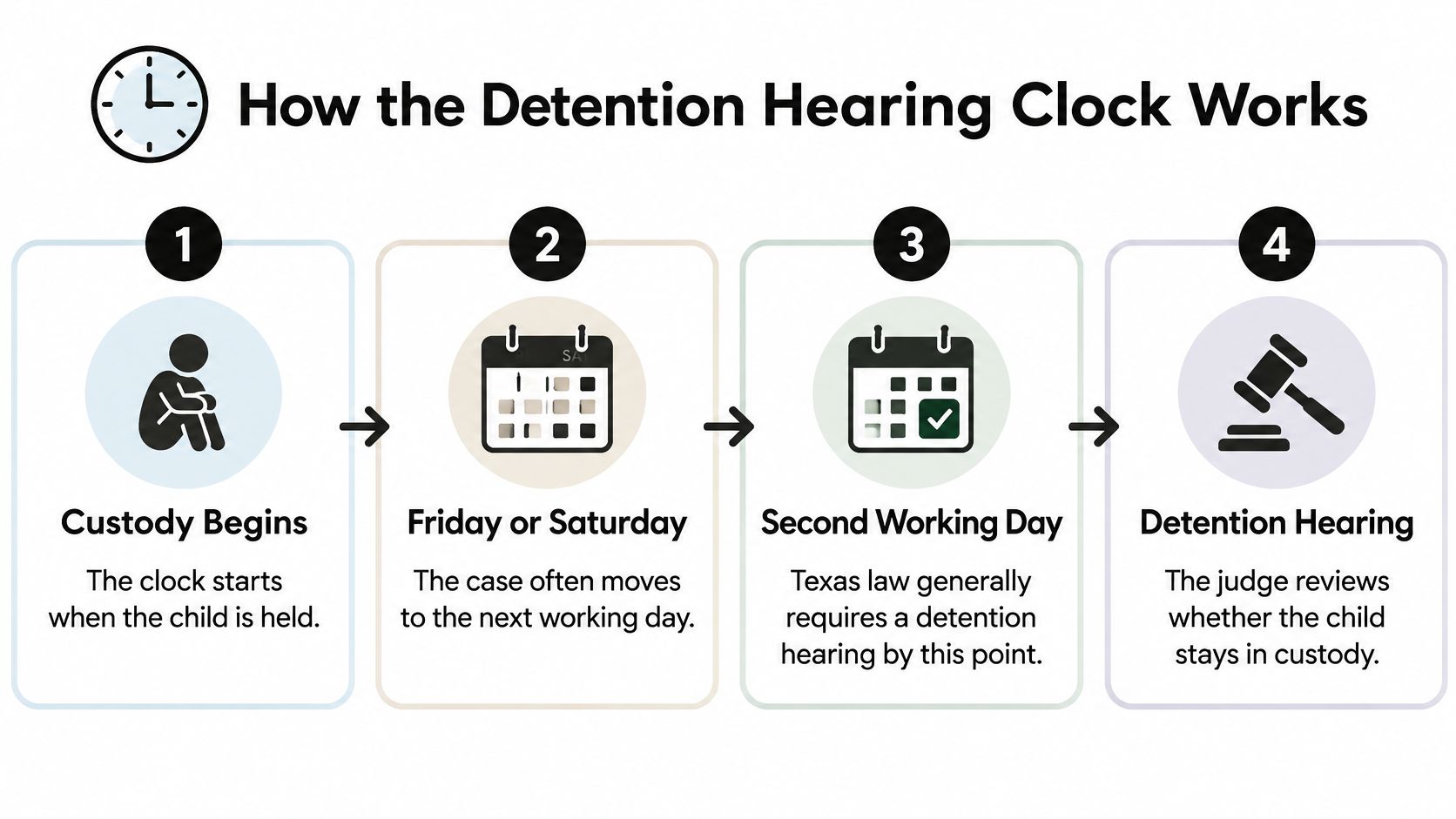
When a child stays in custody, the clock starts right away and it runs on working days. Texas generally requires a detention hearing no later than the second working day after custody; for custody beginning on Friday or Saturday, the hearing ordinarily occurs on the first working day afterward. Harris County Juvenile Probation describes its process as a hearing within the first 48 business hours and directs families to arrive by 9 a.m., with a probation officer providing the hearing date and time, as set out in the Texas Children's Commission detention-hearing guide.
Those two framings describe the same early window. The state rule counts working days, and the county describes the window in business hours, so a weekend or county holiday pushes the hearing to the next working day instead of counting around the clock.
Count working days, not calendar hours, and confirm any weekend or holiday timing directly. Don't count forward on your phone and assume you've found the legal deadline.
The timeline below shows the basic sequence. Your assigned hearing notice controls the actual date.
What to finish before leaving home
- Record when custody began. Write down the day, time, agency involved, and any identifying information you received. Keep arrest-related paperwork together rather than relying on memory.
- Confirm the actual setting. Ask the probation officer for the hearing date, arrival time, court, floor, and contact person. Request written confirmation when possible.
- Plan the downtown trip. Allow time for traffic from Humble, Atascocita, Kingwood, or Northeast Houston, plus parking, security screening, and finding the courtroom.
- Prepare a health and school packet. List medications, doses, allergies, treating providers, school contacts, and urgent care needs. Keep medical information separate from your account of the allegation.
- Contact counsel promptly. Tell appointed or retained counsel that the child is detained. Send the notice and packet through the communication method the lawyer requests.
If a voicemail gives an arrival time that conflicts with general guidance, verify it with probation or the court clerk. Don't choose whichever time seems more convenient.
What the judge is deciding
A detention hearing answers one question: whether the child waits at home or in custody while the case continues. It is a non-jury proceeding, separate from any ruling on the allegation itself, which means the hearing can end with your child released to you when the judge accepts a workable supervision plan.
Counsel, notice to the child and a located parent or guardian, and a judge's review protect the child's position. Your lawyer can explain what information bears on release and how to present the plan for supervision at home.
Bring concrete information about who can supervise your child, how school attendance will work, and how treatment can continue. A practical plan is more useful than an emotional argument about the whole case.
Continued detention immediately affects where the child sleeps, how the family communicates, and how school and medical needs are handled. Tell counsel about those needs early rather than assuming someone else has already documented them.
When Diversion Replaces a Detention Stay
Diversion and detention are separate decisions, and Harris County's figures track them separately. One decides whether the case can be resolved through a program instead of a court finding. The other decides whether the child stays in the detention area or goes home while the case is pending. A family that arrives at 1200 Congress for a diversion review may leave the same day with a program plan rather than a detention order.
Harris County juvenile outcomes families should know
The county juvenile probation report materials report the following historical measures, which describe past years rather than predict what will happen in an individual child's case.
| Measure | Reported figures |
|---|---|
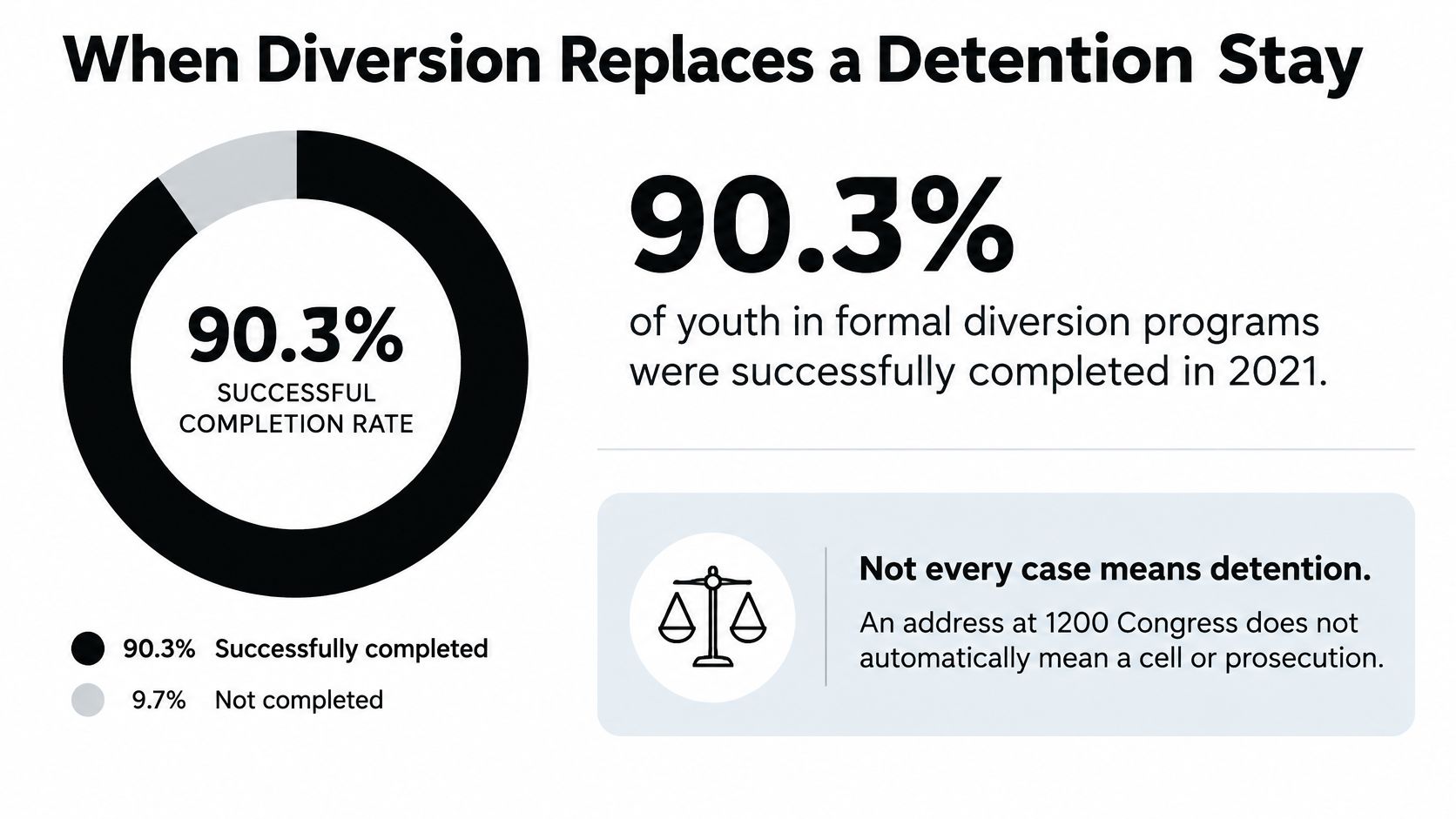
| Formal diversion success | 92% in 2020; 90.3% in 2021 |
| Youth diverted from detention | 87% in 2020; 89.9% in 2021 |
| Dispositions to residential placement | 18.8% in 2021 |
| Recidivism after completed probation | 25% in 2020; 22% in 2021 |
| Hispanic share of detention population | 41.8% in 2021 |
| Black share of detention population | 50.5% in 2021, compared with about 18% of the Harris County population |
The formal-diversion measure concerns participating youth. It doesn't mean every referred child qualifies, and avoiding detention doesn't necessarily mean a case ends without court involvement.
The graphic highlights the formal-diversion result.
Who decides and what should parents ask
Juvenile probation intake helps sort referrals, sometimes with prosecutor involvement. Eligibility and approval turn on the particular program and case, so ask who has authority to approve the proposed option.
Treat participation as a decision that deserves informed review. Before agreeing, ask:
- Choice and consent: Is participation voluntary, and what happens if the family declines?
- Required activities: Must the child attend counseling, classes, assessments, or check-ins?
- Records: What documents will be created, who may access them, and what record-related steps remain afterward?
- School consequences: Can the school separately address the same incident?
- Unsuccessful participation: What happens after a missed appointment, withdrawal, or failure to complete?
Successful diversion is intended to avoid a traditional adjudication, the court's formal determination of the allegation. It isn't an automatic erasure of every record or school consequence. Unsuccessful participation may return the referral toward court, and detention questions require a separate assessment.
Read the equity figures carefully
The detention demographics deserve attention, but the countywide population comparison isn't a youth-only comparison. It identifies a disparity worth examining, not the reason any particular child was held.
The Harris County Office of County Administration's accomplishments page reports that youth referrals declined 43% from 2014 through 2022. That broader shift doesn't resolve your child's eligibility; ask directly whether the child is detained, being considered for diversion, or scheduled for court.
Floors Records Visits and Attorney Access
Identify the assigned office before choosing a counter. Most trips to 1200 Congress are scheduled errands: a hearing, a probation check-in, an attorney meeting, or a records request, and each one may send you to a different floor. The Houston Bar Association court directory lists juvenile operations across the fifth, sixth, and seventh floors, including the locations and court telephone number below.
Where to go inside 1200 Congress
| Office | Listed location | What to have ready |
|---|---|---|
| 313th District Court | Sixth floor | Assigned courtroom and hearing time |
| Other juvenile court listing | Fifth floor | Phone (832) 927-8470; confirm this is your court |
| Juvenile courts and specialty-court administration | Sixth floor | Court coordinator name |
| Additional juvenile court functions | Seventh floor | Confirm the specific office rather than assuming one counter handles everything |
| Juvenile Intake document copies | Sixth floor, Suite 6015 | Valid ID; $1.00 per certified page or $0.10 per uncertified page |
| Probation records | 1200 Congress records window | Weekdays 8:30 a.m. to 4:30 p.m.; no delinquency information by phone |
For document copies, the Harris County District Clerk's FAQ identifies Juvenile Intake in Suite 6015 on the sixth floor, requires valid identification, and lists $1.00 per certified page and $0.10 per uncertified page. It also explains that delinquency records are confidential, aren't disclosed by telephone, and that delinquency documents may be filed in person or by mail.
Requesting copies isn't the same as filing papers
Ask your lawyer whether you need certified copies or ordinary copies before paying, since the price difference is ten cents versus a dollar per page. Also confirm whether the documents are held by the district clerk or juvenile probation, because those are separate records functions inside the same address.
Identification doesn't automatically entitle every requester to every confidential document. Tell staff your relationship to the child and ask what proof of authority is needed.
If you're trying to submit a document, ask for filing instructions rather than merely requesting copies. Keep a copy of whatever you submit and obtain confirmation of receipt.
Juvenile visits require juvenile instructions
For a child in detention, confirm the appointment, housing location, approved visitors, and current visiting window with juvenile detention staff. Don't borrow an adult-jail visiting schedule because an internet result mentions a similar downtown address.
Give the lawyer enough notice to arrange entry and an appropriate meeting with the child. A family visitation appointment doesn't replace confidential attorney access.
Parents handling separate domestic matters should also distinguish this complex from the building covered in the Harris County Family Law Center floor guide. A court notice names the exact address where you must appear, and 1115 Congress is a different building on the same street.
Before driving from Humble or Kingwood, check:
- Destination: The assigned court, office, and floor. Juvenile Intake copies are handled at sixth-floor Suite 6015, while courts sit across three floors.
- Purpose: Hearing, probation check-in, attorney meeting, filing, or records request, because each errand leads to a different counter.
- Entry requirements: Valid identification, an appointment or hearing time, and proof of your relationship to the child for confidential records.
Rights Families Can Use the Same Week
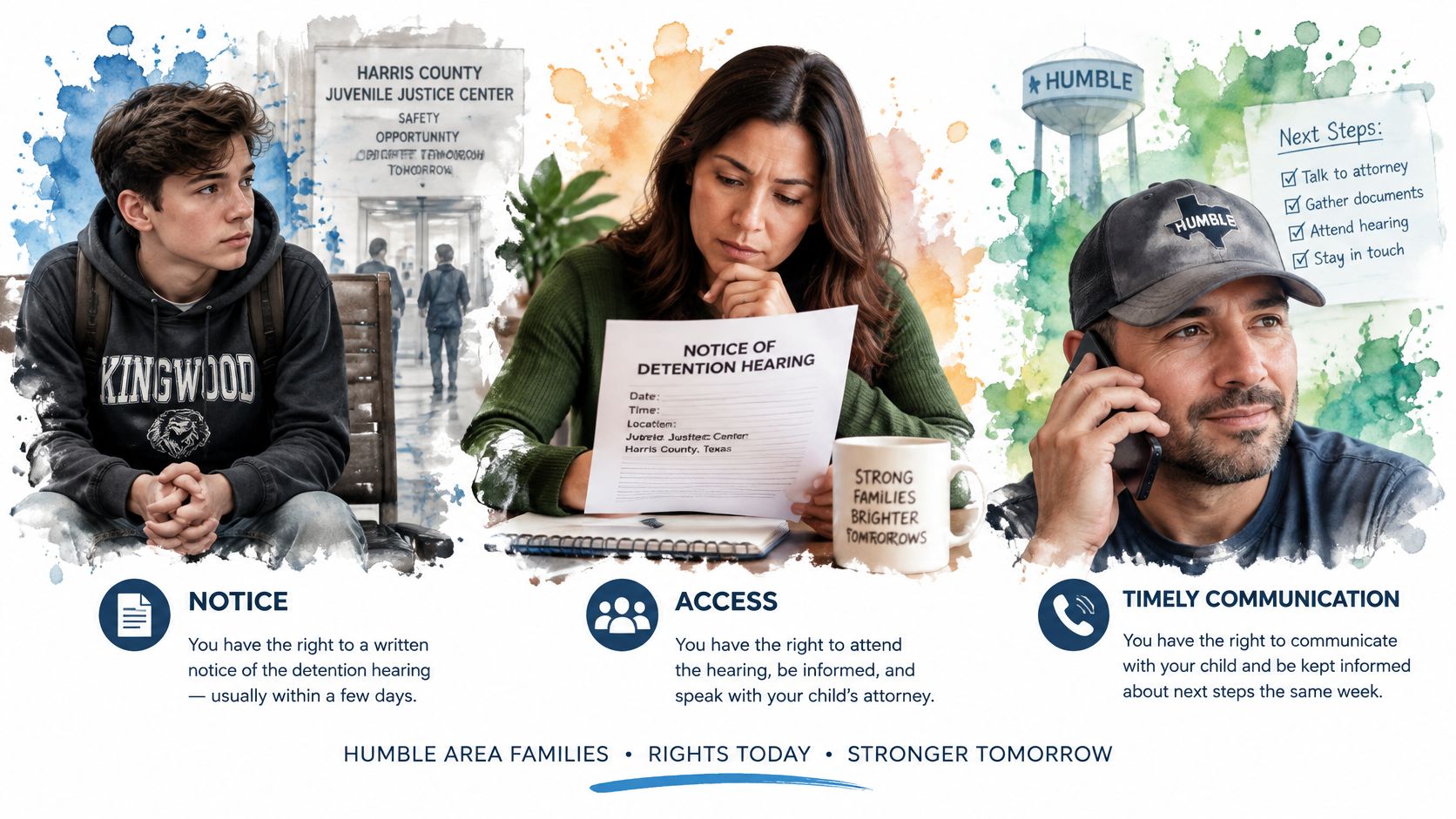
Rights matter when they change what a parent does before the next deadline. A trip to 1200 Congress may be a detention hearing, a diversion decision, a probation check-in, or a records request, so the useful right depends on the reason for the visit. The family's role is to turn notice, confidentiality, and access to counsel into specific preparation.
A Kingwood parent prepares for a detention hearing
A Kingwood middle-school student is held after a Friday arrest. The parent confirms the next working-day setting, reaches counsel, and prepares medication and supervision information rather than posting an explanation online.
Notice, counsel for the child, and judicial review matter here. The action the parent can take immediately is to help counsel present accurate information about the child's needs and proposed care at home, including who can supervise, where the child will stay, and how treatment will continue.
If the paperwork instead concerns child protection, identify that difference immediately. This guide to a Harris County juvenile court CPS removal hearing addresses a different kind of proceeding from a delinquency detention hearing.
An Atascocita family reviews a program offer
A high-school referral leads to a proposed diversion program without a booking. Ask for the conditions in writing, confirm transportation and attendance requirements, and ask what happens if treatment or school schedules conflict before anyone signs.
School support may need its own conversation. If disability accommodations are relevant, Uptown Psychology's explanation of what to expect at a 504 meeting can help parents prepare for that separate school meeting. The 504 guide addresses school accommodations rather than juvenile court procedure.
The available choice is informed participation. Read every condition, ask how missed appointments are handled, and keep school expectations separate from the juvenile terms.
A Northeast Houston parent needs records
A parent calls for delinquency documents and receives no case details. The parent can ask about the proper request process, bring identification, or have counsel seek authorized access rather than treating confidentiality as a refusal to help.
Ask your child to save discussion of the allegation for counsel, including avoiding family group texts about what happened. Parents can supply documents and discuss school or medical needs, while the lawyer decides how the facts should be presented.
An existing custody or support order may require separate advice. A Humble child-support resource can help families frame that issue without assuming the juvenile matter changes an existing order.
Confirm the Hearing Then Call for Help
Once the earlier checklist has the trip details nailed down, two questions remain: who should get your first call, and which problems cannot wait for a court date.
If appointed counsel is already involved, that lawyer gets the first call. Reaching out to several offices at once creates competing instructions, and a second attorney working from partial information can undo preparation the first one already made. When you do connect, say exactly whom you contacted before and what is still unknown.
Some situations raise the urgency of that call: the child is being held rather than released, the allegation is serious, the diversion conditions are unclear, or the hearing information conflicts with the notice you received. Each of those changes what happens next, so each one changes who should be advising you before the appointment.
Separate urgent needs from legal preparation
A medical or psychiatric emergency cannot wait for a court appointment. Children Psych's emergency care guide offers context for recognizing when urgent professional assessment may be needed, though immediate danger calls for emergency assistance, not a website review.
A separate CPS investigation needs its own attention as well. The CPS Defense Attorney in Humble service covers defense against CPS investigations for Humble families, which is a different legal problem from the juvenile court notice that brought you here.
A calm first call doesn't require a complete explanation of the incident. It requires accurate paperwork, a confirmed location, and a clear account of the child's immediate needs.
Have the custody information, court notice, probation officer's name, and medication needs on hand when you call. A missing document is a reason to say so on the phone, not a reason to wait.
Most visits related to 1200 Congress are appointments: a hearing, a diversion decision, a probation check-in, or a records request. Guidance about the appointment scheduled serves your family better than preparation for an outcome nobody has ordered.
The Law Office of Bryan Fagan offers criminal defense and related family-law support for Humble-area families facing questions about juvenile proceedings at 1200 Congress. Schedule a free consultation with our downtown Humble office, and bring your notice and probation contact information so we can discuss the next step for your family.