Skip to content

You're likely dealing with a record that keeps resurfacing at the worst times, during a job screening, a housing application, or a licensing check. In Humble, Atascocita, Kingwood, and Northeast Houston, that pressure feels personal because the next step often depends on whether your Texas record can be expunged or sealed under a nondisclosure order.
Texas does not use one universal cleanup process. It gives people two separate paths, and the right one depends on how the case ended, what the charge was, and how long it has been since the case closed. For many families in Harris County, that difference is the line between moving forward and being stuck with the same background check problem year after year.
Understanding Your Options Expunction vs Nondisclosure
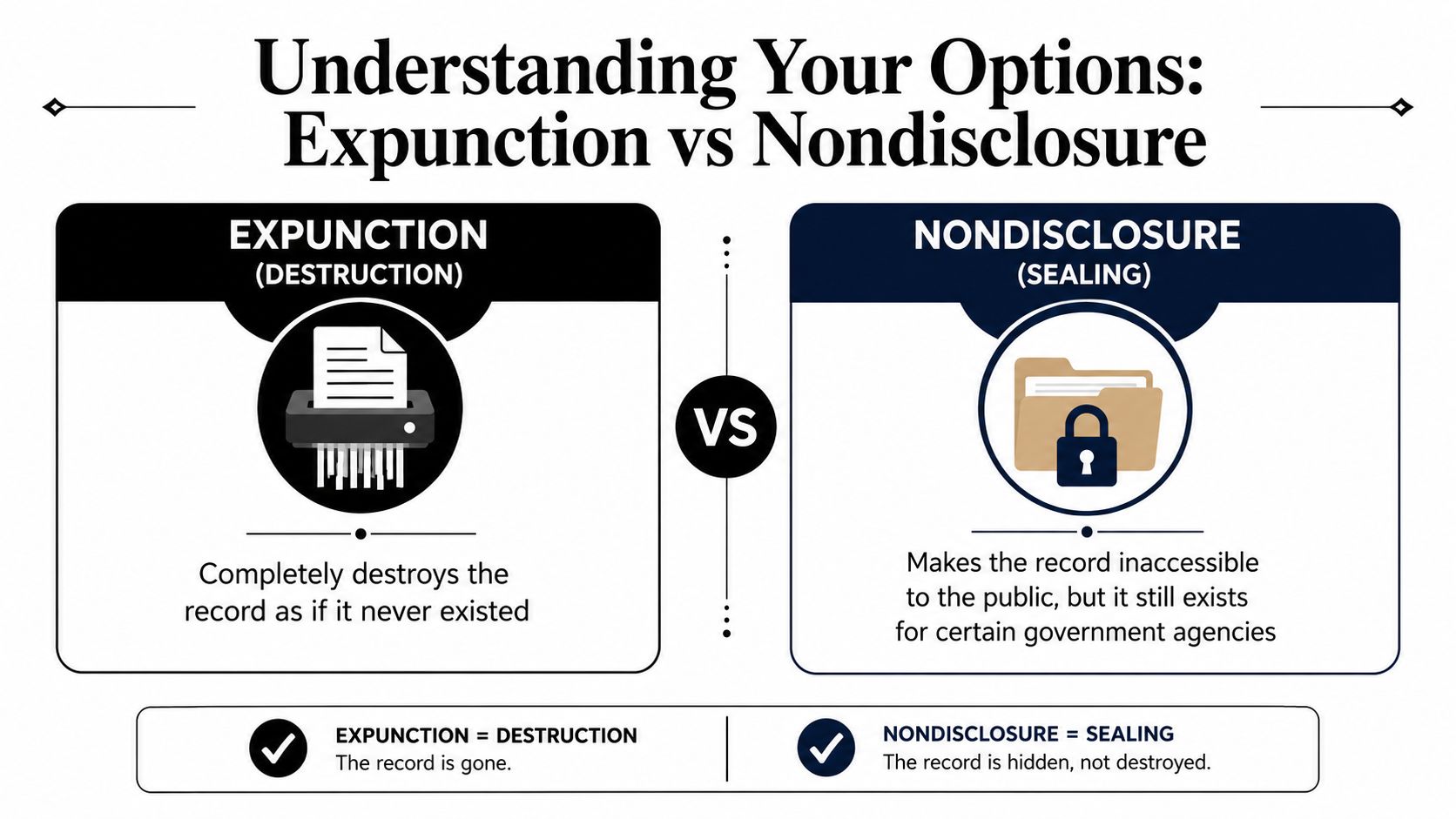
A Texas record usually falls into one of two relief paths, expunction or nondisclosure. The difference is practical, because one option removes the record from public view much more completely, while the other limits access but does not make the record disappear.
Expunction clears the record in a far broader way. Nondisclosure seals it from public review, but certain government agencies can still access it. Texas law guidance describes nondisclosure as the legal term for sealing a criminal record, and it is narrower than expunction because it blocks public access without destroying the underlying file (Texas State University legal guide).
Why the difference matters in Harris County
In Harris County courts, the result of the case usually controls the remedy. If the arrest ended without charges, Texas guidance says expunction timing can depend on the offense level, and the waiting period may be as short as a few months for some low-level misdemeanors or longer for more serious arrests (Texas Law Help). Those timing rules are not paperwork trivia. Judges and prosecutors look at them first, especially in Harris County where the court record has to match the relief you are asking for.
Nondisclosure follows a different path. Texas law help materials describe it as a fit for some first-time misdemeanor cases after deferred adjudication or sentence completion, while many felony convictions are not eligible under that route. For people in Humble, Kingwood, and Atascocita, that means the charge itself and the way the case ended often decide whether sealing is even available before the court ever reaches the merits.
For clients trying to expunge criminal record in Texas, the first question is not whether relief sounds available in the abstract. It is whether the case history fits expunction or nondisclosure under Texas rules, and whether Harris County records show anything that blocks the request.
Practical rule: if the case ended in dismissal or no formal charge, expunction may be the better fit. If it ended in a qualifying deferred adjudication or misdemeanor outcome, nondisclosure may be the path, if the offense is allowed.
A separate family law matter, such as Prenuptial & Postnuptial Agreements in Humble, deals with marital property agreements and is not a criminal record remedy. That distinction matters because people sometimes assume all legal cleanup follows the same process, and in Harris County that assumption can waste time before the right petition is filed.
Are You Eligible to Seal Your Record in Texas
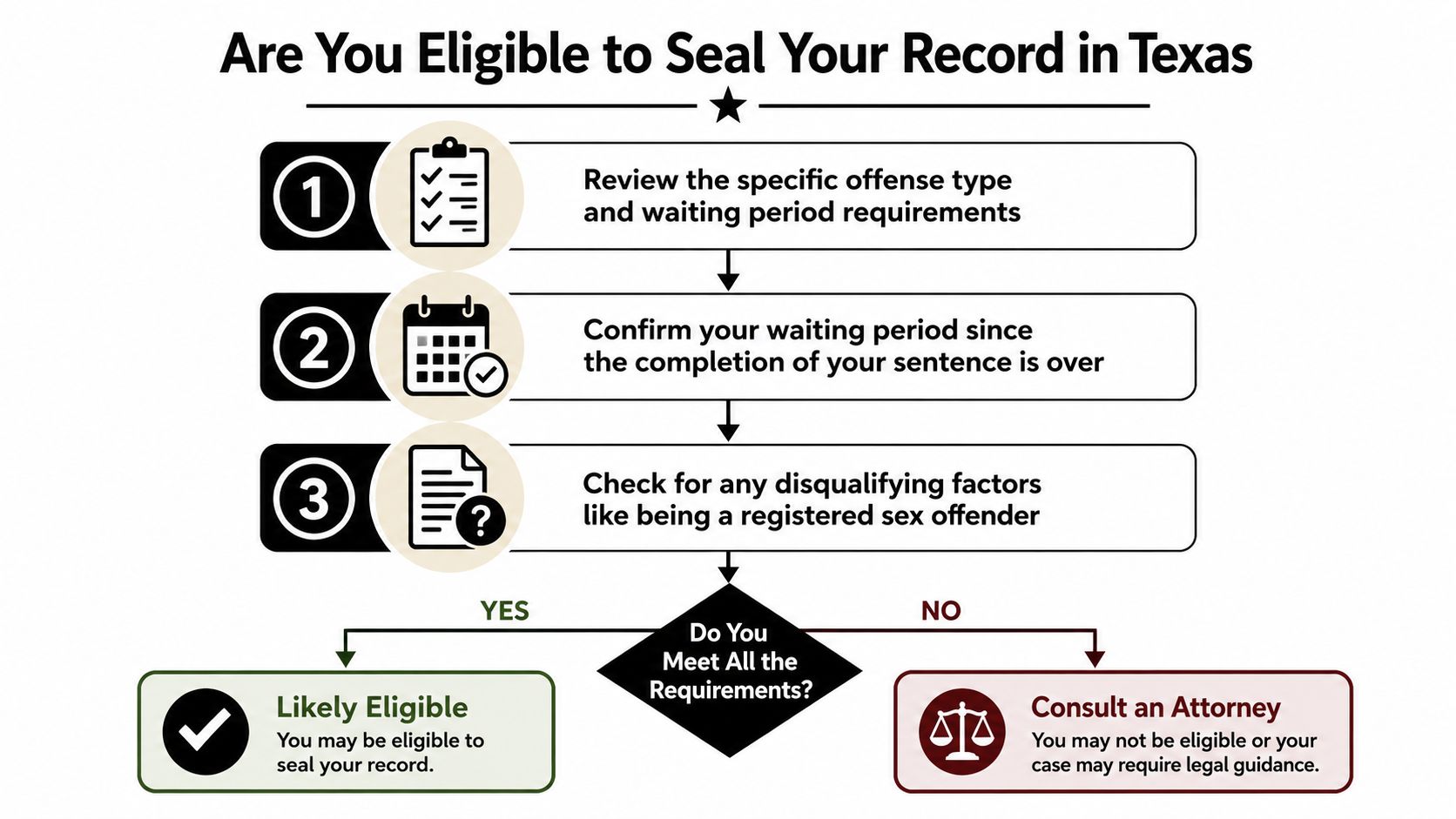
Eligibility is where many petitions succeed or fail. Harris County judges do not guess their way through these cases, they look for the offense type, the case result, the waiting period, and any disqualifying history.
Start with the charge and how it ended
For expunction, the clearest path is usually dismissal, acquittal, pardon, or another result that leaves no qualifying conviction behind. Texas guidance also notes that if no charges were filed after arrest, the waiting period depends on the offense class, which is why the offense label matters so much at the beginning (Texas Law Help).
For nondisclosure, the case outcome matters just as much. Texas State University's legal guide explains that sealing is not available in the same way for every offense, and Texas Appleseed describes the typical qualifying group as first-time, non-violent misdemeanor cases with completed sentences or deferred adjudication (Texas State University legal guide).
Then check the waiting period and exclusions
Texas Law Help says certain misdemeanors under Chapters 20, 21, 22, 25, 42, 43, and 46 require a 2-year wait for some nondisclosure situations, and some felony cases require a 5-year wait. Another important limitation is offense-based exclusion. Under the Texas guidance provided, nondisclosure after deferred adjudication is not available for offenses like murder, capital murder, aggravated kidnapping, injury to a child, abandoning or endangering a child, stalking, certain family-violence-related offenses, or any offense requiring sex-offender registration (Texas Law Help and the Texas eligibility guidance).
If your case involved a family law overlap, such as protective-order history, Protective Orders in Humble is a separate service focused on domestic violence and family safety matters.
If a disqualifying offense appears anywhere else on the record, not just in the case you want sealed, the petition can run into trouble fast.
A sensible self-check is simple. What was the charge? Did the case end in dismissal, deferred adjudication, or something else? Has the required waiting period passed? If you cannot answer those questions confidently, the filing risk goes up.
A Harris County reality check
For Humble and Atascocita residents, the practical mistake is filing too early. The court will not overlook a waiting-period problem just because the record is old enough to feel old. The petition has to match the case history, the offense class, and the eligibility rules exactly.
Gathering Your Documents for the Harris County Courts
Getting the paperwork right is not busywork. It's the part of the process that keeps a judge from seeing contradictions between your petition and the court file.
Build a file that matches the official record
Texas guidance says the petition must match official records exactly, including the defendant's full legal name, offense description, arrest date, court number, and case number. Applicants are also told to obtain a DPS criminal-history record and certified dismissal or judgment documents from the clerk. That makes this a document-control problem as much as a legal one, because a missing order or a mismatch in dates can trigger objections or a continuance (Texas CPS Lawyer process guidance).
The safest approach is to gather the paper trail before anything is filed. In practice, that usually means pulling the criminal-history record, locating the certified court disposition, and confirming the final outcome of every charge you want addressed.
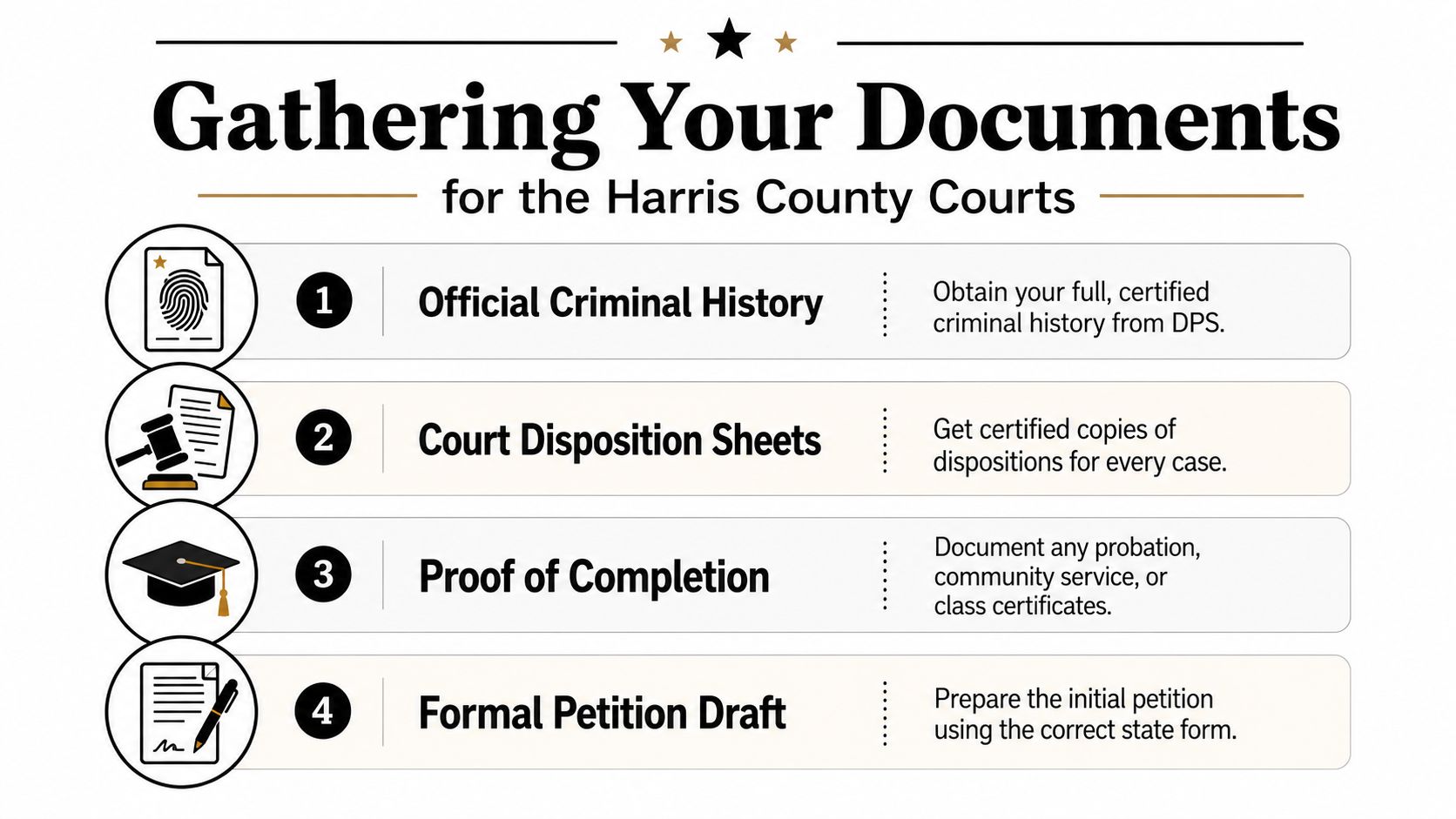
What the court expects to see
A clean file usually includes these core items:
- Official criminal history, because the petition has to line up with the DPS record.
- Certified court dispositions, so the judge can verify what happened in each case.
- Proof of completion, when the case involved deferred adjudication or other court-ordered requirements.
- A correctly drafted petition, using the right court, the right names, and the right case numbers.
If a case touched on parenting or safety issues, Grandparents' Rights in Humble is a separate service dealing with custody and visitation rights for grandparents in Harris County.
The petition should be built as though the prosecutor will read every line against the clerk's file, because that's often exactly what happens.
Humble, Kingwood, and Northeast Houston residents often assume the file is simple because the case was “just a dismissal” or “just probation.” The problem is that the court file still has to prove that result with certified paperwork. Unpaid fines, missing dispositions, or incomplete proof of compliance can slow everything down.
The Filing and Hearing Process in Harris County
A record-sealing case is part paperwork, part courtroom procedure. In Harris County, filing in the wrong court can waste weeks, so the first move has to be precise.

For expunction, Texas procedure places the filing in civil district court. For nondisclosure, the petition usually goes back to the court that handled the criminal case, and CleanSlate Texas notes that a separate petition is required for each criminal record to be nondisclosed. For expunctions, multiple records can sometimes be included in one petition if they are all in the same county (CleanSlate Texas).
Once the petition is filed, notice goes out to the affected agencies. That matters because prosecutors receive notice and may object, which is why the filing has to be accurate from the start. A petition that looks fine on paper but does not fit the statutory category can turn into a contested hearing instead of a straightforward order.
The hearing itself is usually less dramatic than people expect, but it is still formal. The judge checks eligibility, reviews the filing history, and listens for objections. In many cases, the strongest presentation is not a speech, it's a clean file, a calm answer to eligibility questions, and certified documents that line up with the petition.
If you want a broader sense of criminal-court procedure, what happens at arraignment hearing is useful background on how Harris County criminal proceedings move through court.
A short video overview can also help you understand how criminal hearings feel in practice.
The local lesson is simple. In Harris County, filing is not just about submitting forms. It's about sending the right petition to the right court, serving the right agencies, and being ready if a prosecutor objects. That is the part that often makes people nervous, and it's also the part where experienced local guidance helps the most.
Costs Timelines and Common Mistakes to Avoid
The cost question usually comes up right after eligibility. That's smart, because a record-sealing case is an investment of both money and time, and the wrong filing can waste both.
Texas State University's legal guide says filing usually happens in the county where the arrest or charge occurred, and some courts require a DPS background check, fingerprint card, dismissal order, and filing fee. It also notes that attorney-assisted expunctions often cost around $1,500+ in total (Texas State University legal guide). That figure helps set expectations, but the total cost also includes the time spent gathering records, correcting errors, and waiting for court scheduling.
The timeline has two parts
There is the eligibility wait, and then there is the legal process after filing. Texas Law Help's waiting periods, such as 180 days, 1 year, 2 years, 3 years, and 5 years depending on the path and offense class, are only the first clock you have to watch (Texas Law Help). After that, the case still has to move through filing, notice, objections, and hearing dates.
Common mistakes show up in predictable ways:
- Filing too early, before the waiting period ends.
- Using the wrong remedy, especially when the case outcome does not fit expunction or nondisclosure.
- Leaving out certified documents, which gives the court nothing solid to rely on.
- Mismatching case details, such as the arrest date or cause number.
- Ignoring exclusions, especially for offenses that cannot be sealed under the Texas guidance already noted.
A cheap filing that gets denied can end up costing more than a careful filing that is done right the first time.
Another practical issue is offense-level screening. If the record includes a disqualifying offense anywhere on the background history, not just in the case being addressed, the petition can collapse. That's why people in Humble, Kingwood, and Atascocita should treat the process like a file audit, not a simple form submission.
The best way to avoid wasted time is to confirm eligibility first, then match the paperwork to the official record, then file in the right court. If any of those three steps is shaky, the petition is vulnerable.
When You Need a Humble TX Attorney on Your Side
A record-clearing case can look straightforward until one detail goes wrong. That's when families in Harris County realize this process is part legal analysis, part record verification, and part courtroom procedure.
A local attorney can help you sort out whether expunction or nondisclosure fits the case, line up the certified documents, and file in the correct Harris County court. If a prosecutor objects, representation matters even more, because the judge will want a clean record and a clear legal basis for relief. For people who want to understand confidentiality around the lawyer relationship while discussing a record, it also helps to understand attorney client privilege before sharing details.
The choice of counsel matters in criminal matters because the petition has to match the court file exactly, and the court will not correct a bad filing for you. If you are comparing local defense options, how to choose a criminal defense attorney is a useful place to evaluate what kind of help fits your situation.
The Law Office of Bryan Fagan works with Humble, Atascocita, Kingwood, and Northeast Houston residents who need practical legal guidance on criminal defense and related family concerns. For families already carrying the stress of a pending charge, a parenting dispute, or a future background check, having one local team coordinate the next step can make the process feel manageable.
If you're ready to talk through your record and whether expunction or nondisclosure fits your situation, the Law Office of Bryan Fagan can review your case, explain the Harris County process, and help you move toward a clean slate. Visit Law Office of Bryan Fagan to schedule a free consultation with our Humble office and get specific guidance for your next step.