Skip to content

A lot of parents in Humble call a custody case a fight, but that word usually hides what they're really carrying. They're worried about school pickup next week, whether their child will have to move, whether the other parent is telling half the story, and whether a judge in Harris County will understand what daily life looks like in their home.
If that's where you are right now, the first thing to know is this. Learning how to win primary custody in Texas isn't about sounding more upset or making the other parent look worse. It's about showing, with calm and organized proof, that your child is more secure when you are the parent who decides the child's primary residence.
Families in Humble, Atascocita, Kingwood, and Northeast Houston often come into this process feeling overwhelmed by legal terms. The law uses the word conservatorship instead of custody. The practical question is simpler. Who is the parent the court trusts to provide the most stable home base for the child?
Your Child's Future A Guide for Humble Parents
A parent in Kingwood recently described the first week after separation like this: every routine suddenly felt fragile. School drop-off became a negotiation. Soccer practice needed new transportation plans. Bedtime calls turned tense. The parent wasn't trying to "win" against the other side. The parent wanted one thing. A stable plan that protected the child from chaos.
That's how most custody cases really begin in Harris County.
When people ask how to win primary custody in Texas, they usually mean one specific outcome. They want to be named the parent with the right to determine the child's primary residence. Texas courts often call that parent the primary conservator. That role matters because it shapes where the child lives, where the child goes to school, and what day-to-day life looks like.
What primary custody actually means
Many parents are surprised to learn that "primary custody" doesn't always mean the other parent disappears from the picture. In many cases, both parents still keep important rights and duties. The court may still expect both parents to stay involved. The difference is that one parent becomes the home-base parent.
That distinction matters in Humble and Northeast Houston, where work schedules, school zones, and long commutes can make shared logistics difficult. Judges don't want abstract promises. They want a workable routine.
A strong custody case feels less like an argument and more like a clear picture of the child's everyday life.
What local parents need most
Parents in Atascocita and Humble often come in with the same fear. "What if the court only hears the loudest version of events?" Harris County family courts respond better to specifics than emotion. A parent who can show attendance at school meetings, medical involvement, dependable transportation, and a realistic weekly routine usually stands on firmer ground than a parent who only says, "I'm the better parent."
That can feel unfair when you're exhausted. It's still the reality.
If you're facing this now, take a breath. The process is serious, but it isn't impossible to handle. Good preparation can change the direction of a case, especially when your focus stays where the court's focus should be. On your child.
Understanding the Best Interest of the Child Standard
Texas judges don't award primary custody because one parent asks more forcefully. They look at the best interest of the child. In practice, that means the court examines which parent is better positioned to meet the child's emotional, physical, educational, and daily needs in a stable way.
In Harris County, that standard shows up in nearly every decision the court makes. The label may sound broad, but the courtroom questions are usually concrete. Who gets the child ready for school? Who tracks doctor visits? Who keeps the child in a steady routine? Who can make transitions easier, not harder?
Conservatorship in plain English
Texas uses terms that can confuse parents during an already stressful time. Joint Managing Conservatorship is the most common arrangement, and in that setup both parents share decision-making authority in many areas. Even then, one parent is usually named the primary conservator, the parent who determines the child's main residence. The broader trend has shifted over time, but mothers still receive primary custody more often. One source notes that mothers receiving primary custody fell from over 90% in the 1980s to 79.3% in 2025, reflecting greater father involvement, while also explaining that one parent in a joint arrangement is still commonly designated as primary conservator (Texas custody breakdown and primary conservator data).
That doesn't mean fathers can't win. It means nobody should walk into court assuming fairness will carry the day without evidence.
For a closer look at how courts evaluate these issues, see this guide on proving the best interest of the child in Texas custody cases.
The Holley factors judges think about
Lawyers and judges often talk about the Holley factors. You don't need to memorize the case name. You do need to understand the ideas behind it. The court is looking for a stable, child-centered plan grounded in real life.
| Factor | What It Means for Your Case |
|---|---|
| Child's emotional needs | Show how you support routines, comfort, supervision, and age-appropriate structure |
| Child's physical needs | Demonstrate involvement in meals, transportation, health care, sleep, and safety |
| Stability of the home | Present a consistent living arrangement, school plan, and dependable schedule |
| Parenting abilities | Use examples of homework help, school contact, discipline, and daily caregiving |
| Plans for the child | Offer a realistic parenting plan that fits the child's life, not just your preferences |
| Acts or omissions of a parent | Expect the court to look at conduct that affects the child's well-being |
| Any excuse for concerning conduct | If there are difficult facts, address them directly and with documentation |
A judge isn't looking for a perfect parent. Judges know real families are messy. They're looking for the parent who seems most prepared to protect the child's day-to-day stability.
What actually persuades the court
A workable custody strategy often includes school continuity, medical follow-through, and calm communication with the other parent. Parents who can support their child's emotional development also tend to present better. Outside the legal system, some families find tools for boosting kids' resilience and focus helpful during separation because children often need support handling stress and change.
If you need representation specific to conservatorship issues, a Child Custody Lawyer in Humble, TX handles custody and conservatorship representation for Humble families.
Practical rule: Don't build your case around what the other parent does wrong. Build it around what your child needs and how you meet those needs consistently.
Building Your Case Before You Go to Court
The strongest custody files are built at the kitchen table, in school portals, in doctor waiting rooms, and in saved messages long before anyone testifies in a courtroom. By the time a case reaches a Harris County judge, the parent with organized proof usually has the advantage.
That matters even more for fathers and unmarried parents. One Texas custody source reports that 72% of fathers who lose primary custody did not lose because of incompetence, but because they lacked documented evidence of routine involvement before filing, and it also notes that 40% of custody disputes in Harris County involve unmarried parents (fathers' custody documentation and Harris County dispute data). In practical terms, that means many parents lose on proof, not parenting.
Here is the checklist I want parents in Humble, Atascocita, and Kingwood to start using early.
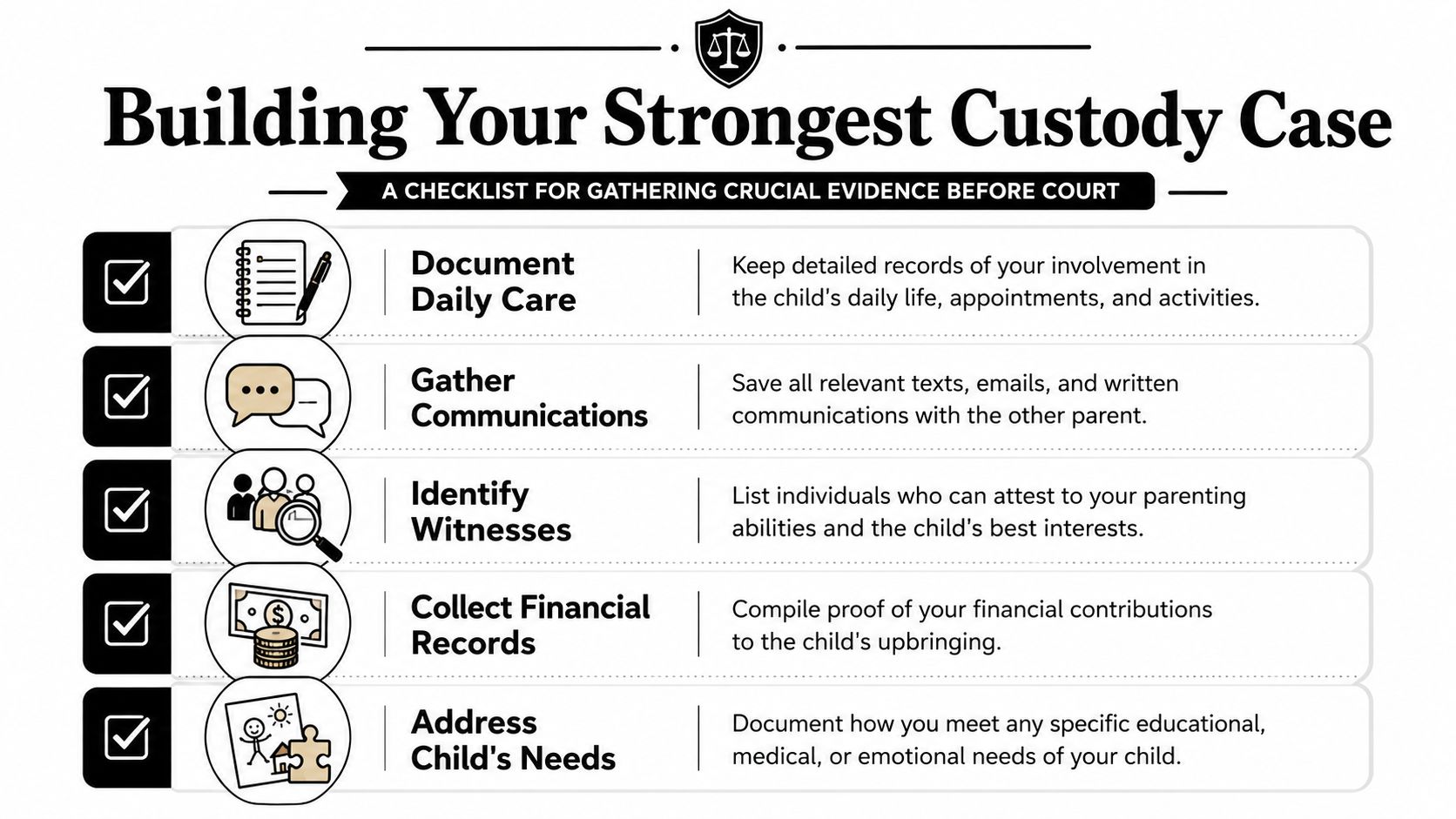
Build a custody dossier
Don't think of this as collecting random paperwork. Think of it as creating a reliable file that shows your role in the child's life.
- Daily care records: Keep a dated log of school drop-offs, pickups, meals, homework help, bedtime routines, and extracurricular transportation.
- Medical documentation: Save appointment confirmations, discharge papers, prescription notices, vaccination records, and notes showing who attended visits.
- School involvement: Keep report cards, attendance notices, teacher emails, portal screenshots, tutoring records, and school event sign-ins.
- Communication records: Save texts and emails with the other parent that show scheduling, cooperation, or your attempts to solve problems calmly.
- Witness list: Write down names of teachers, counselors, coaches, daycare staff, relatives, or neighbors who have firsthand knowledge of your parenting.
- Financial proof: Collect receipts and records showing the child's expenses you cover, especially recurring necessities.
Many parents don't realize how useful an ordinary calendar can become. A clean, consistent timeline often tells a stronger story than a dramatic accusation.
Draft a parenting plan that fits real life
Harris County judges can spot a generic parenting proposal fast. A stronger plan reflects the actual child. That includes wake-up time, school route, allergy concerns, tutoring, sports, church, counseling, and who can handle weekday transportation.
Include specifics such as:
- School routine: Where the child will sleep on school nights and how transportation will work.
- Health needs: Who handles appointments, therapy, medications, and emergency contacts.
- Holiday structure: A clear proposal for Thanksgiving, winter break, birthdays, and summer periods.
- Communication plan: Reasonable rules for parent-child calls, app-based communication, and schedule changes.
If you're already working under an existing order and circumstances have changed, Custody & Support Modifications in Humble addresses modifying existing custody, visitation, and support orders in Harris County.
You can also review a more detailed breakdown of evidence needed for a Harris County custody case.
Organized evidence beats emotional storytelling. Judges remember patterns they can verify.
Navigating the Harris County Court Process
Parents often fear court because they imagine a single dramatic hearing deciding everything. Most Harris County custody cases don't work that way. They move through stages, and each stage shapes the next one.
One of the biggest mistakes I see is delay. Parents wait to file, wait to ask for temporary relief, and wait to define a workable schedule. That hesitation can hand the other side a status quo argument before your case is even moving.
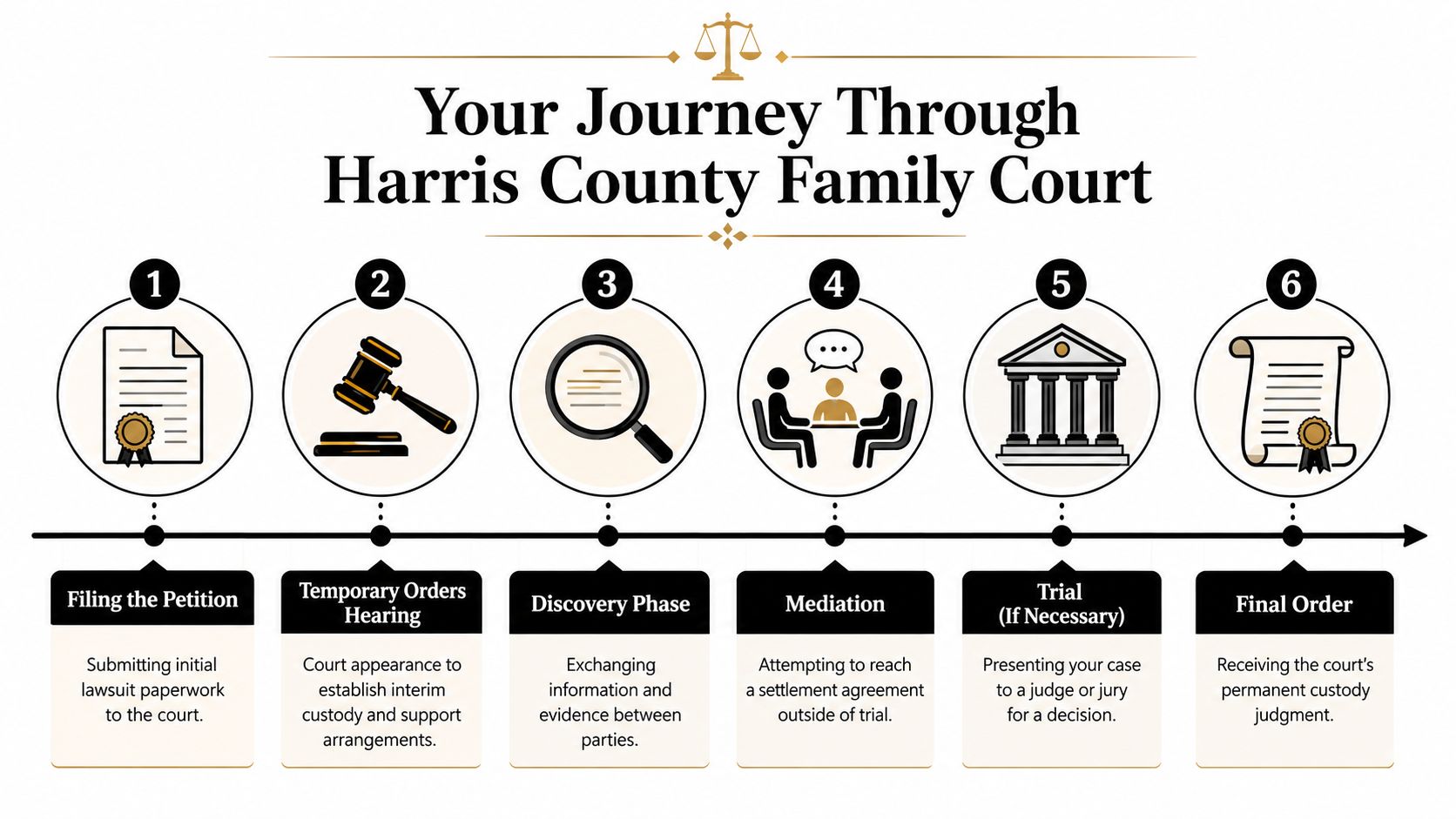
Filing the case
To ask for primary custody, a parent generally starts with a Suit Affecting the Parent-Child Relationship, often called a SAPCR, filed in the county where the child lives. The petition needs to clearly request the conservatorship relief you want. A source discussing Texas custody strategy explains that a parent seeking sole custody should expressly request Sole Managing Conservatorship under Texas Family Code §153.005 and set out the child's needs in the filing (SAPCR filing and temporary orders strategy in Texas).
Filing is only the first step. Service on the other parent has to be handled correctly, and the requests in your petition should match the outcome you're trying to reach.
Why temporary orders matter so much
Temporary orders often shape the whole case. They can decide where the child lives while the case is pending, who pays support, who handles school decisions, and how exchanges happen.
That same Texas custody strategy source makes an important point. Filing for temporary orders immediately after the SAPCR can create a stability pattern that judges often keep in the final ruling. In plain English, if the temporary arrangement works well for the child, the court may be reluctant to disrupt it later.
Temporary orders aren't a side issue. They're often the first real custody battle.
When parents ask how to win primary custody in Texas, this is one of the first practical answers. Don't treat temporary orders like paperwork. Treat them like the beginning of your evidence story.
What comes next in Harris County
After filing and temporary relief, the case usually moves through information exchange, negotiation, and often mediation. Mediation is common in Harris County family cases because many judges want parents to try to resolve disputes before trial. A good mediation session isn't about surrender. It's about knowing what matters most and what trade-offs you can live with.
Parents who do better in mediation usually come prepared with:
- A clear priority list: Know the few issues you can't give away, especially residence, school, and weekday routine.
- A realistic schedule: Proposals that match work hours and the child's routine carry more weight.
- Documents in order: Bring school records, calendars, medical notes, and communications.
- A child-focused tone: Mediators and opposing counsel notice whether you're problem-solving or escalating.
If the case doesn't settle, the judge hears evidence and makes a final ruling. That hearing is not the place to introduce a brand new theory of the case. The groundwork should already be in your pleadings, your records, and your temporary orders presentation.
For local procedure, many parents find it helpful to review how Harris County family court works for Humble residents. If the custody dispute is part of a larger divorce, The Divorce Process in Humble: What to Expect gives a step-by-step look at filing for divorce in Humble and Harris County.
Common Mistakes That Can Hurt Your Custody Case
Some custody cases weaken slowly. Not because the parent doesn't love the child, but because the parent acts out frustration in ways that alarm the court. Harris County judges pay close attention to behavior under stress. Your conduct during the case tells the court what co-parenting with you may look like after the case ends.
The first major mistake is making the case about punishment. If your texts, emails, and courtroom presentation sound like you're trying to expose the other parent rather than protect the child, the court may question your judgment.
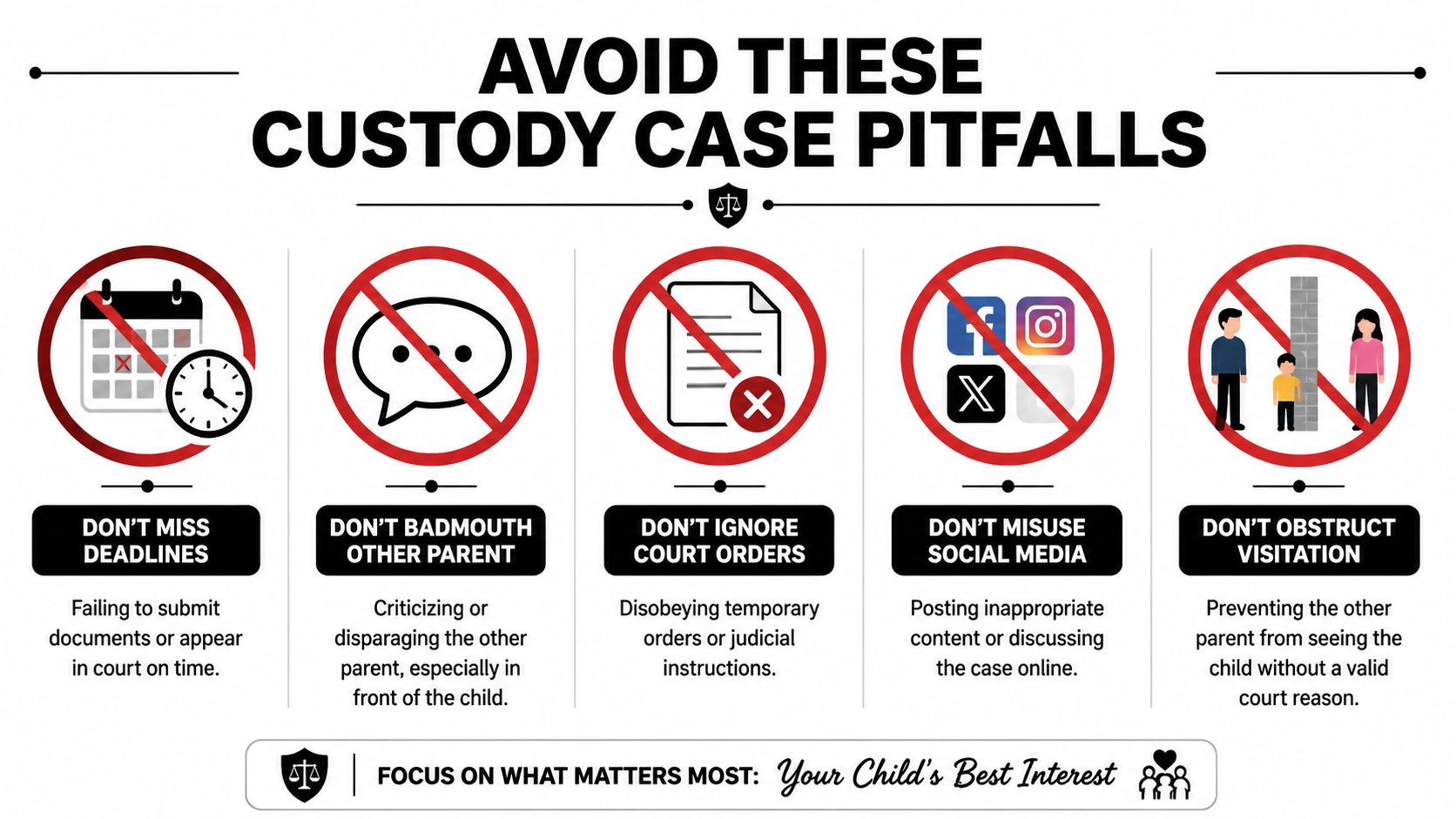
Conduct that quietly damages good cases
These mistakes come up often:
- Badmouthing the other parent: Especially in front of the child, this can make you look more focused on conflict than stability.
- Ignoring temporary orders: Even small violations can undercut your claim that you're the more dependable parent.
- Posting online about the case: Social media turns momentary anger into permanent evidence.
- Blocking communication: Refusing reasonable updates or visitation without a court-supported reason usually backfires.
- Missing deadlines or hearings: Judges expect parents asking for primary status to act organized and responsible.
A parent doesn't need to be flawless. A parent does need to look steady.
Moving for a better school district
This question comes up often in Kingwood, Atascocita, and Northeast Houston. Does moving help or hurt your custody case? The honest answer is that it depends on how well you prove the move helps the child without creating unnecessary disruption.
One Harris County source states that a 2024 study of 1,200 custody rulings found that 34% of primary custody awards went to the parent who relocated for a higher-performing school district, as long as the move minimized disruption and was supported by an educational impact statement (Harris County school-district relocation study).
That doesn't mean every move is smart. A rushed relocation can look self-serving. A carefully documented move tied to school quality, transportation planning, and the child's existing routine can look responsible.
If you want the court to approve a change, show the child gains more stability than the child loses.
If you're comparing homes, schools, or schedules, keep your focus on educational continuity, commute reality, and the child's social life. "Better for me" isn't the standard. Better for the child is.
Frequently Asked Questions from Local Parents
Parents in Humble, Atascocita, and Kingwood usually ask the same practical questions. The answers below are the ones that tend to matter most when a case is still forming.
Quick answers that reduce uncertainty
| Question | Answer |
|---|---|
| Can a father win primary custody in Texas? | Yes. Texas law does not give mothers greater legal rights based on gender alone. The court focuses on the child's best interests and the quality of the evidence. |
| What if I'm an unmarried father? | Under the Texas Family Code, fathers have the same legal rights and responsibilities as mothers, but enforceable rights for unmarried fathers begin with establishing paternity through an Acknowledgment of Paternity or a court-ordered DNA test if needed (Texas fathers' rights and paternity basics). |
| What does "primary" mean in a custody case? | It usually means being the parent with the right to determine the child's primary residence. That role often controls where the child lives and attends school. |
| Should I bring up everything the other parent has done wrong? | Only if it directly affects the child's safety, stability, or well-being. Courts respond better to verified facts than broad character attacks. |
| Do judges care about who has been handling daily routines? | Yes. Daily caregiving patterns often matter more than promises about what a parent plans to do later. |
| Do I need a lawyer? | Some parents represent themselves, but contested primary custody cases involve pleadings, evidence, temporary orders, mediation, and courtroom presentation. Legal guidance can help you avoid expensive mistakes. |
A few local concerns worth addressing
Parents in Northeast Houston often worry that their work schedule will sink their case. Usually, the issue isn't whether you work. It's whether your plan for childcare, transportation, and school consistency makes sense. A realistic plan is stronger than an idealized one.
Another common concern is whether child support decides custody. It doesn't. Support and conservatorship are related, but they're not the same question. If support is part of your case, Child Support Attorney in Humble addresses establishing, modifying, and enforcing child support in Harris County.
Some parents also ask whether they should wait and "see if things calm down." That can be risky when the current arrangement is unstable or informal. The longer a pattern continues, the easier it becomes for the other side to argue that the child should stay in that pattern.
If you're trying to protect your child's routine, the best next step is usually a calm one. Get organized. Gather records. Learn the local process. Ask for advice before a temporary arrangement hardens into the expected status quo.
If you're facing a custody dispute in Humble, Atascocita, Kingwood, or Northeast Houston, a focused legal plan can make the process clearer and less overwhelming. The Law Office of Bryan Fagan works with local families on family law matters including custody, conservatorship, divorce, child support, criminal defense, and estate planning. Schedule a free consultation with our Humble office to talk through your situation and the practical steps that can protect your child's future.