Skip to content

Your child is hurt, the hospital has questions, and an insurance adjuster may already be asking for a recorded statement. If the other parent, a caregiver, a driver, a property owner, or a business may be involved, you may also be facing CPS contact or a criminal investigation. Those are different legal problems, and choosing the wrong lawyer can cost your family time and evidence.
For Humble, Atascocita, Kingwood, and Northeast Houston families, the first question is simple: Is this a civil child-injury claim, a criminal injury-to-a-child case, a CPS matter, or more than one of these at once? This guide gives you a practical plan, explains the Texas deadlines that matter, and shows what to ask before hiring an injury to a child lawyer in Humble, TX.
What to Do Right After Your Child Is Injured in Humble
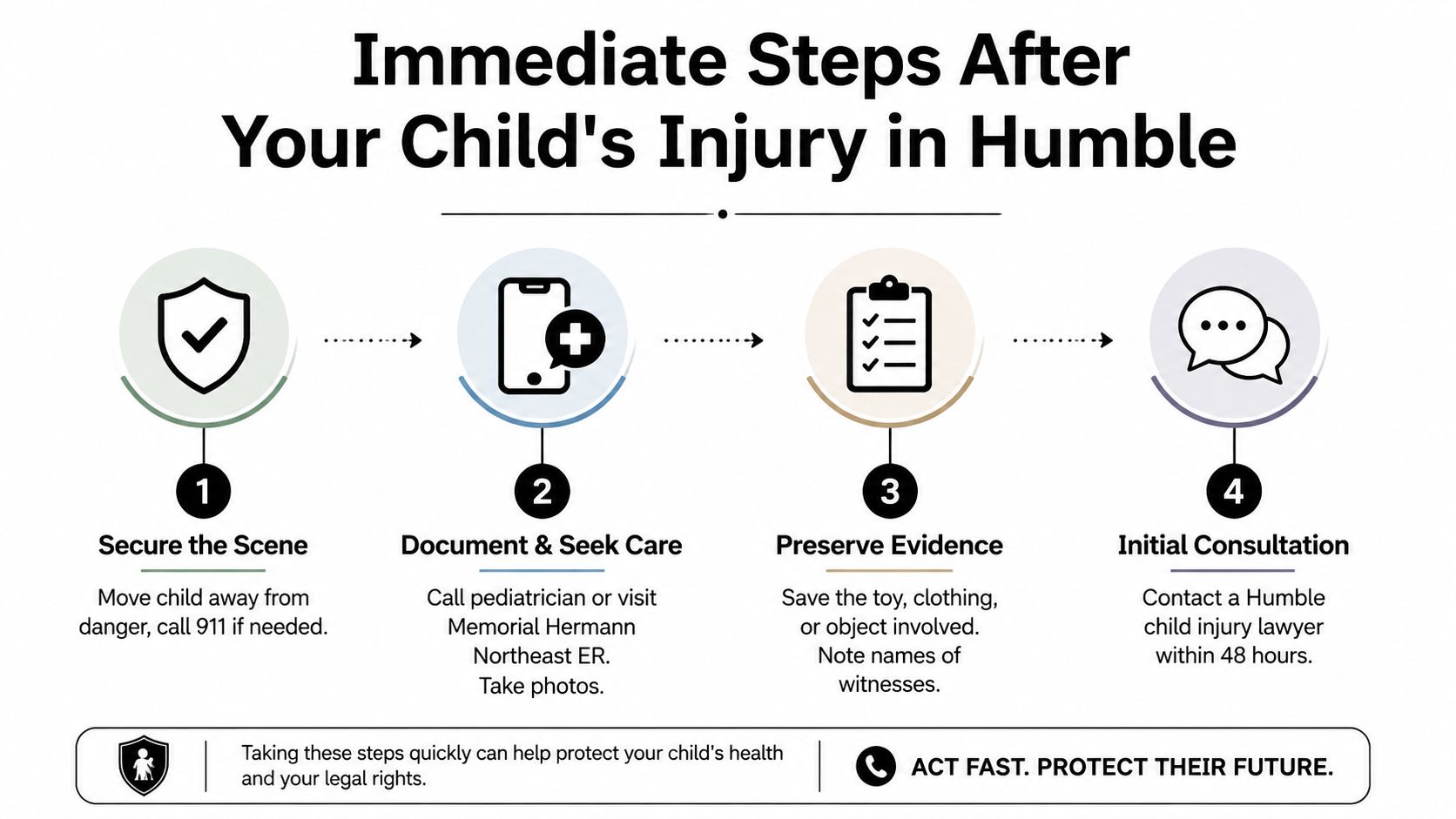
The first hours should follow a calm sequence: protect your child, obtain medical care, preserve evidence, and avoid statements that can be used against you or your claim.
Secure safety and obtain medical care
Move your child away from the hazard, vehicle, product, pool, animal, or person involved. Call 911 if the injury appears serious, your child has trouble breathing, loses consciousness, has severe bleeding, or needs immediate emergency attention. For pediatric-capable emergency care, Humble families may consider Memorial Hermann Northeast or HCA Houston Healthcare Kingwood, depending on the circumstances and medical guidance.
Tell medical staff exactly what happened, without guessing about fault. Ask for the complete medical file, including emergency-room notes, imaging, physician orders, nursing notes, discharge instructions, and follow-up recommendations. A discharge summary alone may leave out details that later help explain the injury and the treatment your child needed.
Preserve the scene and your child's account
Before anyone cleans up, take timestamped photographs and video of the scene. Save torn clothing, damaged car seats, broken toys, defective products, or other objects exactly as they are. Don't repair, discard, alter, or return anything involved in the injury.
Write down what your child said while the memory is fresh, using your own words to identify the speaker and the time. Don't repeatedly question your child or coach an answer. Preserve witness names, license information, police information, and any written request for security footage. Businesses and property owners may overwrite surveillance footage, so a lawyer should send a preservation letter quickly.
Keep receipts for prescriptions, parking, transportation, medical equipment, and every trip connected to treatment. Limit social media posts, and don't discuss blame or settlement publicly. Above all, don't give an insurer a recorded statement before a lawyer reviews the request. If the injury involves a custody or immediate safety concern, review the available guidance on an emergency custody order in Humble while medical care remains the priority.
Understanding Texas Injury to a Child Laws
The phrase “injury to a child” usually describes a criminal allegation, not a personal-injury lawsuit. That distinction matters because the accused person, the injured child, and the parent seeking compensation may each need different legal representation.
Texas Penal Code § 22.04 addresses conduct involving a child 14 or younger that causes bodily injury, serious bodily injury, or serious mental injury. The offense can involve an act, an omission, or criminally negligent conduct. It may apply to a parent, caregiver, household member, teacher, babysitter, or another person, depending on the facts and the legal duty involved. An omission case can turn on whether the person had a legal duty or assumed custody and control.
The criminal case is not the same as the civil track. A civil claim may arise when a driver, property owner, daycare, manufacturer, or another third party allegedly caused the injury through negligence, premises liability, negligent security, auto negligence, or product liability. A personal-injury lawyer generally handles that recovery claim. A criminal-defense lawyer represents the person accused of the offense. A family-law attorney helps address CPS investigations, emergency removal proceedings, custody, and protective orders.
CPS may investigate while a criminal investigation proceeds. Texas Family Code § 261.101 requires a report when a person has reasonable cause to believe abuse or neglect adversely affected a child's physical or mental health or welfare, and the duty applies to any person who suspects abuse or neglect. Parents should take CPS contact seriously, but they shouldn't assume that cooperating informally means answering every question without counsel.
| Track | Statute or Forum | Who Files | Humble Lawyer Type |
|---|---|---|---|
| Civil recovery | Texas tort law and civil court | Parent or child's legal representative | Personal-injury attorney |
| Criminal prosecution | Texas Penal Code § 22.04 | State prosecutor | Criminal-defense lawyer for the accused |
| CPS and custody | Texas Family Code Chapter 261 and Harris County family courts | CPS, a parent, or another authorized party | Family-law attorney |
If you're accused, don't try to explain the situation to police, CPS, or the other parent before getting legal advice. A practical starting point is what to do if falsely accused. For court-process background, Harris County Family Courts: A Humble Resident's Guide describes how family-law cases proceed in the Harris County courts serving Humble.
Statute of Limitations and Punishment Ranges in Texas
Deadlines depend on which legal track applies. A parent pursuing medical expenses and other losses should not wait for a CPS investigation or criminal case to finish before discussing the civil claim with counsel.
For a civil personal-injury action, Texas generally uses a two-year limitations period, subject to exceptions involving minors and other tolling rules. Texas law can allow a child's claim to remain viable until age 20, but the exact calculation depends on the claim, the parties, and applicable tolling rules. Treat the two-year period as an urgent warning, not as permission to delay. Families wanting broader deadline background can review Ares's guide to lawsuit deadlines, then confirm the calculation with a Texas lawyer.
The criminal limitations period differs. The verified Texas legal information for this topic identifies ten years from the child's 18th birthday for injury-to-a-child exposure. Counsel must analyze the specific degree, facts, and any statutory exception. Do not assume that a criminal case is too old merely because the incident happened years ago.
The punishment range also depends on mental state and the harm alleged. Texas Penal Code § 22.04 classifies intentional or knowing conduct causing serious bodily injury as a first-degree felony, reckless conduct causing serious bodily injury as a second-degree felony, intentional or knowing conduct causing bodily injury as a third-degree felony, and reckless or criminally negligent conduct causing bodily injury as a state jail felony. The ranges are substantial: first-degree felony punishment is 5 to 99 years or life and up to a $10,000 fine; second-degree is 2 to 20 years and up to a $10,000 fine; third-degree is 2 to 10 years and up to a $10,000 fine; and a state jail felony is 180 days to 2 years and up to a $10,000 fine. See the statute and punishment summary from Texas Penal Code § 22.04 and Texas punishment ranges for the offense.
| Action | Deadline or Range | Texas Authority |
|---|---|---|
| Civil child-injury claim | Generally two years, with minor-related tolling that can extend the claim until age 20 | Texas Civil Practice and Remedies Code |
| Criminal injury-to-a-child exposure | Ten years from the child's 18th birthday, subject to offense-specific analysis | Texas criminal limitations law |
| First-degree felony | 5 to 99 years or life, plus up to a $10,000 fine | Texas Penal Code |
| Second-degree felony | 2 to 20 years, plus up to a $10,000 fine | Texas Penal Code |
| Third-degree felony | 2 to 10 years, plus up to a $10,000 fine | Texas Penal Code |
| State jail felony | 180 days to 2 years, plus up to a $10,000 fine | Texas Penal Code |
A CPS report should be made promptly. Texas mandatory-reporting guidance commonly emphasizes reporting without delay, and professionals must follow the applicable statutory timing rules. If criminal exposure is possible, speak with a defense lawyer before making a detailed statement. A person facing an assault-related allegation can review aggravated assault lawyer services in Humble to identify the appropriate defense path.
How Lawyers Build a Strong Child Injury Case
A strong case starts with evidence triage, not a dramatic narrative. The National Council of Juvenile and Family Court Judges emphasizes the importance of medical records, protection orders, evaluator reports, and corroborating testimony in child-safety decisions. Its guidance also recognizes that a single credible violent incident can affect custody and visitation findings, so a lawyer should build a timeline connecting injury, disclosure, and risk indicators rather than waiting for a pattern of repeated events.
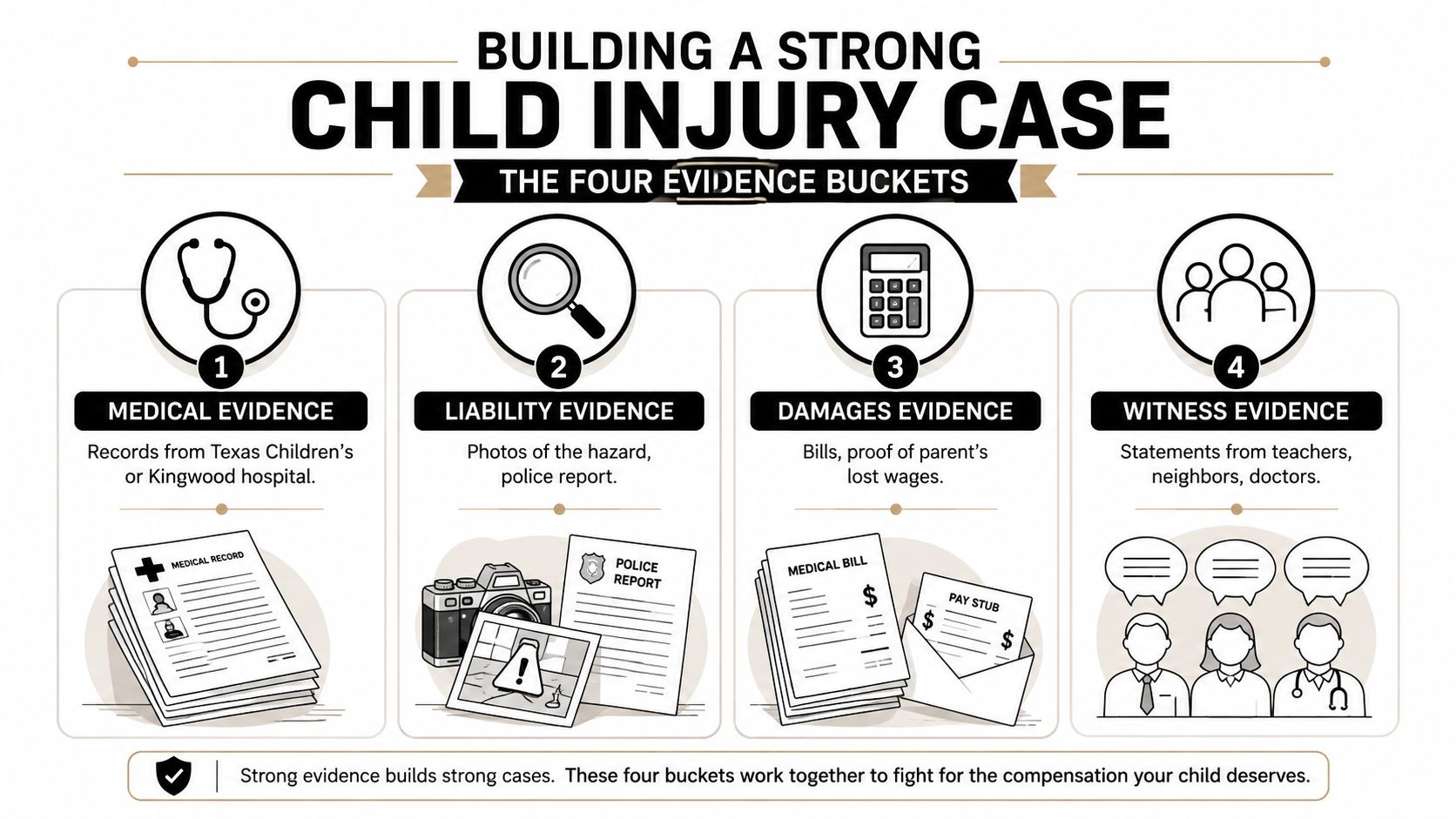
Four evidence buckets
Medical evidence comes first. Collect emergency-room records, imaging, treating-doctor statements, therapy logs, medication information, school nurse records, and follow-up recommendations. The record should show not only the diagnosis, but also pain, limitations, treatment compliance, and the child's progress.
Liability evidence explains who caused the injury and why. It may include incident reports, photographs, police records, vehicle information, product data, daycare records, safety policies, and witness statements. A Humble lawyer should send a spoliation letter when surveillance footage, vehicle black-box data, recreation-program records, or electronic files may disappear through routine retention practices.
Financial evidence supports the claim's practical value. Preserve explanations of benefits, medical bills, prescription receipts, travel records, equipment costs, and lost-wage documentation for a parent who missed work to provide care. Don't wait until settlement talks to reconstruct these expenses.
The child's voice must be handled carefully. Age-appropriate interviews, journals, school-performance records, and statements from teachers or counselors may help establish how the injury affected daily life. Repeated informal questioning can create confusion, so let trained professionals determine when and how the child should be interviewed.
The lawyer then sequences the evidence into a demand package, coordinates with treating doctors for narrative reports, and consults economists or life-care planners when future care may be necessary. That organization affects both negotiation with an adjuster and credibility before a Harris County judge or jury. A meta-analysis of 21 studies found that, among cases carried forward without dismissal, plea rates averaged 82% and conviction rates 94%, while earlier stages showed substantial variation. The practical lesson is clear: early documentation can matter before a case ever reaches trial. The study's findings support early attention to evidentiary strength rather than relying only on courtroom outcomes.
Choosing the Right Injury to a Child Lawyer in Humble TX
Don't hire a lawyer because a website uses the phrase “child injury.” Ask how the lawyer will separate the civil claim from any criminal or CPS issue, who will work on the file, and how the firm will protect your child from unnecessary disruption.
Start with at least three free consultations. Verify each lawyer's Texas State Bar licensure, disciplinary history, and J.D. degree. Then ask direct questions:
- How many child-injury claims have you handled in Harris County?
- Who will work on the file day to day?
- Do you refer serious cases to outside counsel, and on what terms?
- What's your fee structure and case-cost policy?
- What timeline is realistic for investigation, negotiation, mediation, and litigation?
- Which doctors, economists, or other experts may be involved?
- Will you address health-insurance and Medicaid liens?
A good answer should be specific without promising an outcome. Be cautious if the lawyer can't explain the legal track, refuses to identify the person responsible for the file, or pushes you to settle before your child's medical picture is clear.
| Question to Ask | Good Answer Signals | Red Flags |
|---|---|---|
| Who handles the file? | Clear attorney and staff roles | No identifiable day-to-day contact |
| How are costs handled? | Written explanation of fees and expenses | Vague or rushed answers |
| What evidence matters? | Medical, liability, witness, and damages plan | Immediate focus on settlement |
| Will CPS or criminal issues affect the case? | Separate counsel and coordinated strategy | Treating every issue as one lawsuit |
| How are liens addressed? | Discussion of insurer and Medicaid claims | No plan for repayment obligations |
High-volume settlement practices may prioritize quick file turnover. A family-law-rooted firm may offer a different perspective when custody, CPS, or a parent-versus-parent allegation affects the injury claim. Before choosing, families can also review general discussion about increasing case signings in personal-injury practices to understand why intake promises shouldn't substitute for a case-specific plan.
The Law Office of Bryan Fagan's Humble office handles family-law and criminal-defense concerns alongside legal issues affecting local families. In a consultation, the conversation should identify the responsible party, preserve urgent evidence, address immediate child-safety concerns, and determine whether separate civil, criminal, or CPS representation is needed.
Damages, Settlements, and What to Expect
A child-injury claim isn't valued by the label on the incident report. It's valued by the documented harm, the responsible party's legal exposure, available insurance, and the child's medical outlook.
What a civil claim may address
Economic damages can include past and future medical treatment, therapy, prescriptions, medical equipment, transportation, a parent's lost wages while providing care, and diminished future earning capacity. Non-economic damages may include physical pain, mental anguish, disfigurement, scarring, loss of enjoyment of childhood, and the effects of lasting limitations.
Consider two representative Humble-area situations. A backyard pool incident may raise questions about supervision, barriers, warnings, ownership, and premises liability. A rear-end collision on FM 1960 may involve driver attention, vehicle damage, emergency treatment, and insurance coverage. Similar injuries can produce different case values because the records, fault evidence, treatment duration, and future needs differ.
Texas's modified comparative-negligence rules can reduce recovery if the child is assigned part of the responsibility, subject to the governing legal analysis. Insurance limits also shape practical recovery. Commercial general-liability coverage, auto coverage, and statutory limits such as dram-shop protections can affect what money is realistically available, even when the injuries are serious.
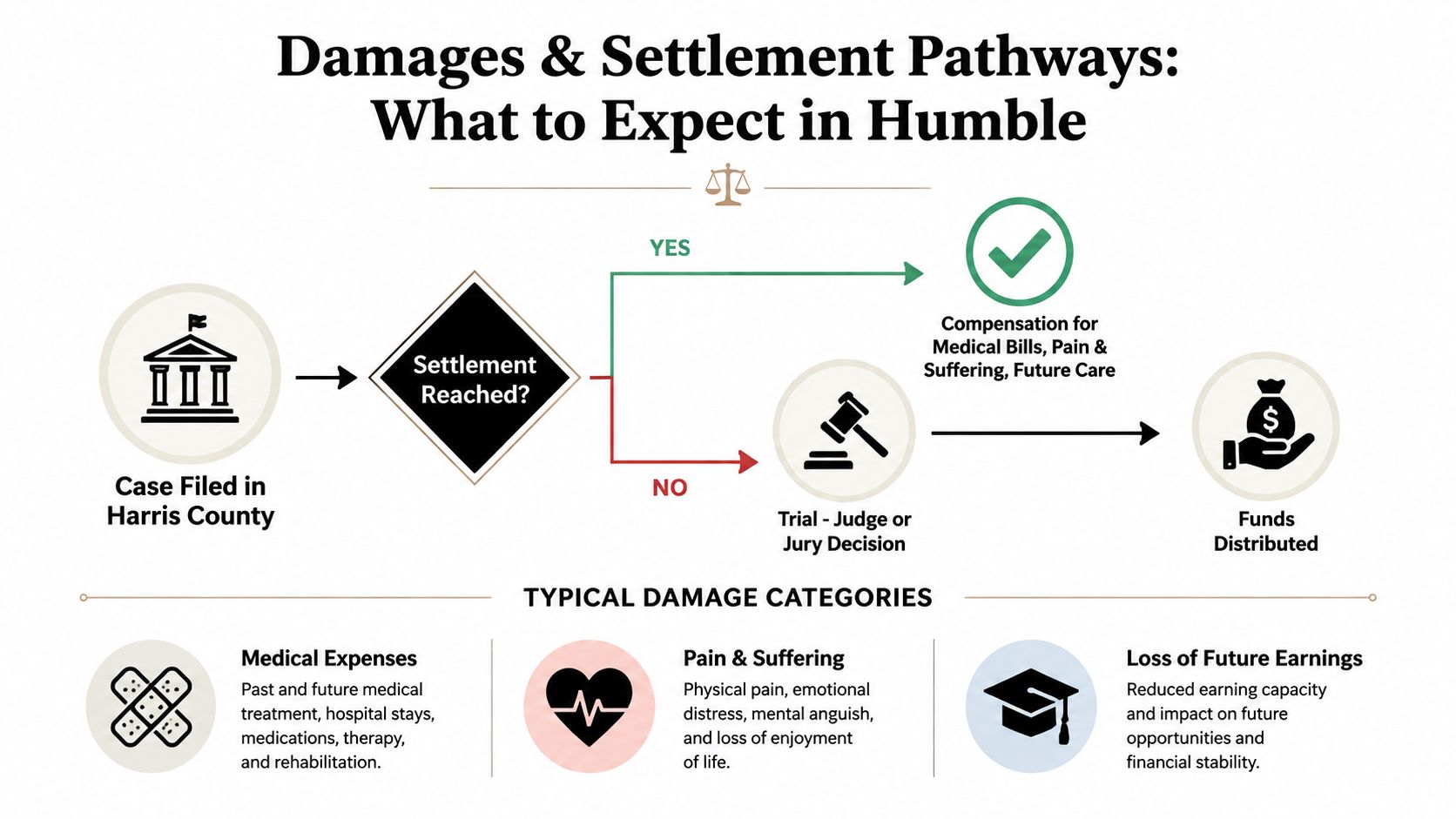
The usual path begins with investigation and a demand letter. Counsel may negotiate before filing, use mediation to resolve disputed liability or damages, and file in Harris County if talks stall. A settlement can't be evaluated properly until the lawyer understands outstanding medical balances, health-insurance reimbursement claims, Medicaid interests, and whether future treatment remains likely.
Practical rule: Don't trade a child's future medical security for a fast check.
Structured settlements may help when a child needs long-term care, but they require careful review of timing, payment design, court approval issues, and protection of the child's interests. Your lawyer should explain those choices in plain English rather than treating settlement as the finish line.
Your Next Steps After Reading This Guide
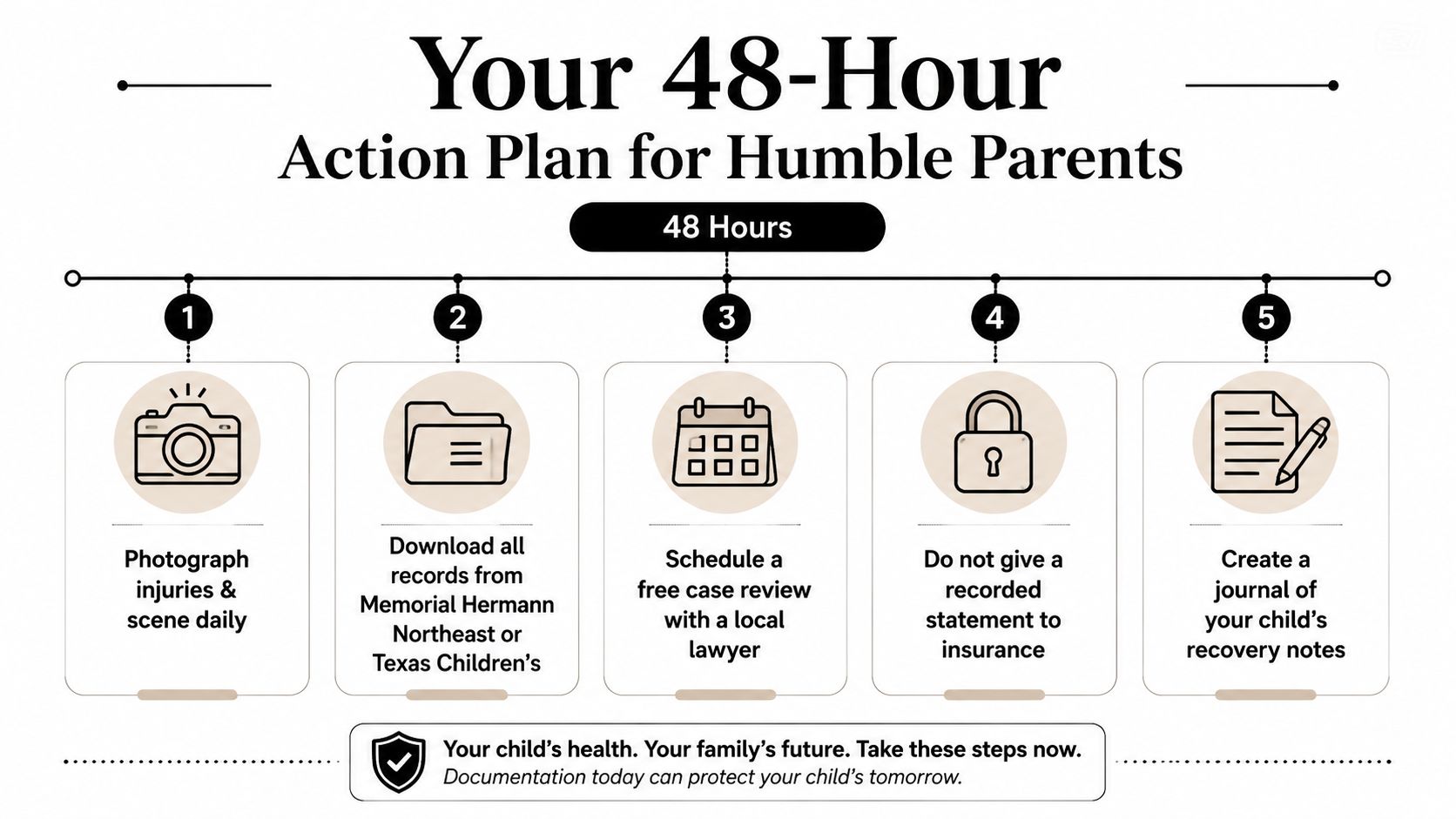
Use the next 48 hours to create order. Your child's medical care and school routine come first, and the legal claim should be built around recovery, not placed on top of it.
Your immediate action plan
- Photograph injuries and the scene. Take date-stamped photographs of visible injuries and the location involved. Continue documenting changes without repeatedly asking your child to reenact the event.
- Download the records. Request records from Memorial Hermann Northeast, Texas Children's, Kingwood Pines, or any other treating provider. Keep the full file, not only the discharge paperwork.
- Locate official numbers. Pull the police report number, CPS case number, incident number, insurance claim number, and witness contact information if any agency or insurer is involved.
- Preserve the object or location. Don't discard the vehicle, product, clothing, car seat, or damaged item. Photograph the location before repairs or cleanup.
- Avoid recorded statements. Tell the insurance carrier that counsel will respond after reviewing the request. Don't post details online.
- Schedule a free consultation. Contact a local lawyer before the civil limitations period creates a problem.
Choose the correct legal track
If a driver, property owner, manufacturer, daycare, or other third party caused the injury, you're generally looking at a civil recovery track. If a parent, stepparent, household member, or caregiver is accused under Penal Code §§ 22.01, 22.02, or 22.04, you need to address the criminal and CPS track immediately. One lawyer may coordinate the overall strategy, but the accused person's defense and the child's civil recovery are not the same representation.
Bring the medical records, photographs, receipts, insurance letters, police or CPS information, witness names, social-media posts, and your one-page timeline to the first meeting. Ask whether your child should attend. In many cases, the initial consultation can be handled with the parent or guardian first, so the lawyer can decide how to involve the child appropriately.
After retaining counsel, the first 30 days commonly focus on preservation, records, liability investigation, insurance notice, and medical coordination. Around 90 days, counsel may be evaluating a demand package, continued treatment, expert needs, or pre-suit negotiations. Around 180 days, the case may be moving toward mediation, formal litigation, or a trial setting, depending on the facts, court schedule, and medical outlook. Those are planning milestones, not promises.
If a custody or divorce order is being violated during the crisis, Enforcement of Court Orders in Humble addresses enforcement of divorce decree and custody-order provisions in Harris County.
The Law Office of Bryan Fagan offers local guidance on family-law, criminal-defense, and related legal issues affecting children and parents in Humble, Atascocita, Kingwood, and Northeast Houston. Schedule a free consultation through the Law Office of Bryan Fagan to preserve evidence, identify the correct legal track, and protect your child's interests before a deadline or recorded statement creates a bigger problem.