Skip to content

You're sitting in an emergency room after a wreck on Beltway 8, trying to remember whether you took pictures before the tow truck arrived. Your neck is tightening, the other driver's insurer is calling, and nobody has explained which deadline applies to your claim. If you live in Humble, Atascocita, Kingwood, or Northeast Houston, the first decisions you make can protect your health and preserve evidence that may later determine whether the insurer treats your case seriously.
A personal injury lawyer in Humble, TX should do more than repeat the standard two-year deadline. Government vehicles, uninsured or underinsured drivers, rideshare policies, disputed fault, and early medical gaps can create shorter or more complicated timelines. The practical rule is simple: get medical care, preserve evidence, and obtain legal guidance before an adjuster or deadline controls the situation.
What to Do Right After an Injury in Humble TX
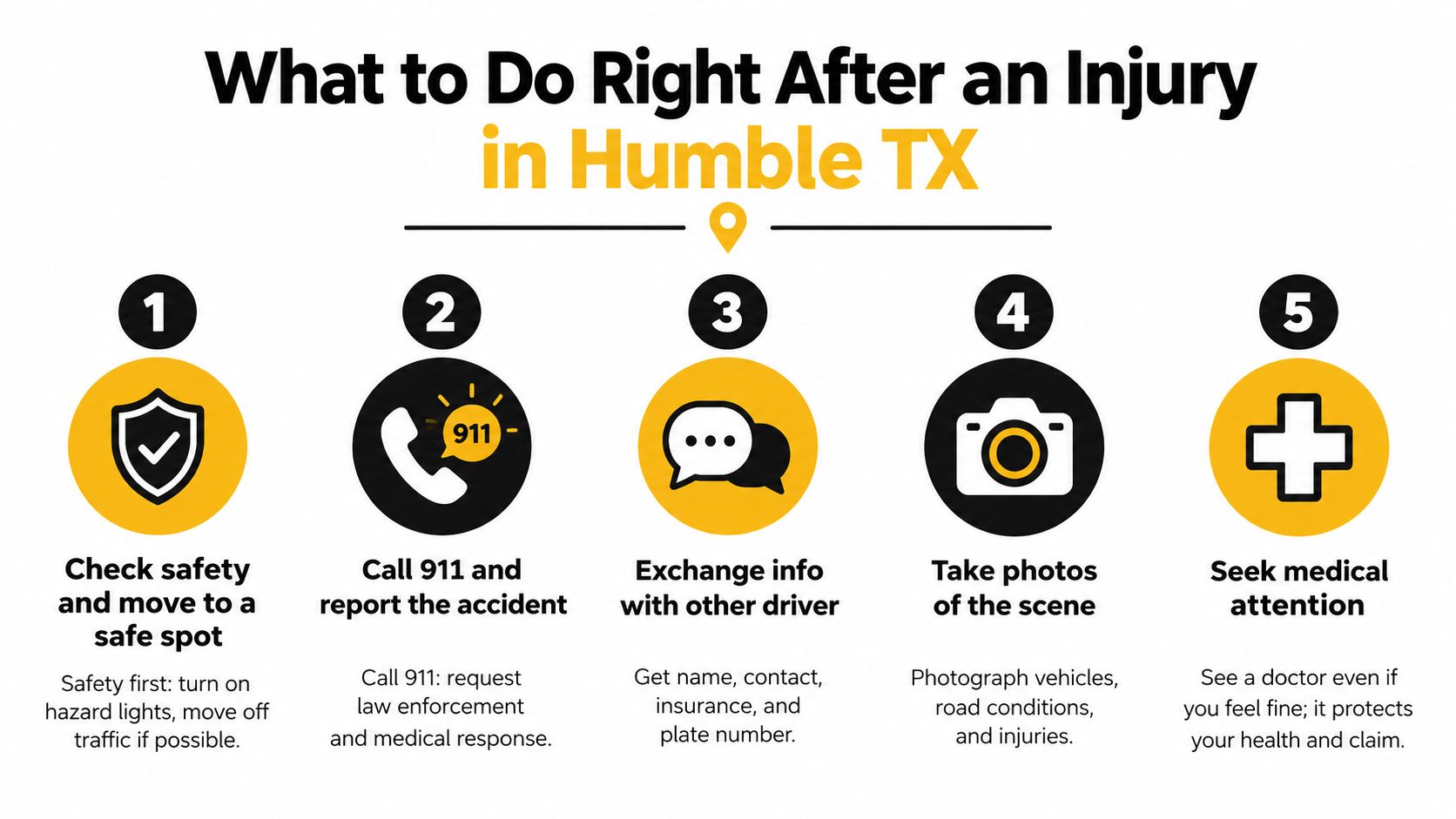
The first twenty-four hours after a crash are messy. You may be standing near FM 1960 or Will Clayton Parkway with traffic moving around you, while your children are frightened and your body is still running on adrenaline. Start with safety. Turn on hazard lights, move away from traffic if you can do so safely, and request medical help if anyone may be injured.
Call 911 and ask for law enforcement. Depending on the location, the responding agency may be Humble Police Department or the Harris County Sheriff's Office. Tell the officer exactly where you hurt, even if the pain seems manageable. A crash report should record the incident, but it won't replace medical documentation, and you shouldn't minimize symptoms because they began gradually.
Protect your health and your statements
Exchange names, contact details, insurance information, and plate numbers. Photograph the vehicles, roadway, traffic signals, visible injuries, and anything that may explain how the collision happened. Take those pictures before the vehicles disappear to a tow yard if it's safe.
Don't give the other driver's insurer a recorded statement before speaking with counsel. You can provide basic notice, but an adjuster's questions may invite speculation about speed, symptoms, or fault. If you need guidance for soreness, stiffness, or other symptoms after the crash, post-accident musculoskeletal care may help you understand appropriate follow-up questions for a medical provider.
Practical rule: Tell your doctor what hurts, follow the recommended care, and keep every appointment or cancellation explanation.
Make two calls after the immediate emergency is handled. First, contact a personal injury lawyer in Humble, TX. Second, notify your own auto insurer and ask about opening any available medical-payments or personal-injury-protection claim. That first-party claim can proceed alongside the liability claim, but your policy language controls what may be available.
If the incident involves a family-safety issue rather than the crash itself, Protective Orders in Humble addresses protective orders in domestic violence and family safety matters. For dog-related injuries, preserve photographs, medical records, and owner information before contacting a dog bite lawyer in Humble.
Evidence Worth Collecting in the First Days
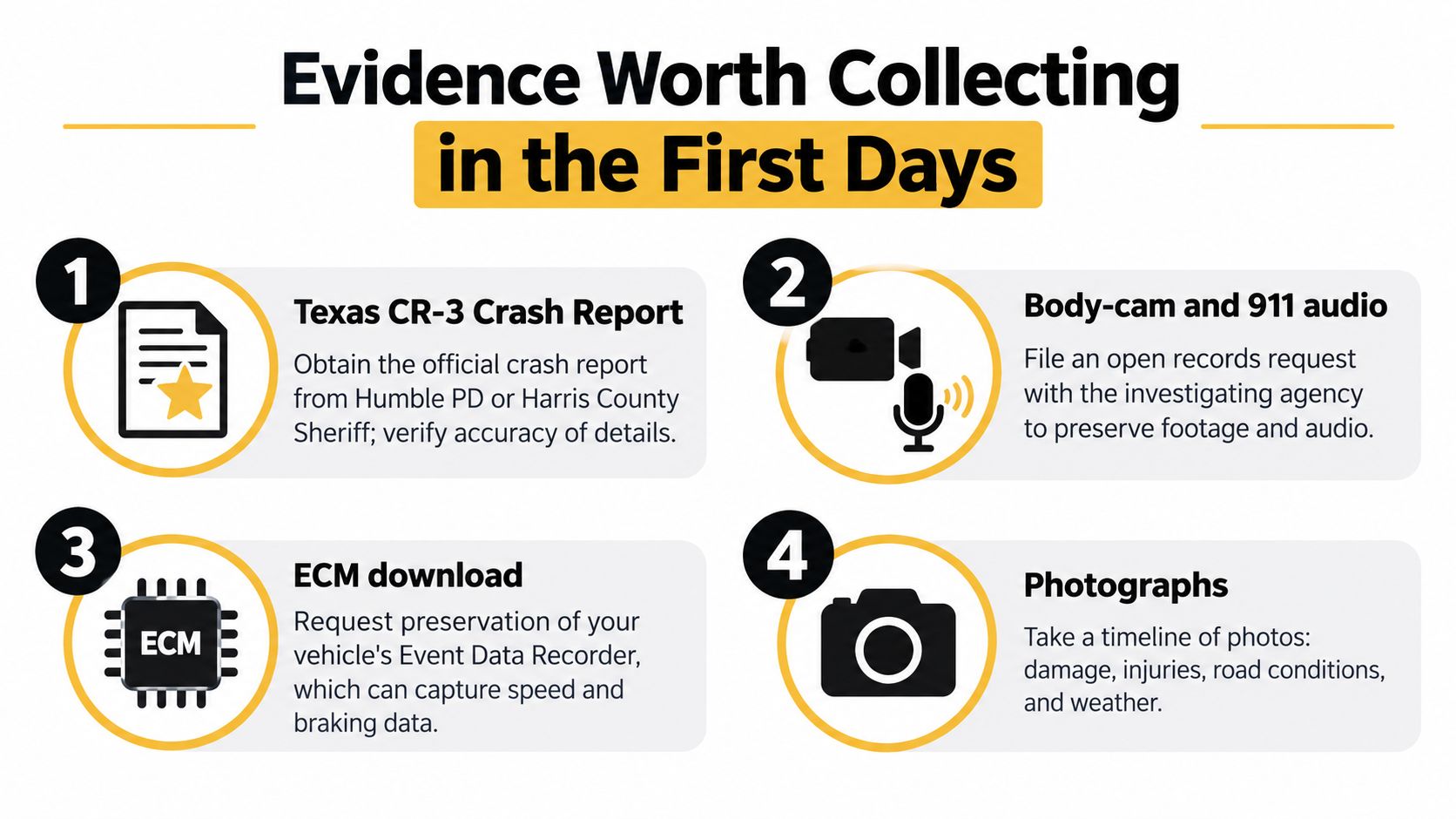
A strong injury claim needs records that answer four questions: how the crash happened, who caused it, what injuries followed, and how those injuries changed daily life. Start collecting before memories fade and before video systems overwrite footage.
Request the Texas CR-3 crash report from the investigating agency. Check the location, vehicle movements, citations, and injury descriptions for errors. If the Humble Police Department or Harris County Sheriff investigated, ask how to request body-camera footage and 911 audio through the agency's open-records process. Those materials may preserve witness statements and officers' observations that later become disputed.
Preserve evidence other people control
Commercial vehicles may contain an event data recorder, sometimes called an ECM or EDR. Send a preservation request promptly, instructing the carrier not to overwrite or destroy relevant data. Make the same request for dashcam footage, Ring doorbell recordings, nearby business video, and intersection footage connected to TxDOT or METRO. Waiting can erase the clearest proof.
Photograph skid marks, debris, vehicle damage, road defects, and weather conditions. Add a reference object or measurements when possible. Record witness names and phone numbers, rather than relying only on social-media profiles.
Your medical file must connect the injury to the collision without unexplained gaps. Keep complete records, imaging reports, prescriptions, referrals, and billing statements. Maintain a mileage log for treatment visits. Save pay stubs, employer letters, and other wage records showing time missed from work.
Give these materials to your lawyer early. They may become part of a demand, discovery response, deposition, or trial exhibit in a Harris County injury case. Organized records also matter in unrelated legal disputes, including grandparents' custody and visitation rights, as reflected in Grandparents' Rights in Humble. The subject changes, but the recordkeeping lesson remains the same.
Texas Deadlines That Actually Govern Your Case
The familiar rule is that most Texas personal injury claims must be filed within two years, under Texas Civil Practice and Remedies Code § 16.003. Wrongful-death claims also generally use a two-year limitations period. That rule matters, but it's not the first deadline in every Humble-area case.
A government defendant can change the timetable. The verified Texas guidance identifies a six-month notice deadline for claims involving a government defendant. That can matter when a city vehicle, METRO vehicle, or TxDOT vehicle is involved. Claims against Harris County may carry a separate one-year deadline, so you shouldn't assume the ordinary limitations period applies.
UM/UIM claims create another trap. Notice and cooperation requirements under your own policy may arise much earlier than the deadline to file a lawsuit. A demand, proof-of-loss requirement, or policy-specific notice provision can affect coverage even when the underlying negligence claim remains timely. Read the declarations page and the full policy, not just the insurance card.
| Case Type | Filing Deadline | Notice Trap | Statute / Source |
|---|---|---|---|
| Most personal injury claims | Two years | Earlier insurer notice may apply | Texas limitations statute |
| Wrongful death | Generally two years | Estate and beneficiary facts require prompt review | Humble wrongful-death lawyer |
| Government defendant | May be shorter than the ordinary period | Six-month notice requirement can apply | Texas Tort Claims Act guidance |
| Harris County defendant | One-year deadline may apply | Government notice rules still need review | County-specific legal review |
| UM/UIM recovery | Policy and lawsuit deadlines may differ | Prompt insurer notice, cooperation, and proof-of-loss terms | Your auto policy |
Deadline warning: Don't wait until month twenty-three to call counsel. By then, video may be gone, witnesses may be unreachable, and a notice deadline may already have expired.
For a plain-language explanation of why statute of limitations matters legally, use the concept as a starting point, not a substitute for reviewing the accident facts and insurance policy. The right first question is not merely, “When does the two-year period end?” It's, “What is the earliest deadline that could affect this recovery?”
How Local Injury Claims Resolve in Practice
Most Humble injury claims don't follow the same path. A clear rear-end collision with prompt treatment may resolve through direct negotiations. A commercial-vehicle collision with contested fault may require suit, depositions, expert work, and a trial setting in Harris County.
The first path is direct settlement with the at-fault carrier. Counsel prepares a demand package containing liability proof, medical records, bills, wage documentation, and a description of ongoing effects. This route can be efficient when the insurer accepts responsibility and the available coverage is adequate, but a quick offer isn't automatically a fair offer.
The second path is pre-suit negotiation or mediation. A lawyer may use a structured demand, conference, or mediation to pressure the carrier without immediately committing the client to full litigation. Mediation can help when both sides understand the evidence but disagree about value or fault. It's less useful when the insurer hasn't obtained the necessary records or is relying on an incomplete account.
The third path is filing in Harris County district court. The 269th or 270th District Court may become relevant depending on assignment and venue. Local docket conditions, discovery requirements, the assigned judge, and counsel's familiarity with Humble-area juries can shape strategy. A case that settles after filing may still benefit from the pressure created by prepared pleadings and enforceable litigation deadlines.
| Path | Typical Timeline | Best Fit Cases | Key Local Factor |
|---|---|---|---|
| Direct carrier settlement | Often shorter than litigation | Clear liability and documented treatment | Adjuster evaluation of Humble-area evidence |
| Pre-suit negotiation or mediation | Depends on records and negotiations | Disputes that may resolve without a full lawsuit | Counsel's preparation and Harris County familiarity |
| Harris County lawsuit | Routine cases may take 6 to 12 months; disputed-fault or commercial cases may run 18 to 30 months if suit is filed | Serious injuries, inadequate offers, contested liability | District-court docket, discovery, mediation, and trial setting |
A settlement-driven system rewards early preparation. One independent summary places approximately 90% to 95% of personal injury cases in settlement before trial, while approximately 4% to 5% reach a verdict (settlement and trial overview). Those figures don't promise a result, but they explain why liability and damages evidence should be assembled before negotiations begin.
For injuries caused by unsafe property conditions, the analysis changes. A premises liability lawyer in Humble can examine notice, ownership, control, warnings, and the condition that caused the injury.
Choosing a Personal Injury Lawyer in Humble TX
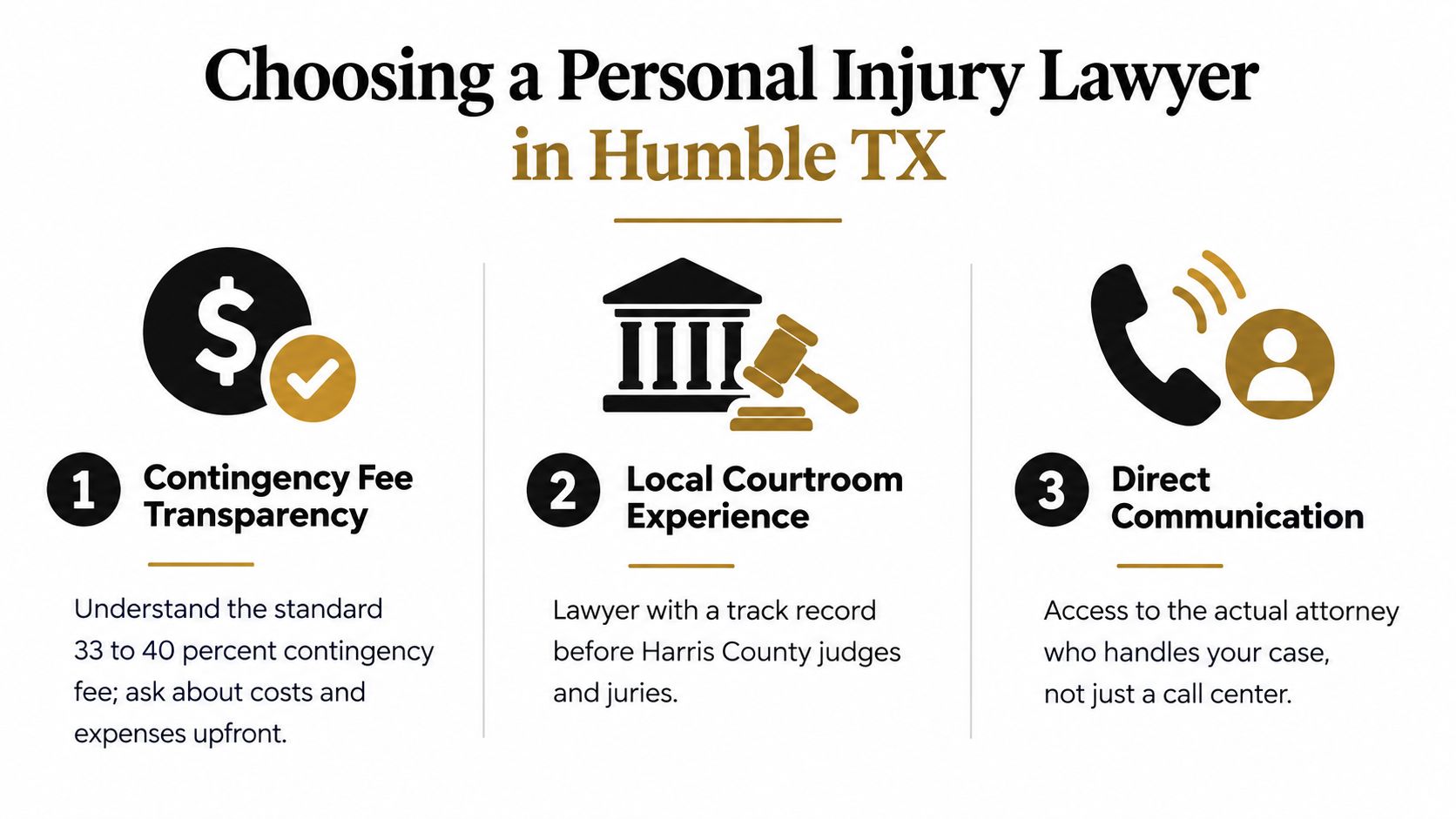
A billboard isn't a litigation plan. When you interview a personal injury lawyer in Humble, focus on three signals: fee transparency, communication, and trial readiness.
Texas contingency-fee arrangements commonly fall between 33.33% and 40% of the recovery, and some agreements increase the fee after litigation begins (Texas contingency-fee guidance). Ask whether the agreement states the percentage before and after filing, who pays case expenses, how costs are reimbursed, and what happens if there's no recovery. You should understand the contract before signing it.
Communication is part of case value
Your attorney doesn't need to call every hour. You do need a reliable system. Ask whether you'll have a named paralegal, a secure client portal, regular status updates, and a direct process for urgent questions. Missed medical information, unanswered settlement questions, or an unreported change in employment can weaken a claim.
Trial readiness matters even when settlement is the likely outcome. Ask whether the lawyer has handled civil litigation in Harris County, understands district-court procedure, and is prepared to present your case before a local jury if the carrier refuses a fair resolution. Don't accept vague statements about courtroom experience. Ask for a clear description of the lawyer's role in comparable litigation.
Bring these questions to a free consultation:
- Who handles my file? Identify the attorney and the team member responsible for daily communication.
- What deadlines apply? Ask specifically about government notice, UM/UIM notice, and policy proof-of-loss requirements.
- What evidence is missing? Request an honest assessment of reports, video, witnesses, medical records, and wage proof.
- What can reduce value? Discuss comparative fault, treatment gaps, prior injuries, and disputed causation.
- What happens next? Ask for the expected negotiation, mediation, filing, discovery, and trial decision points.
The Law Office of Bryan Fagan is one local option for residents seeking legal services in Humble, Atascocita, Kingwood, and Northeast Houston. Its broader practice includes family law, criminal defense, estate planning, wills, trusts, and probate, so ask directly whether the office is the right fit for your injury matter.
Building a Claim That Holds Its Value
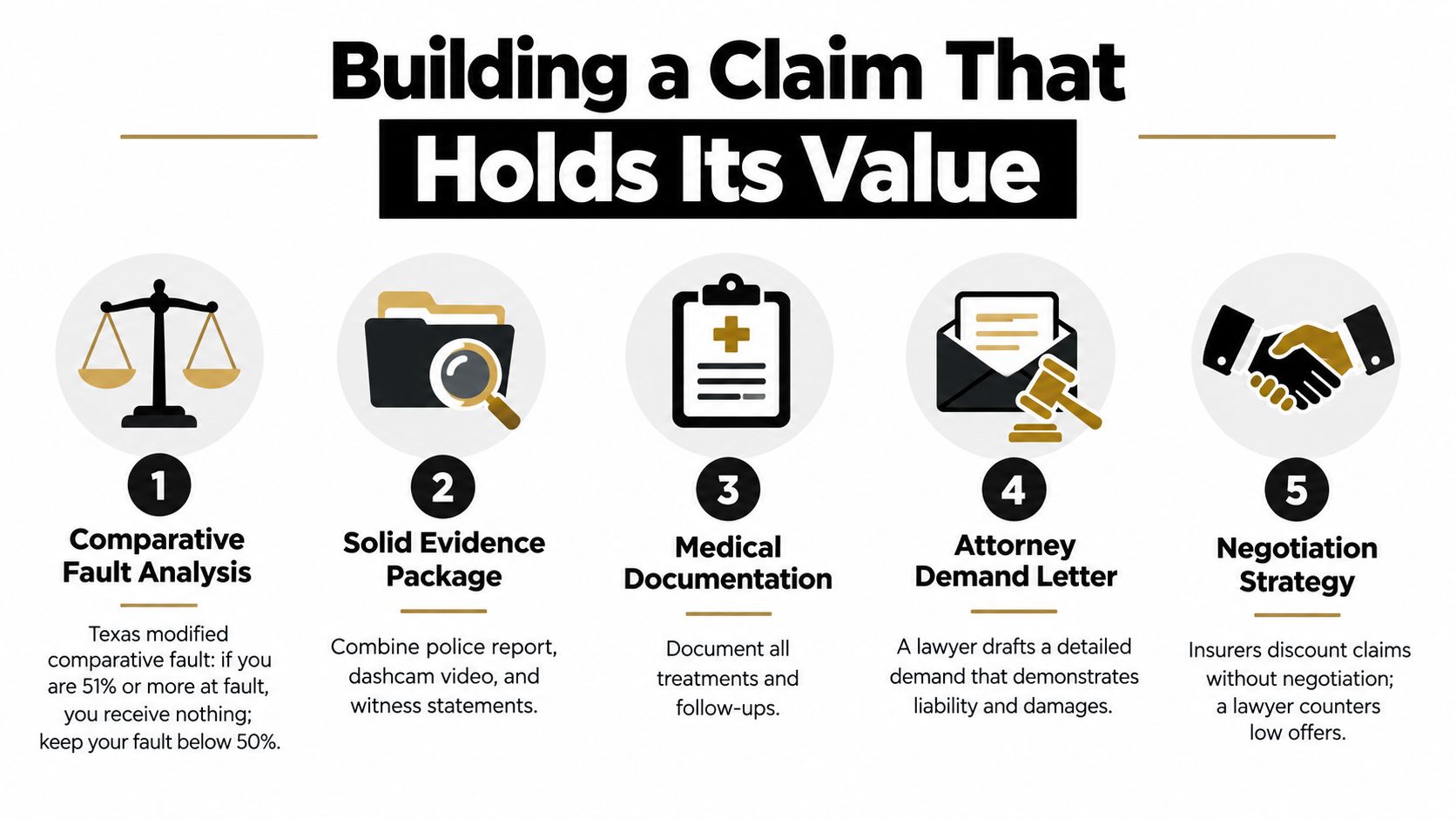
Texas uses modified comparative fault with a 51% bar. Your recovery can be reduced by your assigned share of fault, and you can be barred from recovery if you're 51% or more responsible (Texas comparative-fault resource). That rule makes early proof of lane position, signals, speed, road conditions, and witness observations especially important on Beltway 8 and FM 1960.
A durable claim has two tracks. The liability track shows why the other person or entity caused the event. The damages track shows what the injury required, what it cost, how it affected work and home life, and what care may be needed later. Insurers look for inconsistencies between those tracks, such as delayed treatment, changing symptom descriptions, or missing wage verification.
Assemble the file before the consultation
Create one folder, digital or physical, with:
- A written timeline: Record the collision, symptoms, medical visits, conversations with insurers, missed work, and changes in daily activities.
- Every image and recording: Keep original photographs, dashcam files, text messages, and witness details.
- Medical documentation: Include provider names, imaging, prescriptions, referrals, bills, and follow-up instructions.
- Work-loss proof: Gather pay stubs, employer letters, schedules, and records of reduced duties.
- Insurance documents: Bring your declarations page, policy numbers, claim correspondence, and any settlement offer.
A demand package should bring those materials together rather than listing medical bills. It should address liability, comparative fault, treatment chronology, lost income, future care, and the policy available for recovery. When the evidence supports it, counsel may also evaluate whether a policy-limits demand is appropriate.
The practical standard: Don't ask an insurer to value an injury from a stack of bills. Give it a coherent record showing cause, treatment, impact, and future consequences.
Your Next Steps and Where to Get Local Help
Use the next thirty days to turn a confusing claim into an organized file. You don't need to solve the entire case yourself, but you do need to keep evidence and deadlines from slipping away.
Days one through three
Confirm your medical follow-up and follow the provider's instructions. Notify the relevant insurers, including your own carrier, but don't provide a recorded statement or sign a broad release before obtaining legal advice. Save every letter, email, text, claim number, and voicemail.
Week one
Finish the evidence sweep. Request the crash report, ask the investigating agency about body-camera and 911 records, identify nearby cameras, preserve dashcam or Ring footage, photograph vehicle damage and road conditions, and collect witness information. Ask commercial carriers to preserve vehicle data if a commercial vehicle was involved.
Week two
Interview two or three Humble-area attorneys. Compare contingency agreements, communication systems, local litigation experience, and the lawyer's answers about deadlines. A free consultation should leave you with a clearer understanding of the next procedural step, not pressure to sign immediately.
Weeks three and four
If the fit is right, sign the contingency agreement and authorize records requests. Make sure the agreement explains fees, costs, case responsibility, communication, and what happens if the matter proceeds into litigation.
Bring these documents to your first meeting:
- Police or crash report
- Auto insurance declarations page
- Health insurance cards
- Medical records and bills
- Employer wage letters or pay documentation
- Written accident and treatment timeline
- Photos, videos, and witness contact information
- Letters or recorded-statement requests from insurers
Residents of Humble, Atascocita, Kingwood, and Northeast Houston deserve a direct answer about the deadlines, available coverage, evidence gaps, and realistic resolution path. Contact the Humble office, schedule a free case review, and get that assessment before signing anything or accepting a settlement.
The Law Office of Bryan Fagan offers local legal consultations for Humble-area residents who need clear guidance after an injury and help evaluating deadlines, insurance issues, and evidence. Visit Law Office of Bryan Fagan to schedule a free consultation with the Humble office and discuss your next step.