Skip to content

You're sitting at the kitchen table in Humble, looking at a divorce decree that says your retirement gets divided, but nobody has told you when the money moves. That's where people get burned in Harris County. The decree may say you're entitled to a share of a 401(k), pension, or 403(b), but the plan administrator still won't pay anything until the order is written the right way and approved the right way under federal rules. The gap between those two documents is where most delays, mistakes, and lost influence happen.
If you're dealing with qdro retirement division Humble TX, stop treating the QDRO like a formality. It's the document that turns a court's property division into an enforceable retirement division, and the U.S. Department of Labor says a retirement plan can pay someone other than the participant only if the order is qualified and identifies the participant, alternate payee, plan name, amount or percentage, and payment period or number of payments (U.S. Department of Labor QDRO guidance). If those pieces aren't there, the plan can't safely move money. If the language conflicts with the plan, the order stalls.
For families in Humble, Atascocita, Kingwood, and Northeast Houston, that implementation problem matters more than the headline number in the decree. The right QDRO has to match the divorce judgment, fit the plan's rules, and survive the administrator's review. A decree alone doesn't do that.
What a QDRO Really Does in a Texas Divorce
A QDRO, or Qualified Domestic Relations Order, is not just paperwork after divorce. It is the court order that tells a retirement plan how to pay the alternate payee without violating federal law. Under ERISA, the plan can only honor an order that is qualified, and the order has to name the participant and alternate payee, identify the plan, state the amount or percentage, and spell out the payment period or number of payments (U.S. Department of Labor QDRO publication).
Why the decree alone doesn't move money
Texas courts divide property, but the retirement plan follows its own administrator rules. That's the part people miss. The decree may say one spouse gets part of a 401(k), pension, or 403(b), but the plan won't cut a check to the former spouse just because a judge signed a divorce judgment.
Practical rule: the decree tells the spouses what they agreed to or what the judge ordered, but the QDRO tells the plan how to process it.
The U.S. Department of Labor also says a QDRO can be included in the divorce decree or issued separately, and it can cover more than one retirement plan if each plan is clearly identified (U.S. Department of Labor QDRO publication). That matters in Humble divorces because one family may be dealing with a private 401(k) on top of a pension or a 403(b), and each account may need its own carefully drafted order.
If there's a family safety issue in the middle of the case, it's smart to pair the divorce strategy with the right protective-order work, including Protective Orders in Humble, because retirement division doesn't happen in a vacuum.
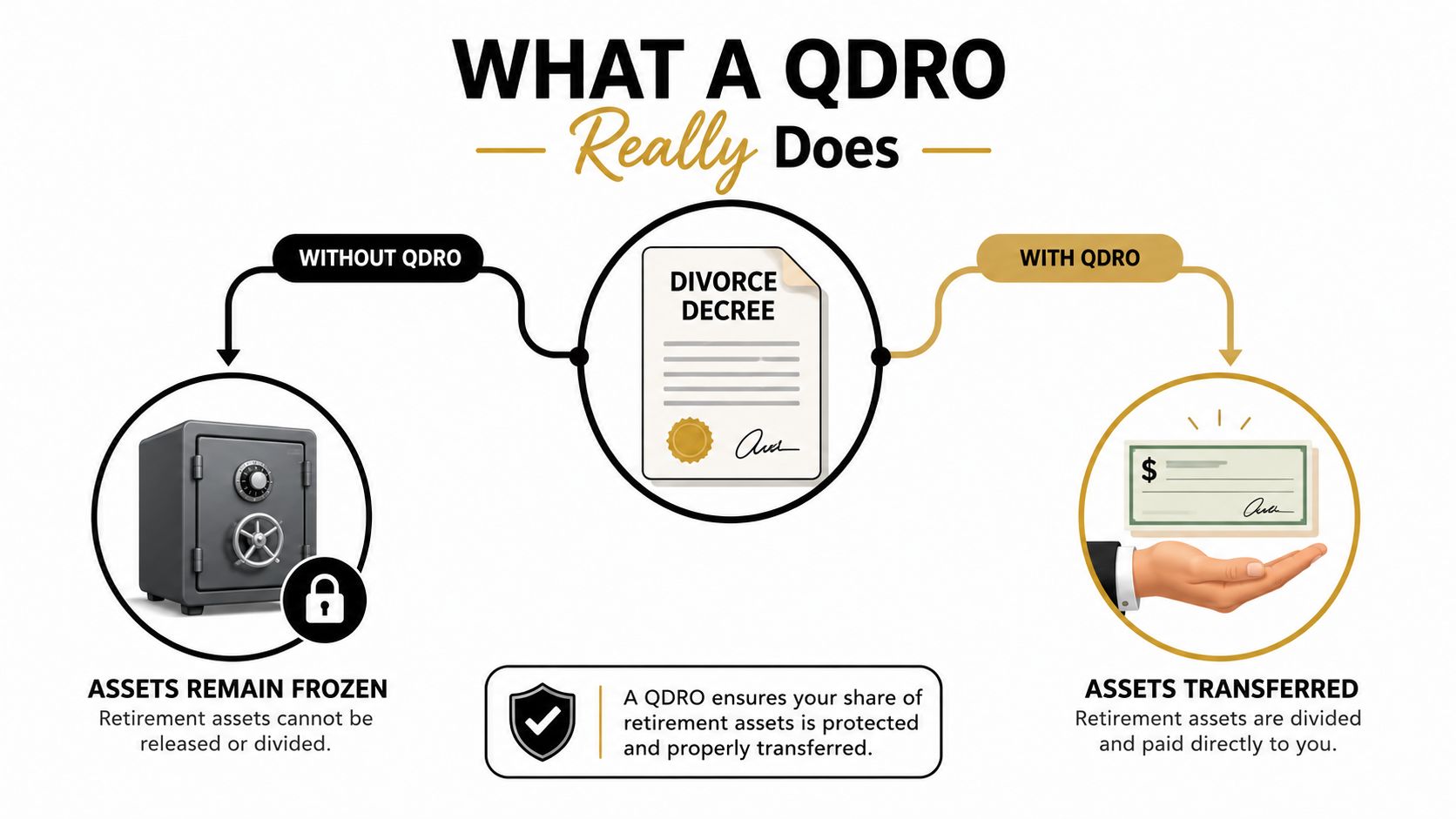
The cleanest way to think about it is this. The divorce court decides the property division, but the retirement plan administrator controls distribution. Without a qualified order, the plan usually can't legally pay the alternate payee from a private-sector plan (Texas divorce retirement division guidance). That's why a decree by itself is not enough, no matter how clearly it describes the split.
How Texas Community Property Rules Treat Retirement
Texas does not treat every dollar in a retirement account the same way. Retirement earned during marriage is generally community property, while the portion built before marriage stays separate property. The Texas-focused guidance in the source material also makes the point that the marital portion must be divided in a just and right manner, not by a casual assumption that everything is automatically split down the middle (Texas retirement division guidance).
What actually gets divided
The primary question is not “Do we divide the whole account?” The central question is “What part was accumulated between the marriage date and the divorce date?” That is the marital slice. Pre-marriage contributions stay separate, and the marital portion is what the court can divide as community property under Texas rules (Texas retirement division guidance).
For a Humble couple, that distinction matters most when one spouse has been with the same employer for years. A 401(k) with a long history may contain separate and community layers. A pension may have an even more complicated service history. A 403(b) for a teacher or healthcare worker in Northeast Houston can be just as detail-heavy. If you don't trace the timeline, you'll draft the wrong order.
Gather the hire date, marriage date, separation date, and all available account statements before anyone starts drafting.
A Property Division Lawyer in Humble deals with exactly this kind of layered division in community-property cases. The right records matter more than the emotional arguments at the settlement table.
For readers comparing retirement types, a useful outside overview is the retirement account comparison guide, because the division method can change depending on whether the asset is a pension, a 401(k), or another plan type. That comparison helps people understand why one formula may work for one account and fail for another.
The short version is simple. Don't ask for “half the retirement” unless you know what the marital portion is. In Texas, the divisible piece is the marital piece, and the paper trail has to prove it.
The QDRO Process Step by Step for Humble Families
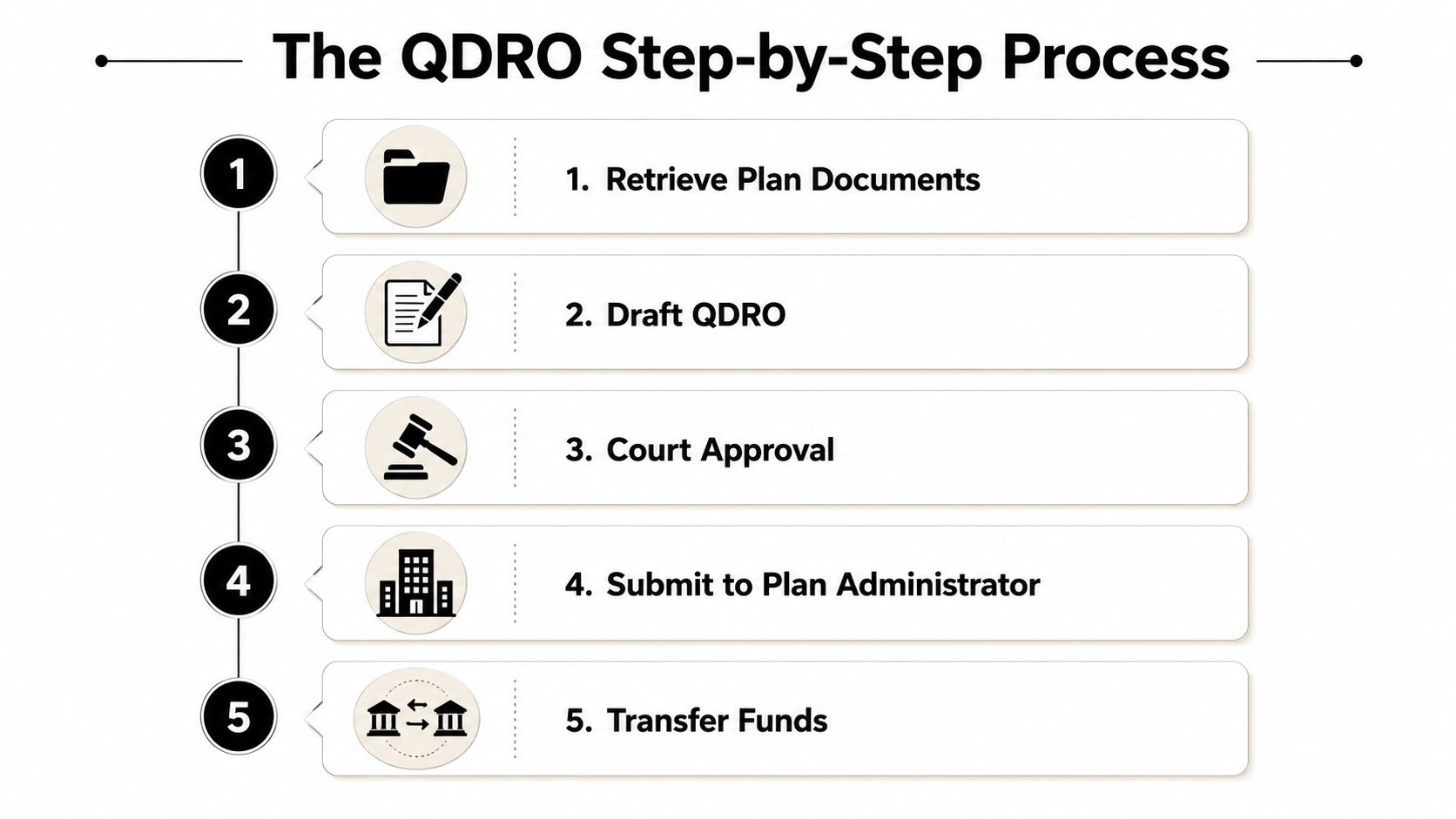
The process works best when it's handled in the right order. First, get the plan's QDRO procedures and any model form. The U.S. Department of Labor says missing required elements is a common reason for delay or rejection, so copying the plan's preferred language saves time and frustration (DOL QDRO procedures guidance).
The order that actually works
- Retrieve the plan documents. Get the QDRO procedures, summary plan language, and any model order from the administrator. That is the fastest way to avoid a rejection that should never have happened.
- Draft the domestic relations order. Make it match the divorce decree exactly. If the decree and the QDRO fight each other, the plan administrator sees the mismatch immediately.
- Submit for pre-qualification review. The Department of Labor recommends having the administrator review the draft before the final order is entered, because that catches problems early (DOL QDRO procedures guidance).
- Get the judge's signature. The order has to be signed and dated by the judge, then certified. Texas Law Help says parties can return to court later if they didn't get a QDRO signed when the decree was entered, but that's the backup plan, not the plan (Texas Law Help QDRO article).
- Deliver the certified order to the plan. The administrator needs the certified final paperwork before distribution can happen.
A short video on the mechanics can help if you're trying to visualize the workflow before a consultation:
The practical lesson is that you don't wait until after the divorce is “done” to think about the QDRO. You build it into the process early. If you also need a broader retirement review, the firm's Dividing Retirement Accounts in Divorce page is a direct place to start. For clients who also want to think ahead about beneficiaries and inherited assets, estate planning by Allied Tax Advisors is a useful side read because retirement division and rollover treatment often get confused.
If your family's long-term planning is still in flux, a good Estate Planning Attorney in Humble can help you separate divorce issues from future beneficiary planning so the same mistake doesn't show up twice.
Public Plans Versus Private Plans in the Humble Area
Here's where many people get tripped up. A private ERISA plan, like a 401(k) or 403(b), does not behave the same way as a Texas public retirement system. The plan rules change the drafting rules, the distribution mechanics, and sometimes even what the order can accomplish. In a real Humble case, that means the spouse at a private company, the spouse at a school district, and the spouse with a state plan may all need different paperwork.
One case, three plan types
Consider a family in Atascocita with two retirement accounts on the table. One spouse has a private 401(k), one has a pension through a public employer, and the decree tries to use the same formula for both. That's where trouble starts. The Texas-focused guidance notes that each covered plan may require a separate order, and Texas public-plan models often require either a marital-service fraction or a fixed percentage (Pension Rights QDRO resource).
The same source also warns that some plans require the award to be less than 100% and to specify exactly how benefits are calculated (Pension Rights QDRO resource). If the formula conflicts with the plan's administration rules, the order can sit unenforced until someone fixes it.
That distinction matters even more with Texas public retirement systems. ERS says payments to someone other than the member or designated beneficiary are allowed only for family-relationship changes like divorce or child support, not for other reasons, and it requires a photocopy of the divorce decree plus the original certified QDRO for review and approval (ERS QDRO FAQ). That is a document-driven process, not a casual request.
Bottom line: if the plan is public, private, or a mix of both, draft for the administrator who will actually process it, not for the spouse who wants a fast settlement.
For clients sorting pension issues against other savings vehicles, a plain-English retirement account comparison guide helps frame the differences before you sign. I'd rather see a client slow down for one week than spend months fixing a formula that never fit the plan in the first place.
Common Pitfalls That Cost Humble Clients Money
The most expensive mistake is pretending the QDRO can be generic. It can't. A retirement order has to fit the plan, fit the decree, and fit federal limits. If it doesn't, the plan administrator can reject it, delay it, or leave it unenforced until someone drafts a corrected version.
The mistakes that do the most damage
- Using an imprecise formula: A vague percentage or a sloppy marital window can conflict with the plan's own rules.
- Skipping plan-specific requirements: If the administrator has a model form or required language, ignoring it is a shortcut to rejection.
- Waiting too long to file: Delay is dangerous because the participant may retire, roll over funds, or otherwise change the account before the order is complete.
- Trying to create new benefits: The Department of Labor says a QDRO cannot require increased benefits, a form of benefit the plan does not offer, or an option the plan does not already provide (DOL QDRO limits guidance).
- Conflicting with an earlier order: A QDRO also can't force payment of benefits that another recognized QDRO already requires the plan to pay to someone else (DOL QDRO limits guidance).
The delay problem is especially common in Harris County because people assume the divorce decree is enough. Texas Law Help makes clear that a spouse can return to court later for a QDRO if it wasn't signed with the decree, and the Texas Employees Retirement System says the QDRO has to be consistent with the signed divorce decree or child support order and then signed and dated by the judge with a certified copy obtained from the county clerk (Texas Law Help QDRO article). That means the paperwork chain has to stay intact from judgment to certification to plan review.
For blended households, retirement division can also affect the way beneficiaries and estate documents should be structured later. A practical read on that issue is estate planning for blended families, because divorce settlements and future inheritance planning can collide if nobody looks ahead.
The right move is blunt. Get the plan documents, match the decree, and submit the order promptly. Anything else invites a fight you don't need.
Timeline, Costs, and Smart Questions to Ask
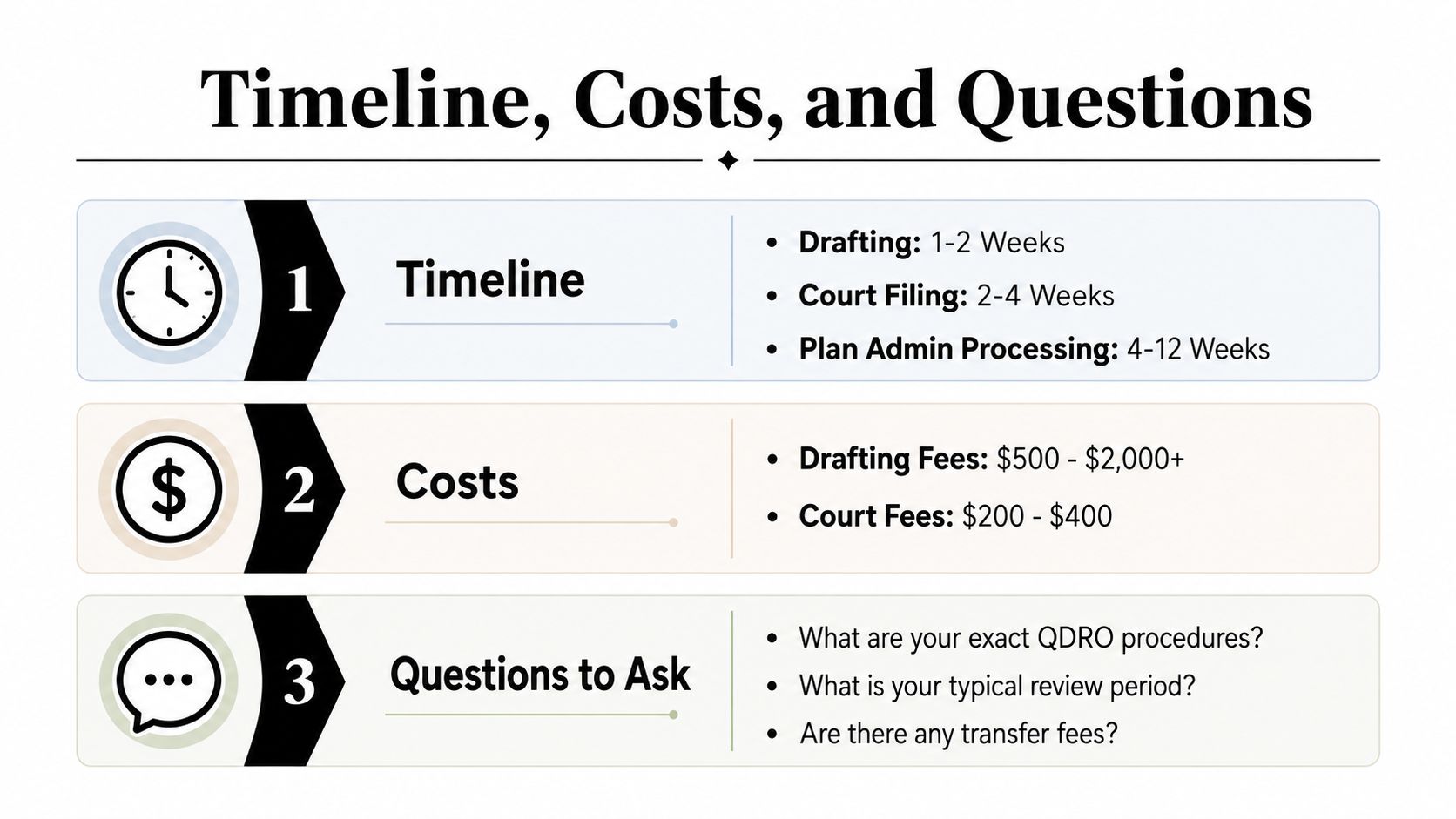
QDRO work is not free, and it isn't instant. Drafting takes time because the language has to track both the decree and the plan rules. Then the administrator reviews it, and that review can slow down if anything is unclear or inconsistent.
What to ask before you sign anything
The plan's review pace is one of the biggest variables, so ask about its QDRO procedures up front. Ask whether the account is a private ERISA plan, a public retirement plan, or a mix of both. Ask whether the administrator uses a model form, whether the award has to be a percentage or a marital-service fraction, and whether there are any qualification or transfer fees.
If the decree is already signed but the QDRO wasn't entered, Texas law still gives you a path back to court, but delay weakens your leverage and increases the chance of a plan-level problem (Texas Law Help QDRO article).
A realistic consultation should also cover timing around the participant's earliest retirement age, because the Department of Labor says payment timing depends on that age unless the plan allows earlier payment (IRS QDRO retirement topics). That's a detail people often miss when they assume a former spouse can just “get their share now.”
I'd bring three things to the first meeting, not one. Bring the most recent statements, the decree language, and the exact plan name. If you're comparing firms, the Law Office of Bryan Fagan's QDRO Attorney Humble TX page is a good place to confirm the scope of retirement-division help before you schedule a consultation.
The clean budget rule is this. Pay to draft it right the first time. Paying to fix a rejected order later is almost always the more expensive path.
Your Next Step With a Local Humble Attorney
Retirement division is usually not an entitlement problem. It's an implementation problem. The share may be written into the decree, but if the order doesn't match the plan's rules and federal requirements, the money can stay trapped in the other spouse's account for far longer than it should.
For Humble, Atascocita, Kingwood, and Northeast Houston families, the smart move is to get the decree language, the plan documents, and the QDRO draft reviewed together. If you want to understand how retirement division fits into the rest of your property case, the firm's property division retirement benefits page is a practical next stop. And if your divorce is part of a larger family transition, keep the broader picture in mind, because retirement, beneficiary designations, and future planning tend to overlap.
The Law Office of Bryan Fagan works with local families on divorce, property division, estate planning, and related family-law issues. If you're staring at a retirement account split and you want a local lawyer to check the decree against the actual plan rules, the next move is straightforward, get it reviewed before the administrator does.
If you're dealing with retirement division in a Humble divorce, the Law Office of Bryan Fagan can review your decree, plan documents, and QDRO language so you know where the money will land. Visit Law Office of Bryan Fagan to schedule a free consultation with our Humble office and get clear guidance before a preventable paperwork mistake slows everything down.