Skip to content

Your SSDI check shows up late, or it arrives smaller than you expected because child support got taken out first. Or maybe you're the parent on the other side, trying to figure out whether your ex's disability benefits can be used to help support the kids in Humble, Atascocita, Kingwood, or Northeast Houston. Either way, the confusion is usually the same, because Social Security disability and child support are tied together, but SSDI and SSI do very different things under Texas law.
That split matters in real homes all over Harris County. It can decide whether a benefit is counted as income, whether it can be garnished, and whether a disabled child's support plan needs to protect SSI and Medicaid at the same time. If you're sorting through a reduction notice, a withholding order, or a support question involving a child with special needs, a plain-English guide can save a lot of stress.
For a broader divorce perspective that connects financial decisions to everyday family planning, DeTalks' guide to divorce is a useful place to start. The key is to separate the programs first, then apply the Texas child-support rules to the right one.
What Disability and Child Support Mean for Humble Families
A Humble parent can open the mailbox and see a notice that looks like bad news at first glance. The monthly SSDI payment that was supposed to help with rent, groceries, or a car repair has been reduced because child support was intercepted. On the other side of the table, a custodial parent may be wondering whether the other parent's disability check can be counted at all, or whether a disability benefit is shielded from child support just because it comes from Social Security.
That's the kind of problem that sends families searching for answers in a hurry. The good news is that the rules aren't random, even though they can feel that way at first. In Texas, the result turns on the type of benefit, the type of support order, and whether a child has a disability that changes the support analysis.
Four questions families usually ask first
Practical rule: don't start with the diagnosis, start with the benefit type. Texas child-support law treats SSDI and SSI differently for a reason, and the label on the check matters more than the label on the condition.
This guide answers four practical questions. First, whether disability benefits count as income for child support. Second, which benefits can be garnished or intercepted. Third, how the special-needs-child tradeoff can change the math for a family. Fourth, what a Humble parent should do next, especially when a case is already moving through Harris County courts.
Texas child-support cases also don't stop at neat, textbook situations. A parent may be going through a divorce, modifying an older order, or trying to enforce support while another issue, like custody or safety, is happening at the same time. A local overview like Harris County Family Courts: A Humble Resident's Guide can help families understand how cases move through the courts serving Humble residents.
That's why this topic comes up so often in family law. A disability benefit can be a lifeline, but it can also be treated as income, affect support calculations, or create a planning problem when a child's benefits are part of the picture. Families in Humble, Atascocita, Kingwood, and Northeast Houston usually need the same thing first: a calm explanation of what the law is doing.
Understanding SSDI and SSI Before Anything Else
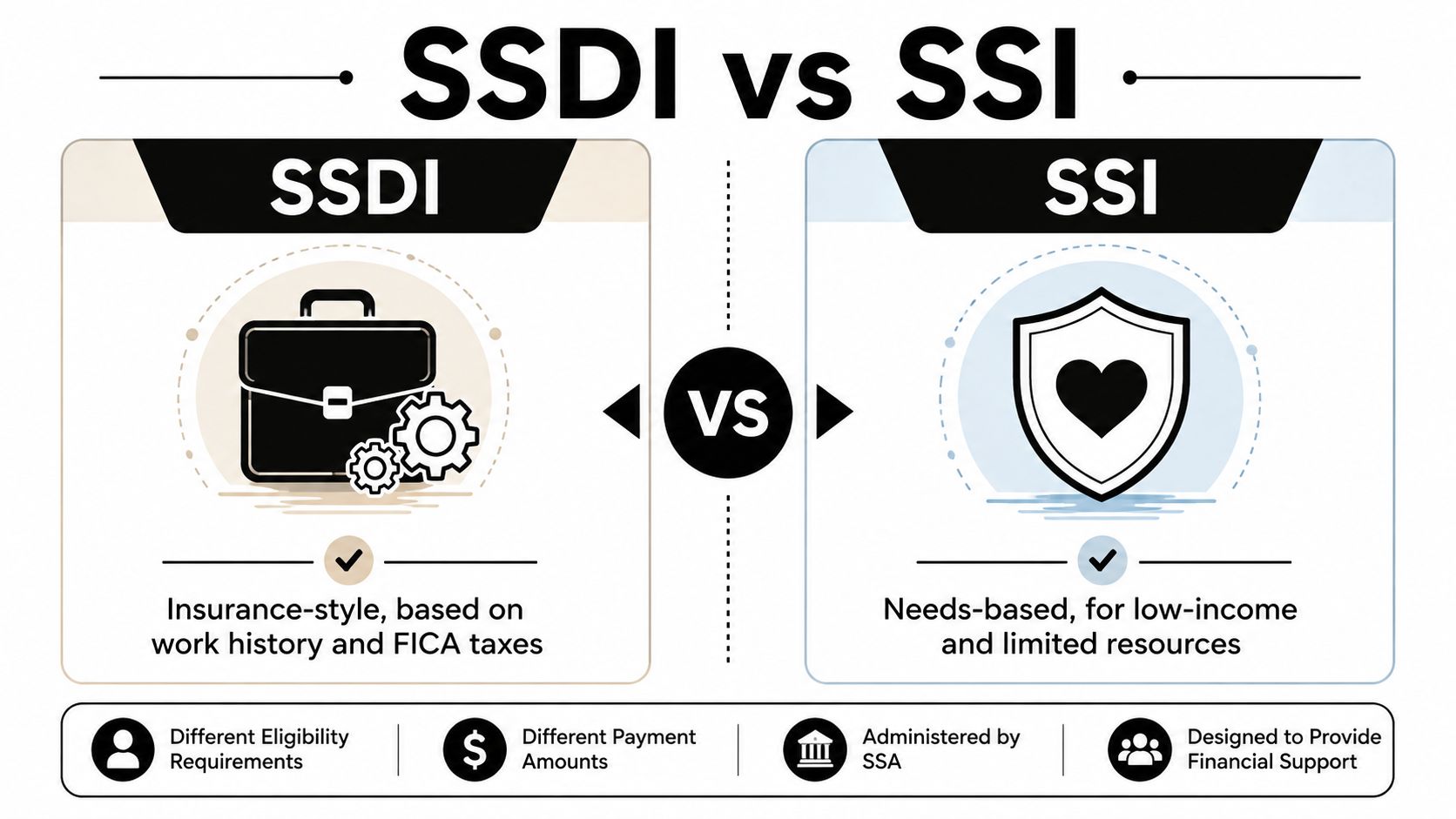
The fastest way to get lost in this area is to treat every disability check the same. SSDI and SSI are both connected to disability, but they come from different legal rules and lead to different child-support outcomes in Texas. Think of SSDI like a pension you earned through payroll taxes, while SSI works more like a safety-net cash grant for someone with limited income and resources.
Why the difference matters in family law
SSDI is insurance-style. It usually depends on work history and the payroll contributions tied to that work. SSI is needs-based, so it focuses on financial need rather than past earnings. That difference is why a Texas child-support case can treat one benefit like income and leave the other outside the calculation.
Medicare often follows SSDI over time, while SSI is tied more closely to Medicaid eligibility rules. That distinction matters in a Humble family law case because the check itself is only part of the story. The core question is whether the benefit acts like replaceable income, or whether it is a means-tested program that the law protects differently.
When a child's own benefit is involved
A separate issue comes up when the child, not the parent, receives Social Security money. Disabled-adult-child benefits, often called DAC benefits, and survivor benefits can belong to the child based on a parent's record or a deceased parent's record. Those benefits are not the same thing as a parent's own disability check, and families sometimes mix them up when they're trying to figure out support, guardianship, or post-18 planning.
The easiest way to remember it is this. Disability itself does not control the legal result. The program type does. If the payment is SSDI, Texas often treats it as income-like for child support. If the payment is SSI, the child-support result is usually very different.
How Texas Calculates Child Support From Disability Income
A Humble parent can sit at the kitchen table with a disability check in one hand and a child support order in the other, and the first question is usually simple. Does this money count, and if so, how much? Texas answers that question by looking at the benefit type, because SSDI usually counts as net resources while SSI usually does not. That difference can change whether support is owed, how much is owed, or whether the guideline calculation ends up at $0.
Texas applies guideline percentages to net monthly resources, but those percentages only matter after the court decides what counts as resources in the first place. For a parent trying to read a paycheck stub, an award letter, or a Social Security notice, that part can feel confusing. The court still looks at the same basic pieces, the parent's other income, the program involved, and whether the guideline amount should stay in place or be adjusted because the facts support a different result. For a plain-English overview of the math, see how Texas child support is calculated.
Texas Child Support Guidelines Applied to Disability Income
| Number of Children | % of Net Resources Applied | Treatment of SSDI | Treatment of SSI |
|---|---|---|---|
| One | 20% | Counted as net resources | Excluded |
| Two | 25% | Counted as net resources | Excluded |
| Three | 30% | Counted as net resources | Excluded |
| Four | 35% | Counted as net resources | Excluded |
| Five or more | 40% | Counted as net resources | Excluded |
The Texas Attorney General explains that retirement, SSDI, and survivor benefits can be garnished for child support, while SSI is treated differently. TexasLawHelp also explains that SSDI counts as income for child-support calculations, the guidelines set support at 20% for one child, 25% for two, 30% for three, 35% for four, and 40% for five or more children, and SSI-only recipients generally owe $0 under the guidelines. For families in Harris County, that split often decides the case before the argument even starts. The same disability label can produce a support order or no guideline obligation at all, depending on which federal program is paying the benefit.
Texas also works from a net-resources cap, and the Texas Attorney General's child support guidelines page explains the cap that applies to the guideline calculation. Once a parent's resources rise above that ceiling, the court does not keep adding support in the same way forever. The judge can still consider the parent's other income, the child's needs, and whether a departure from the guideline amount is justified.
A parent can still ask the court to look at special circumstances. Medical costs, other children, or a lower actual earning ability can justify a different result in some cases. A local Child Support Attorney in Humble handles establishing, modifying, and enforcing child support in Harris County, which is where these questions usually get sorted out in practice.
A support order based on disability income is still a support order. The benefit source changes the math, but it does not erase the obligation.
Texas also recognizes that support can continue past age 18 or high-school graduation when the child has a disability. That matters for families planning for adult care, not just for a birthday that changes the calendar. If the child's disability existed before adulthood and the child needs substantial care and supervision, support can stay in play beyond the usual cutoff.
Garnishment and Interception of Disability Benefits in Texas
A parent in Humble can be halfway through the month and still get blindsided by a notice that child support is being collected from a benefit check. Once a support order exists, the Texas Office of the Attorney General can pursue child support from retirement, SSDI, and survivor benefits, while SSI generally stays outside that collection process. The benefit type controls both the support math and the collection path, so the label on the award letter matters just as much as the amount.
How collection usually starts
In many cases, the collection process begins with an Income Withholding Order sent to the Social Security Administration. If the benefit can be withheld, the Social Security payment may be reduced before the recipient ever sees the full amount. The obligor then gets notice, and bank statements can show the reduction before the person has had a chance to ask what changed.
Federal limits also shape what can be taken. Disability benefits are not an unlimited target, and the collection rules cap how much may be taken depending on whether the money is being applied to current support or arrears. The Consumer Credit Protection Act also affects wage-style withholding. For a parent living on a fixed benefit, those limits can be the line between a hard month and a full cash-flow crisis.
The federal side can surprise people in another way. Tax refund intercepts through the Treasury Offset Program are a separate collection tool, and they often feel disconnected from child support until the notice arrives. Families may be thinking only about a monthly payment, then learn the system is also reaching into tax refunds.
If the case has already turned into a collection dispute, a child support enforcement attorney in Humble can help sort out whether the right benefit type was used and whether the amount being taken matches the order.

What to do when the notice arrives
Act quickly: the first letter usually matters more than the bank statement. If the amount is wrong, or the benefit type was misread, waiting only makes the correction harder.
Read the notice line by line and check three things right away. First, whether the payment is really SSDI, retirement, survivor benefits, or SSI. Second, whether the amount being collected matches the support order. Third, whether the notice is about current support, arrears, or both.
If the amount looks wrong, respond fast and keep everything in writing. Save the award letter, the notice, and the support order together. A mistake about benefit type can lead to an incorrect withholding amount, and those errors are much easier to challenge early than after several months of deductions.
For some parents, the same case may also involve safety concerns, especially when child support and domestic conflict are happening at the same time. A resource like Protective Orders in Humble can matter when the larger family situation includes domestic violence or safety planning.
Some parents also use benefit planning sources, such as ADHD supplements for kids, while they are trying to understand what support collections mean for a child's day-to-day care budget.
When the Child Has a Disability and Support Affects Their Benefits
A parent in Northeast Houston may be weighing a painful tradeoff. More child support would help with groceries, therapies, gas, or medical copays, but that extra support could also reduce or eliminate a disabled child's SSI and affect Medicaid-linked planning. That is not just a billing question. It's a benefits question, a care question, and often a long-term family planning question all at once.
A familiar kind of family decision
A mother in Humble may be supporting a teenager who has needed substantial care for years. The child's benefits are already stretched thin, and the family is trying to decide whether to ask for a support increase before adulthood or keep things stable to avoid upsetting the benefits the child already receives. That choice can feel like choosing between cash now and support later, and there's no one-size-fits-all answer.
Federal SSA policy says child support affects SSI after exclusions. For minors, one-third may be excluded, which means the support payment still counts in the SSI world after that exclusion is applied. In plain English, more support can mean less SSI. For some families, that matters just as much as the dollar amount on the support order.
Texas law also allows child support to continue past age 18 when the child's disability existed before 18 and the child requires substantial care and supervision. That's why a special-needs support plan often has to work with the child's long-term benefit structure, not against it. If the child is expected to rely on needs-based benefits, even a well-meant support increase can produce an unwanted side effect.
Families often miss the planning piece and focus only on the immediate support number. That can backfire. The better approach is to coordinate support strategy with a special-needs planning attorney before agreeing to numbers that could change the child's eligibility picture. A resource like special-needs trust in Texas is often part of that conversation when families are trying to preserve public benefits for a child with long-term needs.
Some parents also look for practical background on day-to-day care decisions, including therapies and child support budgeting. A separate article such as ADHD supplements for kids can be helpful context for families thinking through care costs, but the legal question stays the same, public-benefit rules and support rules have to fit together.
The takeaway is simple. For a disabled child, support isn't only about how much arrives this month. It's about whether that money helps without pushing the child out of a program the family depends on.
Local Steps for Humble and Harris County Families
A parent in Humble who gets a notice about child support and disability income should start with the paper in hand, not with a guess about what it means. The first question is simple. Is this a collection notice, a withholding order, or a support order that no longer fits the family's income picture? If the answer involves a support order tied to a disability-based income change, the next place to look is the Harris County family court that handles the case.
What to file and where to focus
If support is being taken from SSDI and the amount looks off, the case file may need a review and, in some situations, a court modification. If the problem is the withholding order itself, a Motion to Modify the withholding order may be the right filing. If the issue is a mistaken income calculation, the parent should be ready to ask for a correction or exemption based on documents, not just a phone call or verbal explanation.
Before making that call, gather the records that tell the story. The Social Security award letter, the support order, any withholding notice, and medical records showing why the benefit exists should all be together in one place. If the child's needs are part of the dispute, keep school records and care-related paperwork too. The point is to show what changed and why the current order does not match the facts anymore.
For families who want a local starting point on enforcement or collection questions, the basics of Child Support Attorney in Humble still matter here, because the same kinds of issues come up in Harris County cases. If custody issues are part of the picture too, a child custody review can help place the support question in the larger case.
A simple action checklist
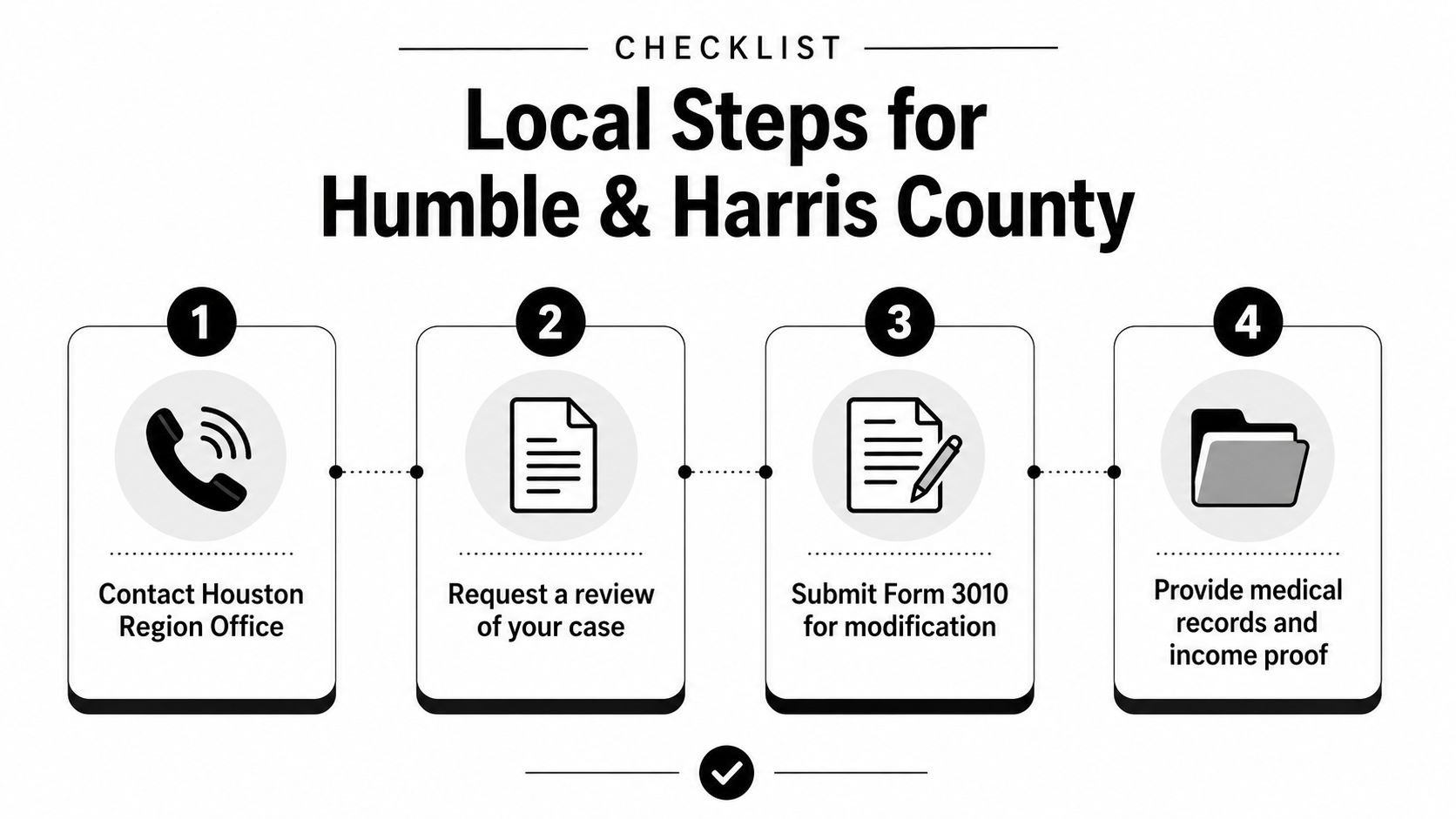
The sooner you compare the notice to the order, the faster you can tell whether the problem is collection, calculation, or both.
If you are enforcing support against a parent on SSDI, ask how the child's benefit is being counted and whether the child is already receiving assigned Social Security benefits. That matters because the child support system and the Social Security system can overlap in ways that do not show up in the monthly deposit alone. When disability income changes, the safest move is to line up the agency notice, the court file, and the family's benefits plan at the same time.
The Law Office of Bryan Fagan helps Humble families with family law, child support, custody, and special-needs planning in a plain-spoken way that fits the questions families bring to the table. Free consultations are available for families who need a local next step.
Key Takeaways and Your Next Step in Humble
The rulebook gets clearer once you separate the benefit programs. SSDI often counts as net resources in Texas child-support cases, while SSI generally does not. Texas guideline percentages apply to disability income, and the current net-resources cap is $11,700/month. For a disabled child, the support question may also involve long-term planning, because a higher payment can change SSI and Medicaid-related outcomes.
The collection side matters just as much. The Texas Attorney General can garnish certain Social Security-related benefits for child support, but SSI is treated differently. If a notice arrives, read it quickly, compare it to the support order, and confirm the benefit type before assuming the number is right. Small delays can turn a fixable mistake into a longer enforcement problem.
For Humble families, the practical path is usually straightforward even when the situation feels overwhelming. Decide whether the issue is calculation, withholding, enforcement, or a child-benefit tradeoff, then bring the right documents to a local attorney or court review. If a child has special needs, don't let the support amount get negotiated in a vacuum, because the benefits side of the case can matter just as much as the monthly figure.
If you live in Humble, Atascocita, Kingwood, or Northeast Houston and you're trying to sort out SSDI, SSI, child support, or a special-needs support issue, the Law Office of Bryan Fagan can review your situation and help you decide what to do next. Schedule a free consultation with Law Office of Bryan Fagan and get clear, local guidance before you agree to a number or miss a deadline.