Skip to content

If you're reading about the Standard Possession Order in Texas, there's a good chance your family is already under stress. Maybe you're in Humble, trying to make sense of a custody case while also getting the kids to school, answering messages from the other parent, and wondering what life will look like next month. Maybe a judge, mediator, or lawyer mentioned an "SPO," and it sounded like one more legal phrase dropped into an already emotional situation.
For many parents in Humble, Atascocita, Kingwood, and Northeast Houston, that term feels intimidating at first. It doesn't have to. In plain language, the Standard Possession Order is the court's default roadmap for parenting time. It gives families a starting schedule so children have structure and parents know what to expect.
That predictability matters. When the calendar is clear, fewer things are left to guesswork. School pickups, weekends, holidays, and summer plans become easier to plan, and that can lower conflict at a time when stability is especially important.
Navigating Custody with Confidence in Humble
A parent in Atascocita recently described the same concern I hear often in Harris County family law matters. "I don't even know what a normal schedule looks like." That's a very common place to start. Most parents aren't confused because they don't care. They're confused because Texas custody language can feel formal and distant from real life.
The standard possession order Texas courts use is meant to bring order to that uncertainty. It isn't designed to punish either parent. It's a framework courts use to create consistency for the child and a practical schedule for the adults involved.
In real life, that means a parent in Kingwood can look at a month and know which weekends are theirs. A parent in Humble can plan Thursday dinners, holiday exchanges, and summer time without renegotiating every detail from scratch. When parents understand the default rules, they usually feel less overwhelmed and more prepared to make good decisions.
Practical rule: The court order is the schedule that matters, not text-message assumptions or last-minute verbal changes.
Families in Northeast Houston also need to know that local court practice matters. Harris County judges deal with these issues every day, and they expect parents to understand the basics of possession, conservatorship, and the child's best interest. The clearer you are about the schedule, the easier it becomes to protect your time and avoid preventable disputes.
If you're also dealing with divorce, support, criminal charges, or estate planning questions at the same time, that stress can stack up quickly. But custody questions usually become more manageable once you break the schedule into simple parts. That's what we'll do here.
What Exactly Is a Texas Standard Possession Order
A parent in Humble will often ask the same question after a hearing: “So what does this order mean for my week?” That is the right question, because a Texas Standard Possession Order is really a calendar rulebook. It tells each parent when possession begins, when it ends, and how the routine works unless the court orders something different.
The Texas Standard Possession Order, or SPO, is the schedule many Texas courts use as the default starting point for parenting time. For children age three and older, Texas law generally treats that schedule as appropriate unless the facts of the case show another arrangement would better serve the child. In Harris County, that starting point matters for families in Humble, Atascocita, and Kingwood because local judges see these cases every day and often expect parents to understand how the default structure works before asking for changes.
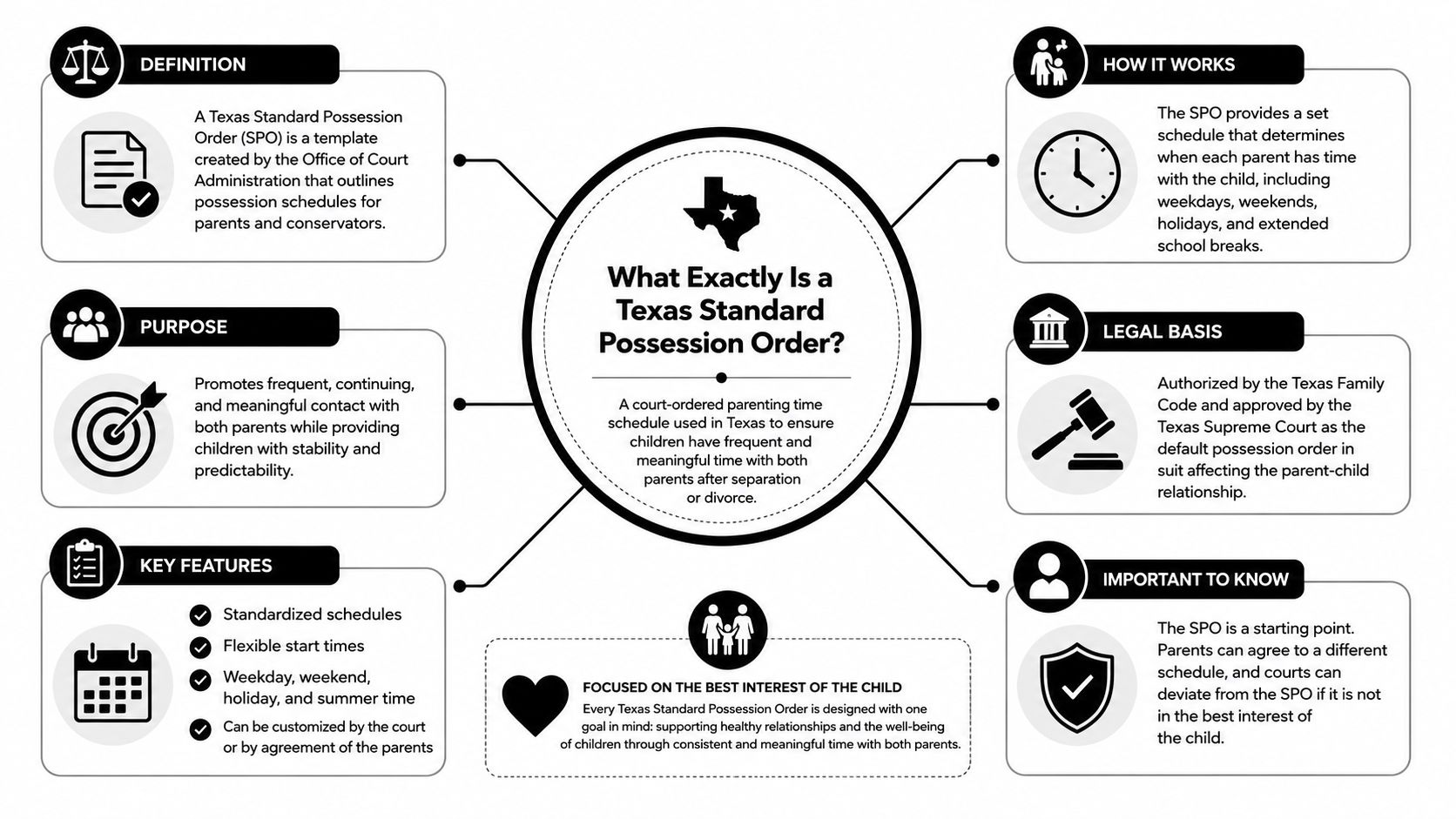
One point confuses many parents at first. A standard possession order is not the same thing as conservatorship. Conservatorship answers who makes major decisions and who decides the child's primary residence. Possession answers the day-to-day calendar. If you mix those up, the paperwork starts to sound much more intimidating than it really is.
The roles parents usually hear in court
Texas courts use a few labels that sound formal, but the ideas are simple.
- Primary conservator usually means the parent who has the right to designate the child's primary residence.
- Possessory conservator usually means the parent who has scheduled periods of possession under the court order.
- Best interest of the child means the judge is focused on what arrangement supports the child's health, stability, safety, and routine.
Those terms are job descriptions, not report cards on either parent.
A simple way to read the SPO is to treat it like the court's default school-year and holiday calendar. It gives parents a shared set of rules so they are not renegotiating every pickup, every Thursday dinner, or every holiday weekend. For many families in Northeast Harris County, that structure lowers conflict because each parent can look at the same order and the same month.
If you want to see how the default calendar is usually laid out for local families, this guide to a child visitation schedule in Humble can help connect the legal wording to real dates and exchanges.
Why the SPO matters in everyday life
The value of the SPO is predictability. A parent in Kingwood can plan work around pickup times. A parent in Atascocita can sign a child up for activities knowing which weekends are already spoken for. A parent in Humble can stop arguing over whether a verbal agreement from two months ago still controls. The signed order controls.
That point matters in Harris County courtrooms. Judges usually want to see the exact language of the order, not each parent's memory of what was discussed by text or over the phone. If the wording is clear, it is easier to tell whether someone followed it.
Parents are also surprised to learn that “standard” does not mean permanent. It means the court begins with a familiar framework. If a child is under three, if parents live far apart, if a child has special medical or educational needs, or if there are safety concerns, the judge may decide the standard schedule is not the right fit.
Your Possession Schedule Under the Standard Order
A lot of parents in Humble, Atascocita, and Kingwood reach this point and ask the same question. "What does this look like on my calendar?"
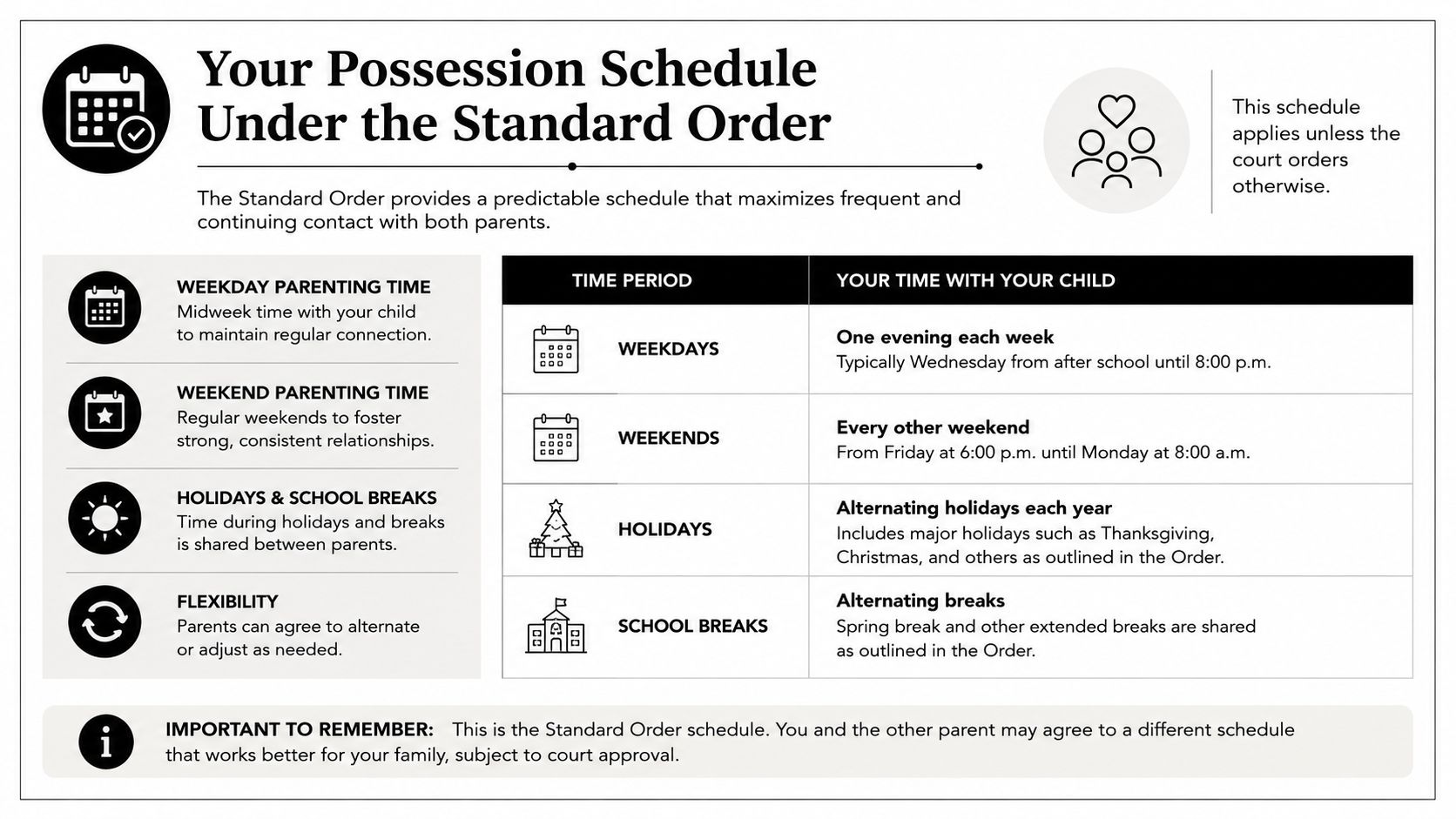
The Standard Possession Order answers that with a set schedule. For parents who live within 100 miles of each other, the usual pattern includes the first, third, and fifth weekends of each month, Thursday time during the school year, alternating holidays, and an extended summer period. In Harris County, judges expect parents to follow the written order closely, especially when pickup times, school dismissal, or holiday exchanges become disputed.
The basic monthly schedule
For many families, the monthly schedule works like a repeating school-and-weekend rhythm. Under a basic standard order, weekends usually begin Friday at 6:00 p.m. and end Sunday at 6:00 p.m. Thursday periods during the school year are often 6:00 p.m. to 8:00 p.m., unless the order uses an expanded version, which is different and comes later.
A real example helps. If you are the parent receiving possession under the order, and the month starts with a Friday that counts as the first Friday of the month, that weekend is yours. The same goes for the third Friday, and the fifth Friday if the month has one. Some parents are surprised when a fifth-weekend month makes the spacing feel uneven. The order still follows the same rule.
If you want to compare the legal wording to real dates, this child visitation schedule for Humble families can make the calendar easier to read.
Holidays override the regular weekend pattern
A common source of confusion is that the holiday schedule can replace the normal weekend schedule, even if a parent would otherwise have that weekend.
Here are the parts parents usually need to check twice:
- Spring Break alternates by year. One parent has it in one year, and the other parent has it the next.
- Thanksgiving also alternates. If the order gives you Thanksgiving that year, it controls over a regular weekend.
- Christmas break is divided into two parts. One parent has one segment, and the other parent has the other segment.
- Mother's Day and Father's Day are treated separately. Those periods usually go to the named parent, regardless of whose weekend it is.
A simple way to read this is to treat holidays like a highlighted block on the calendar. If a holiday block covers the same dates as a regular weekend, the holiday block controls.
That matters in real life. A parent in Kingwood may look at the calendar and see a first weekend. But if that same weekend falls inside the other parent's Thanksgiving period under the order, the holiday schedule wins.
Summer possession and written notice
Summer takes more planning than the rest of the year. Parents are juggling camps, vacations, family reunions, and work schedules, often months in advance.
Under the standard order for parents living within 100 miles, the parent with scheduled possession usually receives a 30-day extended summer period. The exact dates may be chosen by notice, and the other parent may also have rights to designate certain weekends or periods during that time. If notice is not given on time, the order usually supplies default dates. That fallback helps avoid total guesswork, but it can catch parents off guard if they assumed they could decide later.
For local families, this is often where small misunderstandings turn into bigger arguments. One parent may book a trip from Bush Airport. The other may sign the child up for a summer program in Atascocita. The written order decides whose plan controls if the dates overlap.
The good news is that the schedule is usually more manageable once you put it on a calendar and read each part in order.
Expanded Orders and Long-Distance Parenting Plans
A lot of parents around Humble ask the same question after reading the basic calendar. What happens if we live close enough for school pickups to work, or far enough apart that the usual back-and-forth would wear everyone out?
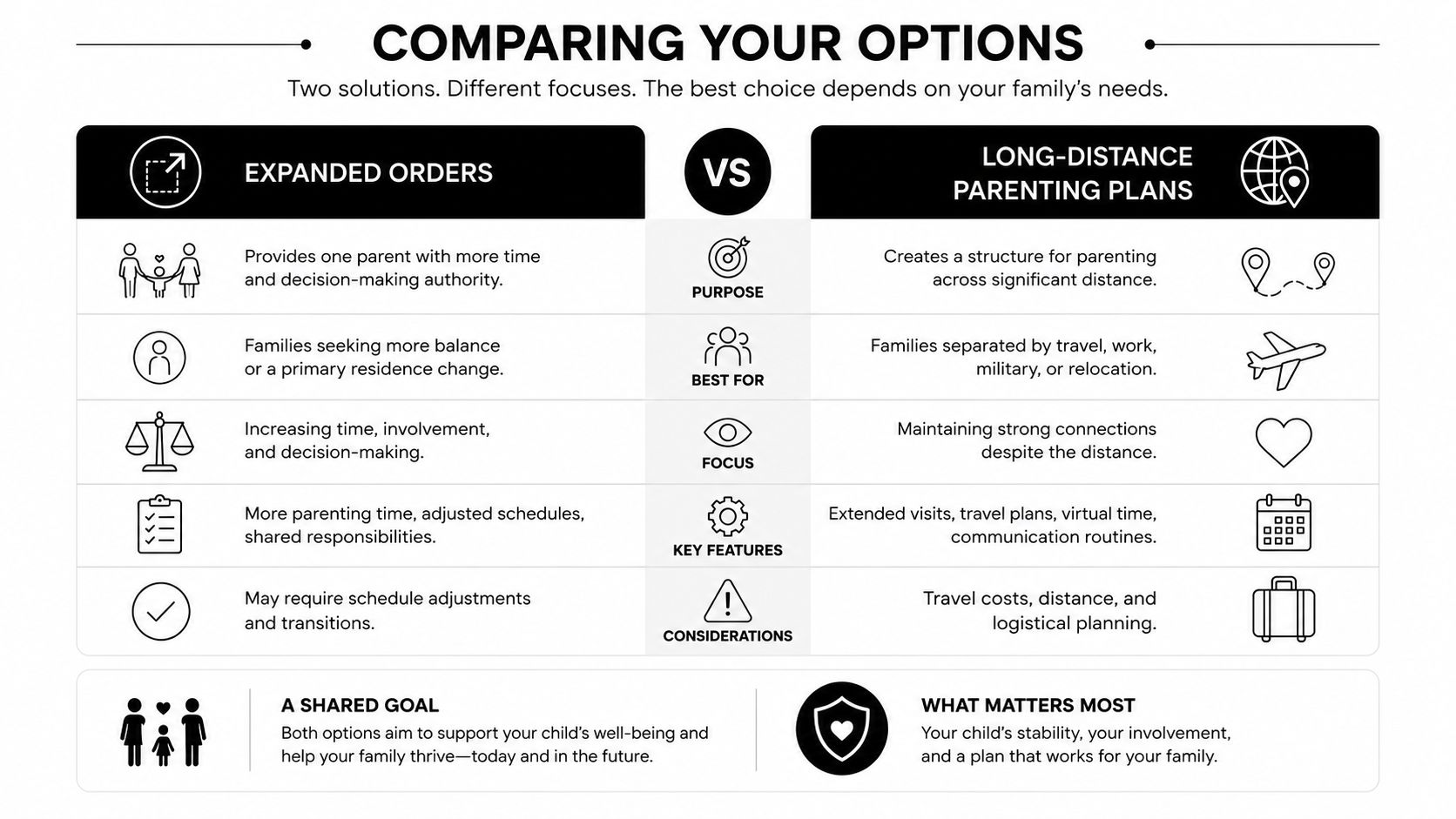
The answer depends largely on distance, and in Harris County that distance changes how practical the order feels in daily life. A parent in Atascocita and a parent in Kingwood may be able to use school dismissal and school return times without much disruption. A parent in Humble and another parent living several counties away may need fewer exchanges and longer blocks of parenting time.
Side-by-side comparison
| Plan type | Who it often fits | Main features |
|---|---|---|
| Standard Possession Order | Parents living within driving distance | Regular weekends, Thursday school-year visits, holiday rotation, summer possession |
| Expanded Standard Possession Order | Parents living close enough for school-based exchanges | Thursday periods may continue overnight, and weekends may begin at school dismissal on Friday and end when school resumes on Monday |
| Long-distance option | Parents living far enough apart that frequent exchanges are harder | The distant parent may keep the regular structure or choose a schedule with one weekend per month and a longer summer period |
An expanded order usually gives each parent more of the child's real routine, not just the fun parts. That can mean homework on Thursday night, packing lunches on Friday morning, and getting the child back to school on Monday. For many local families, that feels more natural than a schedule built around evening handoffs in a parking lot.
A simple way to understand it is to picture the difference between borrowing a child for a visit and real parenting through the school week. Expanded time often gives more of that second experience.
Why expanded orders often work well in Humble-area cases
For families in Humble, Kingwood, and Atascocita, the expanded version can reduce unnecessary transitions. If the exchange happens at school, the child may avoid one extra car ride, one extra doorstep handoff, and one more chance for parents to argue face to face. Harris County courts often favor arrangements that are clear, predictable, and easier on the child.
That said, expanded time is not automatically the right fit. A parent who works night shifts near Bush Airport, a family dealing with heavy traffic across Northeast Houston, or parents with repeated conflict at exchanges may need a different structure. The best schedule is the one the parents can reliably follow week after week.
Long-distance plans trade frequency for longer blocks
When parents live farther apart, short visits can become more stressful than helpful. A child may spend a big part of the weekend in the car. A parent may lose hours to pickup and return travel. The order tries to solve that problem by allowing longer stretches of time with fewer exchanges.
That tradeoff is common in relocation cases. One parent sees the child less often during the month, but gets more meaningful time during summer or other longer breaks. It works a lot like budgeting. If you cannot spend small amounts every week, you may need to plan for larger blocks at set times.
A few practical problems come up often in these cases:
- Travel details need to be specific. The order should spell out pickup locations, return times, and who handles transportation costs.
- Written elections matter. If a parent does not give notice by the deadline, the default dates in the order may control.
- School calendars matter. Humble ISD and nearby districts do not always line up perfectly with a parent's work schedule or travel plans.
- A move can require a new order. What worked when both parents lived in the Humble area may stop working after a relocation.
If one parent is planning a move, or already has moved, our child custody relocation lawyer in Humble, Texas page explains how distance can affect possession, notice, and the need to modify an existing order.
One final point causes confusion. An expanded order and a long-distance order are both versions of possession planning, but they solve opposite problems. Expanded orders usually help when parents live close enough to share more of the weekly routine. Long-distance plans help when parents live too far apart for that routine to work consistently.
When the Standard Possession Order Does Not Apply
A parent in Kingwood might walk into court expecting the usual first, third, and fifth weekend schedule, only to learn that the standard order is not the right fit for their child. That surprise is common. The Standard Possession Order is the default in many Texas cases, but default does not mean automatic in every family.
The court's job is to choose a schedule that serves the child's best interest. In Harris County, judges often start with the standard framework, then ask a practical question. Does this schedule fit this child, this parent, and this family's day-to-day life in places like Humble, Atascocita, or Kingwood?
One of the clearest examples involves very young children. The usual presumption for the Standard Possession Order applies to children age three and older. For infants and toddlers, courts often use a more specific plan because a baby's routine is different from a grade-schooler's routine. Feeding, naps, separation tolerance, and bonding all matter.
Young children often need step-up plans
A step-up plan works like gradually increasing a child's comfort with longer visits. It may begin with shorter, frequent periods of possession, then expand as the child gets older and handles transitions better.
For example, a parent in Atascocita with a 14-month-old may have several shorter visits each week instead of long weekend blocks right away. That kind of order can support bonding without turning the schedule into a constant disruption for the child. Later, the plan can grow into something closer to a standard schedule.
Parents often ask whether this means one parent is being treated unfairly. Usually, no. It means the court is matching the schedule to the child's stage of development. If your current order no longer fits because your child is older and the step-up period has passed, you may want to review your options for changing a Texas custody agreement.
Safety concerns can justify a different order
The standard order may also give way when there are real safety concerns. Courts can order supervised visitation, neutral exchange locations, limited overnights, or other protections if the facts support it.
These cases often involve allegations of family violence, substance abuse, unsafe living conditions, or a serious risk that a parent may not return the child after visitation. Harris County judges do not usually change a possession schedule based on suspicion alone. They look for records, witness testimony, police reports, medical information, prior court findings, and the details of what happened.
Documentation matters.
Parents in the Humble area sometimes hesitate to raise these issues because they do not want to look combative. I understand that instinct. But if your child needs a safer exchange plan or a different possession schedule, the court can only act on the information placed in front of it. Clear facts are more helpful than broad accusations.
The Standard Possession Order also may not apply if the parents agree to a different schedule and the court approves it, or if the child has needs that make the usual calendar unrealistic. A child with significant medical needs, a parent with an unusual work schedule, or a history of high conflict at exchanges can all lead to a more customized order.
That is often where local context matters. A schedule that looks workable on paper may fall apart in real life if exchanges are happening around Humble ISD school routines, long commutes across Harris County, or repeated conflict at pickup locations. A court wants an order people can realistically follow, not one that only sounds good in a courtroom.
Enforcing or Modifying Your Custody Order in Harris County
A custody order can look clear on paper and still fall apart on an ordinary school week in Humble. One parent shows up late at pickup in Atascocita. A child starts a new activity in Kingwood. A job schedule changes, and the old plan keeps creating the same argument.
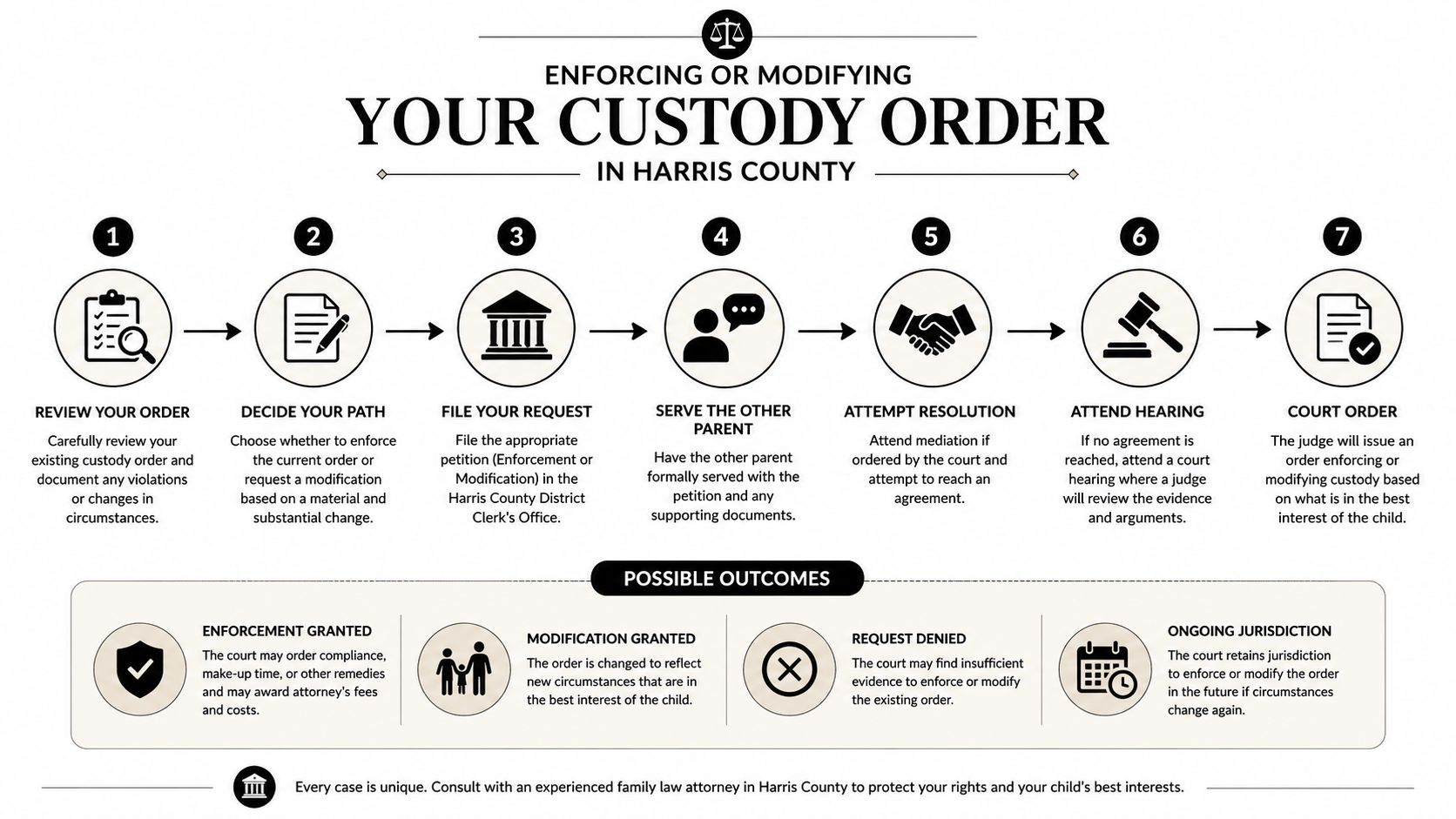
That does not always mean the court order is bad. It often means you need to figure out which problem you have. One path is enforcement. The other is modification. Harris County courts treat those as two different tools.
If the other parent isn't following the order
Enforcement is the tool the court uses when an order already says what must happen, but a parent is not doing it. Harris County judges usually start with the same question. What did the written order require on that date and time?
That is why records matter so much. A judge cannot fix a missed Thursday dinner visit based on a vague statement that exchanges have been messy for months. The court needs specifics.
Start here:
Save messages in their original form
Keep texts, emails, and parenting app messages. Do not edit screenshots or delete surrounding messages that show context.Make a simple calendar
Mark missed pickups, denied visits, late returns, and failed exchanges. Include dates, times, and locations.Compare the facts to the exact order
Read the custody order line by line. Many parents remember the general routine but miss details about holiday cutoffs, exchange times, or who provides transportation.Bring organized information to your lawyer
A short timeline with attached proof is easier for counsel and the court to use than a stack of scattered screenshots.
In families around Humble, Atascocita, and Kingwood, the disagreement is often less dramatic than people expect. It may be repeated late returns, confusion over school pickup, or one parent refusing to follow the holiday schedule. Small violations can grow into bigger conflicts if nobody addresses them clearly.
The Law Office of Bryan Fagan is one local option for families who need help with custody disputes and related family law issues in Humble and nearby communities.
A parent who believes the current order needs to be changed can review this guide on how to change a custody agreement for a practical overview of the modification process.
To hear a broader explanation of family law issues that often overlap with custody disputes, this video may help:
When modification may be the better path
Modification is different. Instead of asking the court to enforce the old rules, you are asking the court to replace them with a schedule that fits the family as it exists now.
A good way to look at it is this. Enforcement addresses rule-breaking. Modification addresses a rulebook that no longer matches real life.
Common examples include a parent moving farther away, a child starting a new school routine, a work schedule that changed from weekdays to rotating shifts, or exchange terms that keep causing conflict. In Harris County, the court will want clear facts showing why the present order no longer serves the child well.
The court can only enforce what the order says. If the order no longer works, modification may be the right tool.
That distinction matters for local families. If you live in Humble and the other parent is in another part of Harris County, traffic, school start times, and long exchange routes can turn a once-manageable schedule into a recurring problem. The right legal response depends on whether the other parent is refusing to follow the order or whether the order itself now needs to be changed.
Your Next Steps with a Humble Family Law Attorney
When parents first learn how the standard possession order Texas courts use functions, they usually feel two things at once. Relief, because the schedule is more predictable than they expected. Concern, because the details matter and mistakes can create conflict fast.
If you're in Humble, Atascocita, Kingwood, or Northeast Houston, keep your next steps simple.
Start with your own facts
Write down the basics of your situation. How old is your child. Where do both parents live. Is the problem about understanding the current schedule, enforcing it, or asking the court to change it. Those facts shape everything.
Gather questions before you meet with counsel
Bring your court order, your calendar, and any written communication that shows where the conflict is happening. If holidays, summer dates, or exchange times are causing confusion, make a short list so nothing gets missed.
Get local guidance before the problem grows
Harris County custody cases are easier to manage when you address issues early. That's true whether you're dealing with divorce, conservatorship, support, criminal allegations affecting custody, or planning issues for your family more broadly. Clear legal advice can help you avoid informal arrangements that create bigger disputes later.
A local attorney can explain how courts serving Humble and nearby communities typically view possession issues, what paperwork matters, and whether your case calls for enforcement, modification, or a custom parenting plan. You don't need to solve everything at once. You need a clear path forward.
If you need help understanding a possession schedule, enforcing an order, or asking the court to change one, schedule a free consultation with Law Office of Bryan Fagan. Our Humble office works with families in Humble, Atascocita, Kingwood, and Northeast Houston, and we can talk through your situation in plain language so you know your next step.