Skip to content

When a custody order gets broken, most parents don’t feel angry first. They feel stuck. You’re waiting in a school parking lot in Humble past the exchange time. Your phone shows unread texts. Your child hasn’t been returned from weekend possession in Kingwood. Or you were supposed to have a scheduled call, and the other parent cut off contact again.
That kind of waiting wears people down fast. It creates panic, second-guessing, and the same question I hear often from parents across Humble, Atascocita, and Northeast Houston: what can I do right now?
Texas gives you more options than many parents realize. A custody order is not a suggestion. It is a court order. If the other parent is refusing to follow it, the court can step in through civil enforcement. In more serious situations, a family court problem can also cross into criminal territory. That’s where many people get blindsided.
The practical issue isn’t only whether a violation happened. It’s whether you can prove a specific violation of a specific provision in a clear order, and whether your response helps or hurts your position. Parents often make things worse by retaliating, withholding the child the next weekend, or relying on verbal side agreements that can’t be enforced later.
This guide is built for that moment. It explains violation of custody order texas penalties in plain English, shows how civil and criminal consequences differ in Harris County, and gives a direct action plan for parents in Humble, Kingwood, Atascocita, and nearby communities.
The Worry and Wait When a Custody Order is Broken
A missed exchange rarely feels minor when you’re the parent living through it. It can start with a simple text saying the child will be “a little late,” then turn into hours of silence. Other times, it’s more direct. The other parent says your weekend is cancelled, ignores the order, and dares you to “take it up with the court.”
That uncertainty is hard on parents and harder on children. Kids notice the tension, even when adults try to hide it. A broken possession schedule can disrupt school, routines, medical appointments, and the child’s sense of stability.
What families in Northeast Houston often face
In Humble and surrounding areas, the problems tend to look familiar:
- Late returns that become a pattern. One missed return might be blamed on traffic. Repeated late returns usually signal something more serious.
- Denied possession periods. A parent arrives for pickup and is told the child isn’t coming.
- Communication interference. Scheduled calls, updates, or contact during the other parent’s possession get blocked.
- Unauthorized changes. One parent decides the schedule no longer applies because it’s inconvenient.
Practical rule: Your frustration is understandable, but your next move needs to be deliberate. Judges respond better to documented facts than to emotional escalation.
Parents often assume they have to just live with it until the next hearing. That’s usually not true. Texas courts can enforce possession and access orders. They can also punish violations when the order is clear and the proof is strong.
What helps and what usually doesn’t
What helps is detailed documentation, prompt legal review, and a response that stays inside the order. What usually doesn’t help is arguing at the exchange site, making threats by text, or deciding to “even things up” by violating the order yourself the next time you have the child.
That trade-off matters. A parent who has been wronged can still damage their case by responding badly. In Harris County, the strongest enforcement cases are usually the ones built calmly and specifically.
If you’re dealing with this in Humble, Kingwood, or Atascocita, the situation may feel personal, chaotic, and immediate. Legally, though, it becomes stronger when you treat it as a record-building problem first.
What Counts as Violating a Custody Order in Texas
A custody order is enforceable only to the extent it says who must do what, when, and under what conditions. In practice, that means a parent violates the order by failing to follow a specific possession, access, exchange, geographic, or decision-making term that appears in the signed order. Judges in Harris County do not enforce handshake deals, text-message rewrites, or one parent’s view of what would have been more reasonable.
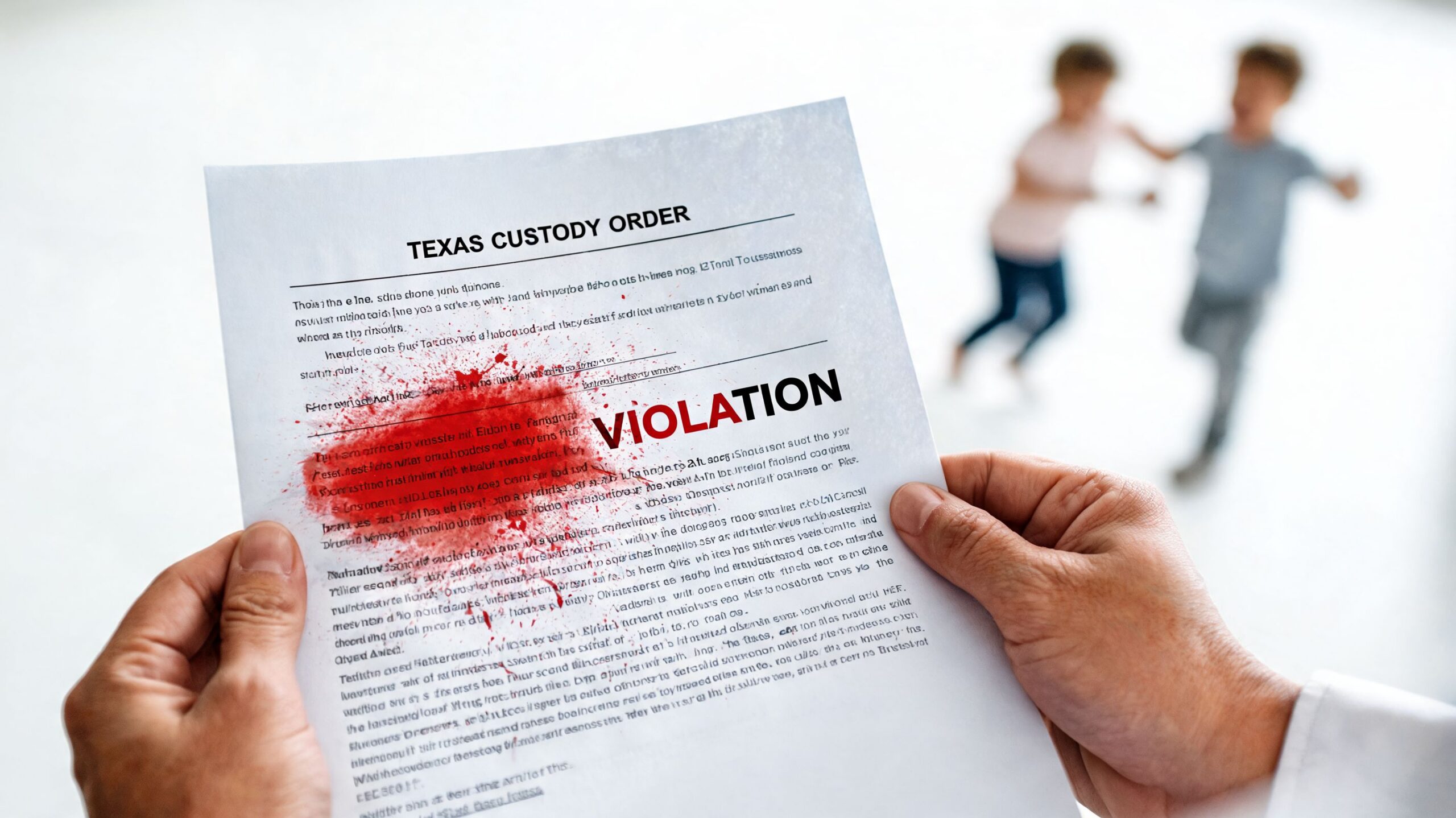
Some violations are easy to spot the same day. Others build a stronger enforcement case because they happen over and over and show a pattern of refusing to follow the order.
Common examples parents recognize immediately
- Refusing to surrender the child at the ordered date, time, or place
- Returning the child late or to the wrong location
- Failing to appear for an exchange
- Cutting off court-ordered visitation, holiday time, or summer possession
- Taking the child outside the geographic area restricted by the order
- Making school, medical, or counseling decisions without the authority the order requires
- Blocking phone or video contact if the order specifically grants that access
Parents often get tripped up by memory. The signed language controls. If your case uses a standard schedule, review the actual terms against your facts. This overview of the standard possession order in Humble can help you compare your order to the exchange, weekend, holiday, and summer issues that commonly lead to enforcement filings.
Specific wording decides whether the violation is enforceable
This is the part many parents do not hear soon enough. A parent can be acting unfairly and still avoid contempt if the order is too vague to enforce. I see that problem in cases with phrases like “reasonable visitation,” “work it out between yourselves,” or missing details about pickup times and locations.
For contempt, the judge usually wants exact language. If the order says the child must be surrendered at 6:00 p.m. on Friday at a named address, that is enforceable. If the order loosely says the parents will arrange a convenient exchange, enforcement becomes much harder and the case may need a clarification or modification instead of, or before, a contempt request.
That distinction matters in Harris County because the same family conflict can move in two very different directions. A vague order may limit what the family court can punish. A clear order, combined with conduct like hiding the child or taking the child in violation of the order, can create civil exposure and raise criminal concerns.
Review the order like a checklist
When I evaluate these cases, the first job is to line up the facts with the exact paragraph that was broken. Long backstories can wait. The wording comes first.
Use this process:
- Pull the most recent signed order, not an older temporary order or a draft.
- Find the exact paragraph covering possession, pickup, return, travel, or decision-making.
- Write down the date, time, and location of the violation.
- State what the order required in plain language.
- State what the other parent did or failed to do.
- Save proof such as texts, call logs, screenshots, school attendance records, photos, or witness names.
A short, organized timeline usually does more for a case than pages of angry messages.
Everyday conflict is not always a custody-order violation
Some co-parenting problems are real but are not contempt issues. Rude texts, last-minute complaints, or arguments about activities may support a modification request or show poor judgment, but they do not automatically prove a custody-order violation. The question is narrower. Did someone disobey a clear court command?
That is why precision matters so much here. Family court judges look for a specific order, a specific act, and proof tied to a specific date. If those pieces are in place, the case is stronger. If they are missing, the legal strategy often shifts from punishment to tightening the order so future violations can be addressed cleanly.
Civil vs Criminal Your Enforcement Options in Harris County
Most custody disputes start in family court. Some stay there. Others escalate because the conduct goes beyond a typical access dispute and crosses into a criminal offense. Knowing the difference matters because the goals, procedures, and risks are not the same.
Civil enforcement is usually the first path
The most common response is filing a Motion for Enforcement in the court that issued the custody order. In practical terms, this asks the judge to review the violations, find the other parent in contempt if the proof supports it, and order remedies.
Civil enforcement is usually the right place to start when the issue is denied visitation, late returns, repeated interference, or refusal to comply with possession terms. The family court can order corrective measures and penalties designed to enforce the existing order.
Criminal charges are different and more severe
A more serious path exists when the conduct amounts to Interference with Child Custody under Texas Penal Code Section 25.03. That offense is a state jail felony, punishable by 180 days to 2 years in state jail and a fine up to $10,000, while civil contempt under Texas Government Code § 21.002 is limited to a fine of up to $500 and/or up to six months in county jail per violation, as described in this discussion of interference with child custody penalties in Texas.
That difference is not technical. It changes the stakes completely. A family law problem can become a criminal case with exposure to incarceration, a criminal record, and long-term consequences outside family court.
Civil Contempt vs. Criminal Interference Comparison
| Aspect | Civil Enforcement (Motion for Contempt) | Criminal Charges (Interference with Custody) |
|---|---|---|
| Primary purpose | Force compliance with the custody order and address past violations | Punish conduct that violates criminal law |
| Where it typically begins | Family court that issued the order | Criminal justice system |
| Common fact pattern | Denied visitation, missed exchanges, return-time violations | Taking, keeping, or enticing a child in violation of the order |
| Penalty range | Up to $500 fine and/or up to six months in county jail per violation | 180 days to 2 years in state jail and up to $10,000 fine |
| Typical remedies beyond punishment | Makeup possession, attorney’s fees, enforcement orders, possible custody changes | Criminal record and related collateral consequences |
| What the judge focuses on | Whether a clear order was violated | Whether the conduct meets the criminal statute |
How the civil and criminal sides can overlap
Parents sometimes assume they must choose one path forever. In reality, the same fact pattern can create both family-court consequences and criminal exposure. A parent who keeps a child beyond the order may face enforcement in family court, and in a serious enough case, law enforcement may become involved.
The important trade-off is strategy. Filing quickly in family court often helps build a disciplined record. Waiting too long can make a pattern harder to prove and can embolden the violating parent.
What tends to work in Harris County practice
The strongest enforcement matters usually have three things:
- A precise order
- A clean timeline of violations
- A parent who did not retaliate
What tends to fail is showing up with generalized complaints like “this happens all the time” but no dates, no screenshots, and no paragraph from the order tied to the conduct. Judges need specifics.
For parents in Humble, Atascocita, and Kingwood, this civil-versus-criminal distinction is one of the most important parts of understanding violation of custody order texas penalties. You are not just dealing with a scheduling disagreement. Depending on the facts, you may be dealing with contempt, modification risk, or a felony-level criminal issue.
The Full Spectrum of Texas Custody Violation Penalties
A missed exchange can start as a family-court enforcement problem and end with police involvement. In Harris County, that shift often catches parents off guard. The court may address one part of the conduct through contempt, while prosecutors look at the same facts under a criminal statute.
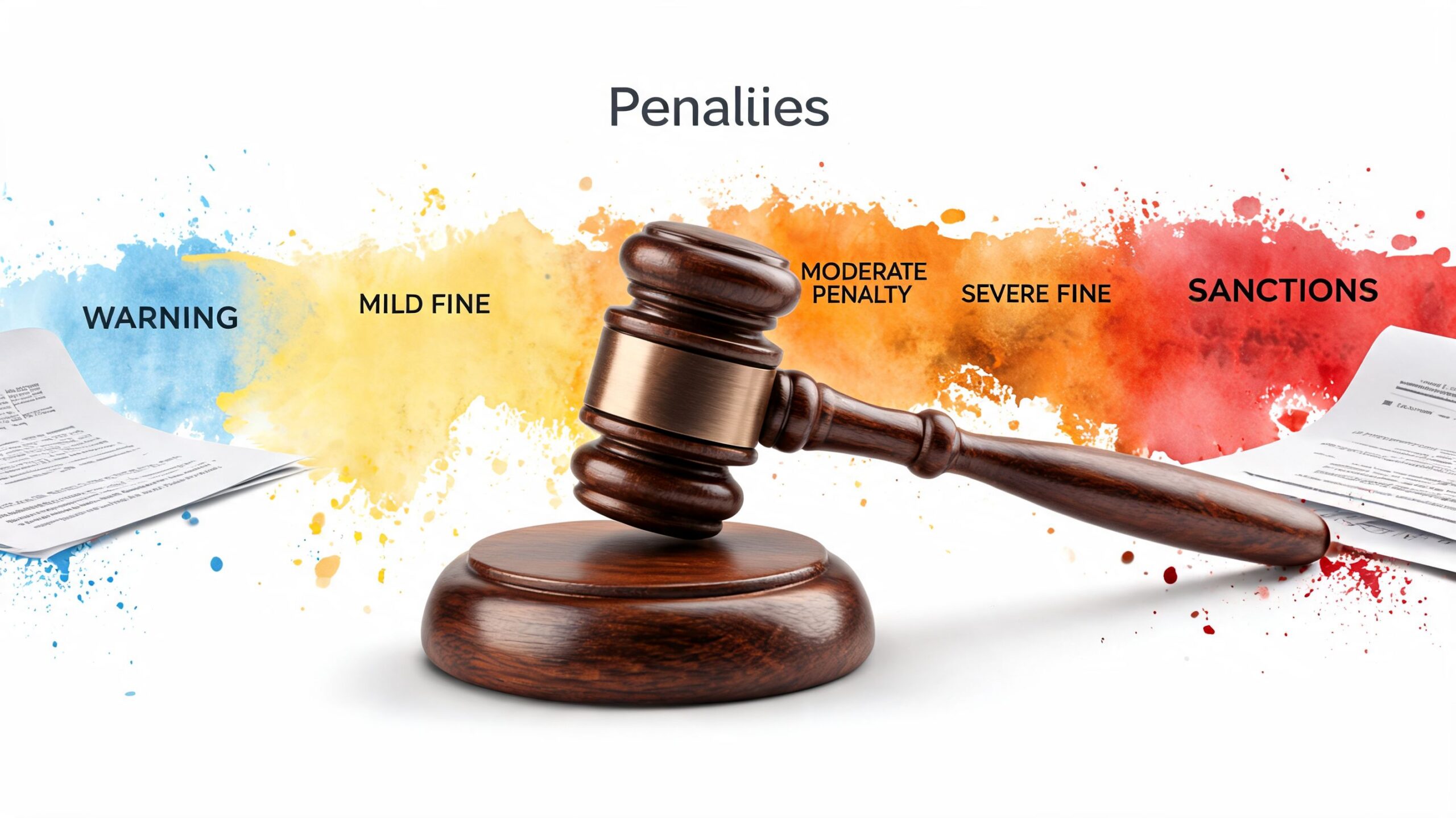
Family-court penalties can become serious fast
Judges usually want compliance first. If a parent keeps ignoring a clear order, the penalties get heavier.
Common family-court consequences include:
- Makeup possession to restore missed parenting time
- Attorney’s fee awards to the parent forced to file enforcement
- Orders with tighter exchange terms, including specific times, locations, and communication rules
- Contempt findings
- Jail time or suspended jail time tied to compliance
- Changes to conservatorship or possession if the pattern shows poor judgment or instability
The practical point is simple. Even a “small” violation can create a record that affects the next hearing. Judges in enforcement cases pay close attention to patterns, and repeated violations often matter more than the excuses attached to them.
Contempt can mean county jail
Texas courts can enforce custody and visitation orders through contempt. Under Texas Government Code Section 21.002, a court may punish contempt with a fine of up to $500, confinement in county jail for up to six months, or both.
That penalty is real, but contempt is technical. The order must be clear enough to enforce, and the motion must identify the violated provisions with precision. I often tell parents that good facts alone are not enough. The paperwork and the wording of the underlying order matter just as much.
Some custody violations cross into criminal conduct
Texas also treats certain interference with possession as a crime. Under Texas Penal Code Section 25.03, interference with child custody can be charged when a person takes or retains a child in violation of a judgment or order. In many cases, that offense is a state jail felony.
This is the civil-criminal overlap parents in Humble, Kingwood, and Atascocita need to understand. A parent may think, “We are just fighting about pickup.” If the child is withheld in violation of the order, the situation can move beyond family court.
For a parent dealing with a child who has not been returned, this guide on what to do if the other parent won't return your child in Texas explains the first steps in practical terms.
Protective-order violations raise the risk even more
Custody exchanges sometimes happen under the terms of a protective order. If a parent violates that order during communication, pickup, or drop-off, the consequences can extend well beyond the custody case.
Under Texas Penal Code Section 25.07, violation of certain protective orders is generally a Class A misdemeanor, and some repeat or aggravated cases can be charged as felonies. That can affect bond conditions, firearm rights, future custody arguments, and how the family court views a parent’s judgment.
A short explanation from our team may help if you want a visual walk-through of how courts look at enforcement and consequences:
The penalty that often matters most is a custody change
Many parents focus on fines or jail. In practice, the longer-term consequence is often more important. Repeated violations can support requests to restrict possession, require supervised exchanges, or modify conservatorship altogether.
That is a hard trade-off. A parent trying to “win” one weekend can lose credibility for months or years. Family judges want stability, follow-through, and respect for court orders. A parent who undercuts those things puts future parenting time at risk.
Informal fixes usually make the case harder
Side deals, undocumented schedule swaps, and self-help tactics tend to blur the evidence. They also give the other side room to argue that the order was unclear or that both parents ignored it.
The stronger approach is disciplined and boring. Follow the written order, keep clean records, and get legal advice before a family-court problem turns into a criminal one.
Your Immediate Action Plan When a Violation Occurs
It is 6:20 p.m. in a Humble school parking lot. Your pickup time was 6:00. The other parent is not answering. Your child is not there. That moment pushes many parents toward angry texts, social media posts, or a rushed decision to “even things up” later. Those reactions usually make a Harris County case harder.
The better approach is controlled and documented. A custody violation can stay in family court, or it can grow into something that draws police attention and criminal allegations. What you do in the first few hours matters.
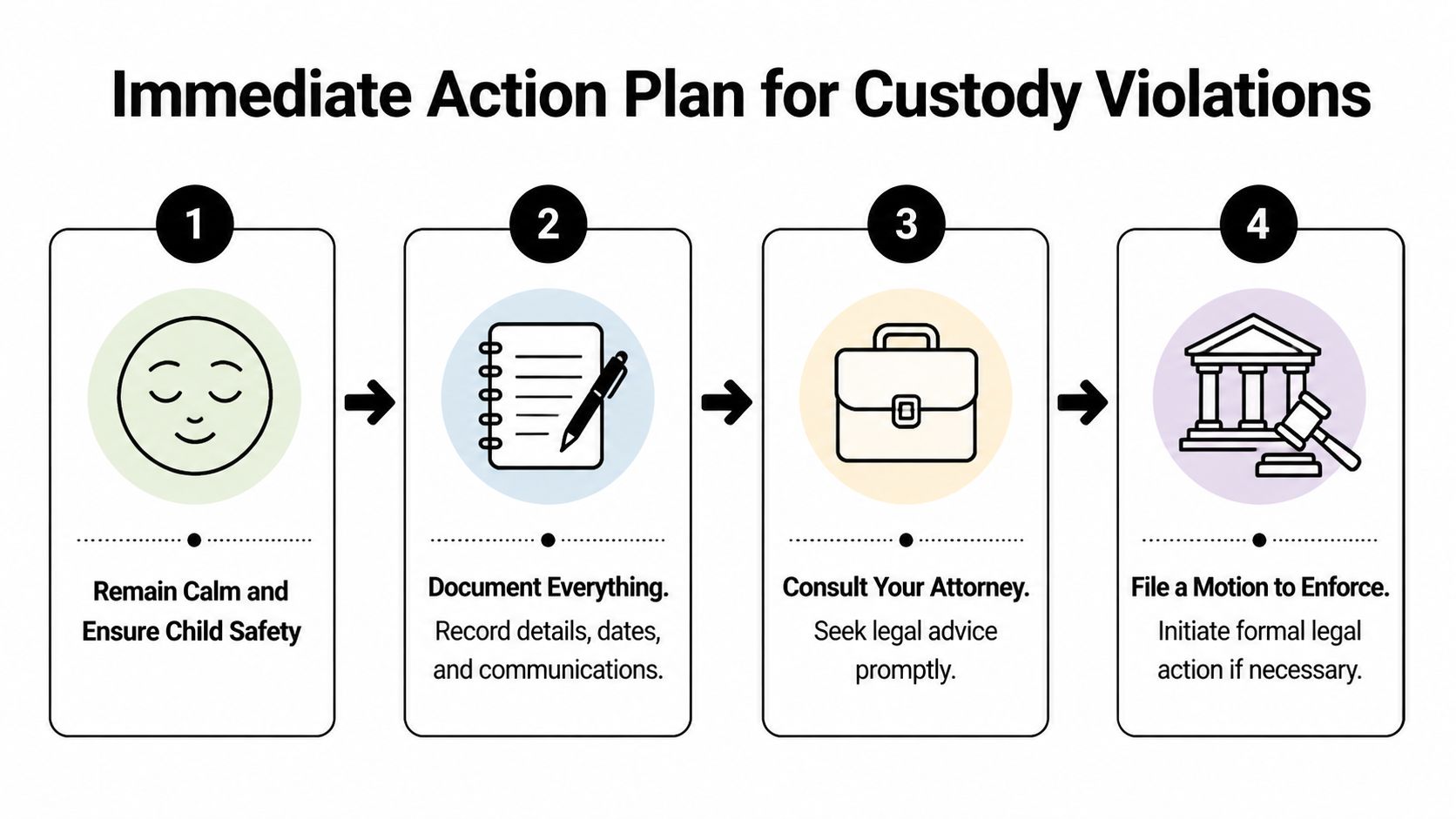
Step 1 starts with the child’s immediate safety
Separate fear from facts. If you have a real reason to believe your child is in immediate danger, call law enforcement right away and be ready to give the officer the exact court order, the child’s full identifying information, and the last known location.
If there is no immediate safety threat, avoid presenting it as one. Family judges in Harris County see the difference between an emergency and a possession dispute. That distinction affects credibility.
Step 2 build a record a judge can follow quickly
Start a timeline the same day. Keep it factual and plain. Judges and prosecutors do not need editorial comments. They need a clear sequence of events.
Your notes should capture:
- The date and exact exchange time
- The required pickup or drop-off location
- The order language that applied
- What happened
- Who saw it happen
- Screenshots, call logs, voicemails, emails, photos, and receipts
Good documentation often decides whether a case looks like a one-time misunderstanding, a pattern that supports enforcement, or conduct serious enough to raise criminal concerns.
Write notes the way you would want a stranger to read them in court: “Arrived at 6:00 p.m. at the designated location. Waited until 6:30 p.m. Sent one text at 6:10 p.m. No response. Child was not produced.”
Step 3 read the order before you react
Parents often act from memory. Memory is risky. Pull the signed order and check the exact possession schedule, holiday terms, exchange location, notice requirements, and any right of first refusal language.
That review matters because the next legal step depends on the exact wording. If the dispute involves a child not being returned, this guide on what to do if the other parent won’t return your child in Texas gives a practical starting point for the first response.
Step 4 send one calm written demand for compliance
If the child is not in immediate danger, send a short message that matches the order. State the missed exchange, the correct location, and your request that the child be returned or produced as required. Keep the tone professional.
One good message helps more than ten emotional ones. It shows the court you tried to resolve the problem without escalating it, and it locks in another piece of evidence.
Step 5 do not create a second violation
Parents in Kingwood, Atascocita, and Humble often ask the same question: “If they kept my child, why do I still have to follow the order?” Because self-help damages your position fast.
Do not withhold the child on your next period of possession. Do not change exchange terms on your own. Do not threaten to disappear with the child, and do not post about the dispute online. A clean enforcement case can turn into a two-parent credibility fight in one weekend.
Step 6 get legal advice while the facts are still fresh
Early review can tell you which lane your case belongs in. Some cases call for a motion for enforcement. Some need a modification request. Some require urgent action because the facts are drifting from a family court problem toward interference with child custody or another criminal issue.
That civil-criminal overlap is where parents get caught off guard. In my experience, the families who act early usually preserve better evidence, avoid damaging text exchanges, and make better decisions about whether to call police, file in family court, or both. For local parents, the Law Office of Bryan Fagan in Humble contact page is one place to start if you need help with both family law enforcement issues and related criminal-defense concerns.
Speed matters here. The goal is not to punish first and sort it out later. The goal is to protect your child, protect your credibility, and choose the response that fits what happened.
Common Defenses and Why You Still Need an Attorney
Not every accused parent who violated an order will be held in contempt. Texas law allows real defenses. The problem is that many people misunderstand what counts as a defense and what just sounds like an excuse.

A vague order can defeat contempt
One of the strongest defenses is that the order is not specific enough to enforce. If the language leaves too much open to interpretation, the court may refuse contempt even if both parents agree there was a dispute.
That’s why experienced counsel often starts by testing the wording itself. If the decree lacks precise schedules, exchange terms, or responsibility language, the case may need a different legal approach.
Impossibility and interference can matter
Another defense appears when the accusing parent made compliance impossible. That doesn’t mean “things got difficult.” It means the alleged violator can show they could not comply because of the other party’s conduct or another legally significant barrier.
Examples can include:
- The exchange location was changed unilaterally
- The accusing parent failed to appear where the order required
- The order’s terms conflicted in a way that made compliance unclear
- A genuine emergency affected the child’s immediate welfare
These defenses are fact-sensitive. They need records, not just explanations.
Good-faith conduct is useful, but only if you can prove it
Parents often say, “I was trying my best,” or “I thought this was safer for the child.” Sometimes that matters. Sometimes it doesn’t. Family courts care a lot about child stability and documented good-faith efforts, but those arguments have to be presented carefully.
A valid defense presented poorly can fail. A difficult fact pattern presented clearly can still be manageable.
That’s one reason self-representation is risky in enforcement cases. Contempt proceedings may grow out of family law, but they carry serious due-process concerns and can expose a parent to jail. The pleading must be specific. The evidence must line up with the order. The defense must fit the law.
Why local representation changes the outcome
An attorney doesn’t just “go to court for you.” In these cases, counsel helps decide what kind of case you have. Is this contempt? Clarification? Modification? A criminal referral risk? A defensive response to an enforcement motion? Those questions affect everything from what gets filed to what evidence matters most.
If you’re trying to protect your rights in Humble or defend against allegations in Harris County, working with a Harris County custody lawyer in Humble can help you avoid the common mistakes that come from treating a technical enforcement issue like an ordinary parenting disagreement.
The trade-off is straightforward. Trying to save money by handling a contempt matter alone can become far more expensive if the result is jail exposure, a fee award, or a damaging custody modification.
Protecting Your Custody Order and Your Peace of Mind
A broken custody order does more than interrupt a weekend. It tests your patience, your judgment, and sometimes your sense of control. The legal system can help, but it works best when you approach it with precision.
The main point is simple. Violation of custody order texas penalties can be serious, and they can escalate. Some cases stay in family court and lead to contempt findings, makeup time, fees, or custody changes. Other cases can cross into criminal law when the conduct becomes more severe. Knowing that distinction early can change how you respond.
The practical takeaway for parents in Humble and nearby communities
If you live in Humble, Atascocita, Kingwood, or Northeast Houston, the most effective response usually looks like this:
- Follow your own order carefully
- Document every violation in a clean, factual way
- Avoid retaliation
- Get legal advice before the pattern gets worse
- Treat unclear orders as a problem that may need fixing before enforcement will work well
That approach protects more than your case. It protects your credibility. In custody litigation, credibility matters almost as much as the underlying facts.
What parents often learn too late
Many parents wait because they hope the other parent will settle down. Sometimes that happens. Often it doesn’t. Repeated violations can become normalized if no one addresses them. Meanwhile, the child keeps living in the middle of a schedule that no longer feels dependable.
You don’t need to overreact. But you also don’t need to accept ongoing violations as the new normal.
The parents who put themselves in the strongest position are usually the ones who act early, stay organized, and let the written order guide the response.
If your co-parent is ignoring the custody order, refusing to return your child, or putting you at risk of a larger court fight in Harris County, there are legal tools available. The right next step depends on the wording of your order, the proof you have, and whether the issue is civil enforcement, modification, or possible criminal exposure.
If you need help understanding your options, schedule a free consultation with the Law Office of Bryan Fagan. Our Humble office works with families across Humble, Atascocita, Kingwood, and Northeast Houston to address custody-order violations, enforcement actions, and related criminal concerns with practical, local guidance.