You're home after a collision near FM 1960, your car isn't drivable, and the insurance calls have already started. Your neck feels different than it did at the scene, you're worried about missing work, and you don't know which call to return first.
If you're searching for a car accident lawyer in Humble, TX, start by separating what needs attention immediately from what can wait. Medical care and disappearing evidence come first. Insurance paperwork comes next, but neither an open claim nor a friendly adjuster protects your lawsuit deadline.
Immediate Steps at the Crash Scene
Check for injuries and call 911 when emergency help is needed. Around Humble, Atascocita, Kingwood, and Northeast Houston, staying in traffic to document a collision can create another danger. Your safety comes before photographs.
Check everyone and request help. Tell the dispatcher about injuries, traffic hazards, and your location. Even when damage looks minor, request police assistance if someone may be hurt, and describe symptoms fully rather than dismissing them.
Move to safety when you can. Turn on hazard lights and move a drivable vehicle out of traffic if it's safe. Don't stand between vehicles or step into a travel lane to recover debris.
Exchange identifying information. Collect names, phone numbers, license plates, driver's license details, insurance companies, and policy numbers. Stick to facts instead of apologizing or guessing who caused the impact.
Photograph the whole scene. Capture vehicle damage from several angles, traffic signals, lane markings, skid marks, debris, and visible injuries. Close-ups alone won't show how the vehicles approached each other.
Identify independent witnesses. Ask for names and contact details, then note what each person says they saw. Don't assume the responding officer will locate every witness.
Get appropriate medical evaluation promptly. Seek same-day care if you're injured, have symptoms, or are unsure whether you need treatment. Aspen Falls Wellness's discussion of neck pain after a crash offers useful context, but online information shouldn't replace a clinician's assessment.
Notify your insurer promptly. The Texas Department of Insurance recommends filing as soon as possible rather than waiting for treatment or repairs to finish. Reporting the collision doesn't mean you must immediately agree on its value.
Keep a phone-ready checklist
Save this sequence where you can find it under stress.
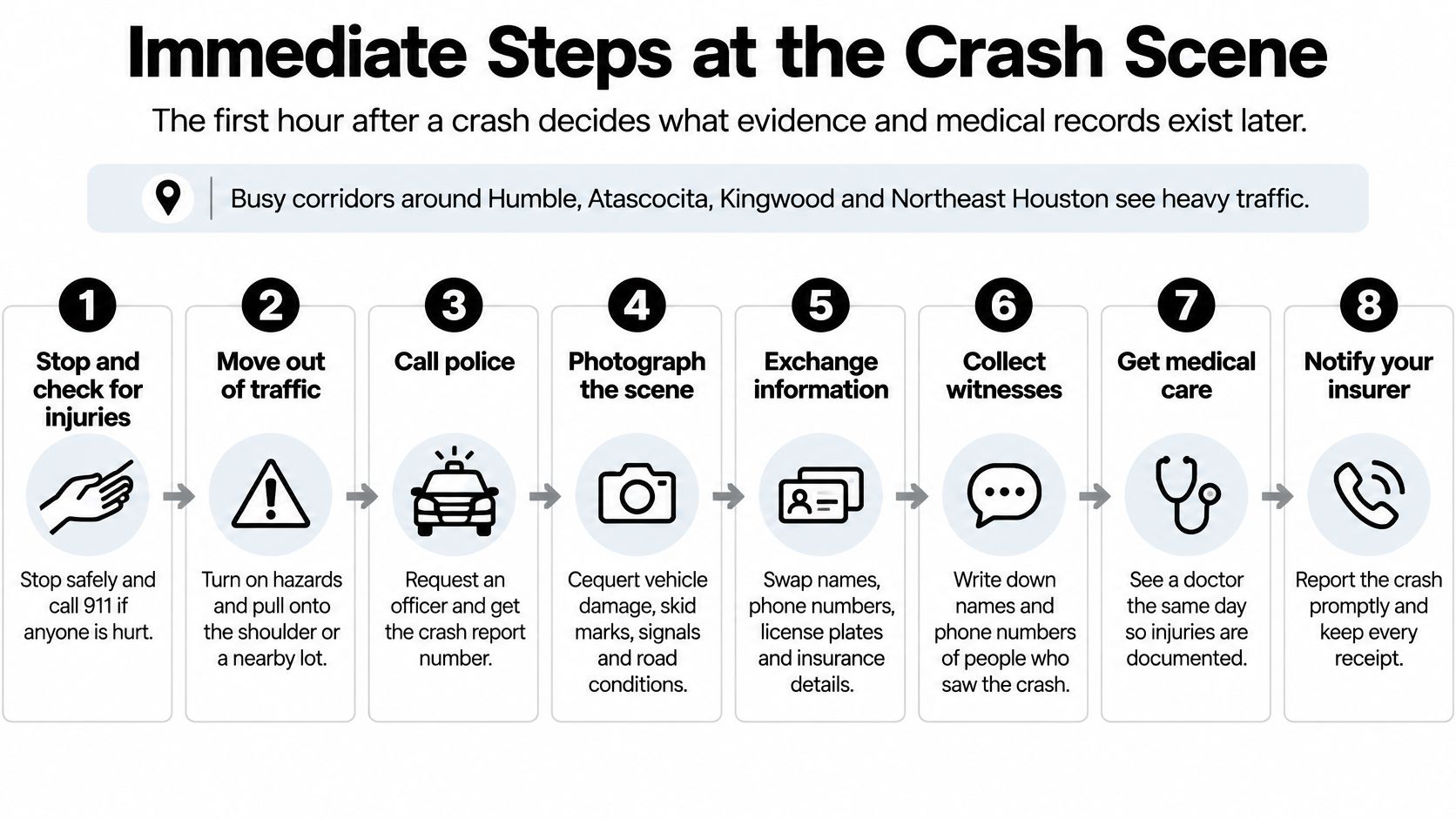
Phone checklist: safety, emergency help, driver information, photographs, witnesses, medical care, insurer notice, receipts.
If a commercial truck was involved, preserve the company name and identifying markings too. Our Humble truck accident information explains why the vehicle's owner and business records may matter alongside the driver's account.
Evidence to Gather Before It Disappears
Crash evidence to collect and where to get it
| Evidence | Why it matters | How to get it |
|---|---|---|
| Texas crash report (CR-3) | Records the parties and officer's observations | Through TxDOT crash records, a regular copy costs $6 and a certified copy costs $8 |
| Scene and vehicle photos | Show damage, positions, road conditions, and visibility | Photograph safely before vehicles are moved or repaired |
| Dashcam or nearby camera footage | May capture the impact and can be overwritten | Ask the owner or business to save the original recording immediately |
| Medical records and bills | Document injury findings, treatment, and costs | Request copies from each provider as treatment progresses |
| Wage records and missed work | Support a lost-income claim | Collect pay stubs, time records, and an employer letter |
| Repair estimates and rental receipts | Document property loss and transportation expenses | Keep every estimate, invoice, and receipt |
| Insurance correspondence | Establishes dates, claim numbers, and representations | Save emails, letters, and dated notes from calls |
The TxDOT city crash report for 2025 lists 2,294 reportable crashes, 862 people injured, 69 serious injuries, and 7 fatalities in Humble. Those are city figures based on processed peace-officer reports, not countywide totals, every roadway incident, or anyone's chances of winning a claim.
Build a sequence, not just a folder
A useful claim file explains what happened before impact, during impact, and afterward. Match the police diagram against photographs, traffic controls, damage locations, witness accounts, and vehicle event data when available.
For example, front-corner damage might fit more than one version of a lane-change collision. A recording showing when the vehicles crossed the lane marking may resolve what damage photographs cannot.
A lawyer may send preservation requests to businesses, vehicle owners, or other parties. Send requests promptly and identify the location, approximate time, and material to retain, but don't assume a request guarantees cooperation.
Separate injury proof from expense proof
Medical records explain findings and treatment; bills explain charges. Keep both, including records from ambulance services, emergency departments, specialists, and rehabilitation providers. Seasons Chiropractic's guide can help you gather bills for your injury claim without overlooking separate providers.
Evidence rule: An official crash report documents an investigation. It doesn't, by itself, decide civil fault or guarantee payment.
A certified report isn't an automatic guarantee of admissibility, either. If no report is available, preserve the underlying evidence and confirm reporting requirements with counsel rather than assuming a driver-completed form substitutes for an officer's investigation.
How Texas Fault Rules Change Your Recovery
An insurer's fault assessment can change the value of every settlement discussion. Texas uses modified comparative responsibility, meaning your own share of responsibility can reduce recoverable damages and, if it exceeds the permitted threshold, prevent recovery.
The practical issue is evidence, not how confidently an adjuster states a conclusion. A driver who says you stopped suddenly on the Eastex Freeway still needs an account that fits the traffic, sight distance, vehicle damage, and available recordings.
Challenge the reasoning, not just the result
Consider a hypothetical collision near Atascocita Road. The other driver says you changed lanes into them, while you say they drifted across the lane marking. Neither account becomes conclusive because someone reported it first.
Protect your position with a disciplined response:
- Describe facts only. Say what you observed without estimating speed or distance you couldn't reliably judge.
- Match each allegation to evidence. Identify which photograph, witness, or recording supports or contradicts it.
- Request the basis in writing. Ask what facts support the insurer's proposed allocation of responsibility.
- Review admissions carefully. Don't sign a statement accepting blame to move vehicle repairs forward.
A percentage reduction isn't the same as reducing a repair estimate. It can affect the entire damages calculation, including injury losses.
Don't negotiate against an unexplained fault percentage. Ask the adjuster to identify the evidence behind it.
A genuine liability dispute is a strong reason to seek legal review. Our Humble personal injury information provides context for evaluating responsibility and documenting losses. Counsel should explain the applicable fault threshold and apply it to your particular evidence before you accept a settlement.
Insurance Coverage That Applies to Your Crash
Texas crash coverage types compared
| Coverage | What it pays | Typical limit or rule |
|---|---|---|
| Liability (30/60/25) | Injury and property damages the insured driver owes others | Texas minimums are $30,000 per injured person, $60,000 per accident for bodily injury, and $25,000 for property damage, according to the Texas Department of Insurance auto insurance guide |
| Personal injury protection (PIP) | Covered accident-related costs regardless of fault | TDI's coverage guidance states most policies have a $2,500 limit, covering reasonable accident-related costs incurred within three years, subject to policy terms |
| Uninsured or underinsured motorist | Covered injury losses when the responsible driver has no insurance or insufficient insurance | Check your declarations page for purchased limits and applicable terms |
| Collision coverage | Repair or replacement of your vehicle | Your policy's coverage terms and deductible control |
When the other driver's coverage falls short
Say a Kingwood resident needs surgery and cannot return to work during recovery. The responsible driver's bodily-injury coverage may be exhausted before it covers the full loss. A policy limit isn't a medical valuation or the full value of a legal claim.
That's why reviewing your own policy matters even when you didn't cause the crash. Find the declarations page, the policy summary listing vehicles, coverage categories, limits, and deductibles. Look specifically for PIP and uninsured/underinsured motorist coverage, often abbreviated UM/UIM.
Check the actual policy rather than relying on an insurance card. The card establishes identifying information, but it doesn't show every available benefit or exclusion.
Before discussing a final offer, organize your treatment information, wage proof, property documents, and coverage details. Ask whether the proposed release resolves only vehicle damage or also gives up injury claims. Those are very different decisions.
Insurer Deadlines and How to Track Your Claim
The following general timelines apply to qualifying claims under your own automobile policy, as described in the Texas automobile insurance consumer bill of rights: acknowledgment within 15 days, a decision generally within 15 business days after necessary information arrives, a possible 45-day extension with an explanation, and payment generally within five business days after approval.
Texas insurer claim timelines
| Stage | Texas rule | What you should do |
|---|---|---|
| Acknowledgment | Insurer generally acknowledges receipt within 15 days | Confirm the claim number in writing |
| Information request | Insurer requests information it reasonably needs | Send records promptly and keep copies |
| Decision | Generally 15 business days after all necessary information is received | Record when you supplied the complete response |
| Extension | Up to 45 additional days with notice explaining why | Request the explanation in writing |
| Payment | Generally within five business days after approval notice | Track receipt and follow up if payment is late |
Track receipt, not just transmission
Create a claim log with columns for the date, person contacted, document requested, document sent, and next action. Save delivery confirmations and upload receipts. A screenshot of an insurer's portal can help establish what you submitted.
The decision period generally turns on receipt of reasonably necessary information, not the day you opened the claim. If the adjuster says something is missing, ask for a specific written list. A vague request for more records makes it difficult to tell whether you've completed your part.
You should also distinguish a request for information from an approval. Ask the adjuster to confirm the status and explain any unresolved issue in writing.
Tracking tip: End each follow-up with a concrete request, such as confirmation that the insurer received the attached records and identification of anything still needed.
The other driver's liability insurer handles your claim differently; don't assume this table governs that relationship. Before giving that insurer a recorded statement, get advice about its scope and purpose. With your own insurer, review cooperation obligations rather than refusing requests without guidance.
A missed deadline or repeated unexplained delay is a reason to have the file reviewed, not proof by itself that the insurer owes everything you requested.
Texas Deadlines and Harris County Lawsuit Steps
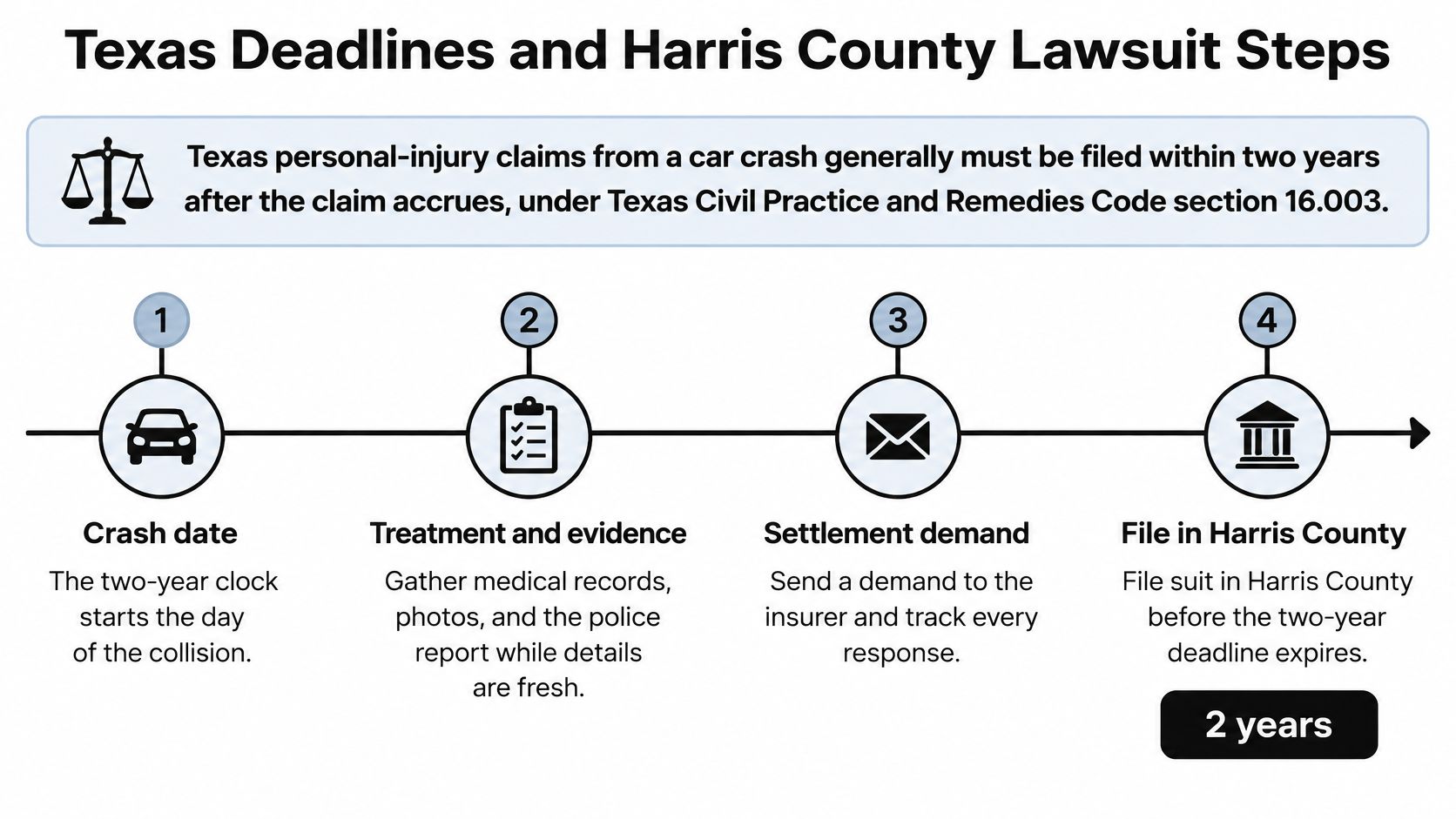
Under Texas Civil Practice and Remedies Code section 16.003, personal-injury claims generally must be filed within two years after the claim accrues, and actions involving injury resulting in death also have a two-year period. For an ordinary collision claim, the crash date is the starting point to investigate and calendar.
Insurance negotiations don't automatically extend the filing deadline. Confirm the actual deadline early, especially when a minor, governmental defendant, or wrongful-death claim is involved. Exceptions and separate notice obligations require fact-specific review.
Prepare the claim without losing the filing window
Identify the parties and preserve their records. The driver may not be the only potentially responsible person or business. Counsel should investigate ownership, employment, and other facts before deciding whom to pursue.
Develop a supported settlement demand. A demand explains responsibility, injuries, treatment, financial losses, and the amount sought. Medical and wage documentation give the insurer something concrete to evaluate.
Negotiate with a clear stopping point. Settlement can avoid litigation expense and uncertainty. But waiting for another offer isn't a sound reason to let a filing deadline expire, and signing too early can surrender claims for treatment needs that aren't yet understood.
This timeline shows the broad sequence, not a substitute for calculating your particular deadline.
What happens if a lawsuit is necessary
- Filing and service. Counsel selects the proper court, files the petition stating the claims, and arranges formal delivery to defendants. The amount sought and court authority matter; not every larger case belongs automatically in district court. Our explanation of Harris County civil courts at law jurisdiction helps clarify that distinction.
- Discovery. Both sides exchange relevant information through written questions, document requests, and depositions, which are sworn question-and-answer sessions.
- Mediation. A neutral mediator helps the parties explore settlement without deciding who wins.
- Trial. If the parties don't resolve the dispute, the court or jury decides contested issues based on admissible evidence.
Court schedules, treatment progress, and disputed evidence affect how long these stages take. Settlement remains possible during litigation, but it shouldn't be promised.
MatterAlert's explanation of how to count court days can help you understand calendar days, business days, and deadline calculations. Don't use a general calculator as the final authority for a lawsuit deadline; counsel must check the governing rule, accrual date, and applicable exceptions.
When to Call a Car Accident Lawyer and What to Bring
Call early when you need ongoing treatment, face disputed fault, lose income, or discover the responsible driver may lack adequate coverage. An insurer pushing for a full settlement before your medical outlook is clear is another reason to pause and get advice.
A consultation should help you understand the documents in front of you, not pressure you to sign them.

Private counsel is often a better fit when time matters because a private attorney can usually act with more urgency. Still, hiring counsel is a practical decision: the disputed amount, complexity, available insurance, and likely expense should all enter the conversation.
Understand the fee before signing
How car accident lawyers are typically paid
| Arrangement | How the lawyer is paid | Best fit |
|---|---|---|
| Contingency fee | An agreed share of money recovered, subject to the written agreement | Injury claims where the client cannot pay upfront |
| Hourly rate | Billed for time worked, usually owed regardless of outcome | Narrow disputes or limited advice |
| Flat fee | A fixed price for a defined task, such as reviewing a settlement | Limited tasks with a clear scope |
Ask for the fee terms in writing. Find out whether expenses are deducted before or after the attorney's fee, who pays expenses if there's no recovery, and what a sample net distribution would look like.
Don't assume that a contingency arrangement means every possible cost disappears if the case is unsuccessful. The agreement should answer that question plainly.
Bring a file that supports a useful conversation
Prepare these materials even if some records haven't arrived:
- Crash details. The report number, investigating agency, collision date, and a short timeline ending with today's date.
- Coverage information. Your declarations page and the other driver's insurance information.
- Medical status. Treatment summaries, symptoms, work restrictions, and upcoming appointments.
- Financial losses. Missed-work dates, wage documents, repair estimates, and transportation receipts.
- Insurer communications. Every offer, denial, proposed release, and request for a statement.
Have questions ready before reviewing any legal-services agreement. If possible, obtain advice before signing an insurer's release or giving a substantive recorded account.
This video is available for additional context while you prepare your questions.
The Law Office of Bryan Fagan is located at 414 E Main St, downtown Humble, TX 77338, serving Humble, Atascocita, Kingwood, Northeast Houston, and Harris County. Our core practice areas are family law, criminal defense, and estate planning, so confirm at intake whether your injury matter fits our services or whether you need a referral.
Our consultation process includes a confidential review, honest feedback on options and potential outcomes, and clear next steps. If the collision also creates a family, estate, or criminal-law issue, identify that separately so the appropriate attorney can address it.
Law Office of Bryan Fagan offers a free consultation to help you understand your options and determine the appropriate next step after a Humble-area crash. Call (281) 817-1827 or visit Law Office of Bryan Fagan to schedule with our Humble office, and tell intake about your injuries, any settlement paperwork, and approaching deadlines so we can confirm the right fit for your matter.