Skip to content

After an 18-wheeler crash near Humble, your family may be dealing with an injured passenger, a wrecked vehicle, missed work, and calls from an insurance adjuster before anyone has had time to understand what happened. On US-59, FM-1960, Beltway 8, or a Northeast Houston corridor, the trucking company may already have investigators reviewing the scene while you're still waiting for medical answers.
That early imbalance matters. A truck accident lawyer in Humble, TX, can protect evidence, manage communications with the carrier, investigate the driver and company, and help your family avoid decisions that weaken a claim. The first 24 to 72 hours deserve focused attention because electronic records, video, vehicle data, and scene evidence may not remain available indefinitely.
Why Humble Families Call a Truck Accident Lawyer After a Crash
A family leaving Atascocita for work might never expect a routine drive to become a legal and medical crisis. After a collision with an 18-wheeler, the truck driver may be speaking with a dispatcher, the carrier may be contacting its insurer, and the family in the smaller vehicle may be staring at crushed metal while trying to decide whether an emergency-room visit is necessary.
That is where a local truck accident lawyer becomes useful. The job isn't to file paperwork. The lawyer opens communication with the motor carrier and its insurance company, prevents the injured person from being pushed into an early recorded statement or quick settlement, and begins identifying every potentially responsible party.
A serious commercial-vehicle claim may involve the driver, the trucking company, a vehicle owner, a maintenance provider, a cargo-loading business, or another contractor. A lawyer can also bring in accident reconstruction professionals, trucking-regulation specialists, and medical experts when the facts justify that expense.
The first legal work happens before a lawsuit
On day one, counsel should be asking practical questions:
- What happened at the scene? Vehicle positions, lane markings, impact points, debris, skid marks, weather, and traffic signals can help reconstruct the collision.
- What was the driver doing before impact? Speed, following distance, lane position, fatigue, route demands, and hours-of-service compliance may matter.
- What records exist? Electronic logging device information, engine-control-module data, dashcam footage, inspection records, maintenance files, and driver records can provide evidence that a basic crash report won't capture.
- What will the injury cost? The assessment should include treatment, future care, lost wages, reduced earning capacity, pain, mental anguish, and the effect on ordinary family life.
The national scale of these crashes explains why trucking claims often require more investigation than an ordinary two-car collision. In 2023, 5,472 people were killed and 153,452 were injured in traffic crashes involving large trucks, according to NHTSA's 2023 large-truck crash summary. Seventy percent of those killed were occupants of other vehicles, so the injured person is frequently a driver or passenger in a smaller car.
For families in Humble, Kingwood, or Northeast Houston, the right lawyer should make the process understandable. You shouldn't have to negotiate with a national carrier while recovering from a traumatic brain injury, fracture, spinal injury, or other serious harm.
What to Do in the First Hours After a Truck Crash Near Humble
The first priority is safety, not evidence. If you can move without worsening an injury, get away from active traffic and wait for emergency responders in a secure location. Call 911 and request medical assistance, and make sure the crash is reported so the responding agency can create an official record.

A practical sequence for the scene
- Move only when it's safe. If you're unable to move, tell the dispatcher where you are and follow emergency instructions.
- Get medical attention. Adrenaline can mask pain. A medical evaluation also creates a record connecting symptoms to the crash.
- Exchange information carefully. Obtain the truck driver's name, employer, insurance details, license plate, and any visible Department of Transportation identification.
- Photograph what you can. Capture vehicle damage, the truck, road conditions, skid marks, debris, lane markings, signs, and nearby businesses or cameras. Don't enter traffic to get a better image.
- Keep your statements factual. Tell the officer what you remember, but don't guess about speed, distance, or fault. Avoid saying “I'm fine” when you're shaken or hurting.
Families often benefit from a written post-accident checklist for drivers because stress makes it easy to overlook basic information. The checklist shouldn't replace medical care or legal advice, but it can help preserve details while memories are fresh.
Dealing with the trucking insurer
An adjuster may call quickly and ask for a recorded statement, medical authorization, or permission to inspect your vehicle. You can provide basic identifying and insurance information, but you don't have to offer a recorded narrative before speaking with counsel. Don't speculate, minimize symptoms, or sign a release that you haven't reviewed.
Keep every medical appointment and follow discharge instructions. Save bills, prescription records, work notes, mileage information, photographs, and messages about the crash. A Humble personal injury lawyer can help organize those materials and communicate with the carrier while you focus on recovery.
Texas Law and Federal Trucking Rules That Shape Your Case
A Humble truck case is governed by Texas injury law, but the proof often comes from federal commercial-motor-carrier rules. The two systems work together. Texas law determines issues such as filing deadlines and comparative responsibility, while federal records may show whether the driver or carrier violated a safety obligation.
Texas generally gives an injured person two years from the crash date to file a personal-injury lawsuit. The deadline usually begins on the accident date, not when treatment ends or the full extent of an injury becomes clear, as explained in this overview of the Texas truck-accident statute of limitations.
Texas also uses modified comparative negligence. A claimant whose responsibility is greater than 50 percent is barred from recovery. If the claimant is 50 percent or less at fault, the damages recovered are reduced by that percentage, according to this explanation of Texas's 51 percent rule.
| Issue | Texas Law | Federal FMCSA Rule |
|---|---|---|
| Filing deadline | Most injury claims generally must be filed within two years of the crash | Federal rules don't replace the Texas filing deadline |
| Shared fault | Recovery may be reduced by the claimant's responsibility, and responsibility above 50 percent bars recovery | Driver and carrier records may help establish how responsibility should be allocated |
| Driver fatigue | Fatigue evidence can support a negligence claim | Hours-of-service rules apply to qualifying commercial drivers |
| Vehicle condition | Maintenance evidence can support claims against responsible parties | Inspections, repairs, and safety records may show regulatory or operational failures |
| Electronic records | Relevant evidence may be requested or subpoenaed in litigation | ELD, ECM, telematics, and other carrier records may help test the driver's account |
FMCSA's hours-of-service summary states that a commercial driver can't drive beyond the 14th consecutive hour after coming on duty, following 10 consecutive hours off duty, and identifies the governing rules in 49 CFR 395. A lawyer may compare those requirements with ELD data, dispatch messages, delivery schedules, fuel records, and witness accounts.
The causation analysis is technical. FMCSA's Large Truck Crash Causation Study analysis identified critical events including running out of the travel lane, loss of control, and rear-end collisions. It also identified factors such as brake problems, traffic interruptions, speed for conditions, roadway unfamiliarity, roadway problems, and fatigue. Those details explain why a crash report alone may not answer who caused the collision.
Why Early Evidence Preservation Can Make or Break a Humble Truck Case
A trucking company may preserve some records as part of its normal process, but a family shouldn't assume every relevant file will remain available. Within the first 24 to 72 hours, a truck accident lawyer should send a written preservation demand, often called a spoliation letter, identifying the collision and instructing the carrier to preserve relevant physical and electronic evidence.

Records that deserve immediate attention
The demand should address more than the truck's repair file. It should identify:
- Dashcam and rear-facing video, including footage stored on a loop.
- ECM and telematics data, which may contain speed, braking, engine, and vehicle-event information.
- ELD records, dispatch communications, GPS information, and route data.
- Driver qualification and training files, including licensing and safety history.
- Inspection and maintenance records, especially brake, tire, steering, and lighting work.
- Post-crash drug and alcohol testing records, where applicable.
- Weight tickets, bills of lading, and cargo-securement records, which may show an overloaded or improperly secured load.
FMCSA states that a loaded tractor-trailer traveling at 55 mph needs about 196 feet to stop in ideal conditions, compared with 133 feet for a passenger vehicle, as described in its commercial-driver following-distance guidance. That difference makes speed, spacing, brake condition, and lane position important in a crowded Humble or Northeast Houston corridor.
A lawyer should also arrange a prompt scene review on US-59, Beltway 8, or FM-1960. Skid marks and debris can disappear, construction can change the road, and nearby video systems may overwrite recordings. TxDOT footage and business-camera recordings often require prompt identification and preservation requests.
A short explanation of why the scene and records matter is available through this Humble premises liability lawyer resource. The legal theory may differ, but the evidence-preservation discipline is similar.
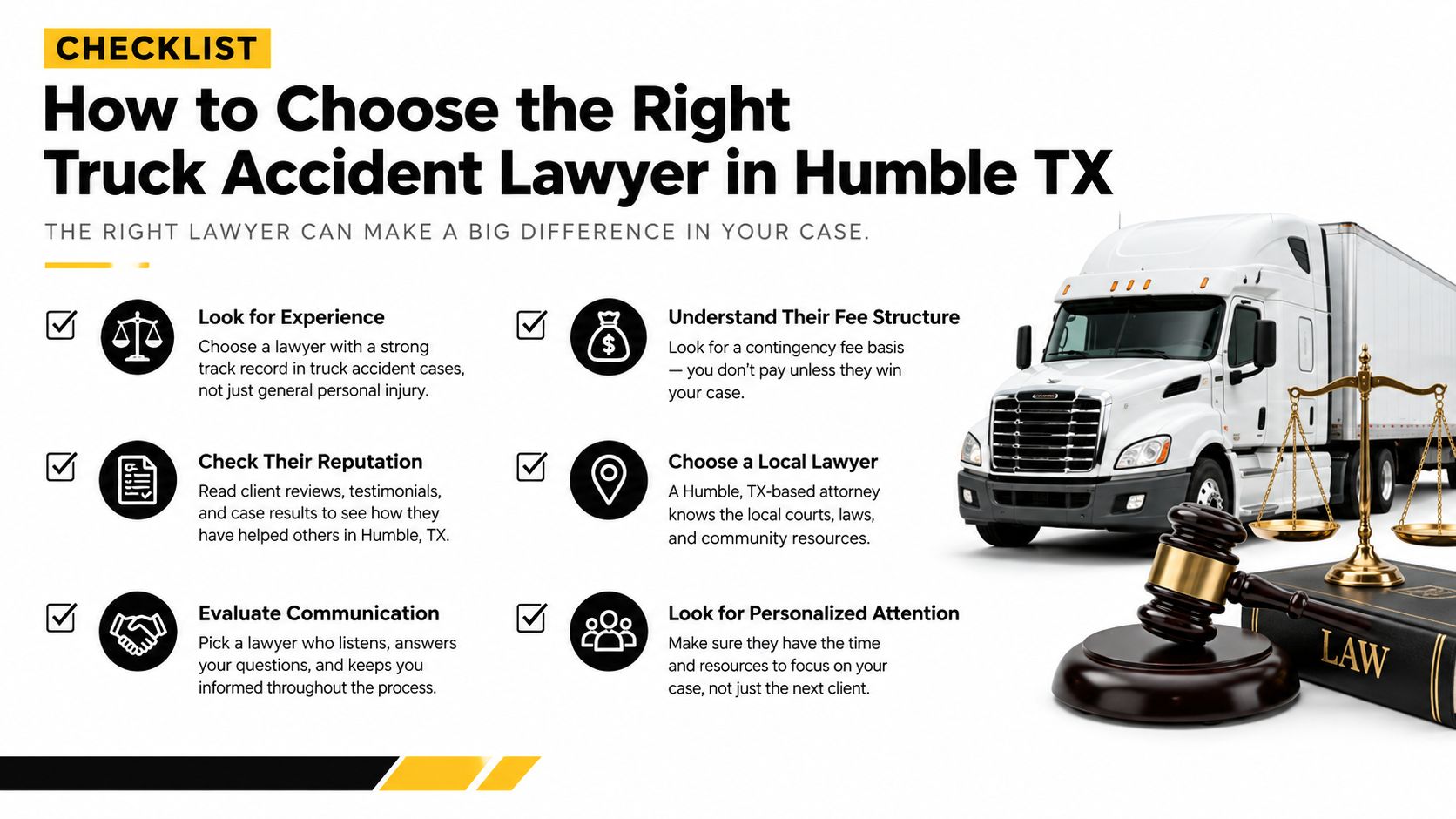
How to Choose the Right Truck Accident Lawyer in Humble TX
A lawyer who handles ordinary vehicle claims may not have the resources or experience needed for a commercial-truck investigation. Ask questions that reveal who will work on the file and how the firm will confront a carrier with a large defense budget.
Four checks before you hire
Look for truck-specific experience. Ask for examples involving 18-wheelers, commercial carriers, cargo issues, driver fatigue, mechanical failures, or disputed comparative fault. Generic personal-injury advertising doesn't answer whether the lawyer understands trucking evidence.
Test local familiarity. A lawyer should understand the practical setting around Humble, Atascocita, Kingwood, Fall Creek, Harris County, and the Northeast Houston corridors. Ask how the firm handles scene inspections, local records, witnesses, and court scheduling.
Ask about technical resources. Find out whether the firm can work with accident reconstructionists, ECM-data analysts, medical experts, and people familiar with FMCSA regulations. You should also ask who pays litigation costs and when those costs are incurred.
Read the fee agreement. A contingency arrangement should explain the attorney's fee, case expenses, expert costs, medical liens, and what happens if the claim doesn't resolve. Never rely on a verbal promise when the written agreement can answer the question.
A useful consultation question: “Who will be my day-to-day contact, and will the attorney I meet personally handle major decisions, negotiations, and litigation?”
Be cautious about guaranteed outcomes, pressure to sign immediately, a firm that offers only a paralegal contact, or a lawyer who can't explain trial experience. You can also ask how the firm evaluates an independent-contractor issue, what preservation letters it sends, and whether it will pursue litigation when a carrier refuses a fair resolution.
For context about how a different category of Harris County litigation proceeds, Harris County Family Courts: A Humble Resident's Guide describes family-law cases in the Harris County courts serving Humble. That information isn't a truck-claim guide, but it illustrates why local court familiarity can matter in legal planning.
Damages, Settlement Timelines, and What Recovery Looks Like
A settlement isn't based only on the vehicle photograph or the first hospital bill. The value of a Humble truck claim depends on the injury, medical outlook, work impact, available insurance, evidence of fault, and the injured person's share of responsibility.
Economic damages may include past medical expenses, reasonably necessary future care, lost wages, and diminished earning capacity. Non-economic damages may include pain, mental anguish, physical impairment, disfigurement, and loss of enjoyment of life. In cases involving particularly serious misconduct, exemplary damages may be considered under Texas Civil Practice and Remedies Code section 41.003, subject to the requirements and limits of Texas law.
There isn't a reliable settlement table that can predict a case from injury labels alone. The available facts don't establish universal settlement ranges, and publishing invented dollar brackets would mislead families. A broken bone with a full recovery presents a different claim from a permanent brain or spinal injury, even if both began in the same type of collision.
How resolution usually develops
- Investigation and treatment: Counsel gathers records, preserves evidence, reviews fault, and tracks the medical course.
- Demand preparation: Once the injury picture is sufficiently understood, the lawyer presents liability evidence and damages documentation to the carrier.
- Negotiation: The insurer reviews the demand and may challenge fault, treatment, causation, or future losses.
- Mediation or litigation: If negotiation stalls, mediation may help. A lawsuit may be necessary to obtain records, question witnesses under oath, and prepare the case for trial.
- Resolution and liens: Before funds are distributed, medical bills, insurance interests, and other liens must be addressed.
Ongoing treatment can extend negotiations because a family shouldn't settle before doctors can reasonably evaluate future care. A disputed liability issue, multiple defendants, unavailable records, or litigation in Harris County can also lengthen the process.
Texas comparative negligence remains central throughout. If the evidence assigns the injured person 20 percent responsibility, a recoverable award may be reduced accordingly. If the defense persuades the fact finder that responsibility exceeds the statutory threshold, recovery may be barred.
When a crash kills someone, the family may need a different legal analysis involving wrongful-death beneficiaries, survival claims, damages, and estate issues. The Humble wrongful-death lawyer resource addresses that separate situation.
Questions Humble Families Ask After a Truck Crash
Should I give the trucking company a recorded statement?
You can provide basic identifying information, but you don't need to give a recorded account before getting legal advice. A recorded statement may later be compared with medical records, photographs, witness testimony, and vehicle data. Don't guess about speed or distance, and don't minimize pain because symptoms seemed manageable at the scene.
How long will a Humble truck case take?
The answer depends on treatment, liability disputes, the number of responsible parties, records, insurance issues, and whether a lawsuit becomes necessary. Some claims resolve during negotiations. Others require depositions, expert analysis, mediation, and trial preparation. A lawyer should explain the factors affecting your case rather than promise a fixed timeline.
What if the truck driver was an independent contractor?
The label doesn't end the analysis. The relationship between the driver, motor carrier, vehicle owner, dispatching company, and maintenance or cargo businesses must be examined. Contracts, control, hiring practices, insurance, and the driver's work records may all matter.
Can I recover if the injured person was partly at fault?
Possibly. Texas permits recovery when the claimant is 50 percent or less responsible, but the damages are reduced by the assigned percentage. Responsibility greater than 50 percent bars recovery under the state's modified comparative-negligence rule.
How does uninsured or underinsured motorist coverage fit in?
Your own policy may provide protection if the responsible party lacks enough insurance, but the policy language, exclusions, notice requirements, and carrier's position matter. Don't assume your insurer is automatically aligned with you. Give notice as required and have the coverage reviewed.
What happens with medical bills while the claim is pending?
Ask providers and insurers about health coverage, payment arrangements, letters of protection, or medical liens before signing anything. Keep every bill and explanation of benefits. A lawyer should explain how proposed settlement funds may be affected before you accept an offer.
Can a minor or elderly relative bring a claim?
A minor may have claims through a parent or legal representative, while an elderly injured person may pursue damages for medical care, impairment, pain, and other losses. Capacity, guardianship, dependency, and estate issues can change the procedure. The facts need individual review.
The safest next step is a local consultation, because the correct strategy depends on the crash report, injuries, insurance, witnesses, and records that still exist.
The Law Office of Bryan Fagan offers free consultations and personalized legal guidance for families dealing with serious legal problems, including the evidence and insurance issues that arise after a Humble-area truck crash. Visit Law Office of Bryan Fagan to schedule a consultation with a local team serving Humble, Atascocita, Kingwood, and Northeast Houston.