Skip to content

You're sitting at home in Humble, trying to understand how a family argument turned into an assault case. Maybe the arrest followed a gathering near FM 1960. Maybe you've already been booked, released on bond, and told not to contact someone you've known for years. Your phone keeps lighting up, your job needs an explanation, and nobody has given you a clear answer about whether you're facing a fine, county jail, or a felony.
An assault charge isn't one thing in Texas. The alleged injury, the identity of the complainant, the presence of a weapon, prior family-violence allegations, and the exact words in the police report can change the entire case. Your first decisions matter, especially before you speak with detectives, post on social media, or violate a bond condition.
A Humble Resident Facing Assault Charges Right Now
A parent from Atascocita may leave a family gathering after a heated dispute believing the matter is over. Instead, Humble officers arrive, someone points to a bruise, and the parent is taken for booking. The next stop may be the Harris County Joint Processing Center. By the time family members start calling around, a magistrate may have set bond conditions that affect where the accused can go, who they can contact, and whether they can return home.
That situation creates practical problems immediately. A spouse may need childcare. A parent may need medication or work equipment from the shared home. An employee may worry that an arrest will reach a supervisor. The person accused may feel angry, embarrassed, frightened, or certain that the other person is lying. Those emotions are understandable, but acting on them can make the case worse.
Your first job is not to win the argument with the complainant. Your first job is to protect your freedom and preserve evidence.
The charge could range from a fine-only Class C misdemeanor to a felony carrying years in prison. Texas law makes those distinctions based on what the state alleges happened, not on whether someone was arrested. A no-contact order can also create a separate legal problem if you send a message, ask a relative to pass one along, or return home without understanding the order.
The Harris County docket adds pressure. Assault cases move through a busy system where bond decisions, prosecutor review, court settings, and negotiations all affect the pace. A defense lawyer should examine the report, body-camera footage, 911 evidence, photographs, medical records, witness accounts, and every condition attached to your release.
This guide focuses on the decisions that matter in Humble, Kingwood, Northeast Houston, and the surrounding Harris County courts. You'll find the charge definitions, the first steps after arrest, the defense theories that can change the case, the collateral effects of family-violence allegations, and a practical way to choose an assault charges lawyer in Humble TX.
How Texas Defines Assault and What Each Charge Really Means
Texas assault law starts with the conduct the state says occurred. Under Penal Code § 22.01, the allegation may involve intentionally, knowingly, or recklessly causing bodily injury, threatening imminent bodily injury, or making physical contact that another person reasonably regards as offensive or provocative. A person doesn't need a visible injury for the state to allege assault.
The injury theory matters most at the misdemeanor level. Assault by threat or offensive contact is typically a Class C misdemeanor, while assault causing bodily injury is generally a Class A misdemeanor. The statute also allows felony treatment in protected-victim situations, including certain allegations involving public servants and other protected categories. See the statutory overview of Texas assault classifications and enhancements.
The penalty ladder
A Class C allegation usually concerns offensive contact or a threat without the bodily-injury theory. It's fine-only, with a maximum fine of $500, and it doesn't carry jail time under the cited Texas assault framework. A Class A assault allegation claims bodily injury and can carry up to 1 year in county jail and a fine up to $4,000, as summarized in Texas assault bodily-injury defense information.
Aggravated assault raises the stakes further. The allegation may involve serious bodily injury or a deadly weapon, and the offense can be a second-degree felony punishable by 2 to 20 years in prison and a fine up to $10,000. Texas also classifies some repeat or relationship-based assaults as felony levels, including third-degree felony punishment of 2 to 10 years or first-degree felony punishment of 5 to 99 years or life, depending on the alleged circumstances. Those ranges are summarized in Harris County assault law guidance.
| Charge | Key element | Classification | Punishment range |
|---|---|---|---|
| Assault by threat or offensive contact | Threat of imminent injury or offensive physical contact | Class C misdemeanor, typically | Fine up to $500 |
| Assault causing bodily injury | Alleged physical pain, illness, or impairment | Class A misdemeanor, generally | Up to 1 year in county jail and up to a $4,000 fine |
| Aggravated assault | Serious bodily injury or deadly weapon allegation | Second-degree felony, in the stated framework | 2 to 20 years in prison and up to a $10,000 fine |
The alleged injury and weapon question often drive negotiations because they determine how much exposure the prosecutor can argue. A photograph of redness, a medical record, a broken object, or a witness description may be used to support the state's version. Your lawyer needs to test whether the evidence proves the required element, rather than accepting the charge label.
For families dealing with related custody or protective-order disputes, Harris County Family Courts: A Humble Resident's Guide describes how family-law cases proceed in the Harris County courts serving Humble.
What the Harris County Docket Tells You About Your Case
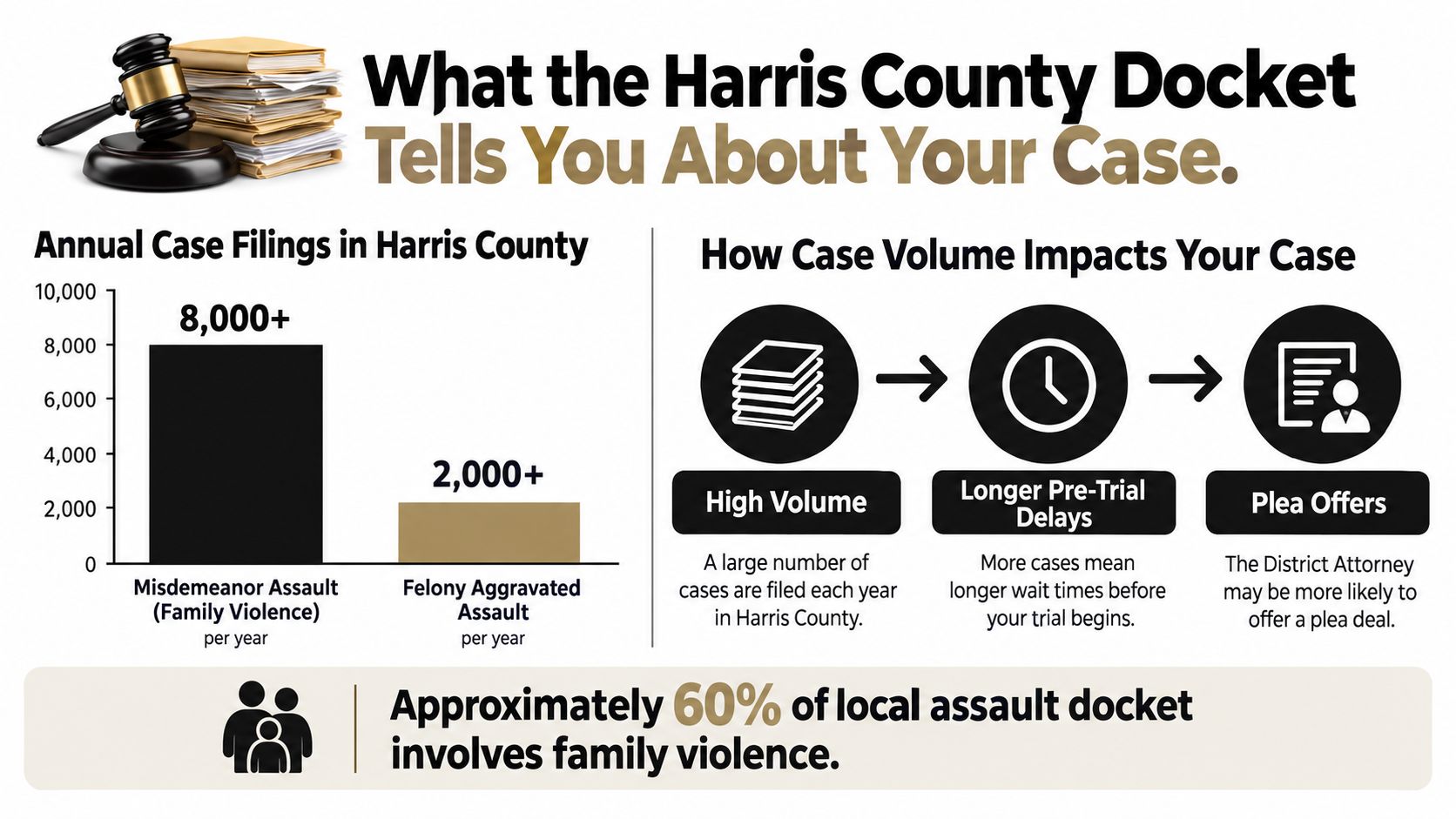
Harris County's volume changes the practical experience of an assault case. The Houston Law Review's summary of county misdemeanor filings lists 12,220 assault cases in 2023 and 12,207 in 2024, with assault representing 24% and 23% of the listed misdemeanor categories in those years, respectively. The same dataset lists 5,517 assault filings in the first half of 2025, showing sustained filing volume rather than a single unusual year. These figures come from the Houston Law Review analysis of Harris County misdemeanor bail reforms.
Volume creates pressure, not a predetermined result
A busy docket can produce quick bond decisions, repeated resets, and plea discussions before the defense has gathered the evidence. Prosecutors and defense lawyers may be managing many files at once, so a weak or incomplete early presentation can leave the initial police narrative unchallenged.
That doesn't mean every case receives the same outcome. It means your lawyer has to create a reason for the prosecutor to reassess the file. Medical records, photographs, witness statements, text messages, 911 audio, and video can change the discussion when they contradict the report or show a different level of conduct.
Bond conditions also deserve close attention. A person released in Humble may face no-contact restrictions, limits on returning to a residence, or other conditions that affect family and work. Read the court paperwork carefully and ask counsel about every unclear term. Practical information about the hearing process appears in what happens at a bond hearing.
A case can also become harder to defend if the accused violates release conditions. Do not treat a bond order as a suggestion. If the order bars contact, don't send an apology, ask for belongings, or use a relative as a messenger without legal advice.
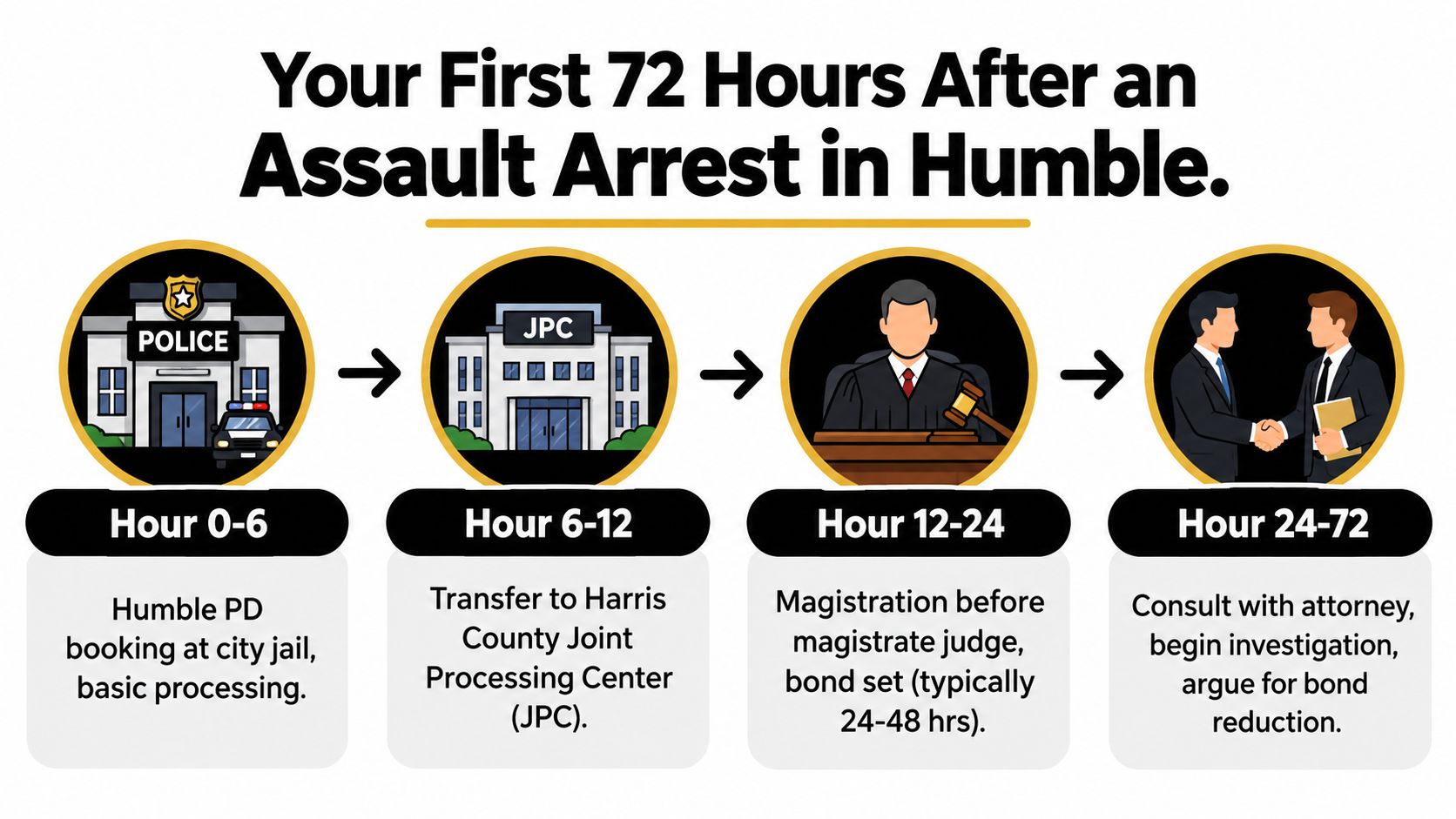
Your First 72 Hours After an Assault Arrest in Humble
The first hours are about control. You need to avoid new evidence against yourself, understand the release terms, and help your lawyer locate evidence before it disappears.
Start with your own words
After booking by Humble police, you may remain at a city facility or be transferred to the Harris County Joint Processing Center. A magistrate reviews the arrest and addresses bond and possible conditions. Don't use that waiting period to explain the entire incident to officers or detectives.
Say that you want a lawyer. Then stop discussing the facts. Don't assume a casual conversation is private, and don't believe that explaining your side before counsel arrives will automatically correct the report. Calls from custody may be recorded or monitored, and statements made to friends or relatives can later reach investigators.
Your family can help by locating identification, prescription information, employment details, and a lawyer. They shouldn't contact the complainant, argue with witnesses, delete messages, or post about the incident. A well-intended phone call can look like pressure or retaliation.
Preserve evidence without creating more problems
Write down the names and contact information of independent witnesses for your lawyer. Save existing messages, photographs, location information, receipts, and relevant videos. Don't edit, forward, or annotate material in ways that could raise questions about its authenticity.
Ask counsel to pursue 911 audio, body-worn camera footage, nearby store video, and other records. Security systems may overwrite footage, and witnesses may become difficult to locate. If you suffered injuries, obtain medical documentation and photographs, but don't use social media to tell your story.
Do not contact the alleged victim to negotiate peace, retrieve property, or ask for a changed statement until your lawyer reviews the order and the risk.
Bond conditions may include a no-contact provision or restrictions connected to family violence. Some cases may also involve issues such as family-violence surcharges or ignition-interlock conditions. Those terms depend on the order and the allegations, so don't rely on what another person's case required.
Your lawyer should also confirm the next court setting, check whether the charge matches the evidence, and begin investigating before the prosecutor's initial position hardens. If you're released, keep every court date and comply with every written condition.
Common Defense Strategies and How They Actually Work
A defense theory has to fit the evidence. Saying “self-defense” without explaining who started the physical encounter, what threat existed, and whether the response was proportionate won't carry much weight with a prosecutor or jury.
Texas Penal Code §§ 9.31 and 9.32 recognize circumstances in which force or deadly force may be justified. Deadly force is limited to specific situations, including when a person reasonably believes it's immediately necessary to prevent certain violent crimes or serious harm. The governing framework appears in Texas self-defense law under Penal Code § 9.31.
| Defense theory | Facts that strengthen it | Key weakness to prepare for |
|---|---|---|
| Self-defense | Injuries on the accused, independent witnesses, video showing the initial attack, and a measured response | The state may argue the defendant started the confrontation or used excessive force |
| Defense of another person | Evidence that another person faced an immediate threat and the intervention stopped once the danger ended | A jury may question whether the intervention was necessary |
| Lack of bodily injury | No medical treatment, limited or inconsistent injury descriptions, and evidence supporting only contact or threat | The state may rely on testimony describing pain even without visible injury |
| Credibility challenge | Prior inconsistent statements, changing accounts, contradictory texts, and body-camera footage | Attacking the complainant without an alternate factual narrative can look evasive |
| Mutual combat or consent | Messages, witnesses, and circumstances showing a mutual physical encounter | Consent has limits and doesn't automatically excuse injury or prohibited conduct |
Defense of property and accident theories may also matter, depending on the facts. A person who grabbed an arm to prevent a vehicle from moving, for example, presents a different factual question from someone alleged to have struck another person during an argument. The lawyer needs to identify the precise act the state intends to prove.
Family-violence cases require careful presentation because the allegation can affect bond, protective orders, and later family-law disputes. The defense should pair the legal theory with a coherent account supported by objective evidence. For readers trying to examine their own reactions and emotional patterns, an anger test for emotional insight may offer a private starting point, but it isn't a substitute for legal advice or a defense evaluation.
The practical question is whether the evidence supports dismissal, reduction, diversion, trial, or another resolution. A discussion of possible dismissal paths appears in how to get charges dismissed.
Choosing an Assault Charges Lawyer in Humble TX
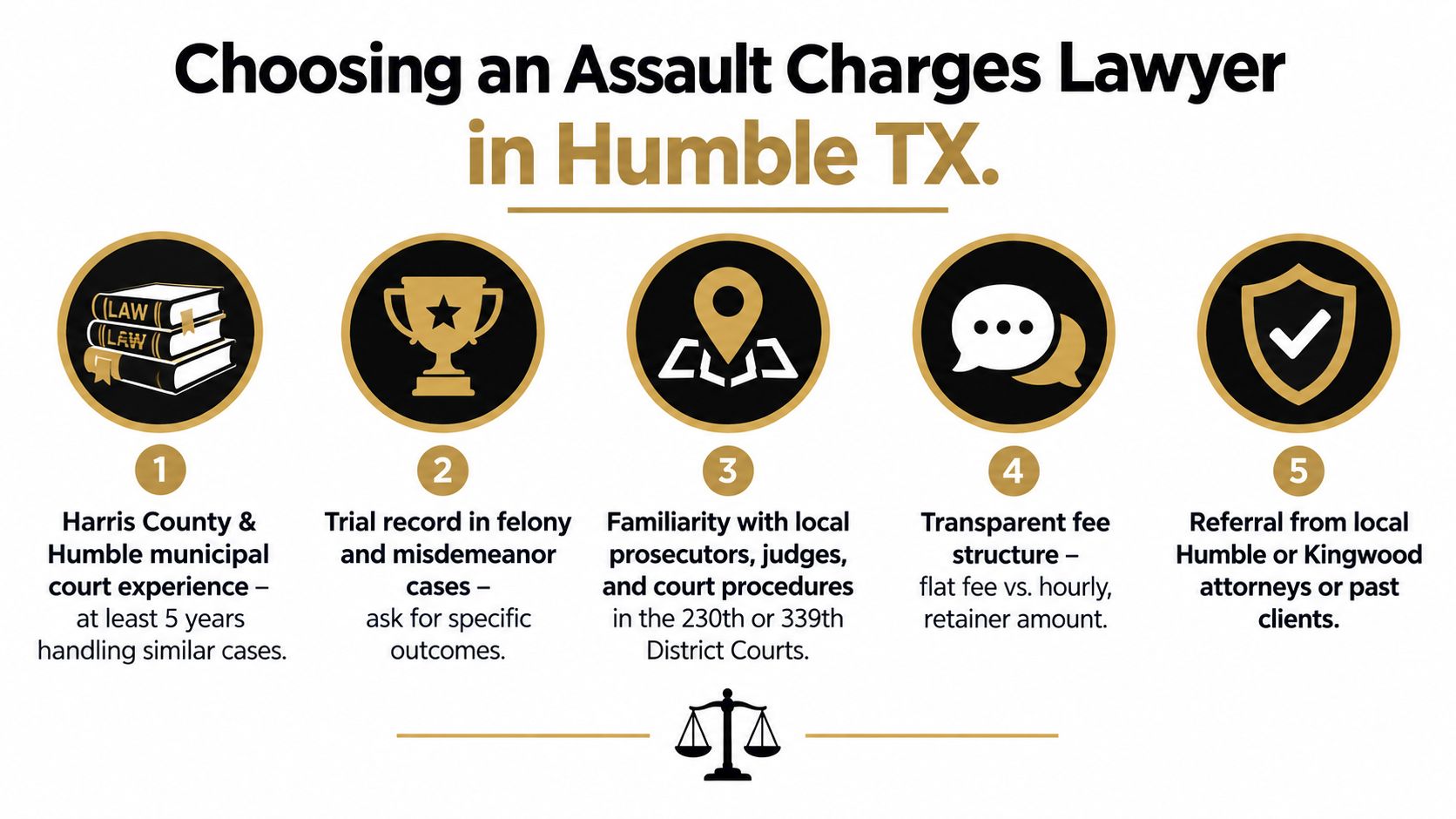
The right lawyer should do more than quote a punishment range. You need someone who understands Humble-area arrests, Harris County criminal dockets, municipal procedures, bond conditions, and the difference between a routine misdemeanor and a case with felony or family-violence consequences.
Start with a focused interview. Ask who will handle the case, how often that lawyer appears in the relevant court, whether the lawyer visits clients in custody, and how the firm communicates after the first setting. Ask how the lawyer evaluates body-camera footage, 911 evidence, medical records, witness accounts, and protective-order paperwork.
Questions that reveal how the lawyer works
- Local experience: Ask about actual work in Harris County and Humble courts, not just a general criminal-defense practice.
- Trial preparation: Ask whether the lawyer handles both misdemeanor and felony trials and what facts would make trial a sensible option.
- Case staffing: Find out whether the lawyer you meet will appear in court or whether another attorney will take over.
- Fees: Request a written agreement that explains the flat fee or hourly arrangement, what the retainer covers, and what could cost extra.
- Collateral consequences: Ask how the firm addresses protective orders, firearm restrictions, employment concerns, family-law effects, and record remedies.
A guarantee of dismissal is a warning sign. So is a lawyer who won't provide a written fee agreement or refuses to discuss consequences beyond the next court date. No responsible attorney can promise a result before reviewing the evidence and the prosecution's legal theory.
A strong consultation should leave you with a clear list of next steps, not vague reassurance. Bring the charging paperwork, bond documents, protective-order materials, court notices, photographs, and names of witnesses. If you're in Kingwood, Atascocita, or Northeast Houston, choose a lawyer who can realistically manage the Harris County court where your case is pending.
Life After the Case and How We Can Help
The end of the criminal case may not end the consequences. A family-violence finding or conviction can affect firearm possession, housing, employment, licensing, custody disputes, and protective-order litigation.
The Texas Family Violence Benchbook explains that people restrained by a protective order or convicted of a family-violence crime can be barred by state and federal law from possessing firearms or ammunition. Protective-order materials also address firearm surrender and possession restrictions. Review the Texas Family Violence Benchbook discussion of firearm restrictions with counsel, especially before possessing, transferring, or storing a firearm.
Civil and family-law consequences
A magistrate protective order and a longer civil protective order are different legal tools, but both can impose restrictions that affect where you live and whom you contact. A pending assault allegation can also become part of a custody dispute, especially when parents are already litigating conservatorship, possession, or a protective order.
Employment and professional licensing require separate attention. Some employers ask about arrests, charges, or convictions. Licensing agencies may require disclosures. Whether a case can be expunged or sealed depends on the disposition, eligibility requirements, waiting rules, and statutory procedure. Texas law provides expunction and nondisclosure pathways in qualifying situations, including certain Class C and misdemeanor outcomes, but eligibility isn't automatic. Guidance on sealing a criminal record in Texas can help you identify questions for your lawyer.
A dismissal or reduction may still require follow-up work. Keep the final paperwork, confirm what appears in record searches, and ask whether a family-violence finding was entered separately from the criminal disposition. If family court is involved, your criminal-defense lawyer and family-law lawyer should coordinate so that a plea decision doesn't create an avoidable custody or protective-order problem.
The Law Office of Bryan Fagan handles criminal-defense matters for Humble residents and can connect those concerns with family-law support when an assault case affects custody or protective orders. The firm also serves Atascocita, Kingwood, and Northeast Houston, with a Humble office available for a free case review.
If you're facing an assault charge, contact the Law Office of Bryan Fagan to discuss the arrest, bond conditions, evidence, and family-violence consequences with a local legal team. Bring your paperwork and act promptly, because early decisions can shape both the criminal case and what follows it.