Skip to content

A traffic stop on FM 1960, a search of an apartment in Atascocita, or a package bought from a smoke shop can turn an ordinary evening into a criminal case. Many people who contact a marijuana possession lawyer in Humble, TX assume the charge is minor because the amount is small or the product was labeled hemp. Texas law doesn't make that assumption safe.
The important questions are practical. How much did the substance weigh? Was the search lawful? Did the person possess it, or was it found in a shared vehicle or apartment? Could Harris County diversion apply? Was the substance marijuana, compliant hemp, or a restricted hemp-derived THC product? The answers can affect whether the case ends through dismissal or diversion, or whether it creates a misdemeanor or felony record.
A Night That Changes Everything in Humble
A 19-year-old Lone Star College student is driving along FM 1960 after class when a Humble police officer says the vehicle smells like marijuana. The officer searches the center console and finds a small bag. The measured contents weigh 2.3 grams, far below a pound, but the allegation still fits Texas's Class B misdemeanor possession tier. The student spends the night dealing with handcuffs, a vehicle tow, and jail intake at the Harris County Joint Processing Center. Nursing school applications now carry a question he never expected to answer.
The amount may be small, but the legal problem isn't imaginary. A conviction can create a criminal record and raise questions for schools, employers, housing providers, licensing authorities, and immigration officials. The student needs counsel to examine whether the stop, search, consent, odor claim, and evidence handling support the charge.
Practical rule: Don't explain the facts to investigators after an arrest. Ask for a lawyer, keep quiet, and write down what happened while the memory is fresh.
Across town, a 34-year-old construction worker faces a different problem. Police search his Humble apartment after a confidential informant reports a purchase. A roommate's jar and a digital scale are in a common area. The worker says the marijuana isn't his, but the State may argue that he knew about it and exercised control over it. A shared address doesn't automatically prove possession, yet proximity can create a difficult constructive-possession dispute.
The first decisions happen quickly
Both people may face a magistrate decision within 48 hours, including a bond determination and possible release conditions. Family members often focus on getting someone home, while the defense also needs to preserve body-camera footage, identify witnesses, obtain search paperwork, and determine how police calculated the weight.
A bond hearing guide for Humble residents can help families understand that first court appearance, but it can't replace case-specific advice. The next question is whether the evidence supports the charge and whether an early local resolution is available.
The rest of this guide explains the weight tiers, Harris County procedure, diversion, the 2026 hemp-THC problem, and the defenses that can change the outcome. A Humble marijuana possession lawyer changes the math by testing the State's evidence instead of treating the arrest report as the final word.
How Texas Weighs the Consequences
Texas measures marijuana possession by weight, and the penalty ladder rises sharply. Under Texas Health and Safety Code § 481.121, 2 ounces or less is a Class B misdemeanor, punishable by up to 180 days in county jail and a fine of up to $2,000. The statute and its penalty ranges are summarized in the Texas marijuana possession penalty provisions.
The next tier, more than 2 ounces but no more than 4 ounces, is a Class A misdemeanor, carrying up to 1 year in county jail and a fine of up to $4,000. Once the amount exceeds 4 ounces, the case becomes a felony. More than 4 ounces but 5 pounds or less is a state jail felony, with 180 days to 2 years in a state jail facility and a fine of up to $10,000. See the Texas possession penalty explanation for the statutory progression.
The weight decides the charge level
| Amount | Charge level | Maximum penalty |
|---|---|---|
| 2 ounces or less | Class B misdemeanor | Up to 180 days in county jail and up to $2,000 fine |
| More than 2 ounces to 4 ounces | Class A misdemeanor | Up to 1 year in county jail and up to $4,000 fine |
| More than 4 ounces to 5 pounds | State jail felony | 180 days to 2 years in a state jail facility and up to $10,000 fine |
| More than 5 pounds to 50 pounds | Third-degree felony | 2 to 10 years in prison |
| More than 50 pounds to 2,000 pounds | Second-degree felony | 2 to 20 years in prison |
| More than 2,000 pounds | First-degree felony | 5 to 99 years or life and up to $50,000 fine |
A defense lawyer won't accept the officer's estimate without checking the laboratory report, packaging, plant material, residue, and chain of custody. The Texas marijuana penalty ranges confirm that more than 4 ounces but less than 5 pounds is already a state jail felony.
Small differences can have large effects
A bag that crosses a threshold can move a case into a different punishment class. That can affect employment, housing, professional licensing, financial aid, immigration, and family-law disputes. The precise question isn't what the officer called the substance. It is what the State can prove about the substance, its usable weight, and the defendant's possession.
Drug-free-zone allegations can add another layer. A school, playground, or public housing location may create an enhancement, so counsel must examine the exact location rather than rely on a generic arrest description. Parents, students, and workers in Humble, Kingwood, Atascocita, and Northeast Houston should treat the location as a fact requiring verification.
Inside the Harris County Court Process
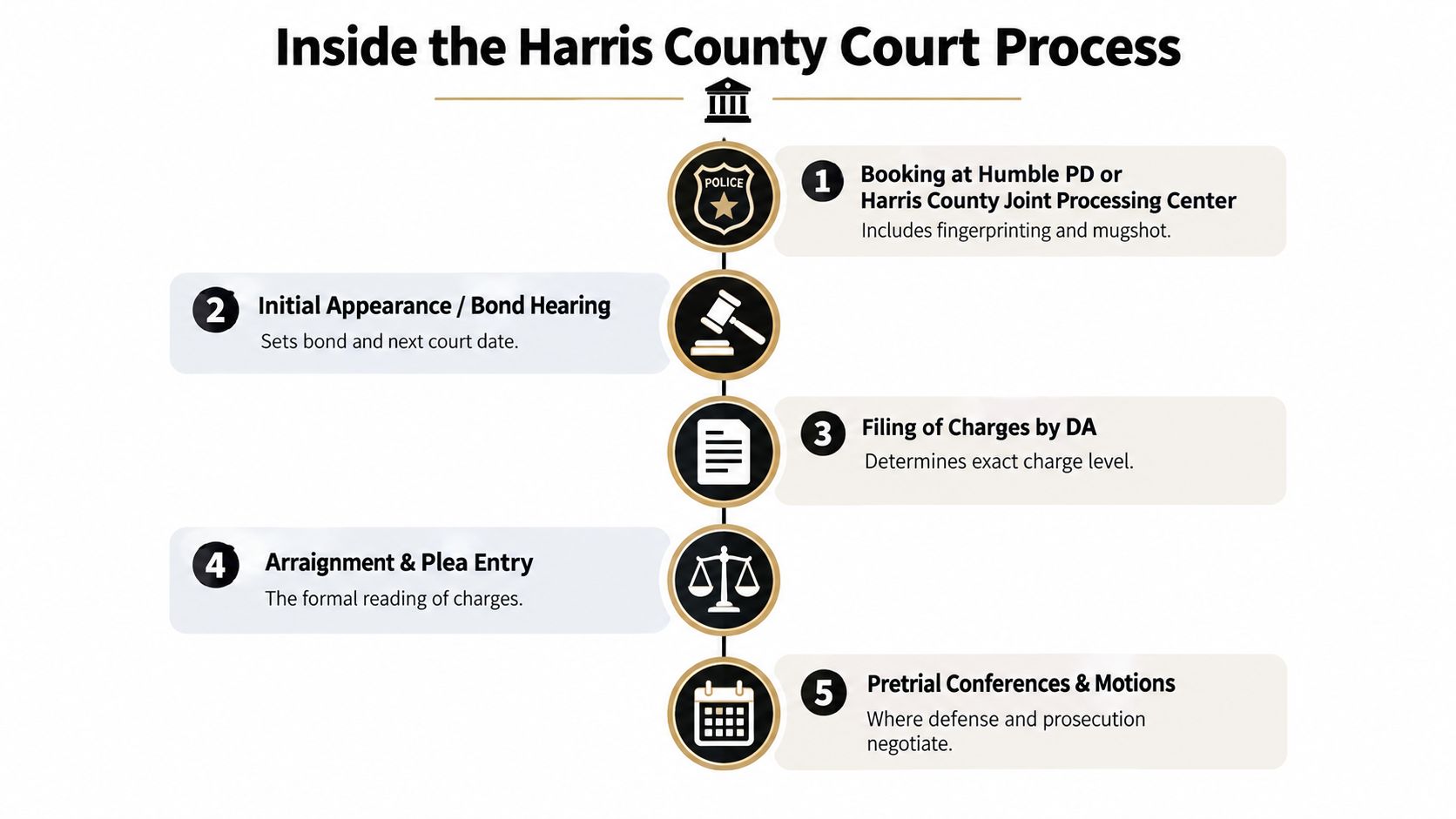
A Humble possession case usually begins with booking at the Humble Police Department or the Harris County Joint Processing Center. Officers record identifying information, take fingerprints and a photograph, inventory personal property, and prepare the paperwork that supports continued detention. The person may then appear before a magistrate within 48 hours, where the court addresses bond and the next setting.
Release conditions can include drug testing or other monitoring requirements. Families should preserve every document from the arrest, including the probable-cause affidavit, bond paperwork, property receipt, and any citation or charging instrument. Those records often reveal inconsistencies that aren't obvious from a verbal account.
From charging decision to pretrial litigation
Misdemeanor cases generally proceed in Harris County Criminal Courts at Law. Felony cases proceed through the Harris County District Courts, including the 174th through 351st District Courts. At arraignment, the defense lawyer addresses the formal charge, enters the appropriate plea, and begins pushing for discovery.
The Harris County District Attorney's Office may provide reports, photographs, video, laboratory materials, witness information, and search documents. A defense lawyer reviews those materials before advising whether to seek dismissal, diversion, a negotiated resolution, or trial.
Pretrial work can include:
- Search review: Test whether the traffic stop, vehicle search, apartment entry, warrant, or claimed consent complied with constitutional requirements.
- Laboratory review: Compare the alleged weight with the testing method, packaging, sample selection, and final report.
- Witness interviews: Locate roommates, passengers, informants, and other people who can explain ownership, access, or the circumstances of the search.
- Negotiation: Present weaknesses in the State's case before the prosecution becomes committed to a particular theory.
Why early action matters
The first 30 days can matter because diversion screening, evidence preservation, and witness interviews are time-sensitive. Video may require prompt preservation requests. A roommate may move, a witness may forget details, and a laboratory issue may become harder to investigate after evidence changes hands.
The court process isn't just a series of dates. In a busy Harris County docket, attorney continuity matters. The lawyer who understands the stop should also understand the lab report, diversion issue, and negotiation position. A separate resource, Harris County Family Courts: A Humble Resident's Guide, addresses how family-law cases proceed in the Harris County courts serving Humble, which is a different court system from a criminal possession case.
Harris County Diversion and Local Options
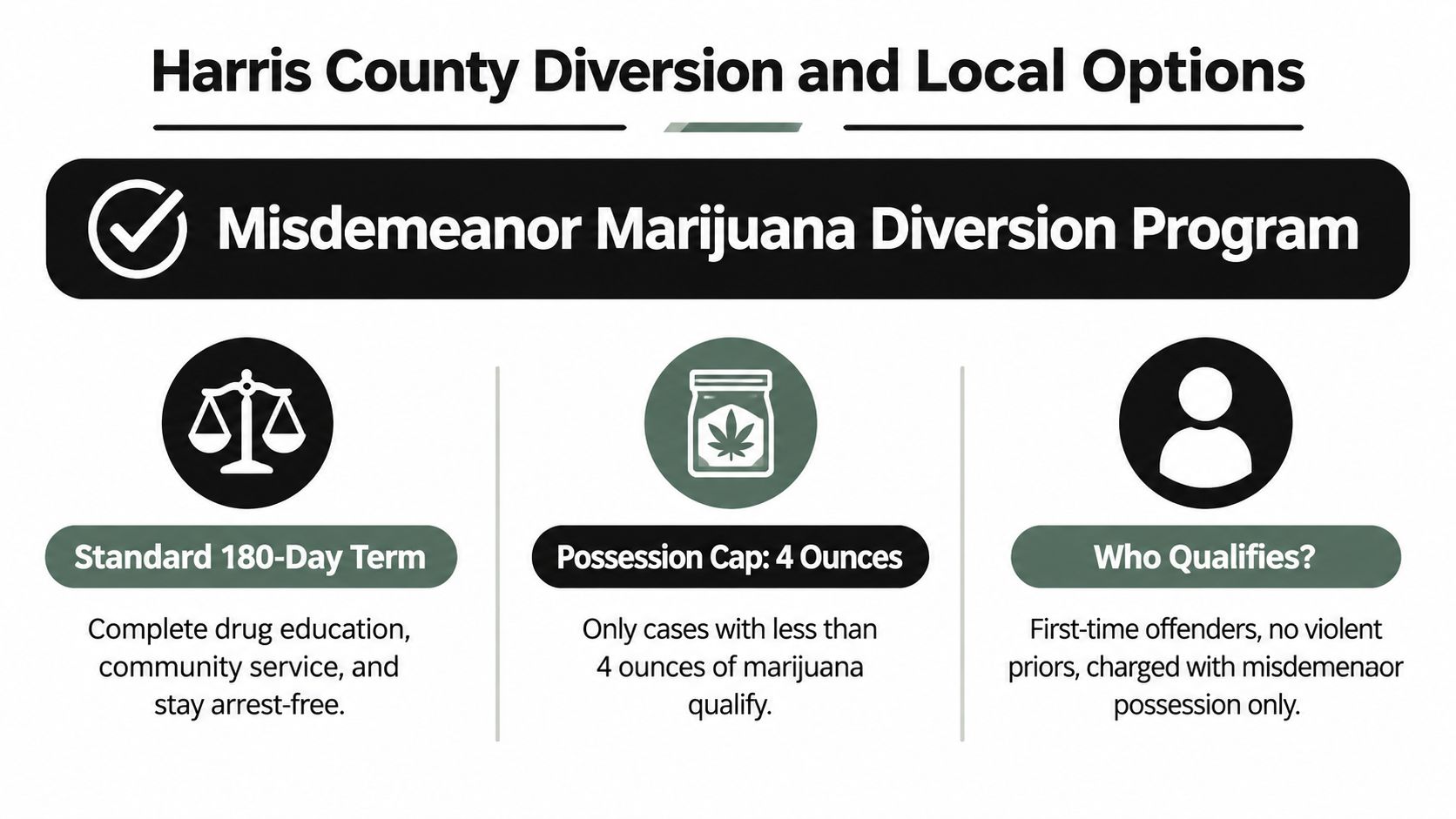
Harris County's Misdemeanor Marijuana Diversion Program can offer a different path for certain possession cases involving 4 ounces or less. The program may avoid arrest and booking in qualifying situations, replacing ordinary criminal processing with a cognitive class and fee. Eligibility still depends on the exact charge, location, criminal history, and procedural posture.
The Harris County diversion policy matters because a person shouldn't assume that every low-level case qualifies. Drug-free-zone allegations can exclude a case, and counsel must verify the amount and location before making a recommendation.
Eligibility is a screening issue, not a promise
A first-time, low-level defendant with no violent history may be a stronger candidate than someone with a prior felony conviction, a pending case in another county, or a drug-free-zone allegation. The lawyer needs the actual paperwork, not just the defendant's description.
Common compliance requirements can include:
- A standard 180-day term: The participant must complete the required program conditions during the assigned period.
- Education or treatment: The person may need to attend a cognitive or drug-education class and follow any assigned treatment direction.
- Testing and reporting: Random drug testing and scheduled reporting may be part of compliance.
- No new charges: New criminal allegations can threaten the diversion agreement.
Successful completion can lead to dismissal and may make the case eligible for expunction. Revocation is different. If the participant fails the requirements, prosecution can resume. A lawyer should explain the consequences before a person signs program paperwork.
For another explanation of Texas case resolutions, review deferred adjudication in Texas. Deferred adjudication and Harris County's marijuana diversion program aren't interchangeable, so the lawyer must match the option to the charge and the client's goals.
The 2026 Hemp THC Trap Many Defendants Miss
The label hemp doesn't end the legal analysis in a Humble arrest. Recent reporting on Texas's 2026 rules describes a ban on possession and sale of most synthetically derived hemp THC products, while compliant delta-9 hemp remains legal only at or below 0.3% THC by dry weight. The 2026 Texas hemp-THC reporting describes the confusion surrounding delta-8, THCA flower, delta-10, and similar products.
That creates a serious defense issue for people in Humble, Kingwood, Atascocita, and Northeast Houston. A vape cartridge, edible, flower product, or package bought from a smoke shop may have a label that says hemp, yet the State may focus on chemistry, concentration, synthetic derivation, and laboratory testing. A certificate of analysis can help, but it isn't an automatic safe harbor if police testing or statutory restrictions point elsewhere.
Labels are evidence, not immunity
| Factor | Legal hemp claim | Marijuana charge risk |
|---|---|---|
| Product label | Package identifies hemp or a hemp-derived product | Police or prosecutors may rely on testing rather than packaging |
| Delta-9 concentration | Product claims compliance at or below 0.3% by dry weight | Testing may produce a different result or reveal a calculation dispute |
| Product type | Delta-9 hemp is presented as compliant | Delta-8, THCA, delta-10, or synthetic THC may face separate restrictions |
| Laboratory proof | Certificate of analysis supports the buyer's understanding | Sampling, methodology, chain of custody, and total THC calculations may be challenged |
| Source | Product came from a retail smoke shop | Retail purchase doesn't decide whether possession was lawful |
The chemistry can matter more than the word marijuana. Defense counsel should obtain the product packaging, purchase records, certificate of analysis, police photographs, field-test information, and laboratory materials. The central questions include what was seized, how it was sampled, whether the test distinguishes compounds, and whether the State calculated the relevant concentration correctly.
A person who bought a product believing it was legal should tell counsel that fact immediately, but shouldn't assume it ends the case. Hemp is a label, not a defense. The defense must connect the product's composition and the State's testing to the law that applied at the time of the seizure.
Defenses That Actually Move Possession Cases
A possession case turns on proof. The State must connect the person to the substance and establish that the search, seizure, testing, and weight evidence support the charge. An arrest report may sound confident, but confidence in the report isn't the same as admissible proof.
Start with the search
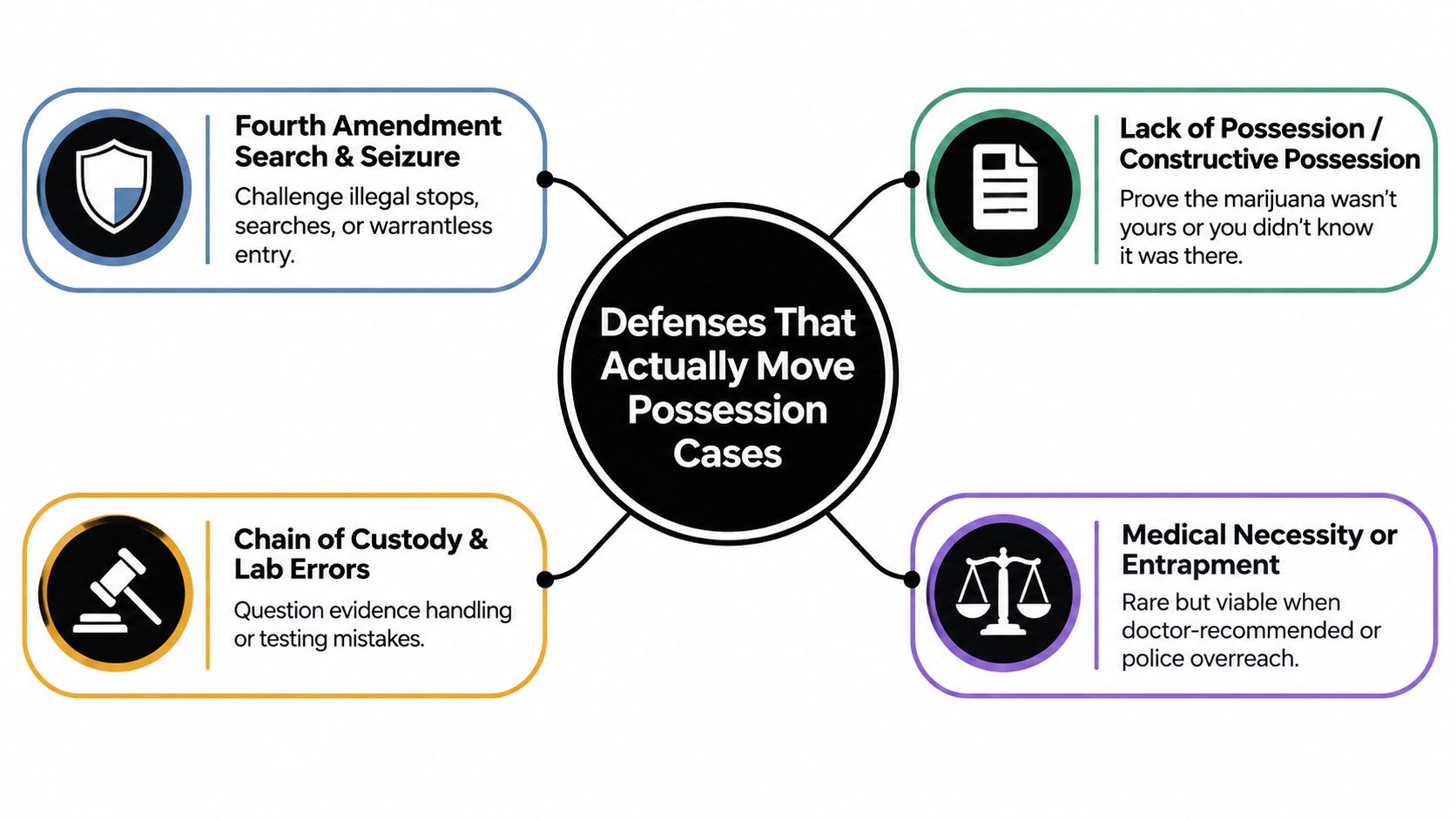
The Fourth Amendment analysis begins before the marijuana is found. Counsel examines whether the officer had a lawful reason to stop the vehicle, whether the stop lasted longer than justified, whether the officer searched beyond the permissible scope, and whether consent was voluntary and properly understood.
Body-worn camera and dashboard video can show the officer's words, the timing of the stop, the position of the occupants, and what happened before consent or a search. For Humble cases, that may involve footage from the Humble Police Department or Precinct 4 Constable's Office. A motion to suppress can seek exclusion of evidence obtained through an unlawful search.
Then test possession and evidence
A person sitting near marijuana doesn't automatically own it. In a shared apartment, vehicle, or room, the defense asks whether the defendant knew the substance existed and exercised control over it. Ownership records, fingerprints, messages, witness accounts, and the location of the item can all matter.
Other pressure points include:
- Weight disputes: Determine whether officers included packaging, residue, stems, or other material, and whether the laboratory measured the legally relevant substance.
- Chain-of-custody problems: Track the evidence from the scene to storage and then to the Harris County Institute of Forensic Sciences.
- Testing challenges: Review field tests, confirmatory testing, sampling, calibration, and the analyst's conclusions.
- Product classification: For hemp-THC cases, compare the package, certificate of analysis, seized product, and laboratory method.
- Police overreach: Entrapment or an unusually coercive operation may matter in the right facts, though these defenses are fact-specific.
What matters most: The defense should attack the connection between the person, the substance, and the legally defined weight.
Prescribed hemp documentation or evidence of a lawful source may help explain the product, but it doesn't automatically resolve a criminal allegation. Cooperation should also be strategic. Speaking with police without counsel can create statements the prosecution later uses to fill gaps in its proof.
Choosing the Right Humble Marijuana Possession Lawyer
Local experience matters because Harris County misdemeanor and felony courts have their own calendars, prosecutors, procedures, and diversion timelines. Look for a lawyer who regularly handles criminal cases in the Harris County Criminal Justice Center and understands both Class B misdemeanor possession charges and felony-weight allegations.
A consultation should be practical. Bring the charging instrument, bond paperwork, search warrant or affidavit, laboratory documents, receipts or product packaging, and information about prior cases. If the evidence came from a vehicle or apartment, bring names and contact information for passengers, roommates, neighbors, or other witnesses.
Questions worth asking directly
- Drug-case experience: How often do you handle marijuana and controlled-substance cases in Harris County?
- Diversion knowledge: Will you evaluate Harris County's Misdemeanor Marijuana Diversion Program directly?
- Hemp-THC analysis: How will you review a delta-8, THCA, delta-10, delta-9, edible, or vape-product case?
- Court coverage: Who will appear at bond, arraignment, status settings, and motion hearings?
- Defense strategy: Will you investigate the stop, consent, search warrant, video, weight, possession, and laboratory evidence?
- Fees and scope: What is the projected total cost, and does the agreement cover pretrial motions and trial preparation?
No responsible attorney can guarantee dismissal, diversion, or an acquittal. A strong lawyer explains the tradeoffs, identifies the weakest part of the State's case, and tells you what additional facts could change the strategy.
People who work in legal services also need to understand how local trust and clear communication affect client relationships. A resource on getting clients with legal marketing may be useful for attorneys evaluating how prospective clients find and assess legal help. For a person facing a possession charge, the more relevant step is reviewing the firm's actual criminal-defense service information, such as the Humble controlled-substance possession lawyer resource.
Your Next Step After Reading This
A Humble marijuana possession arrest doesn't have to determine the final result, but delay can cost you important advantages. The first priorities are simple: preserve evidence, avoid discussing the facts with police without counsel, and have a local defense lawyer review the charging papers before the first meaningful court setting.
Write down the traffic stop or search while you remember it. Include where the officers stood, what they said, who gave consent, who owned the vehicle or apartment, where the substance was located, and which witnesses were present. Save photographs of packaging, receipts, hemp labels, certificates of analysis, text messages, and paperwork from the jail or court.
Use the consultation to make decisions
Bring the documents identified above and ask direct questions about:
- The charge level: What weight and statute does the State allege?
- The evidence: Is the search, possession theory, laboratory result, or chain of custody vulnerable?
- Local options: Could Harris County diversion or another resolution apply?
- The record: What could the outcome mean for work, school, housing, licensing, immigration, or family disputes?
- The cost and timeline: Who handles each setting, and what work does the fee include?
Texas recorded 25,525 marijuana-possession arrests in 2023, compared with 24,329 in 2022 and 21,324 in 2021, according to the Texas marijuana arrest data. Those numbers show that possession cases remain common, not that every case should be treated the same. Your facts control the defense.
The Law Office of Bryan Fagan provides a free, confidential case review for Humble residents. Whether the allegation arose in Humble, Atascocita, Kingwood, or elsewhere in Northeast Houston, early advice can protect your record, employment prospects, and peace of mind.
The Law Office of Bryan Fagan offers local criminal-defense guidance for Humble residents facing marijuana possession and hemp-THC allegations, including review of searches, weight evidence, diversion eligibility, and court paperwork. Schedule a free consultation by visiting Law Office of Bryan Fagan and take the first step toward a clear defense plan.