Skip to content
A traffic stop on a familiar Humble road can turn serious in seconds. You may have been distracted, frightened, or unsure whether the person behind you was law enforcement. If you drove away, even briefly, you could now be facing an evading arrest charge instead of a traffic citation. An accusation isn't a conviction, but you should treat it as an urgent criminal-defense problem.
The right first steps matter. Don't explain the incident to investigators without counsel, don't delete messages or videos, and don't assume the case will disappear because nobody was injured. A knowledgeable evading arrest lawyer in Humble, TX can examine whether the stop was lawful, whether you knew an officer was pursuing you, and whether the evidence proves intentional flight.
What Happens When You Flee a Traffic Stop in Humble
You're driving near Humble, Atascocita, or Kingwood when emergency lights appear behind you. You hesitate, continue toward a safer-looking place to stop, or panic and accelerate. By the time you pull over, the officer may describe the event as intentional flight. That description can transform a stressful traffic encounter into a criminal case.
The accusation often turns on details that aren't obvious from the driver's perspective. Did you see the lights? Could you hear the siren? Was the patrol vehicle marked? Did you slow down while looking for a safe shoulder, or did you deliberately increase distance? Body-camera footage, dashcam video, dispatch audio, and officer reports may tell different stories.

Why this isn't a traffic ticket
Texas treats evading arrest or detention as a criminal offense under Penal Code § 38.04. Fleeing on foot is generally a Class A misdemeanor, while using a vehicle can create felony exposure. The difference affects where the case is handled, what punishment the prosecutor may seek, and how a conviction could affect employment, housing, licensing, and family responsibilities.
Public arrest-record data cited by OpenArrest's Texas evading arrest records lists 4,204 public evading arrest or detention booking records statewide, including 870 bookings in the prior 30 days. The same dataset reports a median booked age of 30, based on those records. These figures don't predict what will happen in your case, but they show why Harris County prosecutors and courts see this charge regularly.
Practical rule: Treat every communication from law enforcement, the prosecutor, or the court as important. A casual explanation can become evidence before your attorney has reviewed the video.
What to do immediately
Write down what you remember while the details are fresh. Record the location, lighting, traffic, officer commands, whether lights and sirens were active, and where you eventually stopped. Preserve phone location information, passenger messages, vehicle camera footage, and any medical or emergency records that explain your actions.
Don't post about the incident. Don't contact the officer to argue about the report. Contact a criminal-defense lawyer serving Humble and greater Harris County before making substantive statements.
Understanding Texas Evading Arrest Law
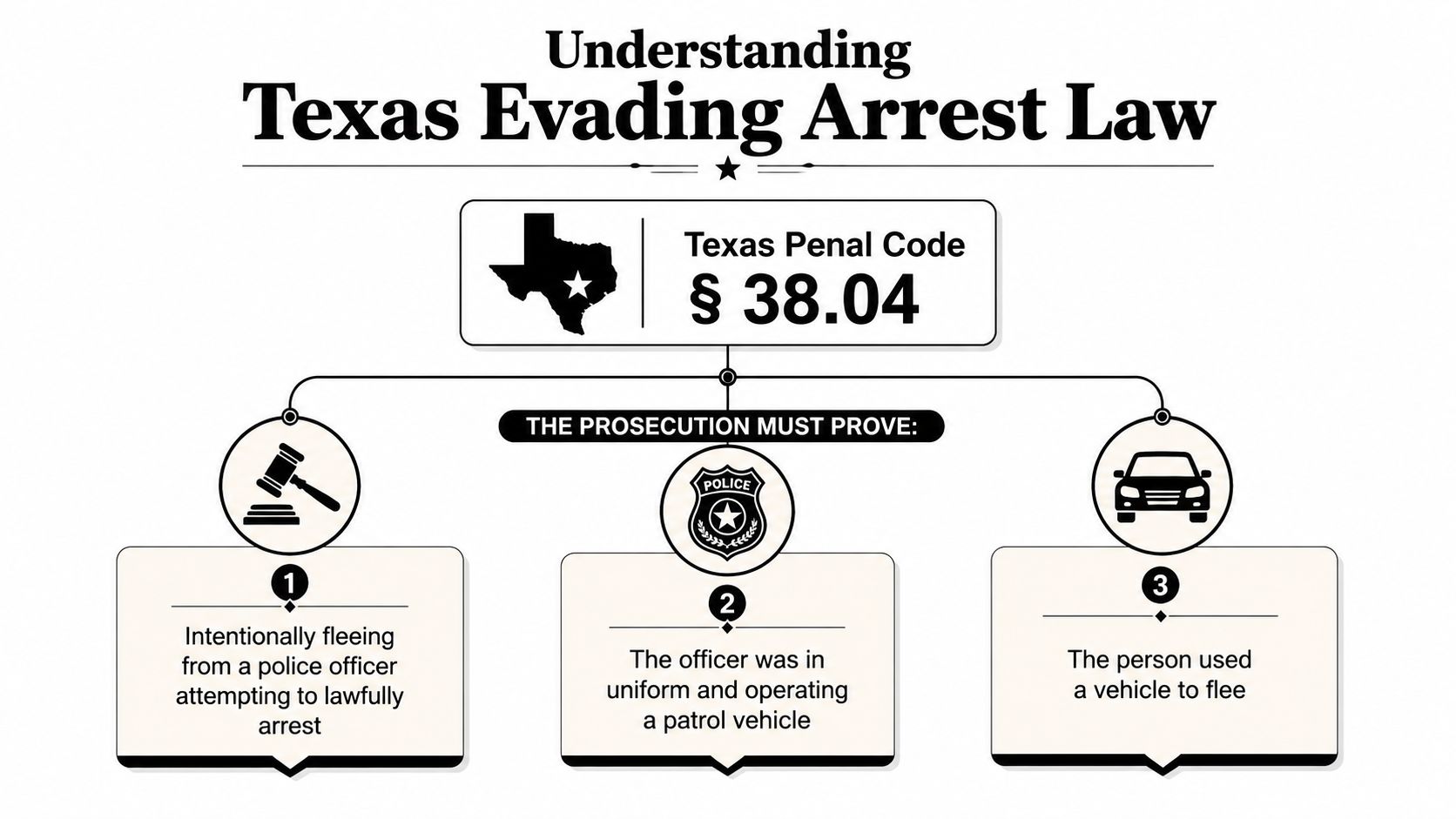
Texas Penal Code § 38.04 requires the State to prove three elements: you intentionally fled, you knew the person pursuing you was a peace officer or federal special investigator, and the officer was attempting a lawful arrest or detention. Those requirements are set out in Texas Penal Code § 38.04.
Intentional flight
The State must prove more than movement away from an officer. It must show that you intentionally fled. A defense lawyer will examine whether you were searching for a safe place to stop, dealing with confusion, responding to a medical problem, or failed to perceive the signal as directed at you.
Intent is often inferred from circumstances rather than proven by a direct admission. Speed, turns, distance, traffic conditions, braking, and your eventual conduct may all matter. A short delay in stopping doesn't automatically establish criminal intent, and the video may show facts that the initial report leaves out.
Knowledge of police identity
The prosecution must also prove that you knew the pursuer was a peace officer or federal special investigator. Marked patrol vehicles, emergency lights, sirens, uniforms, public-address commands, and the location of the encounter can become important. So can poor visibility, an unmarked vehicle, competing traffic noise, or unclear communication.
The question isn't whether an officer later identified themselves. The relevant issue is what you knew at the time you allegedly fled. Your lawyer should compare the officer's account with recordings and physical evidence rather than accept a conclusory statement that you must have known.
Lawful arrest or detention
The officer must have been attempting a lawful arrest or detention. That makes the initial stop a central issue. If the officer lacked the legal basis to detain you, the defense may challenge an essential element of the charge.
Texas has revised § 38.04 repeatedly. The framework traces to the 1973 enactment effective January 1, 1974, followed by significant amendments in 1987, 1989, 1993, 2009, 2011, 2013, and a special-session update effective February 6, 2024, as reflected in the Texas statute history and current text. The 1993 amendment was especially important because it removed language treating an unlawful arrest or detention as an exception to prosecution and made “lawfully” part of the offense elements effective September 1, 1994. A 2011 change also increased the stakes for vehicle-based flight, which Texas courts have recognized can elevate the offense to a third-degree felony.
For a related explanation of how force-based conduct differs from flight, see the Humble resisting arrest lawyer resource. The charges aren't interchangeable, and the evidence needed for each is different.
Misdemeanor vs Felony Evading Arrest Penalties
The most important classification question is often simple: were you on foot, or did you use a vehicle or watercraft? That distinction can move the case from county-jail exposure to a felony with state-jail or prison consequences.
For a Class A misdemeanor case involving flight on foot, Texas allows up to one year in county jail and a fine of up to $4,000, as summarized by this Texas evading arrest penalty explanation. Vehicle-based allegations can carry substantially greater exposure.
| Offense Level | Manner of Flight | Jail/Prison Time | Maximum Fine |
|---|---|---|---|
| Class A misdemeanor | Generally, flight on foot | Up to 1 year in county jail | Up to $4,000 |
| State jail felony | Vehicle or watercraft used | 180 days to 2 years in a state jail facility | Up to $10,000 |
| Third-degree felony | Vehicle use with applicable enhancement | 2 to 10 years in prison | Up to $10,000 |
The state jail felony and third-degree felony ranges appear in this vehicle-based evading arrest punishment guide. The charging classification depends on the alleged facts and applicable statutory provisions, so don't assume the accusation's label is the final word.
Why vehicle evidence becomes decisive
A prosecutor may focus on speed, lane changes, traffic, pursuit duration, and the distance traveled. A defense lawyer should demand the underlying proof instead of relying on descriptions such as “reckless flight.” Video may show ordinary traffic movement, a cautious attempt to find a safe stopping location, or a gap between the officer's signal and your response.
A felony record can affect your future well beyond the sentence. It can complicate employment searches, professional licensing, housing applications, and family stability. Residents who are also managing a family-law matter can review Harris County Family Courts: A Humble Resident's Guide for factual information about how family cases proceed in the courts serving Humble.
How a Humble Criminal Defense Lawyer Builds Your Case
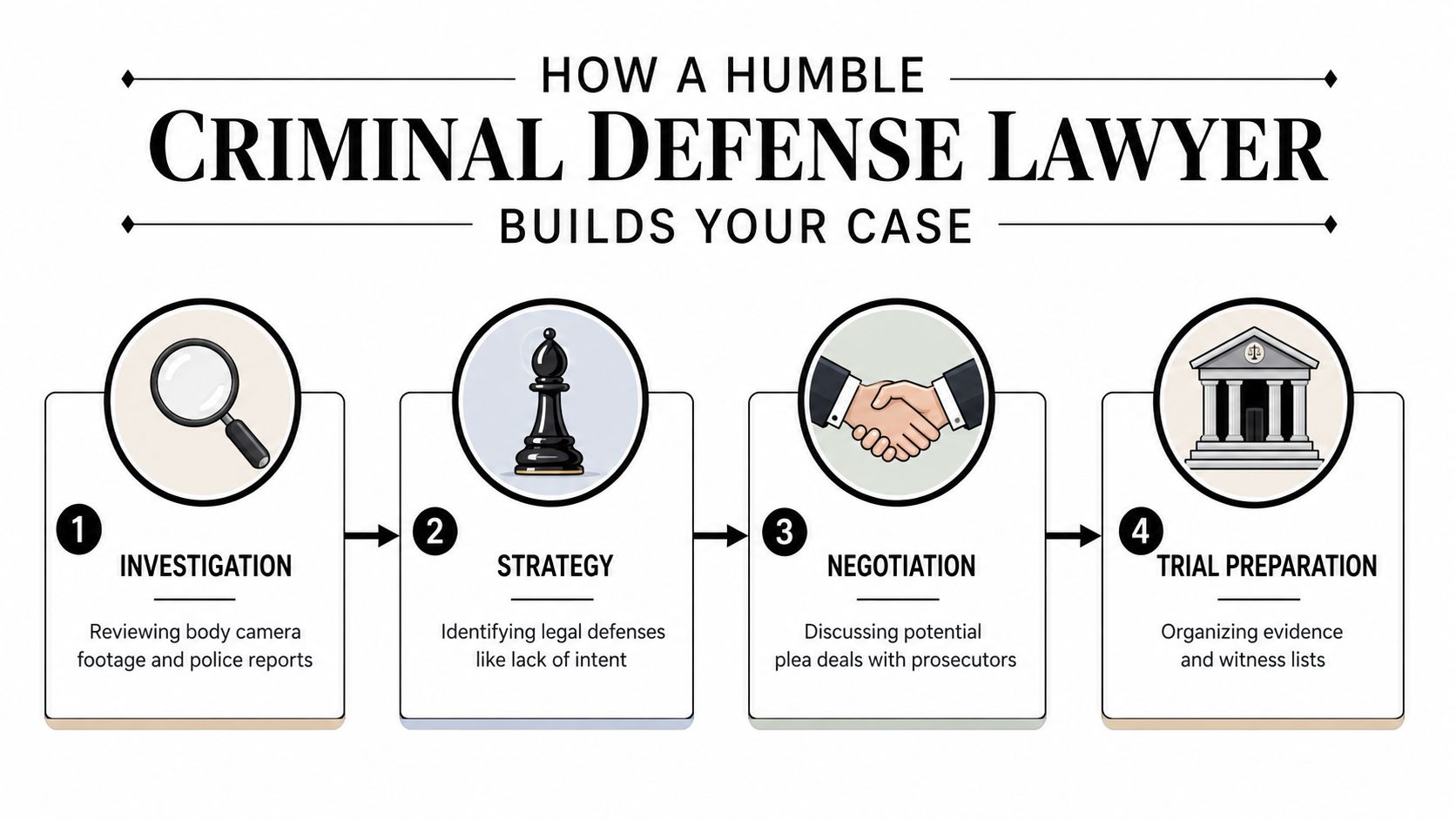
A strong defense starts before anyone argues in court. Your attorney should preserve evidence, identify the legal questions, and build a timeline that tests the officer's version of events.
Investigation comes first
Your lawyer should obtain and review the police report, body-camera footage, dashcam video, dispatch audio, radio traffic, photographs, witness information, and available location evidence. The purpose isn't to collect documents for their own sake. It's to test each statutory element against what happened.
A useful investigation asks:
- What did the officer communicate? Identify the exact commands, lights, siren use, and timing.
- What could you perceive? Consider darkness, weather, traffic, road design, vehicle markings, and background noise.
- What did the vehicle do? Compare speed, turns, braking, lane changes, and stopping behavior with the written report.
- Was the detention lawful? Examine the stated reason for the stop and whether the evidence supports it.
- Does vehicle use apply? Determine whether the State can prove the alleged manner of flight and the classification charged.
Strategy and negotiations
Once the evidence is organized, counsel can identify the best defense path. That may involve disputing intent, challenging knowledge, attacking the lawfulness of the detention, contesting vehicle-use allegations, or presenting a factual explanation that changes how the prosecutor views the case.
Public arrest-record data provides context, not a promise. In the OpenArrest dataset, 62% of 642 cases with a known outcome were dismissed or dropped, while 19% ended in sentencing or deferred adjudication. The figures are not a prediction for any individual, but they reinforce why early review and informed negotiations matter. You can also read about potential dismissal strategies in how to get criminal charges dismissed.
Trial preparation should begin even when negotiations are active. Counsel should organize exhibits, identify witnesses, preserve objections, and prepare to cross-examine officers about perception, communication, timing, and the difference between deliberate flight and delayed compliance. The Law Office of Bryan Fagan also handles factual matters such as Prenuptial & Postnuptial Agreements in Humble, which concerns drafting and reviewing marital property agreements for Humble clients, but a criminal case requires a separate defense strategy focused on the evidence and statutory elements.
Navigating the Harris County Court Process
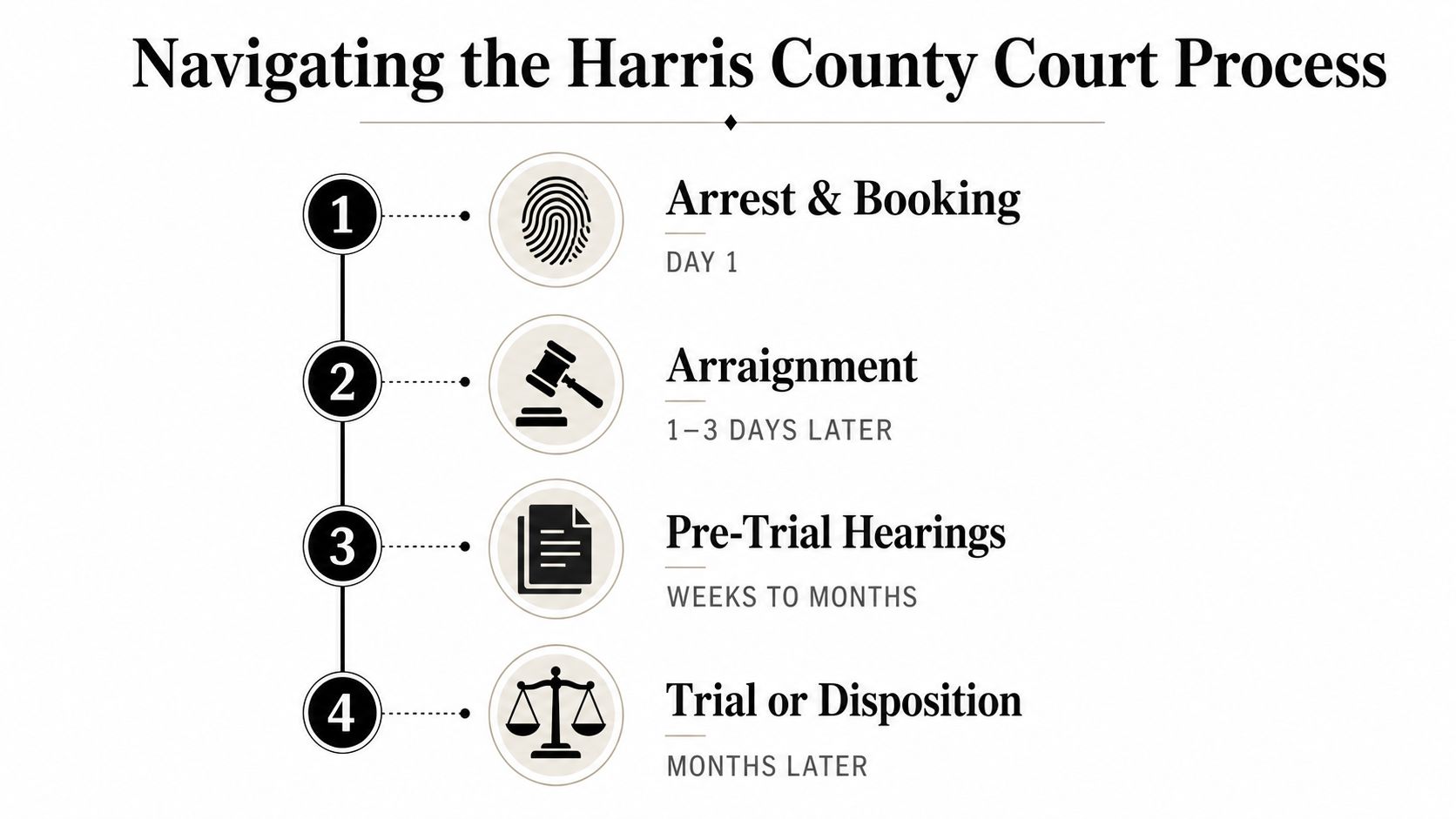
A Humble evading arrest case may begin locally but can move through different levels of the Harris County criminal court system depending on the charge. The process can feel confusing because filing, bond, arraignment, discovery, negotiations, and trial don't happen in one single conversation or courtroom.
Filing, arrest, and bond
In Harris County Justice Court, a criminal proceeding may begin when a complaint is filed in the Justice of the Peace precinct where the offense occurred or where the accused resides, according to the Harris County Justice Court criminal filing procedure. That local starting point can matter to people living in Humble, Atascocita, Kingwood, and Northeast Houston.
After an arrest or citation, the court addresses release conditions and bond. Your lawyer can explain the allegations, identify restrictions, and advise you about what you should and shouldn't discuss. The Humble bond hearing guide provides related procedural information.
Arraignment and pretrial work
At arraignment, the court addresses the charge and your formal response. The case then moves into pretrial activity, where the defense requests discovery, reviews recordings, investigates witnesses, files appropriate motions, and communicates with the prosecutor.
Don't treat court settings as routine appointments. Missing a setting, violating a release condition, or contacting a witness improperly can create new problems. Keep your lawyer informed about address changes, work conflicts, travel, and any new police contact.
Resolution or trial
Many cases resolve through negotiations, but a plea isn't automatic and trial remains an important option when the evidence or legal foundation is weak. Your lawyer should explain the consequences of each offer, including the charge classification, record implications, supervision terms, and risks of trial.
The Harris County process can be demanding for families already handling other legal matters. For a separate family issue, Grandparents' Rights in Humble addresses custody and visitation rights for grandparents in Harris County. Keep those matters distinct, and make sure each receives advice specific to its own legal standards.
Why Local Representation Matters for Humble Families
Local representation matters because criminal cases are resolved through real procedures, real courtrooms, and real communications with Harris County prosecutors. A lawyer who understands the local process can help you avoid preventable mistakes, identify the correct court setting, and prepare for the way your case is being handled.
That doesn't mean a local attorney can promise a result. No ethical lawyer should guarantee dismissal, deferred adjudication, or a specific sentence. It means your counsel can make decisions with the local filing structure, courtroom expectations, and available records in mind.
Early action protects options
The first days after an arrest are often when evidence is easiest to preserve and your account is clearest. A lawyer can send requests for recordings, review bond conditions, advise you about communication, and begin testing the State's theory before assumptions harden into a plea recommendation.
Waiting can create practical problems. Video may be harder to locate, witnesses may become difficult to reach, and an unchallenged police narrative may shape negotiations. Early representation also lets you assess whether the vehicle enhancement, intent allegation, or lawfulness of the stop deserves immediate litigation.
A local office can reduce the burden
The Law Office of Bryan Fagan serves Humble, Atascocita, Kingwood, Northeast Houston, and surrounding Harris County communities from its downtown Humble location. Its practice includes criminal defense as well as family law, estate planning, wills, trusts, and probate, so local families can address different legal needs through a firm familiar with the community.
Cost should be discussed directly during the initial consultation. Ask what work the representation includes, what court appearances may be required, how communication will occur, and what decisions could create additional legal expense. The cheapest short-term choice isn't always the safest choice if it leaves major evidence or legal issues unexamined.
The most useful first meeting isn't a sales pitch. It's a clear review of the charge, the evidence that needs to be preserved, and the decisions that cannot wait.
Schedule a free consultation promptly. Bring the citation or booking paperwork, bond documents, court notices, and any recordings or messages connected to the traffic stop. Don't wait for the next court date to start protecting your position.
Frequently Asked Questions About Evading Arrest Charges
Can an evading arrest charge be expunged or sealed?
Possibly, but eligibility depends on how the case ends and the governing record-clearance rules. A dismissal, deferred adjudication, conviction, and acquittal can have different consequences. Ask counsel to evaluate expunction or nondisclosure only after reviewing the final disposition and your record.
What if the original stop was unlawful?
Because § 38.04 requires an attempted lawful arrest or detention, the legality of the stop can be central. Your lawyer should examine the officer's stated basis, video, dispatch information, and the timing of the alleged flight. Don't assume an unlawful-stop argument succeeds automatically, but don't ignore it either.
Can the charge affect employment or licensing?
Yes, an arrest or conviction may create questions for employers, licensing boards, landlords, or professional organizations. The effect depends on the field, the disposition, and the disclosure rules that apply. Get advice before completing applications that ask about criminal history.
Can I negotiate a reduction?
A reduction may be possible when the evidence, legal issues, and case history support it. The State may evaluate intent, knowledge, the initial detention, vehicle use, and the quality of available proof. Review any offer carefully before accepting it.
For broader ideas on organizing clear answers to client concerns, LegalRev offers client FAQ solutions for attorneys. That resource doesn't replace case-specific legal advice, but it reflects why direct explanations matter when a client is facing an unfamiliar process.
The Law Office of Bryan Fagan provides criminal-defense consultations for Humble residents facing evading arrest allegations, including evidence review, bond guidance, court preparation, and defense strategy. Visit the Law Office of Bryan Fagan to schedule a free consultation and discuss what happened before you speak further with investigators or prosecutors.