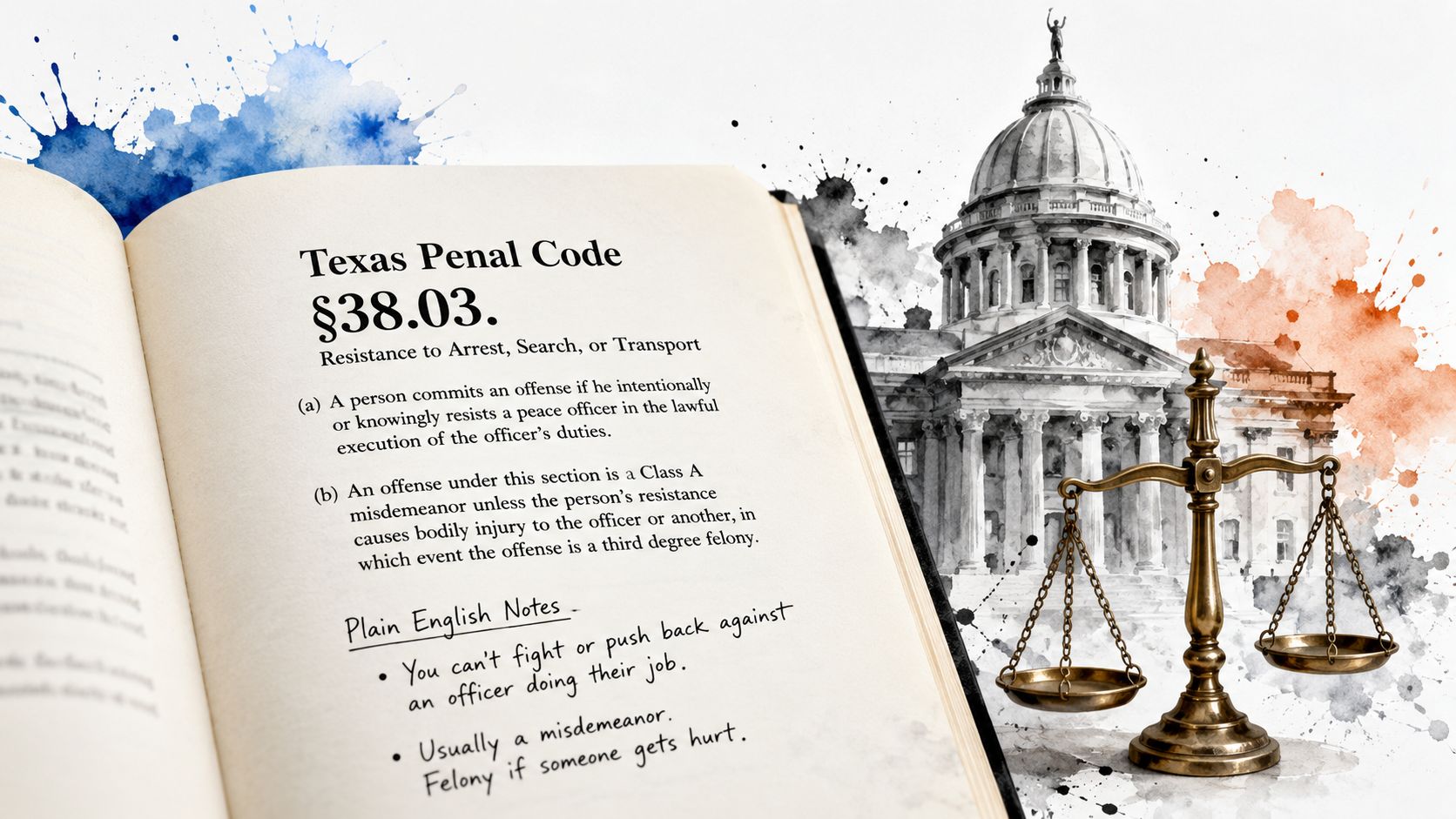
Texas Penal Code §38.03 makes resisting arrest a Class A misdemeanor, punishable by up to 1 year in county jail and a fine of up to $4,000. If a deadly weapon is used or exhibited, the charge becomes a third-degree felony, carrying 2 to 10 years in prison and up to a $10,000 fine.
Maybe the encounter started with a traffic stop on FM 1960, a family disturbance in an Atascocita apartment, or a disagreement outside Deerbrook Mall. You were frightened, confused, or angry. An officer grabbed your arm, you pulled away, and the situation ended with handcuffs and a new charge. Now you're searching for a resisting arrest lawyer in Humble, TX, trying to understand whether a few seconds of physical contact can affect your freedom, job, license, or immigration status.
The answer depends on what happened, what the officer knew, what you intended, and what the video and witnesses show. Texas law doesn't treat every argument or moment of hesitation as resisting arrest, but prosecutors take alleged force against an officer seriously. If you're in Humble, Atascocita, Kingwood, or Northeast Houston, get legal advice before giving a statement or accepting a quick plea.
What Texas Law Says About Resisting Arrest
A few seconds during a tense encounter can produce a resisting-arrest allegation. You may pull your arm back when an officer reaches for handcuffs, brace against a patrol car, or struggle while trying to understand what is happening. Those facts matter, but the charge requires more than frustration, confusion, or an officer's belief that you were difficult.
Texas Penal Code §38.03 applies when a person intentionally prevents or obstructs a peace officer from making an arrest, conducting a search, or transporting someone, while using force against the officer or another person. The officer must be performing an official duty, and you must know the person is acting in that role. You can review the Texas Penal Code text for resisting arrest.
The default offense is a Class A misdemeanor. It can carry up to 1 year in county jail and a fine of up to $4,000. The charge becomes a third-degree felony if the person uses or exhibits a deadly weapon during the resistance. That felony carries 2 to 10 years in prison and a fine of up to $10,000, according to the statute.
The prosecution must prove more than frustration
The State does not need to claim that you punched an officer. Alleged force may include pulling an arm away, stiffening your body during handcuffing, bracing against a vehicle, or physically struggling while officers try to restrain you. Whether that conduct satisfies §38.03 depends on the timing, the officer's instructions, the amount of force used, and the video or witness accounts.
The mental state matters just as much. The allegation must involve intentional obstruction. A defense lawyer should examine whether you knew the person was a peace officer, whether the officer clearly communicated the arrest, and whether your movement was deliberate or an involuntary reaction to pain, confusion, or excessive force.
| Element | Class A Misdemeanor | Third-Degree Felony |
|---|---|---|
| Conduct | Intentional obstruction using force against an officer or another person | The same conduct involving use or exhibition of a deadly weapon |
| Maximum confinement | Up to 1 year in county jail | 2 to 10 years in prison |
| Maximum fine | Up to $4,000 | Up to $10,000 |
| Key issue | Intentional force during an official arrest, search, or transportation | Deadly-weapon involvement |
One point surprises many people in Humble: the lawfulness of the arrest generally isn't a defense to the resisting charge. Section 38.03 expressly says an arrest's lawfulness is not a defense. Your lawyer should instead examine the alleged resistance, the force used, the officer's conduct, and the evidence under the correct legal theories.
How Resisting Arrest Charges Usually Happen in Humble
A typical case begins with an ordinary call, not a dramatic police chase. On FM 1960, US-59, or Beltway 8, an officer may stop a driver and ask for a license or proof of insurance. The driver reaches quickly toward a wallet, refuses to exit, or pulls an arm back when an officer applies handcuffs. The report may later describe those movements as intentional resistance.
A disorderly-conduct call can develop the same way. At a bar, Walmart, or Deerbrook Mall, a person argues with staff or another customer. Officers arrive and order the person to step aside or place their hands behind their back. Verbal disagreement alone isn't the same as force, but shoving, pulling away, bracing against a vehicle, or running can lead to a §38.03 allegation.

Family calls can create competing accounts
Family-disturbance calls in Humble, Atascocita, and Kingwood apartments often produce conflicting stories. One person calls for help, another person claims self-defense, and a third person tries to explain what happened. When deputies arrive, the complainant and another participant may both be detained or charged after the encounter becomes physical.
Harris County Sheriff's Office and Humble Police Department reports commonly focus on the sequence officers say they observed. Prosecutors may quote narrative statements, witness identifications, body-worn-camera timestamps, and descriptions of pulling arms away, bracing against a patrol car, or running a short distance.
Practical rule: The report is the officer's account of the event, not the final verdict. Preserve the evidence that tests that account.
The arrest may also create immediate bail questions. A general resource explaining 2026 DWI bail amounts in Texas can help families understand how bail information is commonly organized, although a resisting-arrest bond depends on the actual charge, the court, the person's record, and the facts alleged. Don't assume a standard chart replaces a case-specific bond review.
Penalties and Consequences You Should Understand
A resisting-arrest allegation can carry serious consequences even when filed as a misdemeanor. A Class A misdemeanor exposes a person to up to 1 year in county jail and up to a $4,000 fine. If a deadly weapon was used or exhibited, the charge becomes a third-degree felony, carrying 2 to 10 years in prison and up to a $10,000 fine.
The felony risk may also come from the statutory enhancement structure involving certain prior convictions. A state-jail felony conviction, including some DWI or drug cases, can affect the grade of a later resisting-arrest case even when no weapon was involved. Counsel needs the complete criminal history before giving a reliable assessment. A person's memory of prior cases is not enough.
| Tier | Jail or Prison Range | Maximum Fine | Trigger |
|---|---|---|---|
| Class A misdemeanor | Up to 1 year in county jail | Up to $4,000 | Intentional force used to obstruct an officer |
| Third-degree felony | 2 to 10 years in prison | Up to $10,000 | Deadly weapon used or exhibited, or an applicable prior-conviction enhancement |
The record can affect more than the sentence
A conviction can appear in employment screening and raise questions for professional licensing. Nurses, teachers, commercial drivers, and other licensed professionals should address the charge before entering a plea. A case arising from a traffic stop may create separate insurance concerns. Federal or immigration authorities may also review the final disposition.
Harris County prosecutors may consider pretrial diversion, deferred adjudication, or a time-served agreement in some cases. The available result depends on the facts and the defendant's record. These outcomes are not interchangeable, and some dispositions can still count as convictions for specific purposes. Before signing paperwork, ask how the proposed result affects employment, licensing, immigration, sealing, and future cases.
Bond comes first after booking. Families should understand what happens at a bond hearing in Harris County and gather accurate information about community ties, employment, residence, and prior court compliance. A prompt case review helps separate the arrest report from video, witness accounts, and other evidence that may contradict it. The charge is an allegation, and the eventual consequence depends on the conduct proved, the person's record, and the result reached in court.
Resisting Arrest vs Evading Arrest vs Obstruction
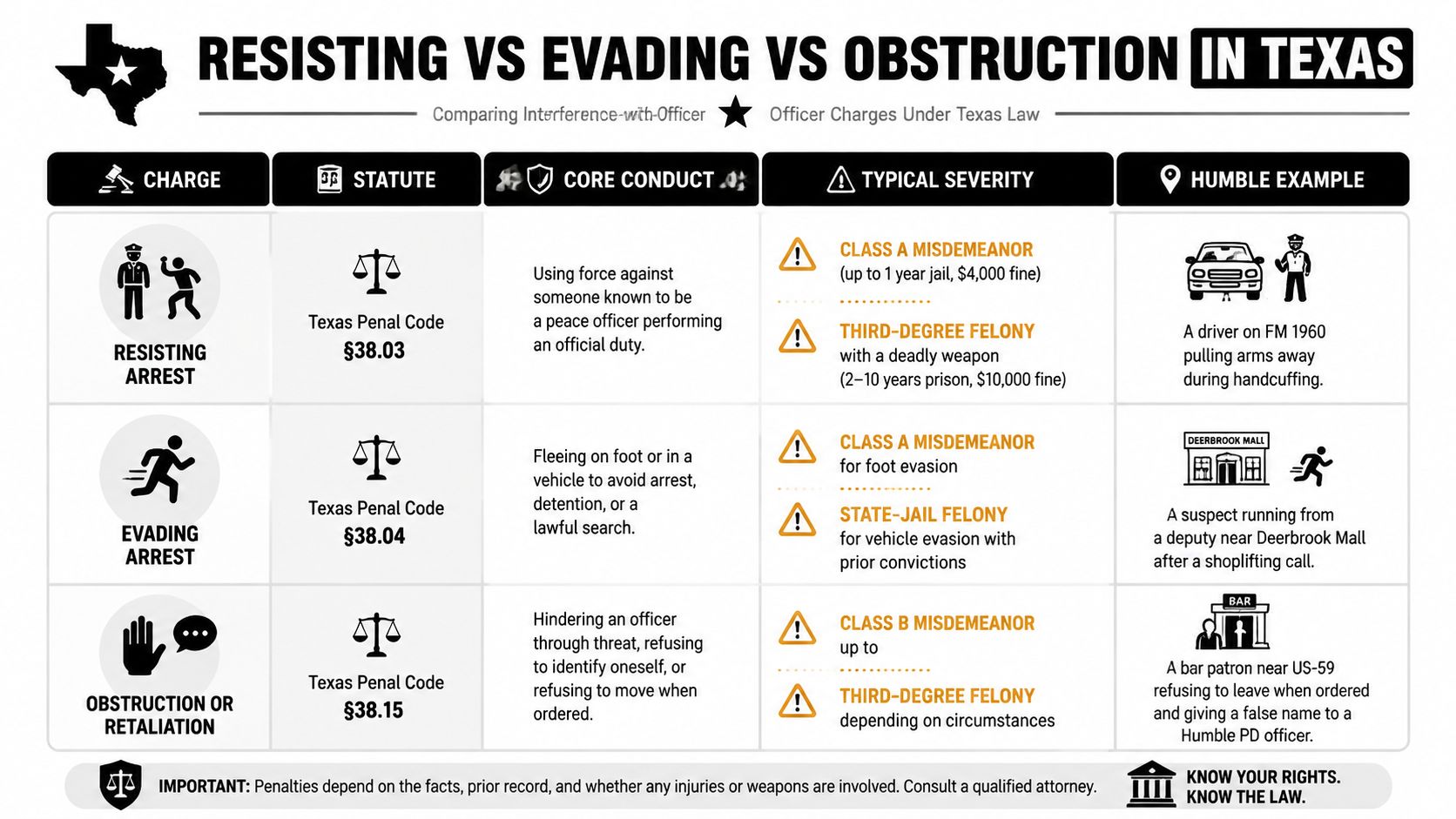
These charges overlap in everyday conversation, but they require different conduct. Resisting arrest under §38.03 focuses on intentional force against an officer or another person. Evading arrest or detention under §38.04 focuses on fleeing to avoid arrest or detention. Obstruction or retaliation under §38.15 addresses other forms of interference described by that statute.
A driver who pulls their arms away during handcuffing may face a resisting allegation. A person who runs from a deputy near Deerbrook Mall after a shoplifting call may face an evading allegation. A bar patron near US-59 who refuses to move when ordered or gives a false name may face an obstruction-related allegation, depending on the facts and the precise offense charged.
| Charge | Statute | Core Conduct | Typical Severity | Humble Example |
|---|---|---|---|---|
| Resisting arrest | Texas Penal Code §38.03 | Using force against someone known to be a peace officer performing an official duty | Class A misdemeanor, escalating to a third-degree felony with a deadly weapon | Driver on FM 1960 pulls arms away during handcuffing |
| Evading arrest | §38.04 | Fleeing on foot or in a vehicle to avoid arrest, detention, or a lawful search | Varies with the conduct and circumstances | Suspect runs from a deputy near Deerbrook Mall |
| Obstruction or retaliation | §38.15 | Hindering an officer through conduct covered by the statute | Varies with the circumstances | Bar patron near US-59 refuses to move or gives a false name |
The label matters because the State must prove the elements of the charged offense. Don't accept the assumption that every refusal, argument, or movement is resisting arrest. Your attorney should identify the exact statute, compare it with the report, and test whether the evidence proves force, flight, obstruction, knowledge, and intent.
Common Misconceptions That Can Hurt Your Case
Myth: An unlawful arrest automatically justifies physical resistance.
Texas law generally rejects that argument. The statute says the arrest's lawfulness isn't a defense, and Texas Penal Code §9.31 generally doesn't justify force used to resist an arrest or search. The narrow exception concerns an officer using or attempting to use greater force than necessary before resistance begins, as explained in the Texas self-defense provision for resisting arrest.
Myth: Silence is resisting.
Silence and physical force aren't the same thing under §38.03. You should answer basic identification questions as legally required, but don't argue about the facts or explain your side during a tense encounter. Tell officers you want to remain silent and want a lawyer.
Myth: Pulling away automatically makes the charge a felony.
The deadly-weapon escalation is what changes the offense to a third-degree felony under the statute. A prosecutor still must prove the charged conduct and any enhancement alleged. A brief movement may be described aggressively in a report, but the evidence must support that description.
Myth: Dismissal of the original charge erases resisting arrest.
The charges can be separate. A traffic, disorderly-conduct, assault, or family-disturbance allegation may be dismissed while the resisting case continues, or the reverse may happen. Counsel must evaluate each file independently.
Myth: Body-camera video always settles everything.
Video can help, but it may begin after the critical movement, fail to capture an angle, or contain audio that conflicts with what the image shows. Officers may document the encounter through timestamps, witness accounts, and their own observations. Preserve all available recordings instead of relying on one clip.
What To Do Right After a Resisting Arrest Charge
The first hours matter. Follow this order.
Stop explaining the encounter. Invoke your right to remain silent and don't discuss the incident on scene, at the Humble Police Department, in a patrol car, or with people who may repeat your words. Don't post a defense on social media.
Cooperate physically with restraint. Don't pull, twist, stiffen, or reach. You can preserve your right to challenge the arrest later without physically fighting officers during the encounter.
Request a bond hearing promptly. Gather accurate information about your residence, work, family responsibilities, and community ties. A family member can also review general information about bail options after arrest by 24-7 Best, but a bond agent's information isn't a substitute for legal advice about your charge.

Avoid contact with witnesses and officers. Don't call the arresting officer to explain yourself. Don't message the complainant, argue with witnesses, or comment about the case online. Those communications can become evidence.
Preserve recordings quickly. Ask a lawyer to pursue 911 audio, store security footage, passenger dashcam footage, dispatch audio, and body-camera evidence. Walmart, Deerbrook Mall businesses, apartment managers, and private drivers may retain video for only a limited period.
Build a timeline. Write down where you were, who was present, what officers said, when restraints began, where force occurred, and whether you had injuries. Don't embellish. Accuracy helps counsel compare your memory with reports and recordings.
Get a Humble-area defense lawyer. A lawyer can request records, assess the bond, and explain how to get charges dismissed based on the actual evidence rather than assumptions.
The best early statement is often no statement. Let counsel preserve the facts before the case narrative hardens.
How a Humble TX Lawyer Can Protect Your Future
A local defense lawyer's work begins before the first scheduled court appearance. In a Humble-area case, counsel can seek an emergency bond review in Harris County, argue for personal recognizance or a reduced bond when appropriate, and contact the arresting agency about preserving body-camera footage, dashboard video, dispatch audio, and witness information.
The investigation should test the report instead of merely repeating it. Counsel can review CAD records, identify independent witnesses, compare dispatch timing with body-camera timestamps, and create a minute-by-minute account of the encounter. That process may show that the arrest was lawful but the alleged force was accidental, that the officer's commands were unclear, or that the report omits important context.
The defense must target each required element
A lawyer handling a §38.03 case should ask direct questions:
- Knowledge: Did you know the person was a peace officer performing an official duty?
- Intent: Did you intentionally obstruct the arrest, search, or transportation?
- Force: What specific movement or contact does the State call force?
- Identity: Was the officer addressing you, and did you understand what was happening?
- Officer conduct: Did the officer use greater force than necessary before your response?
The FBI's officer-safety reporting explains why prosecutors and courts treat arrest encounters seriously. The FBI reported 79,091 officers assaulted in 2023, the highest assault rate in the prior 10 years. In its arrest-situations analysis, 581,239 officers were assaulted over the study period, arrest situations accounted for 18% of those assaults, and 124 officers died during arrest situations, about 23% of the deaths examined. The FBI also identified 109 perpetrators arrested for resisting arrest in one reviewed set of top offense categories. Those figures provide context for law enforcement's focus on safety, but they don't eliminate the State's burden to prove your individual case. See the FBI's 2023 officer-safety report.
A defense lawyer can also evaluate pretrial diversion, deferred adjudication, dismissal, or a negotiated reduction to a less damaging offense when the evidence supports it. The right strategy depends on the report, video, prior record, injuries, witnesses, and the prosecutor's file. A local attorney familiar with Harris County courts can explain practical choices without promising a particular result.
If you're comparing lawyers, use a focused guide on how to choose a criminal defense attorney. Ask who will handle the bond, who will obtain recordings, what evidence needs preservation, and how the lawyer will address the intentional-force element. The Law Office of Bryan Fagan serves Humble, Atascocita, Kingwood, and Northeast Houston in criminal-defense matters, along with family law and estate planning.
The Law Office of Bryan Fagan offers free consultations for Humble-area residents facing resisting-arrest allegations, with practical guidance on bond, evidence preservation, and defense strategy. Visit Law Office of Bryan Fagan to schedule a consultation with a local attorney before you speak with prosecutors or make decisions about your case.