You're a parent in Humble, Atascocita, Kingwood, or Northeast Houston, and you've prepared a divorce, custody, or child-support filing. The legal issues are already stressful. Then the filing portal asks you to choose a court, case type, filing code, document category, and service contact. A mistake in any of those fields can delay the case even when your pleading is legally complete.
The Harris County eFileTexas requirements for a family case become much easier to manage once you separate three questions: who must e-file, how the documents must be prepared, and what happens after submission. The rules differ for attorneys and self-represented parties, and electronic filing doesn't replace service, fee planning, or careful handling of confidential information.
How e-filing works in Harris County family courts
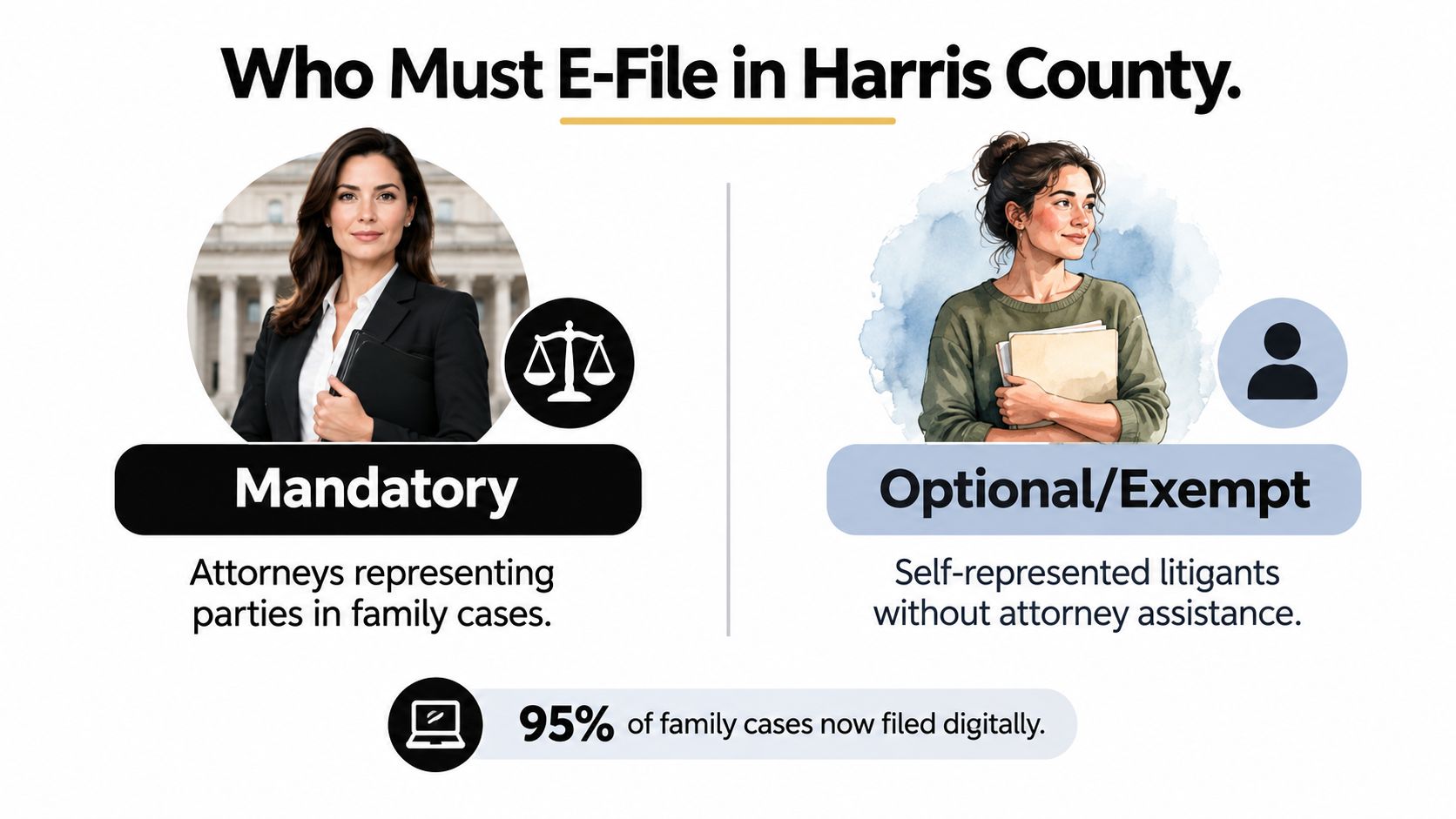
A Humble parent represented by an attorney should expect the lawyer to file through an approved electronic filing service provider, commonly called an EFSP. Texas has made electronic filing mandatory for attorneys submitting civil and family-law documents in its district and county courts, and Harris County applies that framework through the District Clerk. The statewide requirements are described through the official eFileTexas filing system.
A self-represented person, often called a pro se litigant, generally isn't required to e-file. Harris County continues to make paper filing available to pro se filers in the circumstances identified by the clerk, although self-represented parties are encouraged to use electronic filing when it works for them. That distinction matters because the registration, technical preparation, and troubleshooting burden can be very different for a person filing alone.
Identify your filing situation first
Family matters handled through the system can include:
- Divorce cases, with or without children.
- Custody and visitation matters, often involving a parent-child relationship.
- Parentage and paternity proceedings.
- Adoption and termination of parental-rights cases.
- Protective orders and other family proceedings.
A lawyer filing a petition, answer, motion, or later family-law document should use the approved electronic route rather than take paper documents directly to the clerk. A self-represented filer should decide whether e-filing is practical, or whether the available paper option would reduce the risk of a classification or technical mistake.
The portal's continuous availability doesn't make the legal process automatic. If you want to understand how a filing connects to hearings and local case administration, the Harris County family court coordinator guide can provide useful local context. Researchers reviewing court-related videos may also find video summarization for researchers helpful when they need to organize lengthy educational material.
Setting up your eFileTexas account and EFSP registration
An Atascocita parent represented by counsel may never personally operate the filing account, but understanding the workflow helps you communicate with your attorney and verify that a submission is moving correctly. The attorney or authorized filer begins by registering with an approved electronic filing service provider. The EFSP acts as the submission route between the filer and the Harris County District Clerk.
The sequence matters. A practical setup looks like this:
-
Create or confirm the EFSP account. Use the provider approved for electronic court filing and make sure the account information identifies the correct attorney or self-represented filer.
-
Choose Harris County District Clerk. Don't select another county merely because you live elsewhere. A person in Humble, Kingwood, or Northeast Houston may live near a different courthouse, but the filing destination depends on the case and court, not on the nearest building alone.
-
Identify a new case or a subsequent filing. A new divorce or custody case requires a new-case selection. A motion, amended pleading, or other document in an existing matter should be connected to the existing cause number.
-
Select the case category and filing code. Family categories can include divorce, custody, parentage, child support, protective orders, and other proceedings. The correct code helps the clerk route the filing and apply the proper fee treatment.
-
Enter party information exactly as shown in the pleading. Compare names, attorney information, court number, and cause number before uploading anything. Inconsistent spelling or punctuation can make it harder for the clerk to match the filing to the correct case.
-
Upload the lead document and attachments. The petition or motion should be identified as the lead document. Exhibits, affidavits, and other required attachments should be uploaded in the categories the system requests.
-
Add service information when applicable. If the filing requires service, enter the appropriate service contact or service method rather than assuming electronic submission completes service.
-
Review and pay or request appropriate relief from fees. Harris County states that fees vary by action, so the filer shouldn't assume that every family filing carries the same charge.
-
Submit and monitor the result. An upload receipt only confirms transmission. Keep watching for the EFSP status, clerk acceptance, file-stamped documents, or a rejection notice.
Why the first screen deserves attention
Harris County's public guidance emphasizes selecting the correct county, court, case category, case type, and existing cause. The Harris County District Clerk e-services information also confirms that attorney e-filing is required and that filings must go through eFileTexas.gov rather than fax.
That means a portal error isn't always a document error. A correctly written SAPCR or divorce petition can still be misrouted if the filer chooses the wrong case category. Before submission, compare the filing screen against the caption on the pleading, the court assignment, the party names, and the cause number. This short review is often more valuable than rushing to submit late at night only because the system is available.
Understanding Harris County PDF and document formatting rules
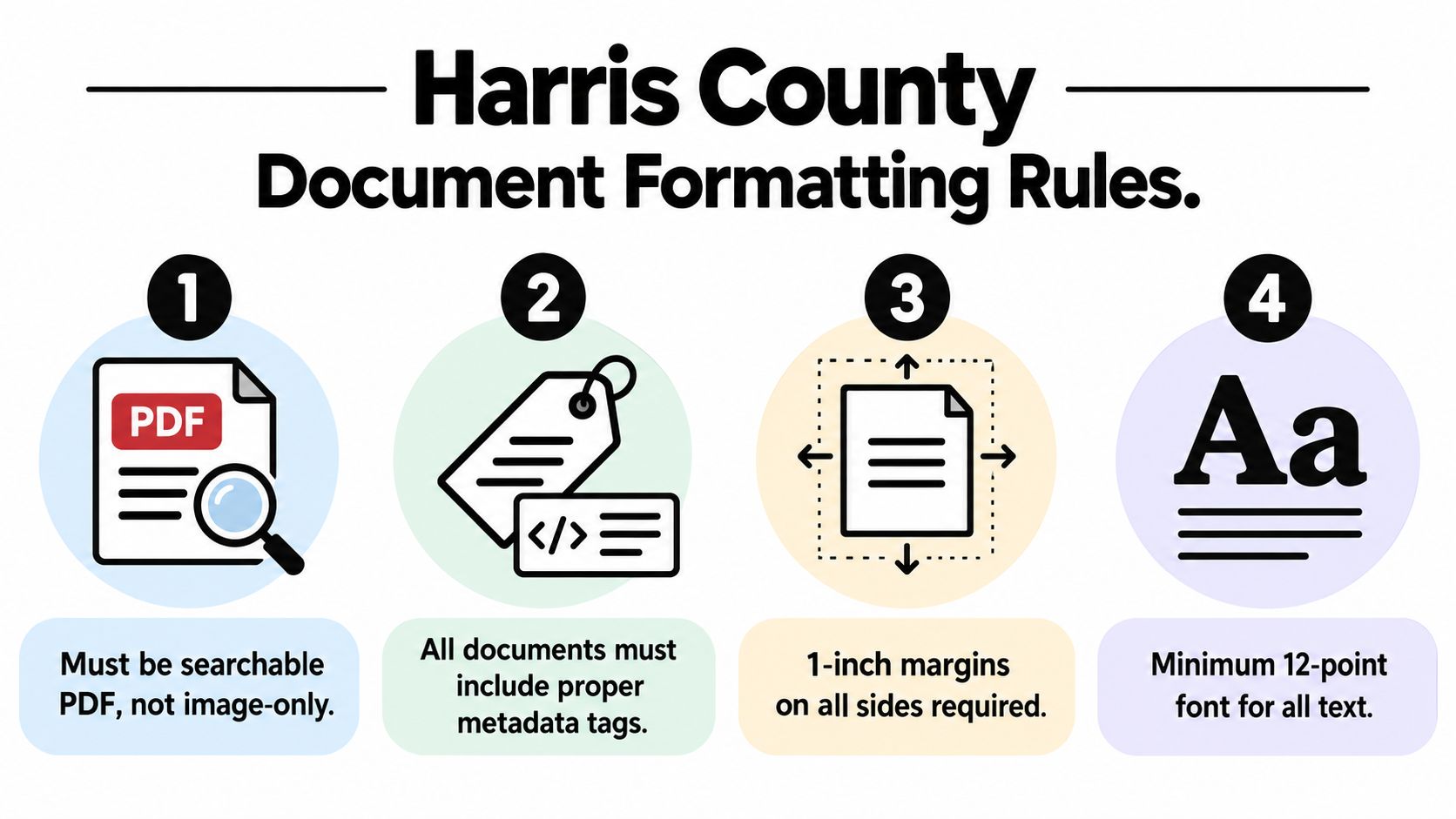
A family-law document can be substantively correct and still fail the clerk's technical review. Harris County requires the electronic filing to be prepared as a text-searchable PDF, formatted on 8.5-by-11-inch pages, with pages rotated properly.
A scan that looks readable on a phone may still be unsuitable if it contains only images rather than searchable text. Before uploading, try selecting and copying a sentence from the PDF. If you can't select the words, ask whether the file needs optical character recognition or a new export from the original document.
Use the technical checklist before uploading
The District Clerk's published requirements include these specific checks:
- Page size: Use 8.5-by-11-inch pages.
- Searchability: Prepare text-searchable PDFs rather than image-only documents.
- Black-and-white scans: Use at least 300 dots per inch.
- Color images: Use at least 600 dpi.
- Envelope size: Keep the electronic envelope at or below 35 megabytes.
- File names: Use permitted alphanumeric characters and avoid special characters.
- Security settings: Don't encrypt, password-protect, or restrict the documents against opening or processing.
- Page direction: Rotate pages correctly so the clerk can read them without turning the file.
- Document separation: Separate the lead document, pleadings, exhibits, and other attachments as required by the filing system.
A supporting affidavit for certain family-court documents should generally be combined with the document it supports instead of uploaded as a separate filing. That packaging choice helps the clerk understand which affidavit belongs with which pleading.
Treat confidential child information differently
A certified child birth certificate, when available, must be filed separately under seal under the local family filing requirements. Don't attach it to a publicly accessible petition or exhibit. Create a separate PDF, select the sealed-document category in eFileTexas, and confirm that the EFSP receipt identifies the document as sealed.
If the certified certificate isn't available, the filer must state that fact in the petition or a separate affidavit and be prepared to show reasonable diligence in trying to obtain it. This is a situation where a technical shortcut can expose sensitive information, so it deserves its own review before payment and submission.
Practical rule: Prepare the public pleading, sealed document, exhibits, and supporting affidavit as separate components only when the filing instructions require that separation. Don't assume one combined PDF is always safer.
If a PDF won't open after scanning, exporting, or downloading, a troubleshooting resource such as this guide to opening PDFs may help identify whether the problem is the file, the application, or a security restriction. The legal content still needs review, but a file that can't open can't be processed by the clerk.
Signatures, verification, filing fees, and waivers
Electronic filing doesn't eliminate signature or verification requirements. The person filing must submit documents with the authorization and signature format required for that pleading. An attorney should confirm that the client has approved the filing where approval is needed, while a self-represented party should sign and verify documents as the applicable form and law require.
Digital-signature tools can help organizations manage authorized signing workflows, but a technology platform doesn't decide whether a signature is legally sufficient. A resource discussing secure digital signing for clinics can help legal-service teams think through document security and signing procedures. The filer remains responsible for using the correct signature and verification language.
Plan for fees before clicking submit
Harris County doesn't provide a universal family-law filing fee. The amount depends on the action and the applicable fee schedule. The county identifies an example in which a new family case involving children may include an additional domestic-relations fee, with $365 listed compared with $350 for a general new family suit without service, as described by Harris County's District Clerk information for Humble residents.
Those amounts can change, and an example isn't a substitute for checking the current schedule. Use the Harris County divorce filing fee schedule as a starting point for understanding the categories, then confirm the current amount with the clerk or your attorney before submission.
For a Kingwood or Northeast Houston household that can't afford the filing cost, ask about fee-waiver procedures before finalizing the submission. A waiver request may require its own information or supporting materials, and the EFSP workflow may handle it differently from an ordinary payment. Do not omit the fee and expect the clerk to infer financial hardship.
After submitting, save the EFSP confirmation, clerk acceptance, and file-stamped documents. The upload receipt proves transmission, not acceptance. Those records can matter when you need to show when a petition, answer, motion, or supporting document reached the clerk.
Service rules and proof of service after electronic filing
Filing and service are separate events. The clerk may accept your petition or motion electronically, but that acceptance doesn't automatically notify every opposing party or complete the legal service required for the case.
The correct method depends on the document and circumstances. A divorce petition, custody filing, child-support matter, or protective-order case may involve different service needs, and the case may require formal service, a waiver, or another authorized method. The e-filing screen's service-contact field helps communicate how a document should move, but entering a contact doesn't replace compliance with the governing service rules.
Check the service path before submission
Before you submit, ask:
- Who must receive the document? Confirm every party or attorney who is entitled to notice.
- What method applies? Don't assume email is enough just because the filing occurred electronically.
- What proof is required? Retain the return, waiver, certificate, or other proof connected to the service method.
- What information is accurate? Check names, addresses, email contacts, and any required service details.
- What happens after acceptance? Monitor both the clerk's filing status and the service record.
A Humble parent may file from home while the other party lives in Atascocita or elsewhere in Harris County. Convenience doesn't change the obligation to use an authorized service method. If a constable or another authorized officer will serve papers, local information about service of divorce papers through Harris County Constable Precinct 4 can help you understand the practical process.
Don't schedule your next legal step based only on the time you uploaded the document. Confirm clerk acceptance and then confirm that service or notice was completed and documented.
Common rejection reasons and how to fix them
Most Harris County family e-filing problems fit one practical pattern: the clerk can't confidently identify, open, route, or legally process what was submitted. Looking at a rejection through that lens makes troubleshooting more orderly.
Start with the rejection notice
Read the exact reason instead of immediately uploading the same package again. Then match the correction to the problem:
- Wrong case type or filing code: Compare the selected category with the pleading's caption and purpose. A new case and a subsequent filing aren't interchangeable.
- Missing attachment: Review the petition's references and the court's requirements. Upload each required attachment in the correct document category.
- Unreadable or image-only PDF: Re-export the document as searchable text or rescan it at the required resolution.
- Oversized envelope: Reduce unnecessary file size while preserving legibility and the required scan quality. Separate documents when the filing system calls for separate uploads.
- Improper file name: Remove special characters and use permitted alphanumeric naming.
- Password or encryption restriction: Create an unrestricted PDF that the clerk can open and process.
- Inconsistent party names or cause number: Match the filing screen to the pleading and existing case record.
- Incorrect sealed-document handling: Remove the certified child birth certificate from the public pleading package, upload it separately under seal, and verify the sealed designation.
- Unpaid or incorrect fee: Check the applicable family-law fee category and address any waiver request through the appropriate process.
A rejection isn't proof that the legal issue is hopeless. It usually means the submission needs a targeted correction, but deadlines still matter. Keep the rejection notice, corrected documents, and new acceptance confirmation together so you can track what changed.
The safest resubmission is not the fastest repeat. It's the version that answers the clerk's stated reason without creating a new problem elsewhere.
Next steps for Humble families and how to get help
Before filing a family case, confirm five points: the correct EFSP and court, the right case category, compliant PDFs, separate sealed material, and an accurate service plan. Then review the fee or waiver process and save the acceptance record after submission.
For local background, the guide to how Harris County family courts serve Humble residents explains the broader court process. Parents dealing with establishment, modification, or enforcement can also review information about a Humble child support attorney. Those resources can help, but they can't determine which filing category or service method fits your specific facts.
Families in Humble, Atascocita, Kingwood, and Northeast Houston shouldn't have to guess about a filing that affects custody, support, visitation, or a child's privacy. A careful review before submission can prevent technical issues from becoming procedural delays.
The Law Office of Bryan Fagan helps Humble-area families understand Harris County family filings, prepare for divorce and custody proceedings, and address child-support concerns with practical guidance. Schedule a free consultation by visiting Law Office of Bryan Fagan to discuss your eFileTexas questions and next steps.