You've moved from another part of the region into Humble, Atascocita, Kingwood, or Northeast Houston. Your child is attending school in Harris County, your medical providers are nearby, and daily life now happens here. It's natural to assume the family case should move with you.
That assumption can create costly delays. Transferring a family case into Harris County from another county depends on the type of case, the court's existing authority, the legally proper venue, residence history, related divorce proceedings, and strict filing procedures. A new address may support a transfer, but it doesn't automatically accomplish one.
Why Moving to Harris County Does Not Automatically Move Your Case
A parent relocates to Humble after temporary orders or a final custody order are already in place. The child starts school in Atascocita, counseling is closer to home, and exchanges now happen around Kingwood or Northeast Houston. From a practical standpoint, Harris County feels like the obvious place to handle the case. Legally, that move by itself does not shift the file to a Harris County court.
The first question is not which courthouse is more convenient. The first question is which court still has authority over the case, and whether Harris County is a legally proper county for the specific proceeding now being filed. Those are separate issues, and families get into trouble when they treat a new address as if it automatically changes both.

Physical relocation and legal transfer are different
A move changes daily life. A transfer changes which court may hear the dispute. Sometimes those happen together. Often they do not.
That distinction matters most for people trying to handle the process without counsel. I regularly see parents assume they can open a fresh case in Harris County because the child now lives here. In many situations, the existing court keeps control until the right motion is filed in the right place, under the right rule, and within the right deadline. Filing in the wrong county first can cost filing fees, time, and momentum.
For an original divorce, custody case, or other family proceeding filed in the wrong county, Texas Family Code §103.002 provides the transfer rule for improper venue when no other court has continuing, exclusive jurisdiction. If the legal requirements are met, the statute says the court shall transfer the case. That does not mean Harris County becomes proper merely because it is easier for one parent. The party requesting transfer still has to connect the case to Harris County under the governing venue rules. (Texas Family Code §103.002)
Texas venue law also separates a legally required transfer from a convenience-based request. The general venue statutes identify recognized bases for filing in a county and address when transfer is mandatory versus discretionary. That difference matters because a judge may agree that Harris County would be easier for everyone and still deny relief if the motion cites the wrong standard or is filed too late. (Texas venue statutes)
Practical rule: A Harris County address can support a transfer argument, but it does not create an automatic transfer order.
Why skipping the analysis creates trouble
Self-represented litigants usually get tripped up at this stage. One parent files in Harris County and learns the original court still controls the case. Another parent informally agrees that Harris County makes more sense, but that agreement does not fix a venue or jurisdiction defect. Sometimes the current court expects a motion in the existing cause number, backed by sworn facts, instead of a brand-new filing.
Before paying a filing fee or handing papers to a clerk, pin down four things:
- The case category: original divorce, SAPCR, modification, or enforcement.
- The controlling court: whether another Texas court still has continuing, exclusive jurisdiction.
- The Harris County basis: residence, underlying events, or a related proceeding that makes Harris County a proper destination.
- The timing issue: whether a venue objection or transfer request is still timely under the posture of the case.
The Law Office of Bryan Fagan's Harris County Family Courts: A Humble Resident's Guide gives a general overview of how family cases are handled in the local courts serving Humble-area families. For an actual transfer request, though, the existing orders, the docket, and the filing sequence usually matter far more than a general description of the courthouse system.
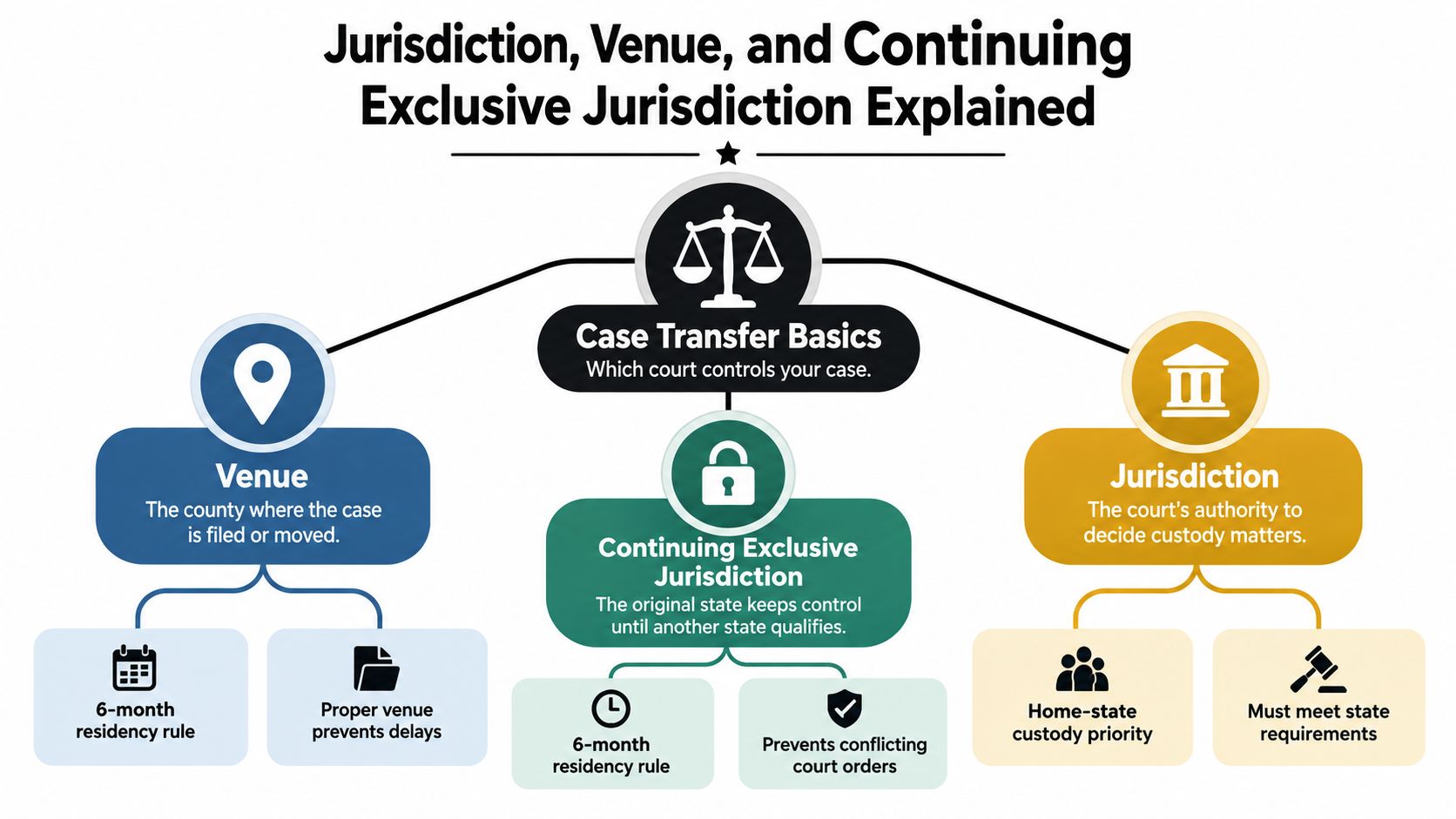
Jurisdiction, Venue, and Continuing Exclusive Jurisdiction Explained
A lot of transfer mistakes start with using the right words for the wrong problem. If you file in Harris County because the family moved to Atascocita or Kingwood, but the original court still has authority over the case, the clerk cannot fix that with a new cause number.
Jurisdiction is a court's power to hear and decide the dispute. Venue is the proper county for filing. Continuing, exclusive jurisdiction, or CEJ, is the rule that usually keeps a Texas court in control of a suit affecting the parent-child relationship after that court properly takes the case.
Original cases follow a different path
In an original family case, the first question is often whether the case was filed in the correct county to begin with. If no other court already has CEJ, Texas law allows transfer of an original proceeding filed in an improper venue, but the request must be made the right way and on time. Texas Family Code §103.002
That is different from asking for a transfer because Harris County would be easier for work, school pickup, or travel. Convenience and improper venue are not the same argument, and self-represented parties often combine them in one motion. That creates delay because the court has to sort out whether you are claiming a legal defect in the original filing or asking for relief under a different standard.
The distinction matters in practice. An improper-venue challenge focuses on whether the case belongs in another county under the rules. A convenience request turns on a separate showing and does not replace the family-law transfer procedure.
Existing custody cases may remain with the CEJ court
For custody, visitation, and child-support matters, CEJ is usually the issue that controls the filing sequence. Parents often assume the county where the child lives now controls everything. In many cases, it does not. The original Texas court may keep authority until the Family Code authorizes transfer.
One of the most important transfer rules appears in Texas Family Code §155.201. When a modification or enforcement is filed in the CEJ court, that court must transfer the proceeding to another Texas county if the child has lived in that county for six months or longer, as long as the motion is timely and the statutory procedure is followed. The six-month period does not have to be continuous without interruption. The court looks at the child's principal residence during the six months before the proceeding began.
That last point catches people off guard. A parent's lease, driver's license, or mailing address in Harris County may help tell the story, but the transfer question usually turns on where the child principally lived and what kind of proceeding is pending.
Good proof usually includes school records, medical records, and housing records that line up with the dates in the motion. Vague statements about having “moved to Houston” are rarely enough.
Related divorce proceedings can control the destination
A second court may also affect where the case belongs. If a divorce is already pending in another court, the SAPCR side of the case may have to move there instead, depending on timing and the procedural posture. So even when Harris County feels like the obvious destination, another county may still be the legally correct one.
Interstate disputes add one more layer. The UCCJEA can control which state has authority over a custody case. That is a different question from transferring a case from one Texas county to another. Before filing anything, identify the existing court, any prior orders, the child's residence history, and any pending case outside Texas.
How to Prepare and File a Transfer Motion Correctly
The safest process begins with the court that currently holds the case. Don't start a second case in Harris County just because the family now lives there. A true county-to-county transfer generally requires a motion in the existing case, followed by an order and the receiving court's filing process.
Step one, classify the proceeding
Read the current pleadings and orders. Determine whether the case is:
- An original divorce or family proceeding.
- A SAPCR involving custody, visitation, or child support.
- A post-order modification.
- An enforcement matter.
- A divorce and SAPCR pending in separate courts.
The classification controls the transfer statute and the evidence required. A modification filed in the CEJ court may implicate the six-month residence mechanism. An original case filed in an improper county may involve mandatory transfer under Texas Family Code §103.002. A general civil convenience rule isn't a substitute for the family-law procedure.
Step two, locate the controlling court and assemble the record
Obtain the cause number, current docket, pleadings, service returns, prior orders, and any notices setting hearings or trial. For a custody-related case, gather records showing the child's principal residence in Harris County, such as school, medical, and residential documents.
Your motion should state the requested Harris County destination with precision. In a contested Texas venue challenge, the moving party must identify the specific county and precinct requested. Leaving out the destination county or precinct can be fatal if the omission isn't cured within the permitted seven-day period after judicial instruction. (Texas Rules of Civil Procedure)
Step three, prepare sworn facts
A transfer motion should explain the factual and legal basis rather than merely state that Harris County is more convenient. A sworn affidavit can address:
- Where the child has lived and during which period.
- When the parties relocated.
- Where relevant records and witnesses are located.
- Whether another court has CEJ.
- Whether a related divorce is pending.
- Whether the parties have provided written consent.
Consent can help, but it doesn't eliminate the need to identify the proper legal procedure. In a contested matter, the moving party still needs a legally recognized basis and supporting facts.
Step four, calendar the deadline before filing
Venue challenges generally must be filed before trial and, in a contested case, no later than 21 days after filing the answer. The motion should be sworn, served as required, and set for a hearing. (Texas Rules of Civil Procedure)
Family Code procedures may control in an original divorce, SAPCR, or other family case, so don't assume that an ordinary civil deadline answers every question. For a modification, TexasLawHelp explains that a motion to transfer is filed in the court where the SAPCR was finalized and commonly includes an affidavit explaining why transfer is needed. (TexasLawHelp guidance on transferring a family law case)
Step five, identify the Harris County destination
Harris County has its own court administration and filing requirements. The correct destination can depend on the case type, the existing orders, and whether a related divorce is pending. Ask the clerk or coordinator what is required for the particular cause, but don't treat administrative guidance as legal advice about whether transfer is proper.
For scheduling logistics, the Harris County family court coordinator hearing-date information can help you locate relevant procedural information. A lawyer handling divorce representation for clients in Humble and Harris County may also evaluate whether Divorce Lawyer in Humble, TX services fit the case.
Filing principle: File the motion where the case is pending, prove why Harris County is proper, and identify the receiving court before the hearing.
Common Mistakes That Delay or Disrupt Transfers
Most transfer problems don't begin with a complicated legal theory. They begin with an incomplete docket, an old form, an overlooked order, or a missed deadline. A parent who has just moved to Atascocita may be focused on school enrollment and housing, while the case continues moving in the original county.
Treating relocation as the whole argument
A move into Harris County can support a transfer, especially when the statutory residence requirements are met. It doesn't automatically end CEJ or establish that every related proceeding belongs in Harris County. The requested relief and the case history remain central.
Filing a new case instead of moving the existing one
Starting over can create duplicate proceedings, conflicting settings, and confusion about which court should act. For a post-order custody or support matter, the original CEJ court may need to enter the transfer order before the Harris County clerk accepts the transferred case.
Waiting until the case is advanced
A party who waits until after discovery, hearings, or trial preparation may face an untimely motion. Contested venue challenges generally must be filed before trial and no later than 21 days after the answer. (Texas Rules of Civil Procedure)
A late request can also increase expense. If a venue challenge succeeds, the case is transferred rather than dismissed, but the plaintiff may face assessment of costs incurred before transfer. That financial risk makes early review more sensible than an informal request raised after the litigation has developed.
Confusing fees and filing requirements
A transfer motion, the transfer of a SAPCR, a divorce filing, and service or record costs aren't necessarily the same charge. Older county materials may display outdated information, and self-represented litigants sometimes budget from a form that no longer reflects current guidance.
Before filing, create a single packet containing the current docket, pleadings, orders, service returns, residence evidence, proposed destination court, sworn motion, affidavit, and deadline calculation. If the other parent contests venue, or if a divorce and custody case are separated, local counsel can protect the record and address objections before a hearing.
Transfer Fees, Timelines, and What to Expect in Harris County
Fee information deserves special attention because official materials have changed. Texas Judicial Branch guidance states that, effective January 1, 2024, Senate Bill 1612 increased the fee for filing a transferred SAPCR from $45 to $80, with the $80 serving as the only filing fee required when the transferred case is filed. (Texas Judicial Branch fee guidance)
The receiving court assesses that transferred SAPCR fee, not the transferring court. Older county pages may still show $45, so verify the current requirement with the receiving clerk before relying on an online form. A motion-to-transfer fee can be separate, and a non-SAPCR divorce matter may involve the initial filing fee for that case type.
The transition also takes administrative time. The original court may need to rule on the motion, the clerk may need to prepare or certify records, and the receiving court may have its own filing and coordinator procedures. Certified records, electronic filing, service, and case-specific requirements can affect the total cost and timing beyond the statutory transfer charge.
For current divorce-related filing information, consult the Harris County District Clerk divorce filing fee schedule. Don't assume that a transfer is immediate just because both parties agree. The order, record, destination court, and receiving clerk's requirements still need to line up.
Next Steps for Families in Humble and Northeast Houston
If you've moved to Humble, Atascocita, Kingwood, or Northeast Houston, gather the current docket, orders, pleadings, answer date, residence records, and any related divorce information before filing. Families also need practical support for moving forward after divorce, especially when court changes add stress. The Law Office of Bryan Fagan serves local families with practical guidance on transfer, divorce, custody, and related family-law concerns.
The Law Office of Bryan Fagan can review your existing case, assess jurisdiction and venue, prepare the transfer filing, and help you address Harris County court procedures. Visit Law Office of Bryan Fagan to schedule a free consultation for your family's next step.