Drug possession means knowingly having control over a controlled substance without legal authorization. In Texas, the substance's Penalty Group and weight, not the word “drug” alone, drive the charge and punishment.
You might be reading this after a Humble traffic stop, a call from a family member in custody, or the discovery of pills in a borrowed car. You're probably asking whether being nearby is enough, whether a prescription matters, and what to do before the next court appearance. Start with the charging document, not assumptions about what an officer found.
A Clear Working Definition for Texas Residents
A bottle of medication in an Atascocita kitchen cabinet and a substance found during a Humble traffic stop can raise very different legal questions. The starting point is knowing control, followed by whether that control was legally authorized.
Texas distinguishes lawful possession obtained under state or federal law from unlawful possession. A valid prescription or practitioner's order can provide authorization, but possessing something outside that authorization can create criminal exposure. The Texas Controlled Substances Act makes the substance's classification and aggregate weight central to the applicable offense.
That's why asking “What is drug possession?” isn't enough to identify someone's legal situation. You need the actual allegation, the substance involved, and the basis for connecting that substance to the accused.
Start with the allegation, not the label
Use this working checklist when reviewing paperwork with counsel:
- Identify the alleged substance. Don't substitute a street name or an officer's informal description for the substance identified in the charge.
- Locate the alleged conduct. Separate possession from an allegation involving delivery or intent to deliver.
- Gather authorization records. Preserve the prescription label, pharmacy records, and any practitioner's order rather than relying on memory.
- Keep jurisdictions separate. Advice about another state's charge or release process isn't a substitute for reviewing Texas paperwork.
If your family is also helping someone arrested in California, a resource to find a Ventura drug bail bondsman may be relevant to that separate situation. It shouldn't guide decisions about a Harris County case.
Practical rule: Ask what the State alleges you knowingly controlled and which law makes that possession unlawful.
For families in Humble, Kingwood, and Northeast Houston, that question turns a frightening label into something an attorney can evaluate. Don't assume every possession accusation carries the same consequences.
Actual Possession vs. Constructive Possession
Actual possession generally involves a substance on someone's body or within immediate physical control. Constructive possession concerns a substance found somewhere else, where prosecutors argue the person nevertheless knowingly controlled it.
The distinction is easier to understand side by side.
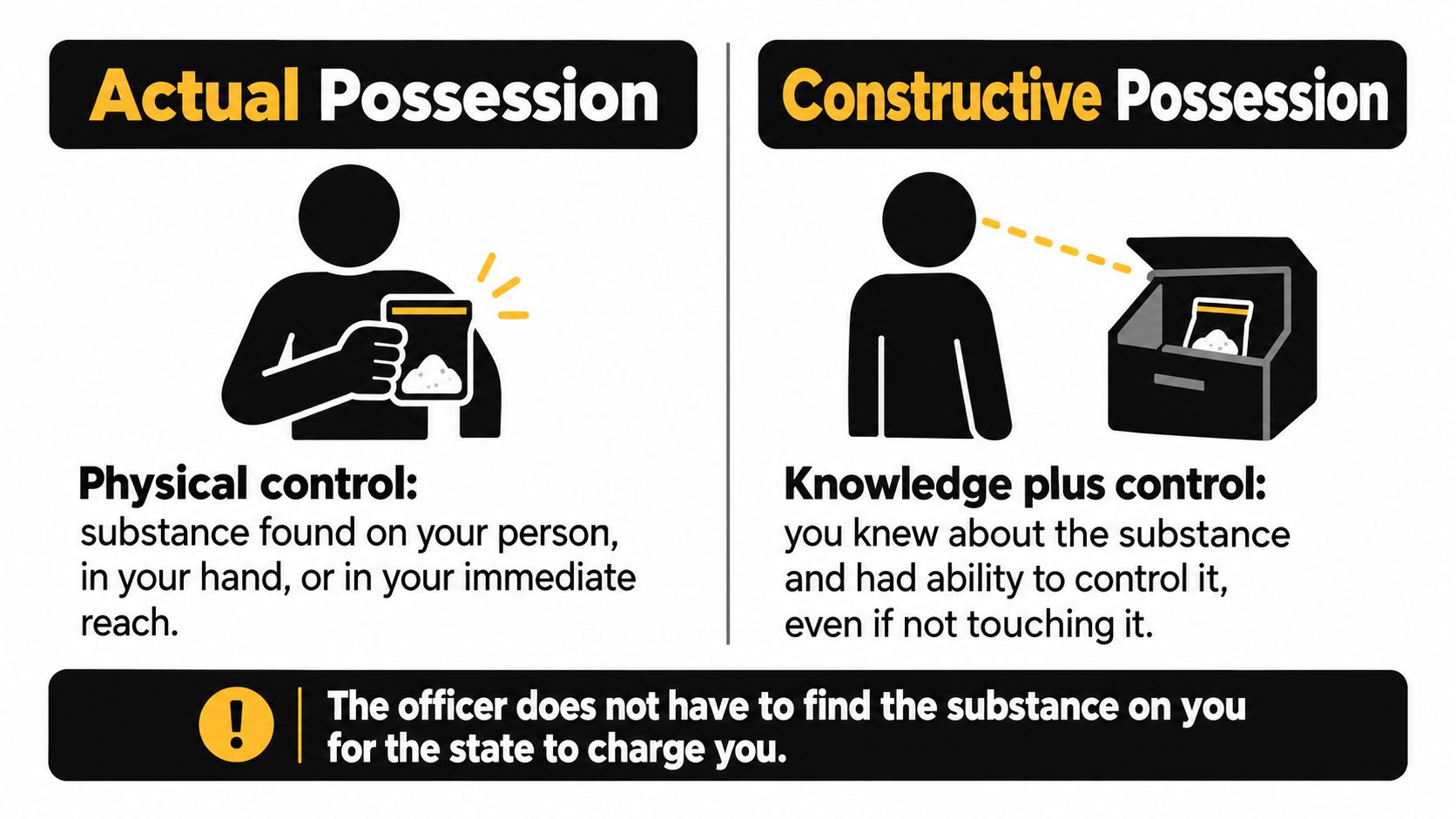
Constructive possession typically requires knowledge of the substance and the ability and intent to exercise control over it. The Cornell-hosted court decision discussing constructive possession illustrates why control without established knowledge isn't enough, although the precise evidentiary requirements vary by jurisdiction.
A shared Kingwood home
Consider a hypothetical situation: officers find a substance in a nightstand in a Kingwood house occupied by several adults. A resident was standing in the hallway when officers arrived. That fact describes the resident's location, but it doesn't answer who knew about or controlled the substance.
A careful review separates the evidence:
- Room access matters. Who used the bedroom, and could other occupants enter it?
- Statements need context. What did each person say, and was the statement recorded?
- Physical evidence needs attribution. Fingerprints, packaging, and personal belongings may help connect an item to someone, but the surrounding circumstances still matter.
- Conduct deserves close examination. Communications and behavior may support or undermine the alleged connection.
The same approach applies to a borrowed vehicle. A substance in a glove compartment raises questions about who used the car, who could access the compartment, and what evidence shows knowledge. Being the driver is a fact to examine, not an explanation of every item inside.
Being near contraband isn't the same thing as knowingly possessing it.
Don't build your response around proving that someone else is guilty. Give your attorney accurate information about access, ownership, and what happened. The useful question is whether the evidence connects you to knowing control, rather than merely placing you nearby.
Simple Possession and Possession With Intent
A possession allegation and a possession-with-intent-to-deliver allegation aren't interchangeable. The second alleges more than control of a substance, so read the charge carefully before describing it to your family or making decisions about a plea.
Suppose, hypothetically, a Humble traffic stop leads to the discovery of a substance and several containers. Your first concern might be the amount found. If the charging document also alleges intent to deliver, your attorney needs to evaluate the evidence supporting that additional allegation separately.
Don't treat packaging, a scale, cash, or a phone as a self-explanatory answer. Ask counsel to examine what each item shows, whether it belongs to the accused, and whether the State's interpretation fits the surrounding circumstances.
Read the verbs on the charging document
Look for possess, deliver, manufacture, or possess with intent to deliver. Then have counsel identify the applicable statute, classification, and alleged quantity. A familiar drug name doesn't tell you which provision the prosecutor is using.
Texas has a distinct rule for substances listed in a schedule but not assigned to a Penalty Group. Under section 481.119's scheduled-substance provisions, knowing or intentional possession is a Class B misdemeanor, while manufacturing, delivering, or possessing with intent to deliver generally starts as a Class A misdemeanor, rising to a state jail felony after one prior conviction and a third-degree felony after two or more prior convictions under that provision.
That's a specific statutory pathway, not a rule to apply to every drug allegation. Preserve prior-case paperwork so counsel can check whether an enhancement fits.
A criminal case may also leave relatives handling separate family questions. If grandparents need guidance about custody or visitation in Harris County, Grandparents' Rights in Humble addresses that distinct issue.
Keep those concerns organized, but don't confuse them with the criminal defense. Each requires its own documents, questions, and legal review.
How Texas Classifies Controlled Substances
A charging document might use a chemical name you've never heard before. Don't guess its legal category from the packaging, appearance, or what someone called it during the arrest.
Texas classifies controlled substances into Penalty Groups 1, 1-A, 1-B, 2, 2-A, 3, and 4, and the applicable group helps determine the charge and punishment. The Texas statutory Penalty Group framework is the starting point for classification, not an informal ranking of how dangerous someone thinks a substance is.
For an unfamiliar or chemically modified substance, classification needs particular attention. Texas recognizes certain analogues in Penalty Groups 1, 1-A, 1-B, 2, and 2-A based on substantially similar chemical structure or specifically designed similar or greater effects under section 481.106's controlled-substance analogue criteria.
Medication and related objects need their own analysis
A prescription-looking bottle doesn't settle the legal question. Texas separately regulates certain noncontrolled prescription medications as dangerous drugs, and unauthorized possession can be a Class A misdemeanor under section 483.041's dangerous-drug possession rules.
- Someone else's prescription. Don't assume the original patient's authorization extends to you. Preserve the bottle and explain the circumstances to counsel.
- A pipe, bag, or scale. Ask whether the allegation involves the substance, paraphernalia, or both. Don't assume an object's ordinary household use resolves the accusation.
- Your own prescription. Have counsel compare the authorization with the substance and circumstances alleged, rather than treating the label as an automatic answer.
Questions about alcohol scheduling and legal status belong to a different classification discussion. Don't transfer conclusions about alcohol to a Texas controlled-substance charge.
Likewise, seek a focused review for a marijuana allegation through the Humble marijuana possession practice page. Accurate classification comes before any useful assessment of exposure.
Felony Grades and the Weight Thresholds That Matter
Simple possession doesn't mean a minor charge. For a Penalty Group 1 allegation, the weight category can make possession itself a felony without an intent-to-deliver allegation.
Texas Penalty Group 1 Possession Thresholds at a Glance
The thresholds below come from the Texas Controlled Substances Act cited earlier. The final column offers practical review priorities, not predictions about a particular Harris County judge or case.
| Aggregate Weight | Texas Felony Grade | Practical Harris County Reality |
|---|---|---|
| Less than 1 gram | Generally a state jail felony | Don't dismiss the allegation as a misdemeanor because the amount appears small. |
| 1 to less than 4 grams | Third-degree felony | Have counsel verify the weight category before evaluating a proposed resolution. |
| 4 to less than 200 grams | Second-degree felony | Review the laboratory result and charging language together. |
| 200 to less than 400 grams | First-degree felony | Obtain a case-specific assessment of exposure and release issues. |
| 400 grams or more | Imprisonment from 10 years to life and a fine up to $100,000 | Treat the allegation as urgent and get a detailed sentencing review. |
Aggregate weight isn't necessarily pure-drug weight
Texas includes mixtures, solutions, adulterants, and dilutants in aggregate weight. Its statutory definitions of possession and measurement also provide special Penalty Group 1-A rules involving commonly abused units and 40-microgram statutory units.
Ask your attorney to compare the laboratory's measurement with the rule governing the alleged substance. A description such as “a little powder” can't replace that analysis.
Bond, probation eligibility, and a final sentence require separate review. Don't use a felony label to invent a bond amount, assume probation is available, or conclude imprisonment is inevitable.
Before considering a plea: Have counsel reconcile the alleged substance, statutory category, laboratory weight, and charging document.
Your family needs a reliable explanation of the actual exposure, not a worst-case number repeated without context. Bring the paperwork and ask which findings could change the classification.
Common Defenses and Evidentiary Pressure Points
An arrest isn't a reason to stop questioning the evidence. It's a reason to organize the questions carefully.
Use this visual as a discussion checklist, not a promise that any particular defense applies.
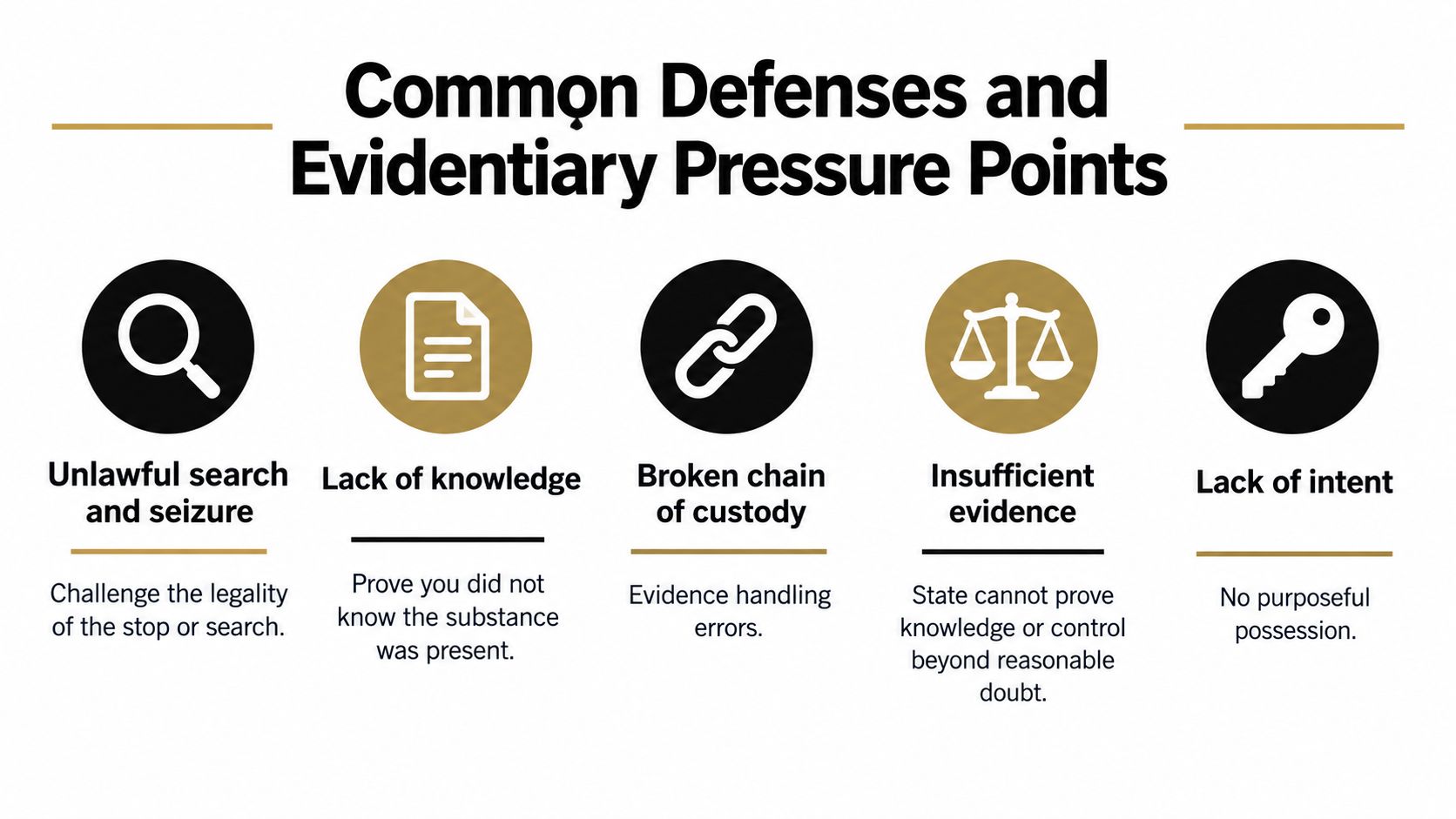
Texas's definition of possession, actual care, custody, control, or management, is broader than holding something in your hand. As discussed earlier, an effective review needs to address the alleged connection to the substance, not just where officers found it.
Ask for an evidence-based review
Have your attorney examine the investigation rather than trying to explain away the charge yourself:
- Stop and search circumstances. Write down what happened so counsel can evaluate the legal basis for obtaining the evidence.
- Identification and handling. Ask counsel to review laboratory identification, analyst qualifications, and records tracking the evidence.
- Knowledge and access. Identify shared spaces, other users, and facts that contradict the claimed connection.
- Authorization. Provide original medication records and let counsel assess whether they address the allegation.
- Resolution options. Ask whether a lesser offense, diversion, or another alternative should be investigated. Don't assume eligibility or a guaranteed dismissal.
A useful consultation question is: What evidence must we examine before deciding whether to challenge or negotiate this charge? That keeps the discussion focused on the State's proof instead of a rushed explanation to a judge.
If testing is also a concern, the Addiction Resource Center LLC resource on legal ways to pass a drug test is a separate informational resource, not advice about your court obligations. Don't alter, evade, or tamper with required testing; discuss medication questions with counsel and the testing provider.
For an additional discussion to consider alongside those questions, watch the following video.
Practical Next Steps After a Humble Area Arrest
You don't need to solve the entire case immediately. You need to protect information, avoid unnecessary conversations about the allegation, and get qualified help.
A relative can help organize documents without becoming an investigator. Don't contact other people to coordinate accounts or pressure anyone to take responsibility.
Protect the case before trying to explain it
- State that you want counsel. Clearly request an attorney and invoke your right to remain silent before answering questions about the alleged conduct. Don't try to negotiate your way out through an improvised explanation.
- Write a private chronology for counsel. Record the location, sequence of events, people present, and what you remember officers saying. Mark uncertainty rather than filling gaps.
- Preserve existing records. Keep prescription bottles, pharmacy documents, messages, photographs, and relevant vehicle or housing records. Don't delete texts or social posts, even if you think they look embarrassing.
- Collect witness information. Give counsel names and contact details. Let the attorney decide how interviews should proceed.
- Organize court and release paperwork. Keep notices and conditions together, and flag anything you don't understand promptly.
For a Harris County release discussion, use the office's explanation of what happens at a bond hearing to prepare questions. Ask counsel to clarify the hearing's purpose, the documents needed, and any conditions you must follow rather than relying on someone else's experience.
Bring useful materials to the consultation
- Case documents. Include the charging paperwork, release documents, notices, and any prior-case records you have.
- Medication information. Bring a written medication list and available authorization records.
- Practical essentials. Have your ID, phone, charger, and a written list of questions.
If the accused remains in custody, a family member can assemble those materials. Tell counsel about missing documents rather than postponing contact until the folder feels complete. These are preparation steps, not a substitute for advice about the individual case.
Finding the Right Advocate Close to Home
Choose an attorney who explains the allegation plainly and asks for the evidence before predicting the outcome. You need someone who can distinguish what is known, what is alleged, and what still needs investigation.
For Humble, Atascocita, Kingwood, and Northeast Houston families, accessible communication matters. Ask who will answer questions, how you'll receive updates, and how the attorney will help you prepare for court appearances. A clear process is more useful than a dramatic promise.
Questions that reveal the attorney's approach
The office's guide on how to choose a criminal defense attorney can help organize your search. During a consultation, focus on concrete questions:
- What needs verification? Ask which documents and evidence are necessary to assess the charge.
- What happens next? Request an explanation of the next known court event and your preparation responsibilities.
- How will decisions be made? Ask how counsel will explain the tradeoffs between challenging evidence and considering a proposed resolution.
- What else should I disclose? Mention employment, licensing, immigration, or family concerns so counsel can identify issues needing additional review.
Don't choose solely because someone promises a quick dismissal. Choose a lawyer who can explain why a proposed strategy fits the evidence and who won't brush aside your questions.
You deserve a plan you can understand without needing a legal dictionary.
A possession accusation can disrupt work, caregiving, and family routines. Keep those practical needs on the consultation agenda, but keep expectations grounded: no responsible attorney can determine the outcome from the word “possession” alone.
Bring the documents you have, describe the facts accurately, and ask for a focused explanation of your options. Getting help close to home should make the situation clearer, not add another layer of confusion.
The Law Office of Bryan Fagan offers criminal defense representation and free consultations at its Humble office for individuals facing drug possession allegations. Bring your charging document, prescription records, and questions, and visit Law Office of Bryan Fagan to schedule a free consultation and discuss a practical plan for your case.