Your spouse wants to talk about the business, the house, or what an inheritance should mean for your family. You're not necessarily considering divorce. You may want financial expectations written down before another loan, retirement decision, or family transition makes the conversation harder.
For families around Humble, a postnuptial agreement in Texas can be a practical planning tool. The important question isn't just whether you can sign one. It's whether the document accurately addresses your property and whether the process gives both spouses a genuine opportunity to understand the consequences.
Why Texas Couples in Humble Are Talking About Postnuptial Agreements
Consider an Atascocita business owner whose company has become a central part of the household's finances. One spouse manages customers and payroll; the other has supported the household while the business developed. They want stability, but they may have very different ideas about what business ownership should mean if their circumstances change.
A Kingwood couple entering a blended marriage might have another concern. They want to build a shared life without losing sight of children from earlier relationships, existing real estate, or inheritance expectations. Northeast Houston retirees may be weighing similar questions about investments and the home they intend to keep.
These are planning situations, not proof that a marriage is failing.
Separate the relationship conversation from the property conversation
A productive discussion starts with the problem you're trying to solve. Is it uncertainty about ownership, anxiety about borrowing, or concern that an estate plan doesn't match your understanding of the assets?
- Business continuity: Identify the ownership interest and financial exposure each spouse wants addressed.
- Blended-family expectations: Discuss which assets should remain individually owned and which should be shared.
- Retirement planning: Clarify the intended treatment of investments, income, and outstanding obligations.
Couples working on both financial trust and their relationship may find DeTalks' resource on how to save my marriage useful alongside legal advice. Relationship work and property planning serve different purposes; neither should be presented as a substitute for the other.
A property agreement should resolve a financial question, not become a test of whether your spouse loves or trusts you.
Our Humble office helps residents assess whether a marital-property agreement fits their goals. Sometimes the right starting point is drafting. Sometimes it's organizing records or coordinating with estate-planning counsel before anyone negotiates ownership changes.
What a Postnuptial Agreement Is Under Texas Law
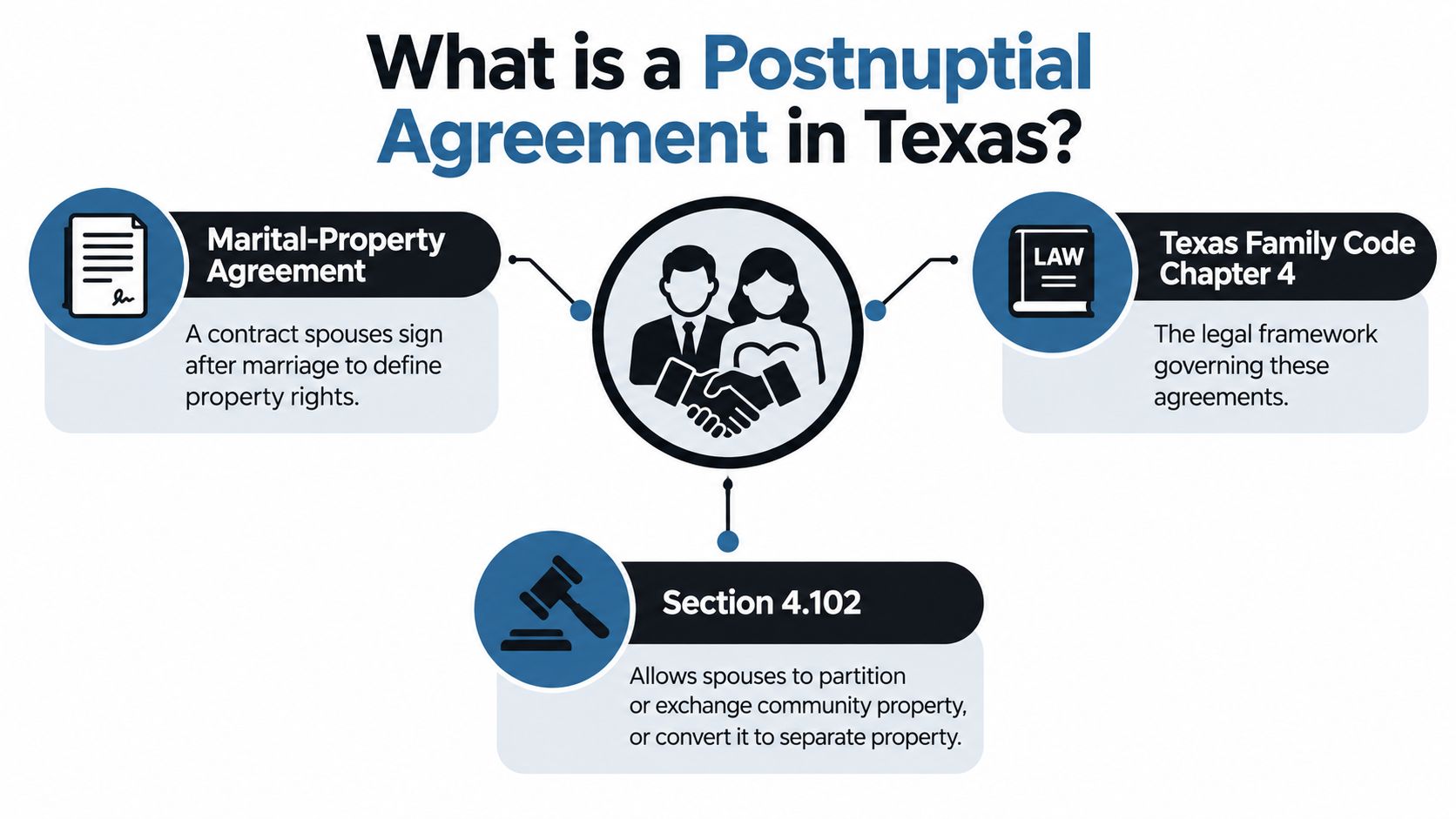
A postnuptial agreement, also called a marital-property agreement, is more than a general promise to be fair. Texas Family Code Chapter 4 provides the framework for spouses to make specified changes to property ownership and the treatment of income.
Think of the marriage as the road and the agreement as a written, turn-by-turn route for particular assets. The document doesn't describe every possible event in your lives. It should tell both spouses which property is covered and what they've agreed will happen to it.
The legal framework can be understood through these connected concepts.
Start with the transaction you actually need
A partition or exchange addresses community property. An agreement concerning income from separate property addresses a different ownership question. Converting separate property into community property is another transaction, with its own technical requirements.
Before choosing language, review what community property means in Texas. Don't assume that the name on an account answers every question the agreement needs to resolve.
Under Texas Family Code §4.104, an agreement partitioning or exchanging community property, or addressing income and property derived from separate property, must be in writing and signed by both spouses, and it's enforceable without consideration; the statutory history also identifies the 1993 amendment, after which §4.105 governs the statutory remedies and defenses for agreements executed on or after September 1, 1993.
Without consideration means neither spouse needs to make a separate payment or provide another legal exchange merely to support the contract. It doesn't mean financial consequences are unimportant.
Translate intentions into identifiable terms
Before drafting, answer practical questions:
- Covered property: Which asset, ownership interest, or income stream does the agreement address?
- Intended result: What should each spouse own after execution?
- Future treatment: What should happen to later earnings or income associated with that property?
A dinner-table assurance that the business will always belong to one spouse doesn't satisfy the written-execution requirement. Nor should an older agreement be evaluated without checking its execution date and the applicable enforcement framework.
Prenuptial & Postnuptial Agreements in Humble covers drafting and review of marital-property agreements for Humble clients. Legal review should begin with the intended transaction, not with a template's title.
Enforceability Requirements Courts Actually Apply
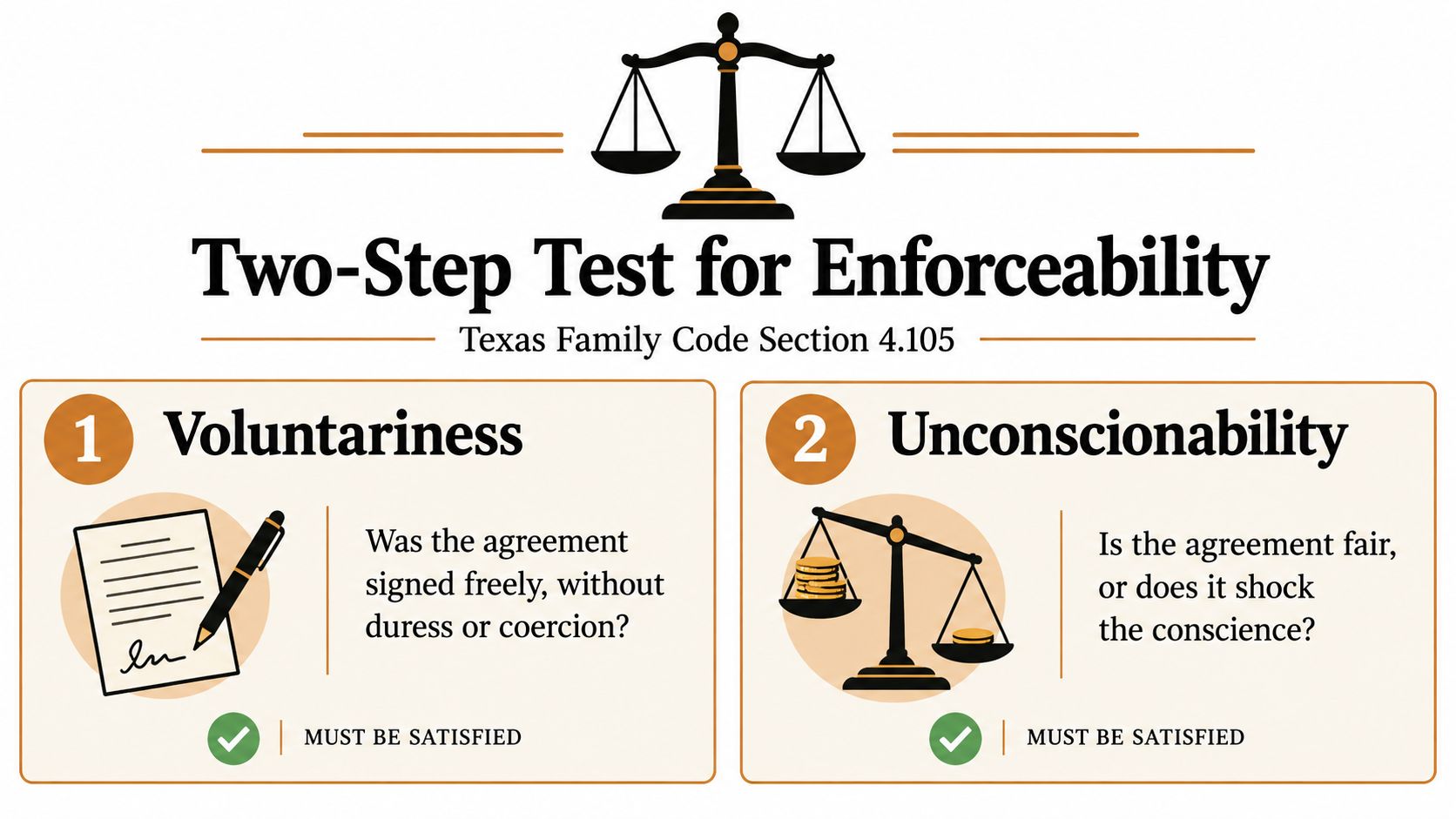
Signatures aren't the entire enforceability analysis. A spouse who later opposes enforcement bears the burden of establishing a statutory defense.
Under Texas Family Code §4.105, that spouse must prove either involuntary execution or that the agreement was unconscionable when signed and, before execution, the spouse lacked fair and reasonable disclosure, didn't voluntarily waive additional disclosure in writing, and didn't have, and reasonably couldn't have had, adequate knowledge of the other spouse's property or financial obligations. The court decides unconscionability as a matter of law, and the statute makes these remedies and defenses exclusive.
The distinction matters: these are alternative routes to a challenge, not a general invitation to undo any agreement that later feels unfavorable.
Fairness and disclosure must be evaluated precisely
Calling a document unfair doesn't complete the statutory analysis. For the unconscionability route, the court considers the agreement at execution and the accompanying disclosure, waiver, and knowledge issues.
A used-car purchase offers a limited but useful analogy. Knowing the purchase price isn't the same as receiving meaningful information about the vehicle's condition. Similarly, knowing that your spouse owns a company isn't the same as receiving information about its value, borrowing, guarantees, and contingent obligations.
The analogy isn't a legal test. It illustrates why a summary such as “we both know our finances” is a poor substitute for an organized record.
Practical rule: Preserve what each spouse received before signing, not just what the final agreement says they received.
Prepare for a Harris County dispute before one exists
If enforcement becomes disputed in a Harris County family-law case, counsel should connect the document to evidence about negotiation, disclosure, and execution. Harris County Family Courts: A Humble Resident's Guide explains how family-law cases proceed in the courts serving Humble.
Keep a file containing:
- Financial schedules: Assets, debts, guarantees, and supporting documents exchanged before execution.
- Valuation records: Dates, methods, and documentation supporting the listed values.
- Review history: Drafts, questions, revisions, and correspondence showing meaningful consideration.
- Counsel documentation: Acknowledgments of independent advice where appropriate.
These records don't guarantee enforcement. They give an attorney something concrete to evaluate and present instead of competing recollections.
How a Postnuptial Differs From a Prenuptial Agreement
Not signing a prenup doesn't mean you've missed every opportunity to address property ownership. The distinction begins with timing: a prenuptial agreement precedes marriage, while a postnuptial agreement is made between spouses after the wedding.
Texas Family Code §4.102 authorizes spouses to partition or exchange community property, including property already owned or acquired later; transferred property becomes the receiving spouse's separate property, and the agreement may also classify future earnings and income from that property as separate property.
That authority can address concerns that weren't visible before marriage. A business acquisition, changing investment strategy, or decision to combine households may call for a different arrangement than the spouses originally expected.
Postnuptial vs Prenuptial Agreements in Texas
| Factor | Prenuptial Agreement | Postnuptial Agreement |
|---|---|---|
| Timing | Before the wedding | During the marriage |
| Planning focus | Expectations entering marriage | Ownership questions within an existing marriage |
| Typical provisions to discuss | Property expectations, business interests, and financial arrangements | Partition, exchange, future income, and specified ownership changes |
| Disclosure intensity | Organize individual financial information before negotiating | Reconstruct existing assets, shared accounts, liabilities, and relevant financial history |
| Independent counsel | A useful safeguard for separate interests | Particularly useful when spouses are changing an existing arrangement |
| Practical use | Plan before combining financial lives | Address developments after financial lives have become intertwined |
The disclosure difference is often practical rather than a reason to assume a different legal burden. A married couple may need to untangle records that didn't exist before the wedding. Don't assume that postnuptial agreements automatically face stricter statutory disclosure rules because the parties are married.
Choose the instrument that matches your present situation
Our explanation of what a prenuptial agreement is can help readers considering marriage distinguish that planning stage from an existing marriage. For spouses, the useful conversation is about current ownership, not whether they should have acted earlier.
Separate-to-community conversion is a transaction between spouses with additional formalities. It deserves focused review rather than being treated as an ordinary clause copied from a premarital document.
Families comparing resources across states should keep jurisdiction clear. Olson & Sons' discussion of Kona divorce lawyer premarital agreements is an outside resource for that separate jurisdiction, not authority for Texas drafting.
For deeper local review, our marital-agreements service addresses the drafting and review needs of Humble spouses. Bring your present financial picture rather than trying to adapt a document written for a different stage of life.
Drafting a Valid Postnuptial Agreement Step by Step
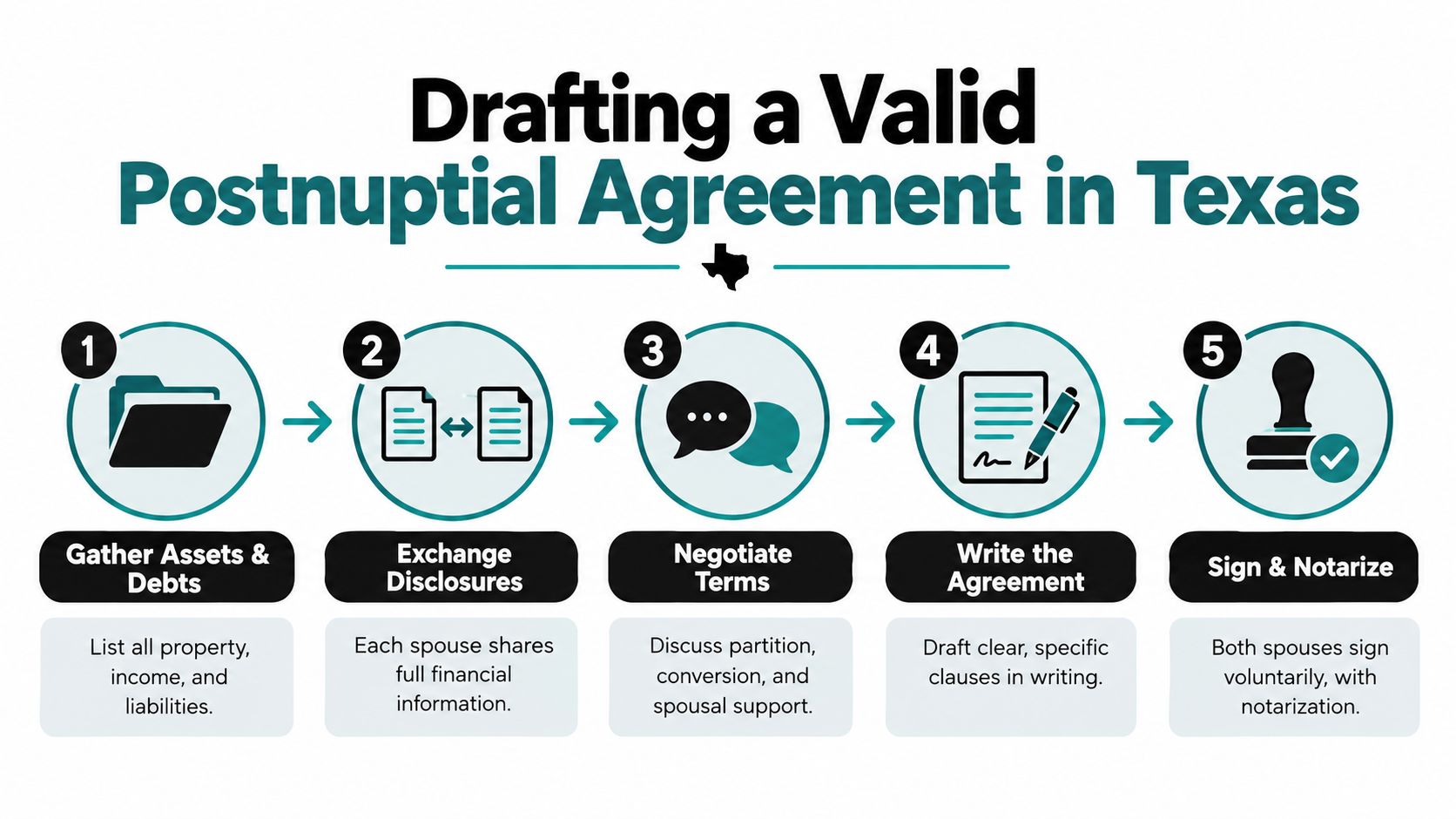
Begin with records, not proposed waivers. A useful drafting process allows each spouse to understand what exists before deciding who should own it.
This visual provides an overview of the workflow; the document's legal requirements still depend on the transaction involved.
Gather and exchange the financial picture
Prepare asset and debt schedules with documentary support. An Atascocita couple discussing an LLC should gather ownership documents, financial statements, dated valuations, and loan or guarantee records. A Kingwood blended household discussing real estate should assemble deeds, acquisition records, mortgage information, and documentation supporting the claimed separate-property basis.
A Northeast Houston retiree addressing inherited stock should identify the securities and relevant acquisition records. These are hypothetical planning examples, not accounts of particular clients.
- Exchange disclosures early: Share the supporting material before negotiations are effectively finished.
- Resolve missing information: Identify uncertain values or incomplete records rather than burying them in broad language.
- Compare objectives: Write down what each spouse wants changed and what each wants left alone.
Obtain advice and negotiate the actual terms
Independent counsel for each spouse is a sensible safeguard, particularly when the proposed agreement changes ownership substantially. Ask counsel to explain both the immediate effect and what either spouse would give up.
Negotiate with room for questions. If a revised clause changes the bargain, allow meaningful reflection on that revision instead of treating an earlier review as sufficient.
The Fourteenth Court of Appeals' analysis in Choudhury v. Choudhury highlights the alternative challenges of involuntary execution and unconscionability combined with the statutory disclosure deficiencies. Rushed discussions and incomplete financial information are avoidable risks, not proven rankings of the most common reasons agreements fail.
The accompanying video is available for readers who prefer an audiovisual resource.
Execute and preserve the complete document
Check the final agreement against its exhibits before signing. Confirm that the asset descriptions, dates, and intended classifications match what both spouses negotiated.
The workflow graphic includes notarization, but the basic partition-agreement formality discussed earlier is written execution with both signatures. Don't mistake an illustration for an additional statutory requirement or assume notarization cures other defects.
Store complete signed originals safely, and ensure both spouses can obtain their agreement and disclosures. Ask counsel what implementation work the particular assets require after execution.
Our Humble office can assist with hands-on drafting and review. Arriving with organized records makes it easier to focus on consequential choices instead of searching for missing account statements.
Common Provisions Texas Couples Include
A useful provision answers a specific ownership question. “Protect the business” is an objective; identifying the business interest, associated obligations, and intended treatment of future income is drafting work.
The discussion should make room for both spouses' concerns.

Match the clause to the asset
Partition provisions identify community assets the spouses intend to allocate differently. For business interests, distinguish ownership from compensation, distributions, retained earnings, goodwill, and appreciation. A Northeast Houston owner seeking to address future company growth needs precise treatment of those categories, not an unsupported promise that everything connected to the company is protected.
For premarital or inherited assets, document the original ownership basis and identify what the agreement is intended to change. Retirement accounts and stock options warrant asset-specific review rather than being grouped under “investments.”
Debt provisions should identify the obligation and the responsibility being allocated between spouses. Ask counsel separately about lender rights and implementation; an ownership clause shouldn't be treated as the answer to every creditor question.
Treat conversion as a distinct legal decision
Under §4.203, converting separate property into community property requires a written instrument signed by both spouses, identification of the property, and an express conversion statement, without consideration; Texas Bar practice materials on property agreements also describe prominent warning language and the importance of fairly and reasonably disclosing conversion's legal effect.
A Humble spouse considering conversion of a gifted home should understand that this changes ownership classification. It isn't merely a sentimental declaration that the house belongs to the family.
- Conversion details: Specify the interest, valuation date, associated debt, and intended treatment of later income or appreciation.
- Support proposals: Have counsel evaluate any proposed spousal-support waiver within applicable statutory limits rather than assuming a blanket waiver works.
- Tax coordination: Seek tax advice before adopting ownership changes or a future settlement strategy.
Tax Attorney Stephen A Weisberg's resource on tax implications of divorce is a separate planning resource, not a substitute for individualized advice about your agreement.
Precision helps both spouses understand the bargain. It doesn't make every proposed bargain legally enforceable.
Readers anticipating separation can review Texas divorce property division to frame questions for counsel. Drafting should address the identified assets without pretending to settle every possible future dispute.
Red Flags and Common Misconceptions
A spouse hands you a finished agreement and says there's no reason to involve anyone else. The schedules omit business debt, the property descriptions are broad, and you're expected to sign immediately.
That situation calls for a pause, not an argument about whether you're being supportive. Ask for the missing information and a genuine opportunity for independent review.
Replace shortcuts with a reviewable process
- Hidden assets or undisclosed debt: Request supporting records and reconcile omissions before negotiations continue.
- Surprise presentation: Separate receiving the draft from agreeing to execute it.
- Pressure tactics: Stop the signing process and obtain private legal advice.
- Vague descriptions: Replace categories such as “all investments” with asset-specific terms.
- Unexplained consequences: Ask counsel to describe the practical ownership change in plain language.
These concerns are often addressable before execution. After signing, the question becomes whether the facts support an available legal challenge, not whether the process could have been better.
A postnuptial isn't a divorce decree
A marital-property agreement shouldn't be confused with a settlement made in an active divorce proceeding. Under Texas Family Code §7.006, spouses in divorce or annulment may enter a written agreement concerning property, liabilities, and maintenance; before judgment, they may revise or repudiate it unless another rule makes it binding, and it becomes binding on the court when the court finds its terms just and right.
For Humble residents navigating Harris County proceedings, that means counsel must identify the kind of agreement involved. Don't assume a negotiated settlement already has the effect of a final decree.
Likewise, don't use a postnuptial as your only estate-planning document. Coordinate ownership decisions with review of wills, trusts, and beneficiary arrangements so your intentions are considered together.
If criminal charges or another urgent legal matter are also affecting your household, raise that issue separately with appropriate counsel. A property agreement isn't a substitute for criminal defense or an answer to every financial consequence of another case.
The practical response to uncertainty is straightforward: preserve records, avoid pressured signing, and obtain advice before making an ownership change you don't fully understand.
Frequently Asked Questions From Humble Families
Is it too late after the wedding?
No. Focus on your current assets and goals rather than regretting the missed prenup.
What if we want changes later?
Ask counsel to evaluate a formal revision or replacement. Don't rely on handwritten edits or verbal assurances.
What happens if divorce follows?
Bring the complete agreement and disclosure file to your divorce attorney before negotiating property terms.
When should we stop drafting alone?
When ownership is disputed, records are incomplete, or either spouse feels pressured. Families in Humble, Atascocita, Kingwood, and Northeast Houston can seek review before committing.
The Law Office of Bryan Fagan offers drafting and review of marital-property agreements, with guidance on how your property goals intersect with divorce and estate planning. Schedule a free consultation at our downtown Humble office, and bring your asset list, debt information, and any proposed agreement. Visit Law Office of Bryan Fagan to discuss a practical next step for your family.