A parent in Humble may be preparing an inheritance while worrying about an adult child's debt, a difficult divorce, or trouble managing money. The family wants to provide lasting support without handing over unrestricted control all at once. A spendthrift trust can help with that goal, but its protection has limits, especially when child support or other legal claims are involved.
For families in Humble, Atascocita, Kingwood, and Northeast Houston, understanding how the trust works before signing or changing estate documents can help prevent painful surprises later. The key is knowing what stays protected inside the trust, what happens when a trustee makes a distribution, and which obligations may still matter.
What a Spendthrift Trust Means for Texas Families
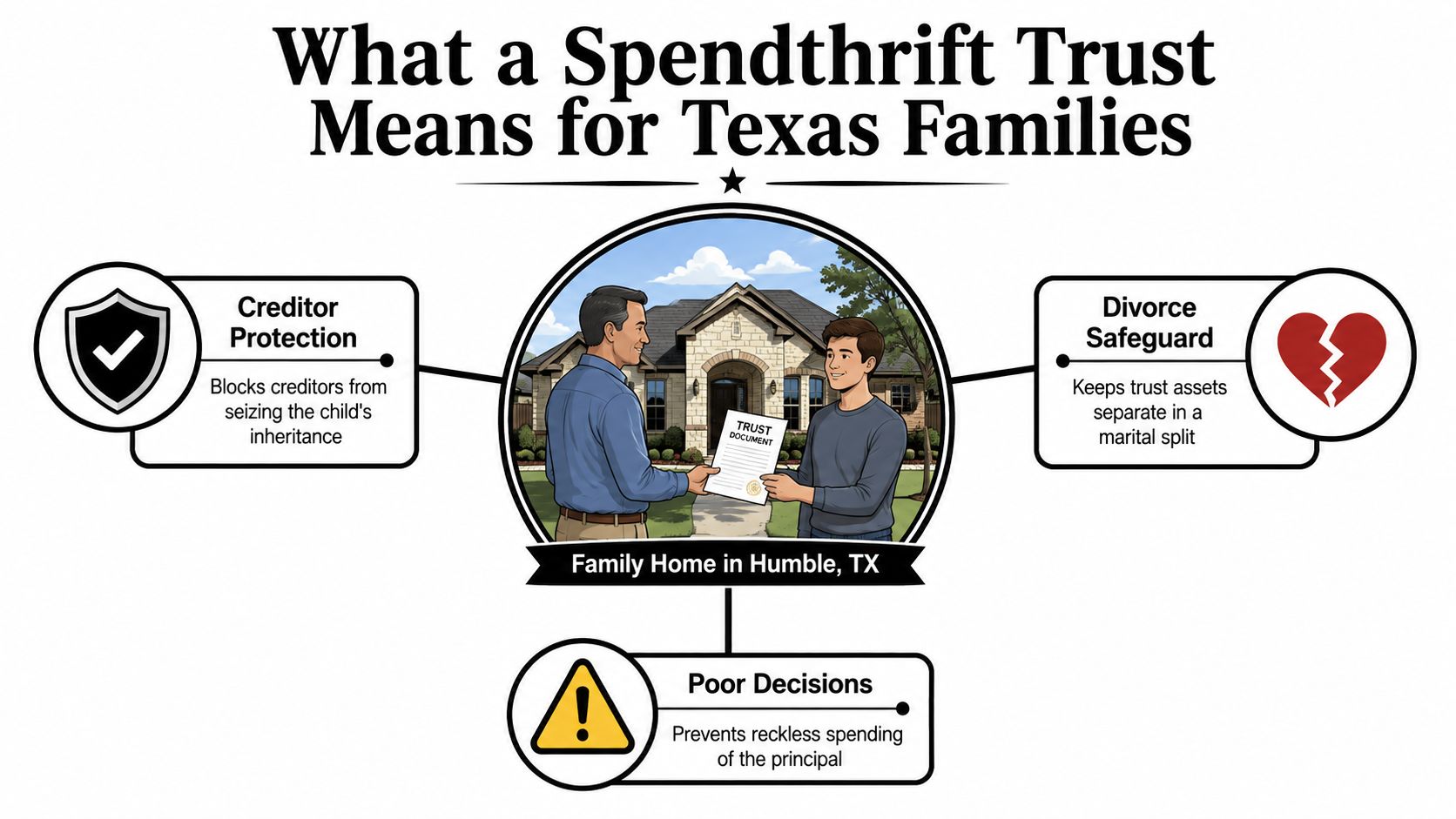
Suppose a parent wants to leave money to an adult child who's rebuilding after debt problems. The parent hopes the inheritance will help with housing and education, but worries the child might spend it quickly or that creditors could claim it. A spendthrift trust can give a trustee control over when and how trust property is distributed, instead of giving the beneficiary immediate, unrestricted access.
In plain English, a spendthrift trust is a trust with language restricting a beneficiary from transferring their interest in trust property before the trustee distributes it. The beneficiary generally can't sell or pledge that future interest, and ordinary creditors generally can't seize it while it remains in the trust. That differs from an arrangement where a beneficiary can demand their share or assign the right to receive it.
What the trust controls
The trustee manages the property under the written trust terms. Those terms might allow distributions for the beneficiary's needs or let the trustee make decisions based on defined standards. The arrangement can help parents provide for a loved one who needs financial structure, or help keep an inheritance within a family line. A trust can also be part of broader planning for someone with special needs, although that goal requires careful consideration of public-benefit rules.
A spendthrift clause doesn't make a beneficiary's money untouchable forever. The central distinction is whether property is still held by the trustee or has already been paid or delivered to the beneficiary. Once the trustee distributes funds, the spendthrift restriction generally no longer protects those funds as trust property.
A useful way to think about it: The trust can control property before distribution. It can't promise that money will remain protected after the beneficiary receives it.
Families researching different trust structures may also find this overview of NYC high-net-worth trust planning useful for understanding how irrevocable trusts fit into broader planning. The right structure for a Texas family still depends on the family's goals and circumstances.
How Texas Law Treats Spendthrift Provisions
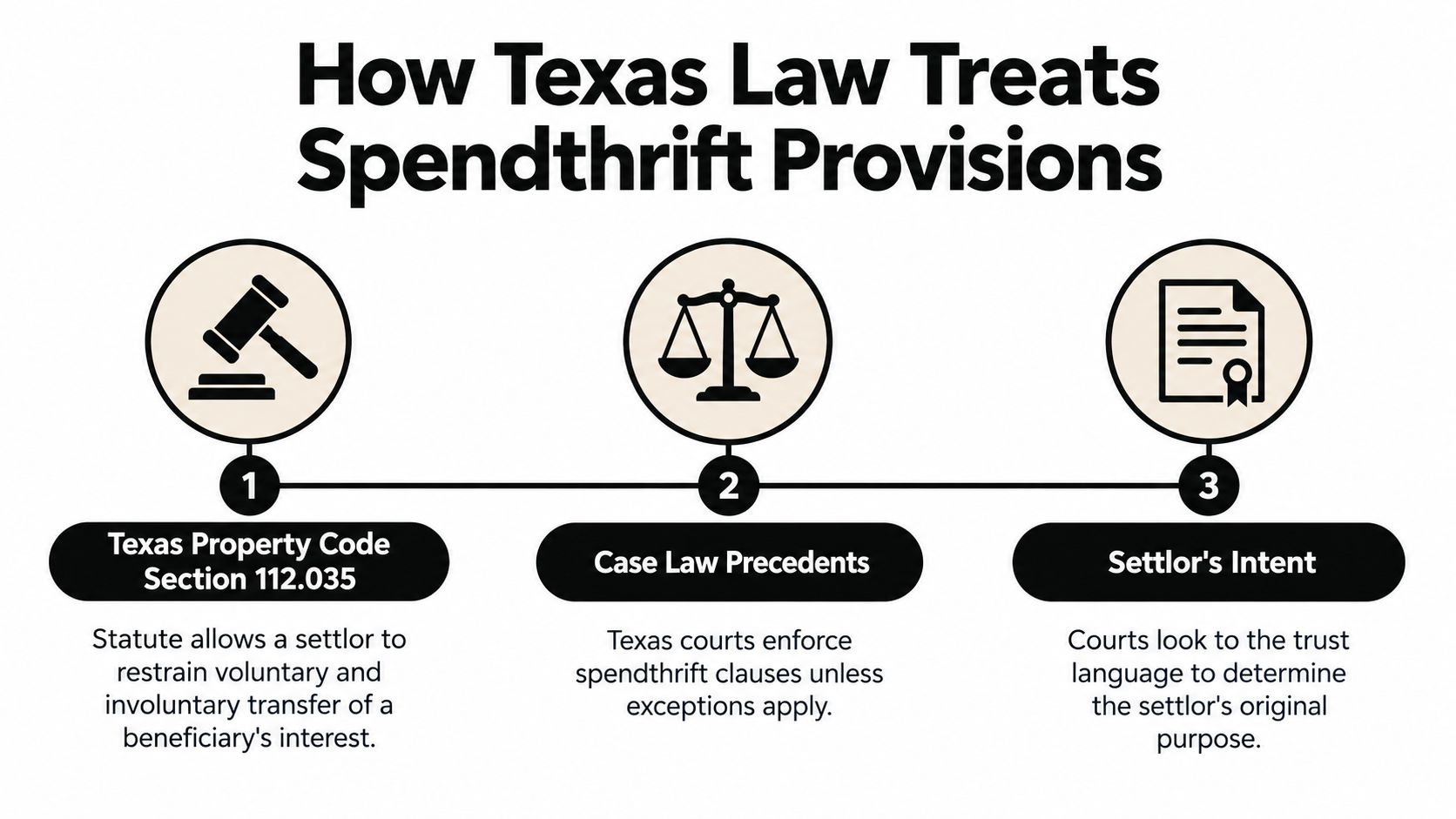
Texas recognizes spendthrift provisions through both earlier court decisions and statute. That matters because the protection isn't merely a custom attorneys add to trust documents. Texas Property Code §112.035 sets out the statutory framework for restricting a beneficiary's ability to transfer an interest in trust income, principal, or both while the trustee hasn't paid or delivered those assets (Texas Property Code §112.035).
The rule traces back to Texas courts, which treated spendthrift provisions as valid before the Texas Trust Code was enacted. The modern statutory framework was added by Acts of the 68th Texas Legislature in 1983, with an effective date of January 1, 1984. It was modeled on Restatement (Second) of Trusts §§152–153, published in 1957. That lineage reflects a legal approach that recognizes the settlor's ability to direct how trust property is held for a beneficiary.
What the statute means in practice
A settlor is the person who creates and funds the trust. Under the statute, the settlor can restrict voluntary transfers, such as a beneficiary trying to assign a future interest, as well as involuntary transfers sought by creditors. Texas law also says that declaring an interest to be a “spendthrift trust” is sufficient to restrain alienation to the maximum extent the Texas Trust Code allows.
The provision has been amended in 1997, 2005, 2007, 2013, and 2017 as Texas trust law developed. For a family planning an inheritance, that history offers useful context: the protection has a statutory basis, but the specific trust language and applicable exceptions still matter.
One practical limit is especially important. Section 112.035 addresses assets that remain unpaid or undelivered by the trustee. Once property is distributed, the statute's spendthrift restraint generally doesn't continue to shield it as trust property. A Humble family should therefore consider not only what the trust says, but also how its distribution terms will work in everyday life.
The embedded video offers another way to explore the topic:
Creditor Protection and Where It Stops
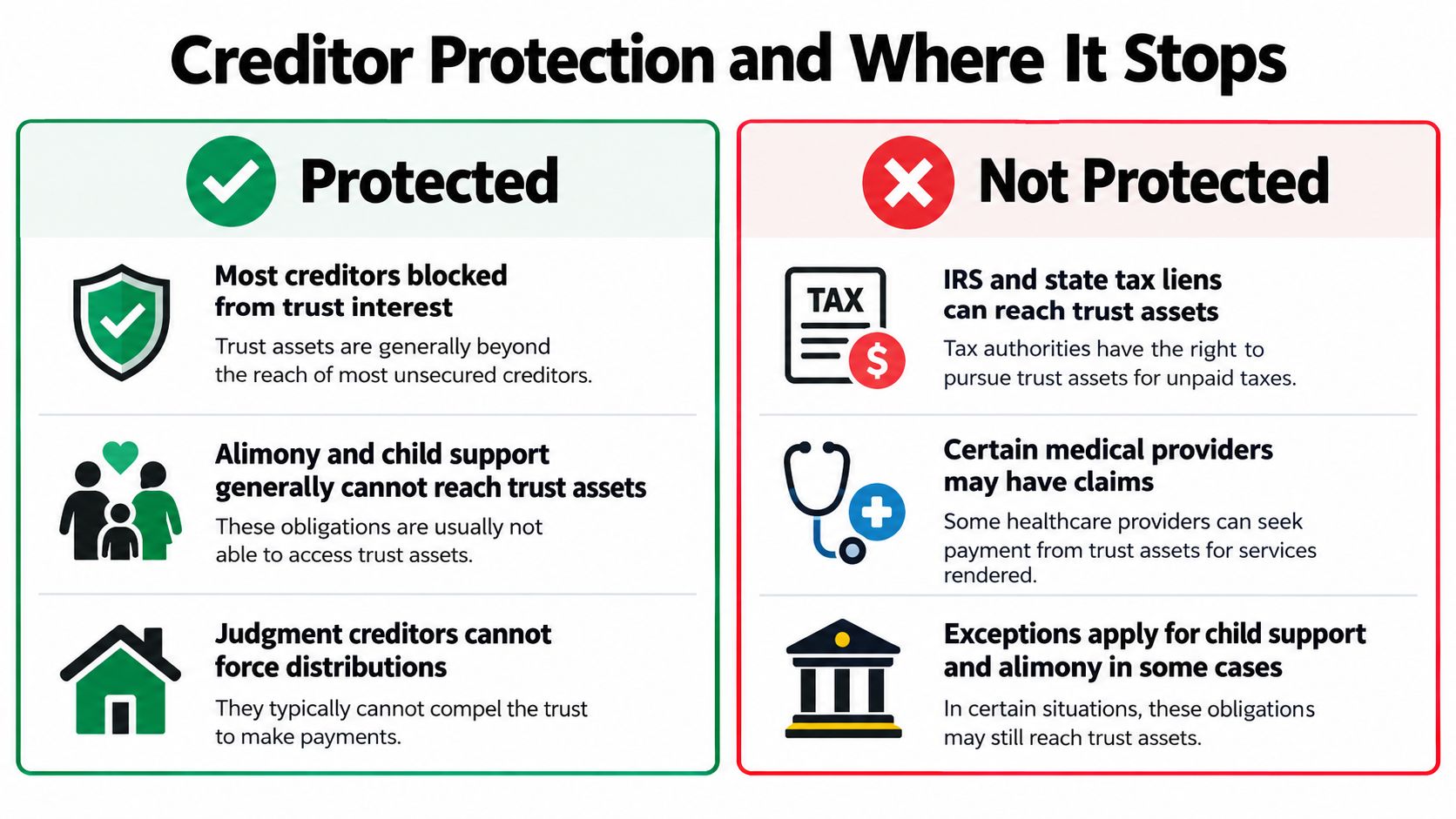
A spendthrift clause can create a meaningful barrier between a beneficiary's trust interest and many ordinary creditor claims before distribution. That can be useful for Kingwood and Northeast Houston families planning inheritances, including in blended-family situations or when a beneficiary has difficulty managing money. But it isn't an absolute shield, and the exceptions matter most when a family is dealing with support obligations or government claims.
Support obligations need separate attention
Texas Family Code §154.005 makes a specific distinction for discretionary trust disbursements: a court may order child-support payments from trust income, but not from trust principal (Texas Family Code §154.005). So a spendthrift clause doesn't necessarily prevent a court from considering trust income when child support is being determined or enforced.
For a parent facing divorce, custody litigation, or a child-support dispute, the trust terms and the history of trustee distributions may be relevant to the analysis. Income and principal aren't interchangeable for this purpose. Clear records help show what the trust earned, what it retained, what it distributed, and the basis for each payment.
Know which claims may qualify for an exception
The Uniform Trust Code materials describe exception creditors who may reach a beneficiary's interest despite a spendthrift restriction. They include a child, spouse, or former spouse with a judgment or court order for support or maintenance; a judgment creditor who provided services to protect the beneficiary's trust interest; and claims by a state or the United States when authorized by law (Uniform Trust Code materials on spendthrift exceptions). An eligible claimant may seek a court order attaching present or future distributions, and a court may limit the relief to what's appropriate under the circumstances.
Before relying on a trust as part of an estate plan, list any existing support orders, tax obligations, lawsuits, or other claims. Share that information with counsel so the plan can be reviewed with those risks in view.
Drafting and Administering a Spendthrift Trust in Texas
A trust document has to do more than use the word “spendthrift.” Its terms should explain who manages the assets, when the trustee may distribute them, and what happens if circumstances change. A Texas estate-planning review often considers the spendthrift language alongside distribution standards, separate shares for beneficiaries, trustee powers, and instructions for what happens if a beneficiary dies before receiving everything.
The trustee's role is practical as well as legal. The trustee manages property, follows the document, and keeps records of decisions and payments. Because Texas law treats trust income and principal differently for child-support purposes, the accounting should clearly distinguish earnings, retained principal, and distributions.
A workable planning sequence
Clarify the purpose. Decide whether the trust is meant to manage an inheritance, support a beneficiary over time, or address another family concern. Be candid about any debt, support order, or pending lawsuit that might affect the plan.
Choose the terms and trustee. The document should set out the distribution approach and who will make decisions. Consider whether a family member, professional, or corporate trustee can handle the responsibilities fairly and keep reliable records.
Review, sign, and fund. After drafting and review, the settlor needs to transfer the intended property into the trust using the appropriate paperwork. Depending on the asset, that may involve retitling an account, updating a beneficiary designation, or preparing a new deed for real estate. A trust that hasn't been properly funded may not hold the property the family expects it to manage.
For a practical overview of transferring assets into a trust, consult this trust funding guide. Humble families can also review how to create a trust in Texas as they prepare for a conversation about their goals. An Estate Planning Attorney in Humble page describes wills, trusts, and estate plans for Humble families.
There isn't one reliable timeline that fits every trust. Drafting, family review, questions about property ownership, and coordinating deeds or account paperwork can all affect how long setup takes. After funding, the trustee should keep organized records and revisit the plan after significant family or financial changes.
Spendthrift Trusts Compared to Other Texas Options
A spendthrift clause isn't always a separate kind of trust. It's a provision that may be included in a trust structure, so the family's choice often involves two questions: what larger planning tool fits the goal, and whether its terms should restrict transfers by the beneficiary.
The right comparison depends on who needs protection and from what. A parent planning for a child's inheritance may have different priorities from a person planning for possible incapacity or considering how assets could affect Medicaid eligibility. The table below is a starting point, not a determination of how a particular trust will be treated.
Choosing the Right Texas Estate Planning Tool
| Tool | Creditor Protection | Revocable | Medicaid Friendly | Best For |
|---|---|---|---|---|
| Spendthrift provision in a trust | Can restrict many claims against a beneficiary's unpaid trust interest, subject to exceptions | Depends on the trust it's part of | Depends on the trust terms and applicable rules | Managing an inheritance for a beneficiary |
| Irrevocable trust | Depends on who created it, its terms, and applicable law | Generally not freely revocable by the settlor | Requires careful review of ownership and eligibility rules | Longer-term planning where the settlor gives up some control |
| Domestic asset protection trust | Depends on its structure, governing law, and the facts | Depends on the trust terms | Requires separate review | Considering asset-protection planning beyond an inheritance |
| Guardianship | Not a trust-based creditor shield | Not applicable in the same way as a trust | Depends on the person's circumstances and program rules | Addressing decision-making when a person needs legal support |
Medicaid treatment can't be assumed from a trust's name alone. Ownership, access, distribution language, and the person's circumstances may all matter, so families planning for long-term care or a beneficiary with special needs should get advice specific to those concerns. A trust-versus-will comparison can help frame the broader estate-planning decision.
A guardianship serves a different purpose from an inheritance trust. It concerns decision-making authority, while a trust sets rules for managing property. If the family's concern involves disability or public benefits, consider whether a special needs trust in Texas belongs in the discussion.
Two Real-World Examples from Texas Families
A Kingwood grandparent wants to leave an inheritance to a young adult grandchild who has struggled with debt. Rather than giving the grandchild unrestricted access, the grandparent creates a trust and names a trustee to manage the funds under written distribution terms. If a future creditor tries to claim the grandchild's unpaid trust interest, the spendthrift provision may limit that creditor's access while the property remains in the trust.
The trustee can consider distributions for needs such as housing, education, or health if the trust terms permit. The arrangement doesn't guarantee every request will be approved, and it doesn't protect money after the trustee distributes it. Its practical value comes from letting the parent or grandparent set instructions before the inheritance is received.
Now consider a Humble parent whose adult child is involved in a custody dispute and has a discretionary trust. The trust may limit ordinary creditor claims against property that remains undistributed, but a child-support matter raises a separate question. Texas law allows a court to order payment from discretionary trust income, while not authorizing payment from principal under the cited provision. Accurate records distinguishing the two can help make the trust's financial picture clearer.
The broader lesson is that trust protection and family-law obligations can overlap. The Uniform Trust Code materials also identify potential exception claims involving support orders, services protecting a trust interest, and certain claims by government entities. A family looking at both inheritance planning and a beneficiary's support obligations should tell the attorney about the full situation before relying on the trust as a solution.
Common Questions Humble Residents Ask About Spendthrift Trusts
Can a spendthrift trust protect an inheritance from a beneficiary's poor decisions? It can keep control with the trustee and restrict transfers of an unpaid trust interest, depending on the document. It can't stop a beneficiary from spending money after the trustee distributes it, so distribution terms are central to the plan.
Can it protect assets in a Texas divorce? Don't assume that it will. A court may consider discretionary trust income for child support under Texas law, and the trust terms and distribution history can matter. Divorce and property division also involve facts beyond the spendthrift clause, so get advice about the specific dispute.
Could a trust affect Medicaid eligibility? It may, depending on who owns or controls the assets, the trust language, and the benefit rules involved. Families considering a trust for long-term care or a loved one with special needs should review those issues before transferring property.
Who can serve as trustee in Texas? A family member, an independent professional, or a corporate trustee may be considered, depending on the plan and the person's ability to administer it. The choice affects how distributions are handled and whether records stay clear and consistent.
Talk with a Humble Estate Planning Attorney
A spendthrift trust should fit into a complete plan for the family, not stand alone. For residents of Humble, Atascocita, Kingwood, and Northeast Houston, reviewing the trust alongside wills, healthcare directives, and powers of attorney can help address how assets will be managed and who will make decisions.
The Law Office of Bryan Fagan's downtown Humble office offers a free consultation for families considering estate planning or navigating related family-law questions. The first meeting is a conversation about your goals and concerns, not a sales pitch. Bring any existing trust documents and information about support obligations or claims so the discussion can focus on what matters to your family.
The Law Office of Bryan Fagan helps Humble families consider trusts alongside wills, healthcare directives, and related family-law concerns. Schedule a free consultation to discuss whether a spendthrift trust fits your circumstances, and visit Law Office of Bryan Fagan to learn more.