Receiving child-support papers at home can make an already difficult situation feel urgent and confusing. If you live in Humble, Atascocita, Kingwood, or Northeast Houston, don't assume the notice is only about a monthly payment. It may involve establishing support, changing an existing order, collecting arrears, or responding to an alleged violation, and each situation can call for a different response.
Treat the paperwork as a legal matter from the start. Find the deadline, confirm which order and case the notice refers to, and preserve records before you contact the other parent or make an agreement. The right next step depends on the actual pleadings, order, and agency records, not on a verbal promise or a guess about what the notice means.
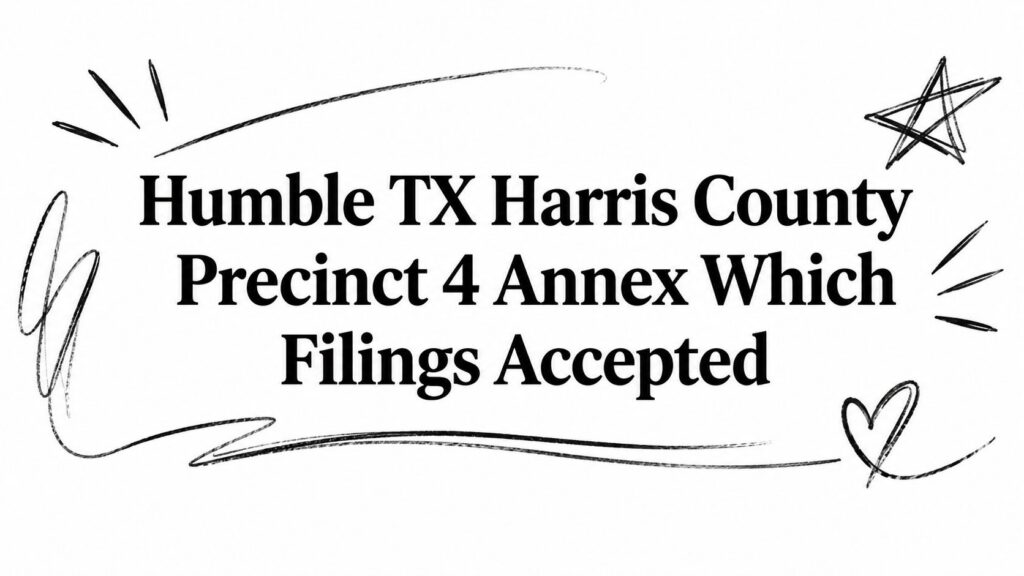
Take Control of the Enforcement Notice
A Humble parent loses a job, falls behind, and then receives papers from a court or the Texas Child Support Division. They assume it's an administrative reminder and set it aside. By the time they realize the papers require a response or a court appearance, they may have lost time to check the balance, gather proof, or get advice.
A notice can concern an original support case, a request to modify an existing order, or enforcement of an order already in place. Those aren't interchangeable. The papers identify the proceeding, parties, case number, requested relief, and any stated response or hearing dates. Read them carefully before deciding what they mean.
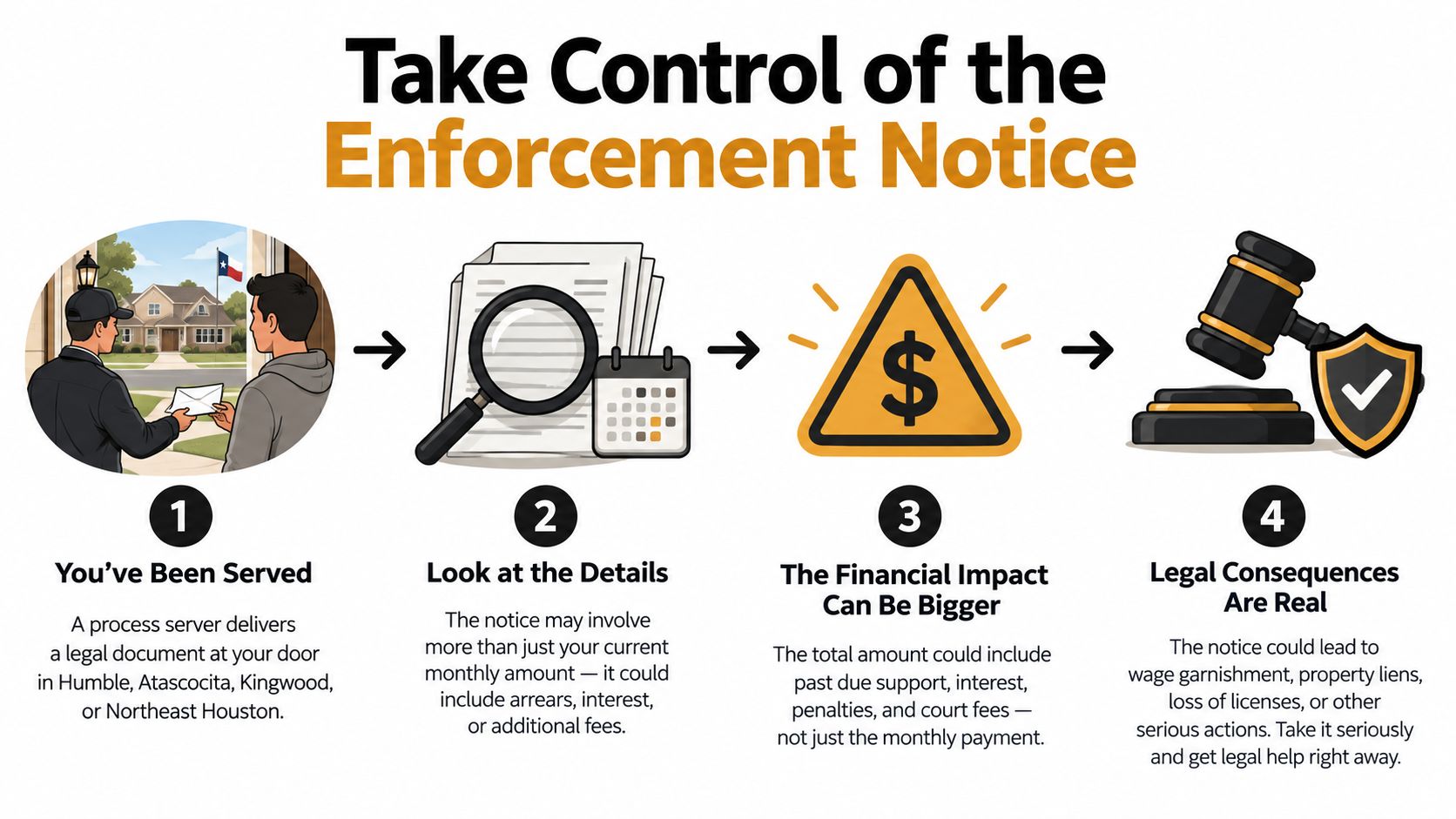
The financial picture may reach beyond the current monthly amount. A case can involve past-due support, disputed credits, medical support, or enforcement remedies. Nationally, the U.S. Census Bureau reported that custodial parents were owed $33.7 billion in child support in 2015, and that about 60% of support due was reported as received. Those figures show why the order and payment history matter, but your case balance must be checked against your own records and official account history (Census Bureau findings on child support).
Don't treat silence as a strategy. Stopping payments or relying on an informal promise usually doesn't change a court order. Contact the agency or court channel named in the papers, and get advice before agreeing to terms or ignoring a hearing date.
This article provides general information, not a decision about your particular case. The pleadings, signed order, and official agency records control your deadline and response.
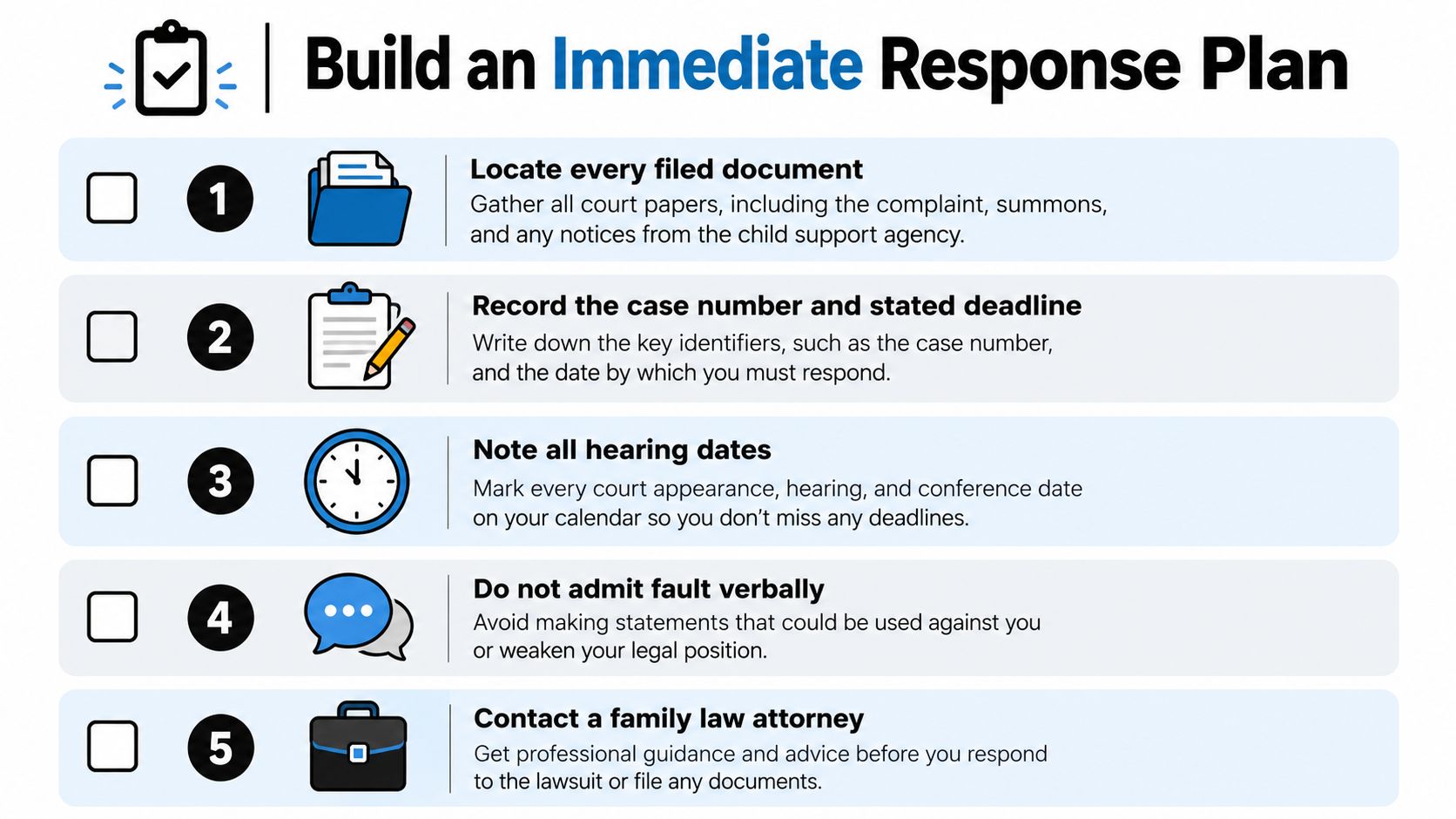
Build an Immediate Response Plan
Start with the papers, not assumptions. Take these steps promptly and keep copies of everything you send or receive.
- Locate every document. Gather the petition, citation, notices, current and earlier orders, and any agency correspondence. If a document is missing, ask the court or agency identified in the notice how to obtain it.
- Record the case number and every date. Write down the response deadline, hearing date, and any instructions about filing or contacting the agency. Put dates on a calendar and don't rely on memory.
- Confirm what order is in effect. Compare the notice with the signed order. Check whether a later order changed the amount, custody terms, medical support, or payment instructions.
- Identify who is handling the matter. Note whether the case is being addressed through a court, the Texas Child Support Division, or both. Use the contact details and case channel stated in the official papers to ask procedural questions.
- Preserve your financial records. Save payment confirmations, bank statements, receipts, payment-app histories, wage-withholding records, and income documents. Make a realistic list of current income and necessary expenses rather than estimating from memory.
- Get advice before taking a position. Before filing a response, signing an agreement, or appearing at a hearing, ask a Texas family law attorney to review the order, deadline, and evidence.
Contacting an agency to clarify how to submit records or confirm a hearing is different from conceding that its balance is correct. Be accurate and calm, and keep a record of who you spoke with and what you were told. Don't make an informal payment arrangement your only plan if the underlying court order needs to change.
A missed deadline, an incorrect balance, and an undocumented agreement can become one larger dispute. Verify the papers first, then decide how to respond.
Organize Evidence and Reconstruct the Balance
A strong response starts with a timeline that another person can verify. The signed order tells you what the court required. The official payment ledger shows which payments the case has credited. Bank records and receipts can help establish whether additional payments reached the other parent or the intended account.
Collect the records that answer those separate questions:
- The order and later orders: Confirm the amounts, effective dates, payment instructions, and any separate medical or dental obligations.
- The official payment history: Request or download the case ledger through the proper agency or court channel.
- Payment evidence: Gather bank statements, receipts, canceled checks, and payment-app histories, especially for payments made directly rather than through the official system.
- Income and withholding records: Keep pay stubs, employer withholding information, job-change records, and documents showing when employment began or ended.
- Custody and communication records: Organize the operative schedule, calendars showing actual exchanges, and messages about payment arrangements or direct payments.
- Household records: List current income and expenses clearly. A resource on zero-based budgeting for households can help structure a monthly budget without treating that budget as proof of what the order requires.
Consider a parent who believes every installment was paid. The agency ledger shows a balance, but two bank deposits made directly to the other parent don't appear as credits. The parent shouldn't insist that the balance is wrong. They should identify the dates and amounts from the records, connect each deposit to the payment obligation, and ask how to submit proof for review.
Keep current support, medical or dental support, and accumulated arrears in separate columns. A single total can hide whether the dispute concerns missed monthly payments, a medical obligation, or a credit that wasn't posted. For a more detailed approach to checking a claimed balance, see this guide to calculating child-support arrears in Texas.
Texas county guidance emphasizes documenting direct payments, including through an affidavit, so preserve the underlying evidence rather than relying on a verbal account. A reconciled chronology gives you, the agency, and the court a concrete basis to evaluate what was due, what was paid, and what remains disputed.
Evaluate Paternity Income and Custody Defenses
A defense matters only if the facts support it. Disputing parentage, challenging income calculations, and asking the court to account for time the children spent with you are different issues. One may affect whether support can be established against you; another may affect how an amount is calculated; a custody disagreement may require proof about the order and actual schedule.
| Dispute | Evidence to organize | What it may affect |
|---|---|---|
| Parentage | Existing parentage or court records, relevant case documents, and any required testing information | Whether legal parentage has been established and whether support can be ordered against you |
| Income calculation | Pay records, tax and employment documents, job-change history, and reliable records of variable income | The income information used to determine or review support |
| Custody time | The operative order, calendars, exchange records, and messages about the children's schedule | Whether the court should consider the actual circumstances under the applicable process |
A last-minute text saying "I'll pay less this month" doesn't establish a lasting income pattern or change a court order. If your earnings vary, bring a broader record showing when income changed and what you received. If you say the children spent substantial time with you, compare that claim with the order and a reliable calendar. A disagreement over visitation doesn't, by itself, erase a support obligation.
Texas child-support proceedings can address more than one issue. A parentage dispute may be fundamental to the case, while a disagreement about income may concern the amount rather than whether support is owed at all. Medical support can also be addressed separately from cash support. Don't assume that resolving one question disposes of every demand in the papers.
For a practical way to organize changing earnings and household costs, these expense tracking system tips may help you assemble clearer records. If parentage is disputed, get advice on the process and the documents needed; this overview explains how to establish paternity in Texas.
Understand Texas Support and Enforcement
Read the order as a set of obligations, not just one monthly figure. It may address cash support, health insurance, medical or dental support, and arrears as distinct items. Check what it says about each, who must pay or provide coverage, and where payments must go.
Two parents with similar circumstances can end up with different account balances. One loses a job but continues making documented payments and promptly pursues a formal change to the order. Another has the same income disruption but stops paying without contacting the agency or seeking a change. Their employment situation may be similar, but the credited payments and legal status of their orders may not be.
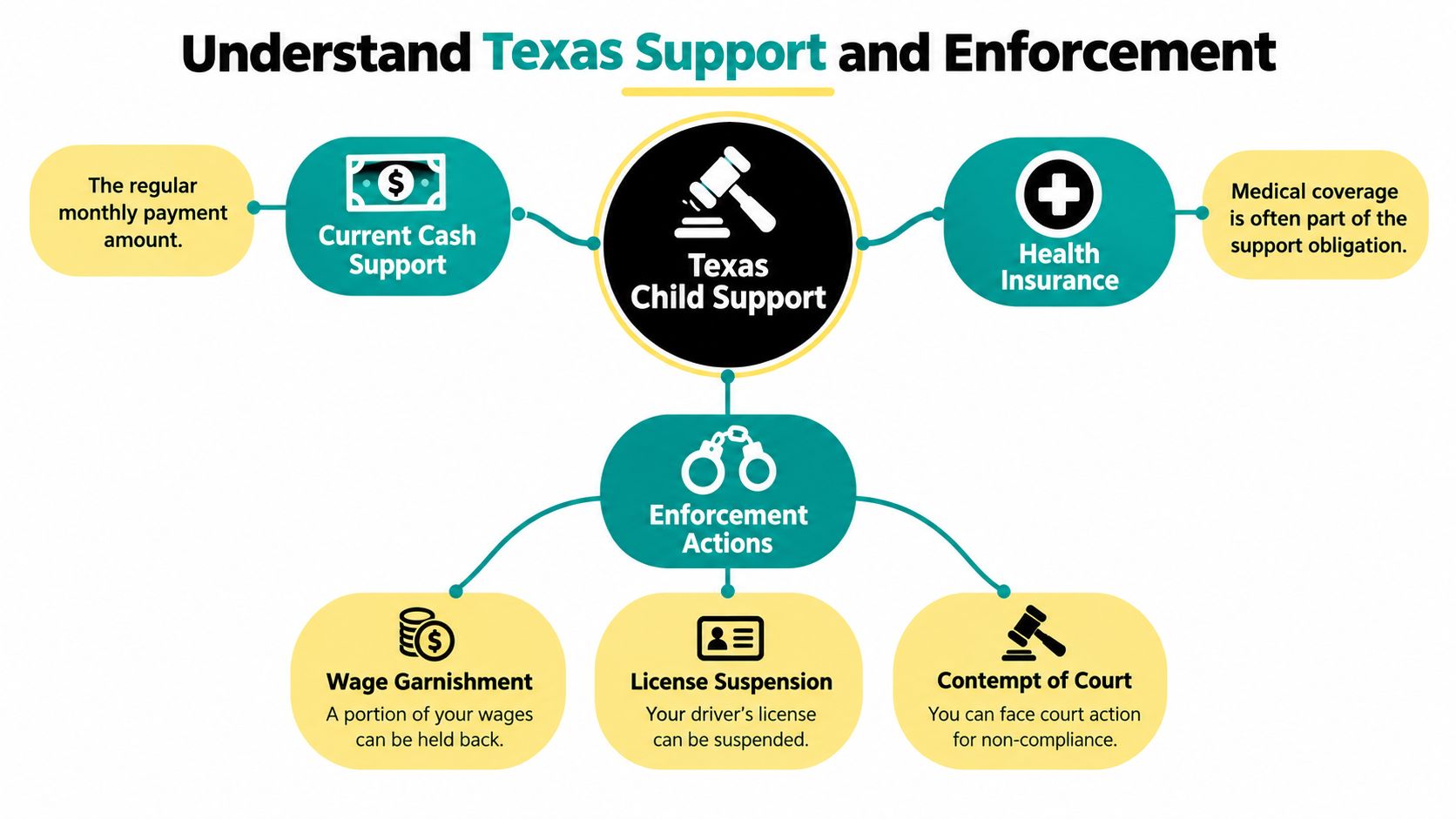
When payments are missed, Texas enforcement can reach beyond wages. The Office of the Attorney General lists tools that can include income withholding, liens, account freezes, license suspension, tax-refund interception, contempt, probation, and possible incarceration. It may seek suspension of driver's, professional, hunting, and fishing licenses through licensing agencies, and may pursue liens against property and other assets. The available action and process depend on the case and order, so verify the claim and get advice before responding to an enforcement demand (Texas OAG enforcement procedures).
The OAG Evader Program has specific eligibility conditions. A late payment alone doesn't automatically put a parent on a public list. The OAG states that court-ordered delinquent support must exceed $5,000, an arrest warrant must have issued, the parent must be avoiding apprehension and have made no regular payments during the preceding six months, and other requirements must also be met, including a confidentiality waiver signed by the custodial parent and an available photograph. Bankruptcy proceedings or TANF benefits can also affect eligibility (Texas OAG Evader Program requirements).
For background on how child-support treatment differs from ordinary tax questions, see this explanation of child-support tax considerations. Don't use general tax information to infer the terms of your order or how an agency has credited a payment.
Compare Modification Negotiation and Enforcement Options
A job loss, disability, incarceration, or custody change may justify asking the proper legal process to review future support. It doesn't automatically change the order. Keep prospective modification separate from past-due arrears: a new order may change what is required going forward, while amounts already accrued generally need their own accounting and resolution.
| Option | Purpose | Documentation | Effect on future support | Treatment of past-due amounts |
|---|---|---|---|---|
| Modification | Ask the proper forum to change an existing obligation based on changed circumstances and the applicable legal standard | Current income, job-loss or disability records, custody information, and the existing order | Can change the obligation if approved through the required process | Doesn't automatically erase arrears that accrued before the change |
| Negotiated arrangement | Set out a practical plan for payments, credits, or resolving a disputed balance | Written payment history, proposed terms, and evidence supporting the agreed figures | May help manage compliance, but don't assume it changes the court order by itself | Must clearly address what is owed and how any agreement will be presented or approved |
| Enforcement defense | Challenge the amount, payment credits, identity of the person liable, or legal basis for collection | Order, agency ledger, payment records, parentage documents, and relevant correspondence | Doesn't itself modify an order that remains in effect | Can dispute the claimed balance, but the result depends on the evidence and process |
Suppose a parent is incarcerated or loses employment and can't maintain the ordered payment. The parent should document the change and promptly seek advice about prospective relief, while separately obtaining the official arrears history and checking for missing credits. Waiting for income to return doesn't, by itself, update the order or settle the past-due amount.
An informal promise to pay less can create confusion if the signed order still requires the original amount. A negotiated plan may be useful, but put the terms in writing and find out whether they need to be submitted to a court or agency to take effect. For a local overview of the formal process after income changes, review information about modifying child support after job loss in Humble.
Texas administrative review may address establishing, modifying, or enforcing support and determining paternity. If the parties agree through the Child Support Review Process, a proposed order goes to a judge for signature; if they don't agree, the matter can proceed to a court hearing. Don't treat an agency discussion or private agreement as a replacement for checking the operative order.
Know When to Contact a Family Lawyer
Get legal advice promptly if the papers give you a short response date, allege contempt, mention an arrest warrant, or arrive while wages or assets are already subject to enforcement. The same is true if you dispute parentage, can't reconcile the alleged arrears, or have had a significant change in income or custody.
Before a consultation, bring the notice, every signed order you can locate, the case number, the official ledger, payment proof, current income records, and a calendar of relevant custody dates. Ask which forum is handling the case, what deadline applies, what evidence supports your position, and whether you should pursue modification, negotiate, or contest the enforcement claim. A lawyer can also help you distinguish a dispute over the balance from a request to change future support.
Public benefits can affect the process. Texas guidance says parents receiving TANF or Medicaid generally must cooperate with the Office of the Attorney General on identifying the other parent, establishing parentage, and obtaining or enforcing support orders. If family violence or another safety concern makes cooperation dangerous, ask about a possible good-cause exemption before taking action; Texas guidance directs people to call 2-1-1 for information. The OAG enforces child-support orders, but it doesn't enforce visitation orders (Texas guidance on child support and public assistance).
For Humble-area residents seeking help with establishing, modifying, or enforcing support in Harris County, the Child Support Attorney in Humble page describes that practice area. If you've been sued for child support, don't wait for a confusing balance or missed deadline to become harder to address.
The Law Office of Bryan Fagan helps Humble-area families assess child-support papers, organize payment and income records, and consider appropriate responses to establishment, modification, or enforcement proceedings. Schedule a free consultation through the Humble office by visiting Law Office of Bryan Fagan to discuss the order, deadline, and next steps in your case.