You're in a Kingwood parking lot, an Atascocita kitchen, or a Humble office, searching your phone for the court that handles your divorce. The natural question is, “Which neighborhood court do I use?” The practical answer is different: your divorce generally proceeds through a Harris County Family District Court in Houston, not through a separate Kingwood, Atascocita, or Humble divorce court.
That distinction matters. The Harris County District Clerk processes the case, the assigned Family District Court manages it, and the court's judge and courtroom must be verified after filing. The courthouse is downtown, but the case still starts with a local question about county residency, related family cases, and the correct filing workflow.

Why the Neighborhood Name Does Not Pick Your Divorce Court
Harris County doesn't assign divorces by subdivision. A resident of Kingwood, Atascocita, Humble, or another Northeast Houston community generally files into the county's Family District Court system, where judges handle family-law matters such as divorce, child custody, child support, visitation, protective orders, and emancipation of minors. The listed Family Courts are located at the Harris County Civil Courthouse, 201 Caroline Street, Houston, Texas 77002. (Harris County Family Courts)
The county courthouse's posted public hours are Monday through Friday, 8:00 a.m. to 5:00 p.m., but docket-call times vary by court. Don't treat courthouse hours as your hearing time. Your assigned court's setting controls, and you should confirm it through the District Clerk or the court's own information.
The question to ask instead
The better question isn't, “Which court serves my ZIP code?” Ask:
- Do I meet Texas and Harris County residency requirements?
- Has a related custody, support, or protective-order case already been filed?
- Which Harris County Family District Court received the divorce after filing?
The Harris County District Clerk maintains district-court family records and provides a public civil and family case-search system for available cases. That office is the practical administrative doorway for a divorce filed by someone living in Northeast Houston.
Practical rule: Treat your neighborhood as a starting point for venue analysis, not as the name of your court.
Your personal life may be centered in Humble or Kingwood, and your children's schedules may revolve around Atascocita schools, activities, and relatives. The legal file follows the county court system. For families already balancing work, parenting, transportation, and court deadlines, reliable coordinated routines for busy families can make the administrative side easier, but it doesn't replace checking the assigned court.
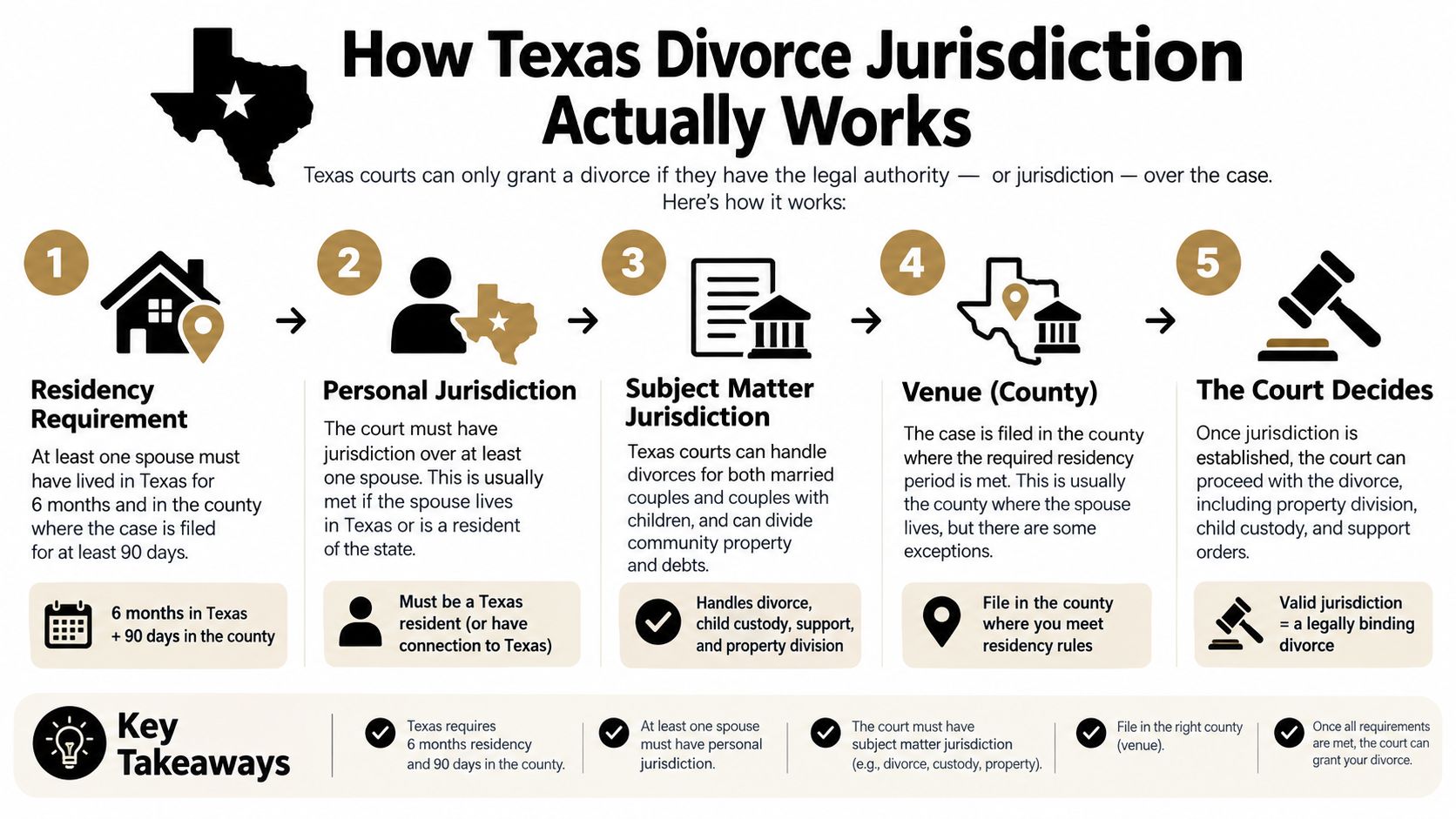
How Texas Divorce Jurisdiction Actually Works
Texas divorce cases belong in district court. Your neighborhood address helps identify the proper county, but it doesn't independently create a neighborhood court with authority to dissolve a marriage.
Texas venue generally requires that, when the petition is filed, at least one spouse has been domiciled in Texas for the preceding six months and has resided in the county of filing for the preceding 90 days. The Texas State Law Library describes the operational rule as filing in the district court of the county where either spouse has lived for the last 90 days, provided the Texas residency requirement is also satisfied. (Texas Family Code, Chapter 6)
Use this residency test
Suppose you live in Humble and have maintained your Harris County residence for the required county period. If you also meet the Texas domicile requirement, Harris County will ordinarily be the county where the divorce is filed. The same reasoning applies to an Atascocita or Kingwood resident who can document the required residence history.
Gather the facts before filing:
- Texas domicile: Confirm when at least one spouse established a Texas home and intended to remain here.
- County residence: Document the Harris County address history for the required period.
- Temporary absences: Note military service, work travel, or other absences that may affect the analysis.
- Prior proceedings: Search for existing divorce, custody, support, or related family cases.
Jurisdiction and venue are different
Jurisdiction concerns the court's legal authority to decide the matter. Venue concerns the proper county or location for filing. Meeting the residency requirements points toward Harris County venue, but it doesn't guarantee that a newly filed case will remain in the court you first expect.
A prior proceeding can change the answer. If the other spouse has a related family case in another county, or if Harris County already has a case involving the parties or subject matter, a lawyer should review the competing filings before you submit a petition. Filing in the wrong place can create delay, transfer issues, and avoidable expense.
The Family District Courts vs Other Harris County Options
Residents often ask whether a Justice of the Peace court, municipal court, or a nearby county can handle the divorce. Those are usually dead ends. A Harris County divorce is generally handled by a Family District Court, not by a neighborhood Justice of the Peace court or municipal court.
The Harris County Domestic Relations Office mediates divorces and suits affecting the parent-child relationship that are pending in the Harris County Family District Courts. That reinforces the central point: mediation and related family services operate around the county's family-court system, not around a separate suburban divorce forum. (Harris County Domestic Relations Office mediation process)
| Forum | Handles Divorce? | Relevant to Kingwood, Atascocita, and Humble? |
|---|---|---|
| Harris County Family District Court | Yes | This is the generally relevant trial-level forum when Harris County venue is proper. |
| Justice of the Peace court | No | It doesn't grant divorces. |
| Municipal court | No | It isn't the forum for dissolving a marriage. |
| Another county's district court | Only when legally proper | Moving the filing to another county simply for convenience usually isn't enough. |
Why the alternatives cause confusion
A Justice of the Peace court may be familiar because it handles certain local proceedings. A municipal court may be close to home. Neither court replaces the district court's role in a divorce.
Likewise, filing in a neighboring county isn't a shortcut when the residency facts point to Harris County. County venue depends on the statutory requirements and the parties' circumstances, not on which courthouse has the easiest parking.
If you're searching “Kingwood Atascocita Humble which Harris County court hears divorce,” focus your energy on the assigned Harris County Family District Court and the District Clerk's filing process. That's where the case becomes a managed court file.
How to Identify the Family District Court Assigned to Your Case
You won't always know the specific judge and courtroom before filing. The assignment can depend on the case, a related family proceeding, transfer rules, and current docket administration. Don't assume every Harris County divorce goes before the same judge.
Follow the file, not the neighborhood
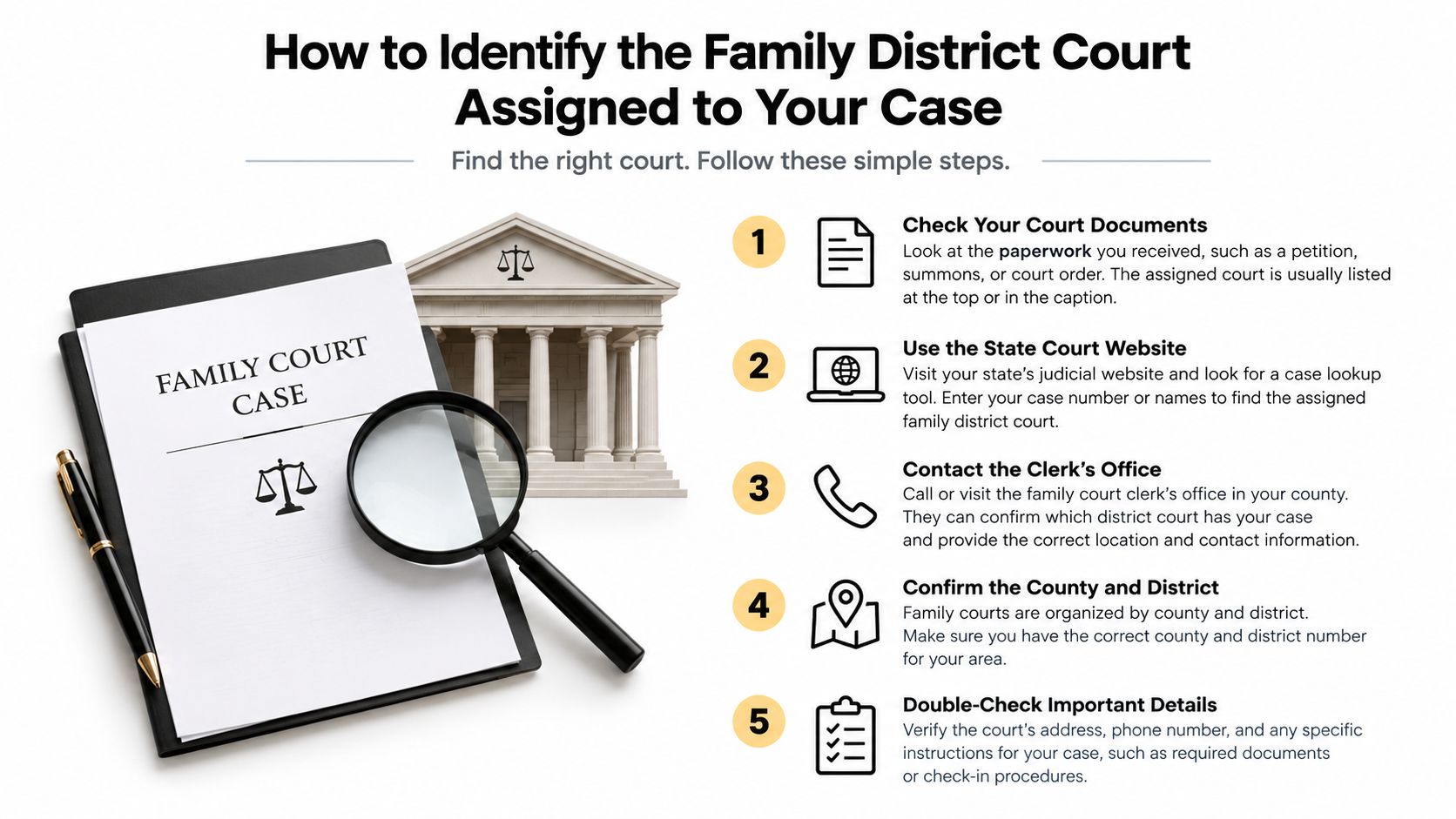
Start with the file-stamped petition. After acceptance, look for the cause number and the assigned court information. The cause number is the identifier you'll use to track case activity, hearings, and later filings.
Then work through these checks:
- Confirm acceptance. Verify that the District Clerk accepted the filing rather than rejecting it for a correction.
- Record the cause number. Keep it with your petition, service documents, and every later filing.
- Search the case. Use the Harris County District Clerk family case lookup to review available case information.
- Check the court directory. Match the assigned court with the official Family District Courts directory.
- Review settings and activity. Use the county's case-information, hearing, trial-date, and case-activity tools to verify what has been set.
Recheck before every appearance
A filed petition doesn't tell you everything you need for a hearing. A temporary-orders setting, prove-up, or other appearance may have a specific courtroom, judge, date, and docket-call procedure. Verify those details close to the appearance instead of relying on a generic online timeline.
For a plain-language overview of how family-law matters proceed through the local system, Harris County Family Courts: A Humble Resident's Guide describes how family-law cases proceed in the Harris County courts serving Humble.
Filing the Divorce From Petition Through Prove-Up
The filing process is a chain. A mistake at one link can affect service, scheduling, or finalization, so treat every stage as something to verify.
Start with the petition
The divorce begins with an original petition containing required identifying information and the relief requested. An uncontested divorce still needs correct pleadings and final documents. A contested case may also require requests involving children, support, property, temporary orders, or other issues.
Attorneys may electronically file documents in Harris County Civil, Family, and Criminal District Courts through the statewide eFileTexas system. If you're filing without counsel, review the county's family forms and electronic-filing instructions before submitting anything. The Harris County eFileTexas requirements for a family case can help you identify filing details that deserve attention.
Confirm each procedural milestone
After submission, work through the file in order:
- Acceptance: Confirm the District Clerk accepted the petition and note any rejection message requiring correction.
- Cause number: Save the number immediately and use it for future filings and searches.
- Service or waiver: Make sure the respondent receives legally proper notice or signs the appropriate waiver when permitted.
- Waiting period: Texas generally requires a 60-day waiting period before finalization, subject to limited statutory exceptions. Confirm how the rule applies to your situation.
- Temporary orders: If the family needs immediate rules for support, possession, bills, or children, monitor the assigned court for a temporary-orders setting.
- Discovery and mediation: Contested cases may require exchange of information, negotiation, mediation, and preparation for trial.
- Final decree: The divorce is not complete until the court signs the final decree and the clerk processes it.
A prove-up hearing may require testimony or a prove-up affidavit, depending on the assigned court and the case posture. Bring the documents the court requires, including any proposed final decree and supporting materials.
A local Divorce Lawyer in Humble, TX handles divorce representation for clients in Humble and Harris County. Whether you proceed alone or with counsel, check the assigned court's instructions directly.
Courtroom reminder: Docket-call times vary by assigned court. Recheck the setting, courtroom, and judge before you travel from Kingwood, Atascocita, or Humble to downtown Houston.
When a Related Family Case Quietly Controls the Court
The most important court-assignment fact may be hiding in an older file. A prior custody, child-support, conservatorship, or divorce case can affect where the new matter belongs.
Harris County family-court rules generally direct matters involving the same parties or subject matter, including divorce, support, and conservatorship issues, to the court that first obtained jurisdiction. That means the right first question may be, “Does a related case already exist?” rather than, “Which court is closest to my home?”
Protective orders require special attention
Protective-order venue can also affect a divorce involving alleged family violence. Texas guidance generally permits filing where the applicant resides, where the respondent resides, or where the alleged family violence occurred. But if a divorce or suit affecting the parent-child relationship is already pending between the parties in the same county, the protective-order application must be filed in that divorce or SAPCR court. A post-divorce protective order generally belongs in the court where the original divorce petition was filed, although it may be transferred or reassigned for the hearing. (Texas Courts protective-order guidance)
This is not a reason to delay protection while researching venue. If you're in immediate danger, contact law enforcement or a domestic-violence provider and seek emergency legal guidance. Court-assignment analysis matters, but immediate safety comes first.
Self-Help Tools, Local Forms, and When to Call a Humble Attorney
A self-represented divorce is possible, but it still requires organized work. The Harris County Domestic Relations Office directs self-represented parties to TexasLawHelp family, divorce, and children's materials, Harris County Law Library prove-up affidavit samples, a pro se litigant resource guide, District Clerk family forms, and electronic-filing instructions. (Harris County self-represented resources)
Use those resources to understand the required forms, notice process, hearing steps, and final documents. Keep a complete copy of every filing, download electronic notifications, and consider tools that help you save and flatten PDF forms before submitting documents that must preserve their completed fields.
Self-help fits best when the facts are simple
Handling the case yourself may be workable when both spouses communicate, property is straightforward, service is cooperative, and no related family case exists. Even then, you remain responsible for choosing the right forms, meeting deadlines, monitoring the docket, and presenting a complete final package.
A consultation becomes especially useful when the case involves:
- Children: Custody, possession, support, and decision-making terms need careful drafting.
- Property: Real estate, retirement accounts, business interests, and debts can't be reduced to a quick form.
- Service problems: Out-of-state service, unknown addresses, or contested notice can derail the case.
- Existing proceedings: A prior custody, support, or protective-order file may control the court.
- Disagreement: Contested issues require strategy, evidence, discovery, and preparation for mediation or trial.
The Law Office of Bryan Fagan offers family-law guidance from its Humble office, along with criminal defense and estate-planning services for local families. You don't need to apologize for asking for help. A lawyer can review the venue facts, identify the assigned court, and explain what must happen next without turning a difficult situation into a guessing game.
Your Next Step as a Kingwood, Atascocita, or Humble Resident
This week, make a short file for your divorce. Confirm the Texas domicile and Harris County residence facts, search for any existing Harris County family case, gather the identifying information needed for the petition, and bookmark the District Clerk's case-search system. If you've already filed, locate the cause number and verify the assigned court before scheduling or attending anything.
If the emotional strain is affecting sleep, work, or parenting, support matters too. A resource explaining how divorce grief differs from depression may help you recognize when professional mental-health support belongs alongside legal planning.
For a straightforward uncontested matter, you may choose to begin with official self-help materials. If children, property, safety concerns, or an earlier family case are involved, schedule a consultation before filing.
The Law Office of Bryan Fagan helps Humble, Kingwood, Atascocita, and Northeast Houston residents evaluate venue, prepare family-law filings, and manage divorce and custody proceedings. Visit Law Office of Bryan Fagan to schedule a free consultation and discuss the Harris County court process with a local legal team.