A Class A misdemeanor is Texas's most serious misdemeanor. Under Texas Penal Code §12.21, a conviction can bring up to 1 year, or 365 days, in county jail, a fine of up to $4,000, or both.
You may be reading this after an arrest in Humble, Atascocita, Kingwood, or Northeast Houston and wondering whether the charge is “just a misdemeanor.” That reaction is understandable, but a Class A case deserves prompt attention. The possible jail exposure can affect your work, housing, professional license, family responsibilities, and immigration situation.
The charge may have started with an argument, a DWI stop, an accusation involving property, or an alleged violation of an order. The label on the paperwork doesn't tell the whole story. The exact statute, evidence, prior record, court conditions, and available defenses all matter.
A Humble Neighbor's Introduction to Class A Misdemeanors
A Humble resident gets home after an arrest and sees “Class A misdemeanor” on the paperwork. Family members want to know whether the person will go to jail, whether the case can be dismissed, and whether the arrest will follow them through future background checks. Those concerns are real, but the first step is to separate the legal classification from the final result.
Texas treats a Class A misdemeanor as a serious misdemeanor-level offense. The law allows up to one year in county jail, a fine of up to $4,000, or both, and that exposure is substantially greater than a fine-only Class C misdemeanor. The same concern applies to people charged in Atascocita, Kingwood, and Northeast Houston, not only inside Humble. Texas statutory materials provide the governing framework.
That maximum doesn't mean every person receives the maximum sentence. A judge and prosecutor may consider the charged offense, criminal history, evidence, plea discussions, sentencing findings, and statutory enhancements. A first-time defendant's options may differ significantly from those of someone with a qualifying prior conviction.
Why the label matters
Class A is the highest ordinary misdemeanor level, but it isn't a felony. Punishment is served in county jail rather than state prison. Even so, a conviction can create practical problems that continue after court, including employment screening, housing applications, licensing reviews, and family disputes.
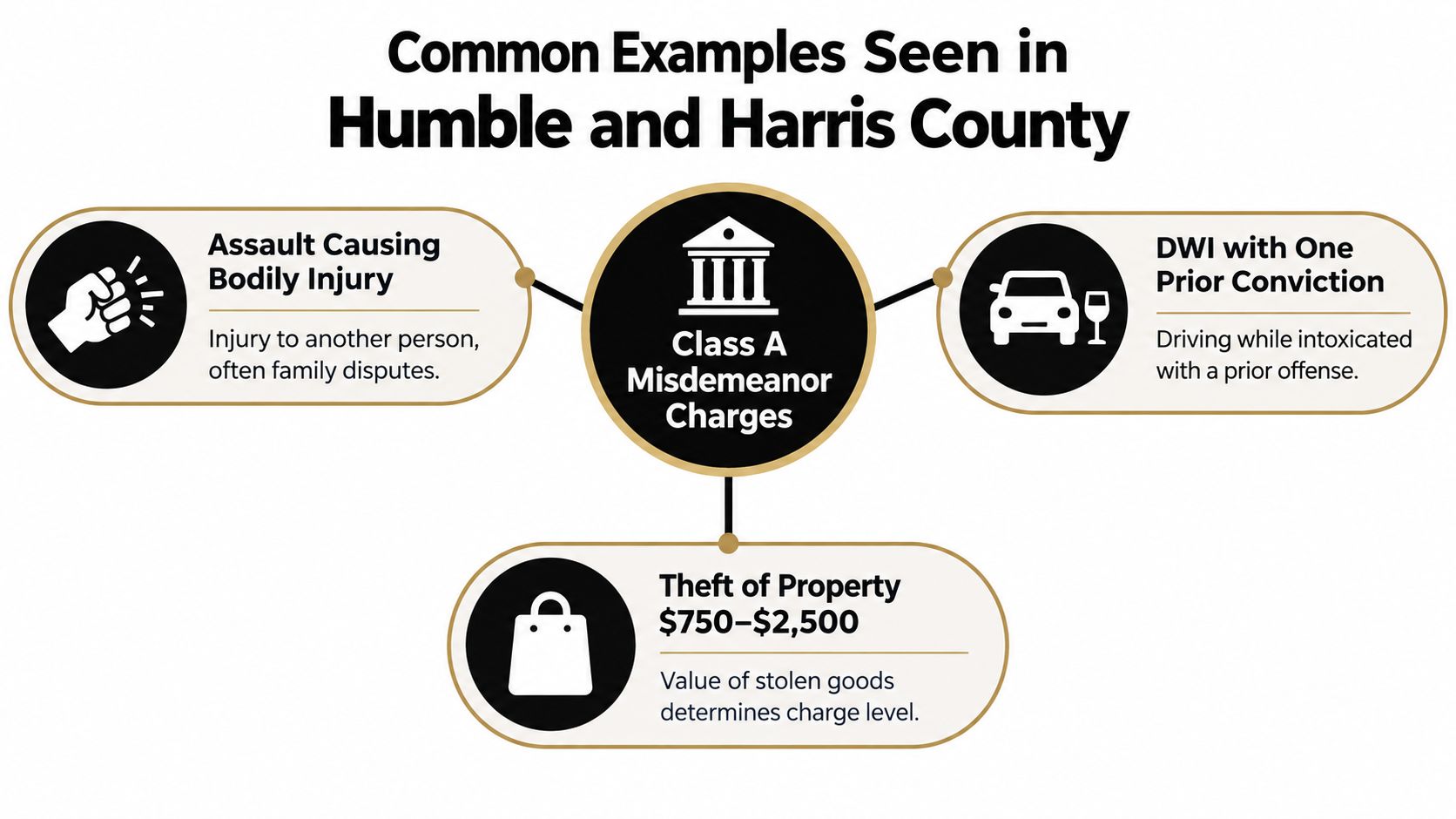
Common examples include assault causing bodily injury, burglary of a vehicle, certain protective-order violations, harassment after a prior conviction, and DWI with one prior conviction. Property-value allegations can also affect classification, and the prosecution's theory may involve a completed offense, an attempt, or a conspiracy.
A local defense lawyer can help you read the complaint, identify the precise statute, and understand what the State must prove. The criminal defense team serving Humble residents can also discuss court dates, bond conditions, diversion, probation, motions, and record-relief issues.
Practical rule: Don't decide how serious the case is from the word “misdemeanor” alone. Read the exact charge and punishment range.
How Texas Defines and Punishes a Class A Misdemeanor
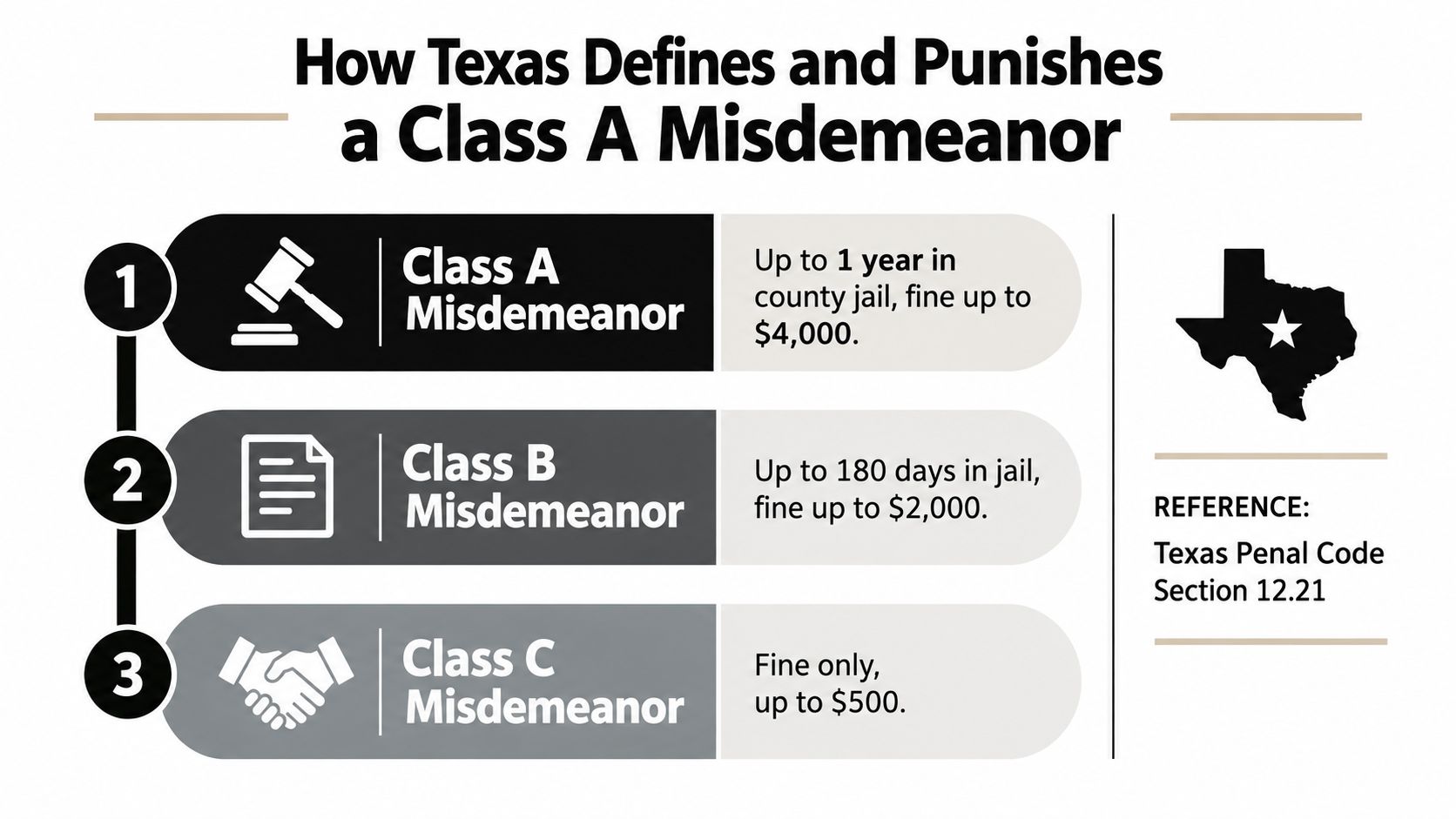
Texas has three ordinary misdemeanor categories: Class A, Class B, and Class C. Think of them as a legal ladder. Class C is the lowest rung, Class B is in the middle, and Class A is the highest misdemeanor rung.
Under Texas Penal Code §12.21, a person convicted of a Class A misdemeanor may receive up to 1 year, or 365 days, in county jail, a fine of up to $4,000, or both. The maximum fine is eight times the $500 maximum associated with a Class C misdemeanor, and the potential jail term is more than twice the 180-day maximum for a Class B misdemeanor. These statutory limits appear in the Texas Penal Code punishment provisions.
County jail is different from state prison
A Class A misdemeanor is punished in a county jail, not a state prison. That distinction is important, but it doesn't make the case minor. Jail exposure can interrupt employment, childcare, medical care, schooling, and family arrangements.
The statute establishes maximum exposure. It doesn't impose an automatic sentence. The eventual outcome can depend on the specific offense, the strength of the evidence, the defendant's history, plea negotiations, and the court's sentence.
Texas repeat-offender law can also change the consequences. If the prosecution proves a prior conviction for a Class A misdemeanor or any felony, Texas Penal Code §12.43 can require at least 90 days in county jail while retaining the one-year and $4,000 maximums. A prior record should therefore be reviewed at the beginning of the case, not after a plea decision.
Read the charging document carefully
The complaint, information, or indictment should identify the statute and the alleged conduct. Don't rely only on what someone said at the scene or what appears in a booking description. The charging language determines which elements the State must prove and which defenses may be available.
A court appearance may involve issues unrelated to family law, even though criminal charges can affect a custody or support dispute. For background on how family cases proceed in Harris County courts serving Humble, see Harris County Family Courts, A Humble Resident's Guide. If you need practical information about detention after an arrest, you can also find out county jail hold times, while remembering that the exact process depends on the case and court.
How Class A Compares to Other Misdemeanors and Felonies
The clearest way to understand a Class A misdemeanor is to compare punishment levels without assuming that the label predicts the final sentence. Class A is more serious than Class B or Class C, but it remains legally distinct from a felony.
| Classification | Max Jail Time | Max Fine |
|---|---|---|
| Class A misdemeanor | Up to 1 year in county jail | Up to $4,000 |
| Class B misdemeanor | Up to 180 days in county jail | Up to $2,000 |
| Class C misdemeanor | No jail term under the ordinary classification | Up to $500 |
The Class A figures come from Texas Penal Code §12.21. The table shows maximum exposure, not a prediction of what a judge will order. A negotiated disposition, probation, diversion, dismissal, evidentiary ruling, or trial result may produce a different outcome.
The difference from a felony
Felony punishment generally involves the possibility of state-prison imprisonment, while a Class A misdemeanor's confinement is county-jail time. That difference affects the formal classification and the type of punishment available, but a misdemeanor conviction can still create serious collateral consequences.
Classification can also change when the facts change. Prior convictions, injury, property value, the identity or status of the alleged victim, and the prosecution's legal theory may move conduct into another misdemeanor class or a felony category. The statutory label must be checked against the precise facts.
A misdemeanor designation doesn't answer every practical question. Ask how the charge affects your record, employment, licensing, family matters, and immigration situation.
People sometimes compare Texas charges with laws in other states and assume the terms mean the same thing. They don't always. For a separate explanation of Florida terminology, Florida traffic misdemeanor charges explained offers useful interstate context, but it shouldn't be used to interpret a Texas charging document.
Common Examples Seen in Humble and Harris County
Class A misdemeanor status describes a punishment level, not one specific crime. Texas assigns different conduct to that level based on the elements of the offense and aggravating facts. The Texas criminal law classification chart identifies several examples relevant to local cases.
Assault and order-related allegations
Assault causing bodily injury is one example. The evidence may include photographs, medical records, witness accounts, messages, and competing explanations of what happened. A family or dating relationship can add protective-order and family-violence issues that require careful handling.
Certain first-offense violations involving protective or magistrate's orders can also fall within the Class A category. Harassment after one prior conviction, criminal trespass involving a habitation or deadly weapon, and burglary of a vehicle are other examples identified in the classification materials.
If the allegation involves an assault, an attorney for assault charges in Humble can review the accusation, statements, injuries, defensive-force issues, and available evidence. Separately, Enforcement of Court Orders in Humble addresses enforcing divorce decree and custody order provisions in Harris County, which is a family-law issue distinct from defending a criminal charge.
Prior convictions can change the level
DWI illustrates how repeat conduct can affect classification. The Texas classification chart lists a first-offense DWI as Class B and DWI with one prior conviction as Class A. The prior conviction is therefore not a minor detail. Counsel should verify what the State is relying on and whether the record legally qualifies.
Property allegations require a different kind of review. Theft of property valued at $750 or more but less than $2,500 is generally a Class A misdemeanor. The same value range appears in certain criminal-mischief provisions involving property damage. Receipts, repair estimates, appraisals, ownership records, payment history, and fair-market-value evidence may become central.
Attempts and conspiracies
Texas preparatory-offense rules can also affect classification. An attempt is generally one category lower than the offense attempted, and an attempted state-jail felony can be classified as a Class A misdemeanor. Similar grading rules can apply to conspiracy involving a state-jail felony.
That means the State's theory matters. A person may need to challenge whether the prosecution can prove the intended offense, the required act, and the necessary intent. The probable-cause affidavit and charging instrument should be compared with the available evidence.
Defenses Court Process and Practical Next Steps Locally
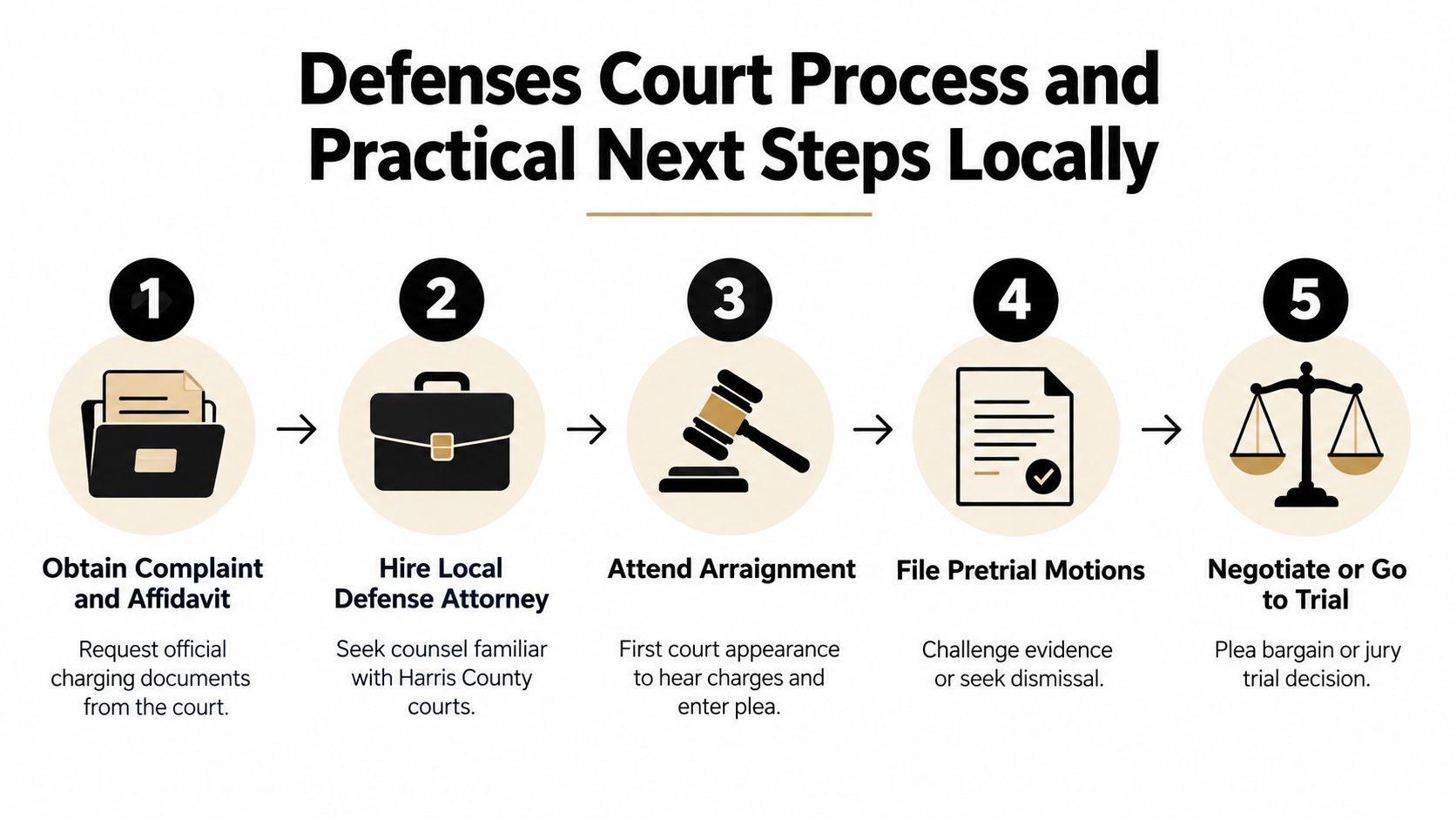
A Class A case becomes easier to manage when you turn uncertainty into a checklist. The first goal isn't to explain the facts to everyone. It's to preserve your rights and obtain the documents needed for a reliable legal assessment.
Start with the official record
Obtain the complaint and affidavit. Request the official charging documents, probable-cause affidavit, bond paperwork, and future court dates. Confirm the exact Penal Code section.
Protect communications. Preserve messages, photographs, invoices, repair estimates, location information, and witness details. Don't delete material, alter accounts, or post about the incident publicly.
Review bond conditions. Read every condition, including no-contact provisions, travel restrictions, reporting duties, and testing requirements. A violation can create new problems even before the original case is resolved.
Ask about legal options. Counsel can examine suppression issues, identification problems, witness credibility, missing elements, defensive claims, diversion, probation, plea negotiations, and trial strategy.
Track every appearance. Missing a court date can lead to additional complications. Keep the court's contact information and update counsel if your address or phone number changes.
Property evidence deserves special attention
For theft or criminal-mischief allegations, value can affect the classification. Keep receipts, repair records, appraisals, ownership documents, payment history, photographs, and communications that address the property's condition or fair market value. The Texas property-offense statutes provide the relevant value framework.
Local procedure can feel unfamiliar, especially when a Humble case involves Harris County systems, law enforcement records, prosecutors, and several court settings. A general explanation of what happens after arrest in Colorado may help readers understand why other states' procedures differ, but it isn't a substitute for Texas-specific advice.
Lasting Impact Deadlines and Clearing Your Record
A Class A case can affect more than the courtroom. A conviction or unresolved record may create concerns about employment, housing, professional licensing, family responsibilities, or immigration status. Those effects depend on the disposition and the person's circumstances, so record planning should begin before a plea is entered.

Watch the charging deadline
For ordinary Texas Class A misdemeanors, the general limitation period is two years from the offense date under Code of Criminal Procedure Article 12.02. That deadline isn't an automatic dismissal rule. The analysis can change because of the exact offense, statutory exceptions, tolling rules, the charging instrument, and special provisions.
Assault demonstrates why offense-specific review matters. The cited statute provides a three-year period for certain misdemeanor assault prosecutions. Counsel should identify the exact statute, determine the legally operative offense date, inspect the charging document, and calculate any exception before relying on the general rule. The Texas limitations statute should be read alongside the specific offense provisions.
Expunction isn't automatic
A dismissal, diversion result, probation outcome, and conviction can have different record-relief consequences. Texas Courts materials explain that, for certain arrests where charges weren't filed, a Class A or B misdemeanor generally involves a one-year waiting period before expunction, subject to additional conditions. Successful pretrial diversion may also support eligibility. The Texas Courts discussion of expunction and nondisclosure explains why the result depends on the legal details.
Expunction generally concerns removal or destruction of qualifying records after a court process. Nondisclosure is different. It restricts access in qualifying circumstances but doesn't mean the record is treated exactly as though it never existed.
For residents of Atascocita, Kingwood, and Northeast Houston, keep the dismissal, diversion, probation, and court paperwork. Before assuming a record has disappeared, confirm the disposition, waiting period, related charges, statutory exclusions, and whether a petition and court order are required. Guidance on sealing a criminal record in Texas can help you identify the questions to raise.
Protect Your Future With Our Humble Legal Team
A Class A misdemeanor is serious, but the classification isn't a prediction that you will receive the maximum punishment. The strongest next step is to identify the exact charge, protect your court position, preserve evidence, and evaluate record consequences before making a decision.
Bring your charging paperwork, bond documents, court dates, prior-case information, relevant messages, photographs, receipts, repair estimates, and witness details to a consultation. Don't discuss the incident publicly or with investigators before receiving legal advice, and don't ignore a court date or bond condition.
The Law Office of Bryan Fagan serves families and individuals in Humble, Atascocita, Kingwood, and Northeast Houston with criminal defense, family law, divorce, custody, estate planning, wills, trusts, and probate services. A local attorney can help you understand the accusation, assess defenses, address Harris County procedure, and plan for possible record relief.
The Law Office of Bryan Fagan offers free consultations for people facing Class A misdemeanor charges and related family or record concerns. Contact the Humble office with your charging documents and upcoming court information so the team can help you take the next step with a clear plan.