In Texas, assuming trust is the smarter move is often too broad. For many Humble families, a well-drafted will is the more proportionate tool, because Texas probate can be managed in a straightforward way and the document can still do the important work of naming guardians, directing probate property, and keeping the plan simple.
| Dimension | Last Will and Testament | Revocable Living Trust |
|---|---|---|
| Takes effect | At death | During life, once funded |
| Probate | Usually goes through probate for estate assets | Properly funded trust assets generally avoid probate |
| Incapacity | Does not manage assets during incapacity | Successor trustee can step in if the trust is funded |
| Privacy | Probate filings can become public | Trust administration is generally more private |
| Funding requirement | No retitling needed for the will to exist | Assets must be retitled or otherwise moved into the trust |
| Best fit | Straightforward estates, guardian nominations, basic distribution plans | Privacy, continuity, multi-step distributions, or incapacity planning |
For a quick side-by-side resource, some readers also find the plain-English breakdown in compare will and trust in Texas helpful before they decide. The bigger point is simple. A will and a trust are not interchangeable, and the right answer in Texas depends on what you own, who you're protecting, and how much complexity your family has.
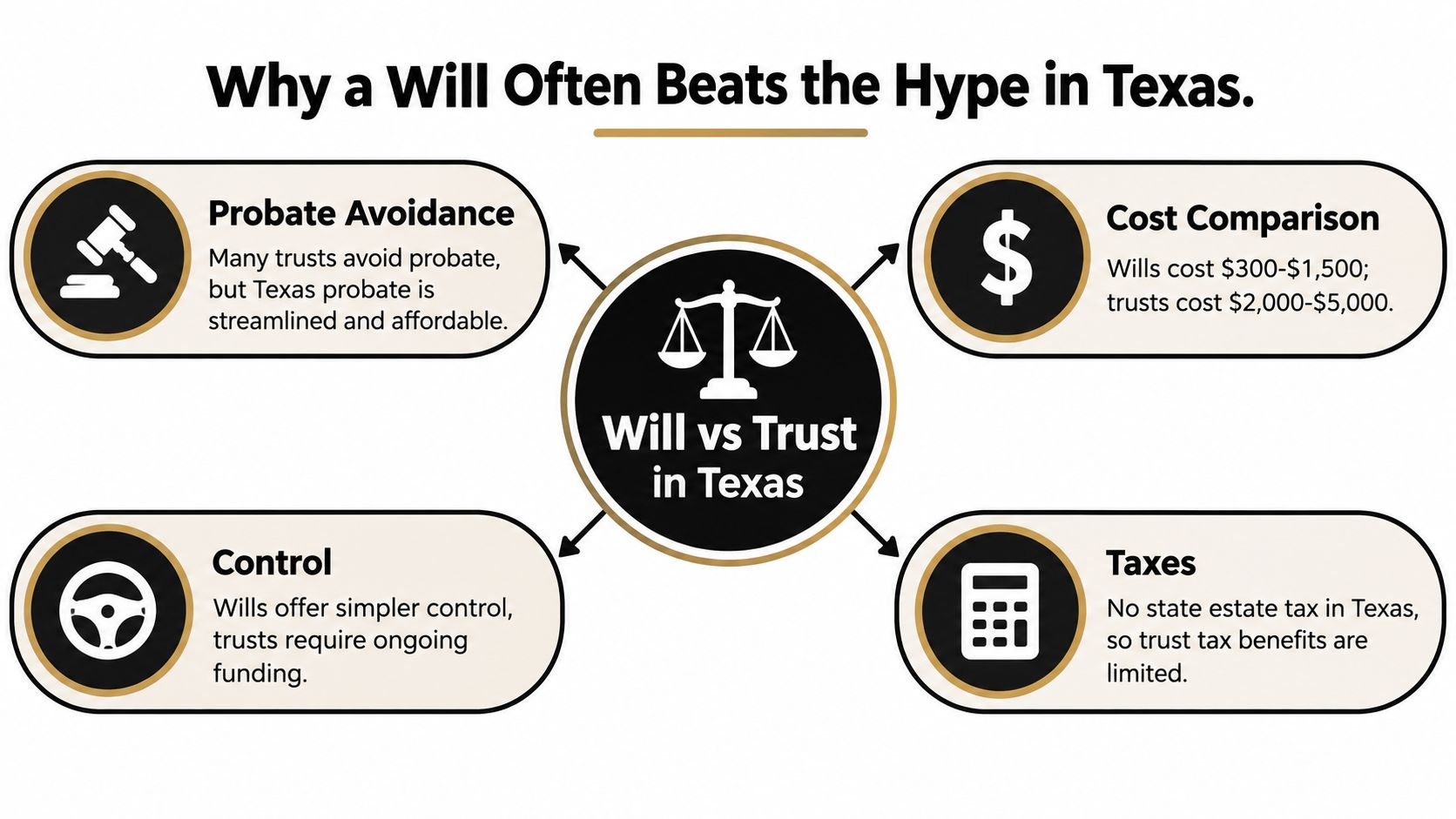
Why a Will Often Beats the Hype in Texas
A lot of trust marketing starts with one promise, “avoid probate.” That's too simplistic for Texas families. If your estate is modest, your assets are mostly in one state, and your heirs are capable adults, a will is often the cleaner, more proportionate choice.
What a will actually does
A Texas will is a post-death document. It names who inherits probate property, can appoint a guardian for minor children, and lets the court know who should serve as executor. It also gives your family instructions on how your estate should be handled after death, which matters far more than many people realize.
A revocable living trust is different. It's created during life, can usually be changed or revoked while you're alive, and can hold and administer property if it's properly funded. That's why trusts are often talked about as continuity tools, while wills are the basic instruction manual for what happens after death.
Practical rule: if you want the simplest Texas answer, start with the question, “What do I actually need this document to do?”
A common mistake is treating a trust like a magic replacement for everything else. It isn't. A trust can be a strong planning tool, but a will still matters, especially as a pour-over will that catches anything left outside the trust. A will can also create a testamentary trust inside the probate process when that structure makes sense for children or vulnerable beneficiaries.
If you want a broader local overview, the estate-planning team at Estate Planning Attorney in Humble focuses on wills, trusts, and estate plans for Humble families. That's the right lens for this issue, not “trust good, will bad.”
The Two Mechanics That Actually Drive the Decision
The decision turns on two mechanics, not slogans. First, how property passes. Second, what happens if you become incapacitated. If you miss those two points, you'll pick the wrong document.
Probate pathway versus living control
A will works after death, and only after a court admits it to probate. In Texas, that means probate validates the will, pays debts, and transfers the remaining property to the right people. If an asset passes by beneficiary designation or some other nonprobate method, the will doesn't control it.
A trust works differently. If a revocable living trust is funded, the trustee can manage trust property during life and after death without waiting for the will to move through court. That's the whole attraction of the tool.
Funding is the dealbreaker
A trust only works on assets that are transferred into it. If the house, bank account, or brokerage account stays in personal name, that asset may still need probate. That's why a trust is not a finish line, it's a container that has to be filled correctly.
Bottom line: a will controls the property that falls into your probate estate, a funded trust controls the property you actually retitle into the trust.
Will vs Revocable Living Trust at a Glance
| Dimension | Last Will and Testament | Revocable Living Trust |
|---|---|---|
| Probate pathway | Usually required for probate assets | Properly funded trust assets usually avoid probate |
| Incapacity handling | No asset-management role during incapacity | Successor trustee can manage trust assets |
| Privacy | Probate is generally public | Trust administration is generally private |
| Beneficiary-designated assets | Does not control them | Does not control them either |
| Implementation burden | Lower during life | Higher, because funding matters |
A will is usually easier to live with day to day. A trust demands more follow-through. For many Harris County families, that's the whole decision.
The Texas Varieties Worth Knowing
Not every trust is built for the same job. If you're comparing trust vs will in Texas, you need to know which trust you're talking about, because the word gets used too loosely.
Revocable, irrevocable, testamentary
A revocable living trust can be changed or revoked while the creator is alive. People use it for continuity, privacy, and incapacity planning. A standard revocable trust is also treated by the IRS as a grantor trust during the grantor's life, so the income is generally taxed to the grantor. IRS guidance also says assets in a revocable trust are included in the grantor's gross estate for federal estate-tax purposes. That's why revocable trusts are usually about control and administration, not automatic tax savings. IRS guidance on revocable trusts and grantor treatment
An irrevocable trust is different. Once it's set up, it's generally much harder to amend. Those trusts are more often used for asset protection, tax planning, or specific benefit-planning goals.
A testamentary trust is created by a will and only comes into existence after death and probate. That makes it useful when you want staged distributions for children or a beneficiary who needs oversight, but you still want to keep the main plan inside a will.
A pour-over will is the safety net. It sends forgotten assets into the trust at death. That does not erase the need to fund the trust properly, but it does prevent a stray asset from being left without a destination.
When each one earns its place
A young family may need a will plus a simple trust structure for children. A blended family may need a trust that controls timing and distribution. A business owner may need a trust for continuity, incapacity instructions, and cleaner succession. A single homeowner with adult heirs may need nothing more complicated than a careful will and updated beneficiary forms.
If you want a deeper comparison of trust structures, the internal guide on revocable trust vs irrevocable trust is the right next stop.
Probate, Cost, and Timing in Texas Compared
Texas probate is not automatically a long, expensive court fight. For many families, a properly drafted will paired with independent administration provides a practical route with limited court supervision.
What Texas probate often looks like
Texas law allows a will to authorize independent administration, which reduces ongoing court involvement. The Texas State Law Library describes this process as typically faster and less expensive than dependent administration. The Texas Bar reports that independent administrations account for more than 80 percent of Texas probates. Texas probate and independent administration overview
A Texas will may also support a muniment-of-title proceeding when the estate meets the requirements. This option can transfer title to certain assets without a full administration. It is often overlooked, so families should ask whether it fits before assuming a trust is necessary. For a fuller walkthrough, see our guide on how to avoid probate in Texas.
The four-year probate window matters
A Texas will generally must be submitted for probate within four years after death. Leaving the original will in a drawer can create avoidable complications, especially if heirs wait too long to act. Executors and heirs in Humble, Atascocita, Kingwood, and Northeast Houston should locate the original document promptly and obtain legal guidance early. Texas probate deadline and filing rules
If you need local help with estate settlement in Harris County, Probate Lawyer in Humble, TX handles probate administration and estate settlement in Harris County.
Texas Cost, Timing, and Court Involvement
| Factor | Will with Independent Administration | Funded Revocable Living Trust |
|---|---|---|
| Court involvement | Usually limited after the court opens the case | Usually none for properly titled trust assets |
| Timing | Often faster when the will is clear and heirs cooperate | Often faster for assets already in the trust |
| Funding work | No trust funding, but beneficiary forms still matter | Retitling assets is required |
| Privacy | Probate filings are public | Administration is generally more private |
| Mistake risk | Missed deadlines and missing originals can create problems | Unfunded assets still end up in probate |
For a straightforward Texas estate, a will with independent administration can be the more economical choice. A trust earns its cost when the family needs incapacity management, privacy, staged distributions, or coordinated handling of assets that have been properly transferred into the trust.
In Texas, the trust-versus-will decision should turn on your family's facts, not on probate scare stories from national websites.
Humble Family Scenarios That Change the Answer
The right answer depends on the family in front of me, not the slogan on a website. In Humble and the surrounding Northeast Houston area, three scenarios come up again and again.
Young couple with minor children
A young couple needs a will because a will is where you name a guardian for minor children. That part is not optional. If the couple also wants someone to manage a child's inheritance in stages, a trust can sit beside the will and handle the money while the will handles the guardianship nomination.
Families often get practical here, not philosophical. The spouse wants a simple plan, but they also want a structure that protects a child's inheritance if something happens to both parents. That's a trust-based planning question, but it starts with the will.
Blended family in Atascocita or Kingwood
A blended family usually needs more control, not less. A revocable trust can help direct distributions so a surviving spouse is provided for without accidentally cutting out the maker's own children from a prior relationship.
That's especially useful when the family wants staged distributions instead of one lump sum. A pour-over will can back up the trust, but the trust does the heavy lifting. In blended-family work, clarity beats assumptions every time.
Small business owner or self-employed professional
Business owners usually need a trust more often than a simple will. Why? Because incapacity planning and continuity matter more when one person is the main operator. A trust lets a successor trustee step in on trust-owned assets without waiting for a court to sort things out.
A will can still play a role, especially for leftover property and final instructions, but it doesn't keep the business moving during incapacity. For a local owner with books, clients, and payroll concerns, that's not a small detail.

A simple Texas estate often does fine with a will and good beneficiary forms. Once children, a blended family, or a business enters the picture, a trust starts pulling its weight.
Funding the Trust and Other Implementation Essentials
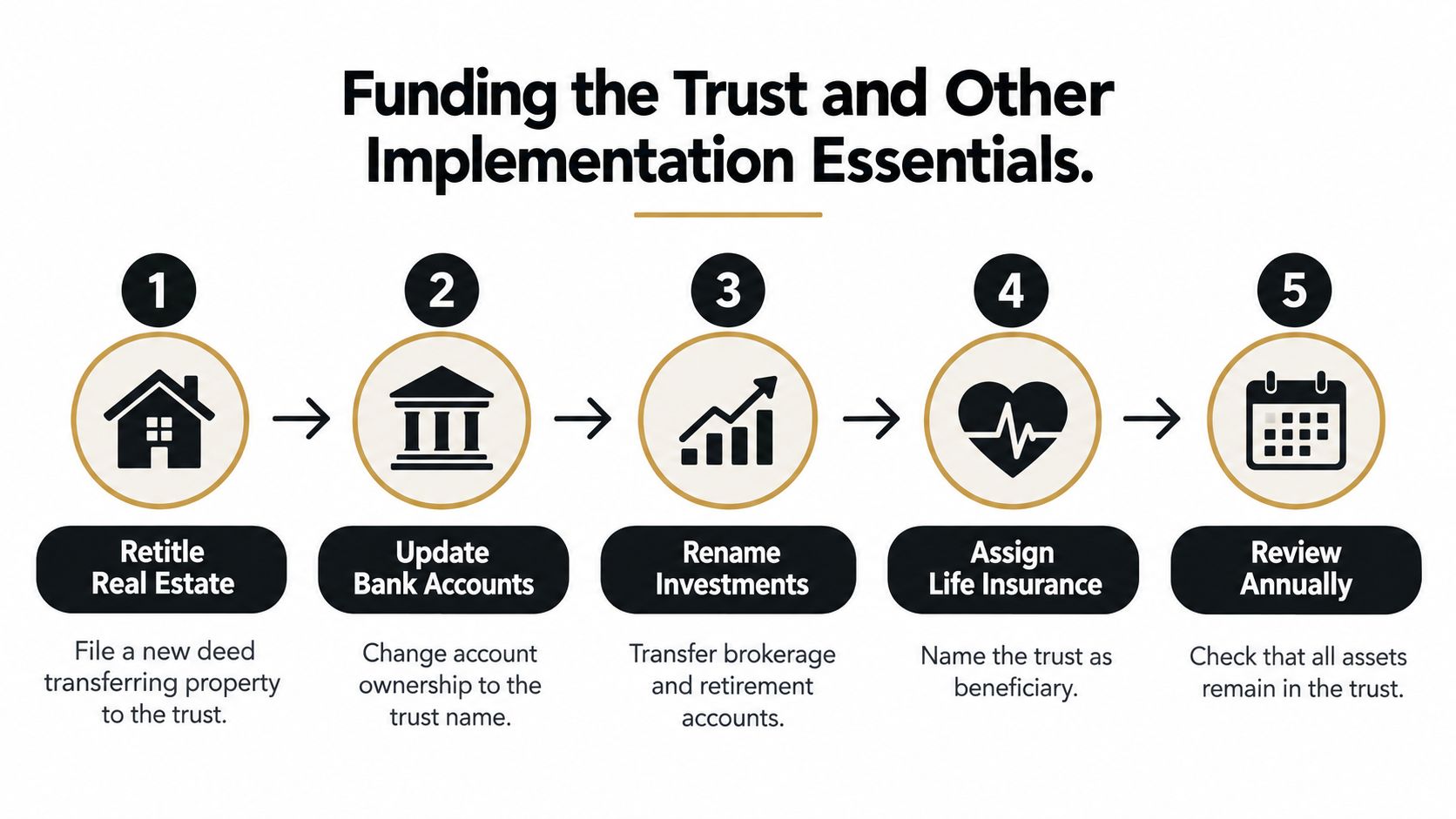
A signed trust does not control assets until those assets are transferred into it. With a revocable trust, funding is a separate implementation task, and it must be handled deliberately.
The trust has to own the right assets
Real estate usually requires a new deed. Bank accounts may need retitling in the trust's name, while brokerage accounts require an account-by-account review. Beneficiary designations also deserve attention because some assets pass outside both the will and the trust.
The common failure is stopping after the signing ceremony. The family then has a trust document but assets titled elsewhere. Use a written funding checklist that identifies each asset, the required transfer form, and the person responsible for completing it.
Texas execution formalities matter too
A Texas will generally must be signed by the testator, or by another person in the testator's presence and at the testator's direction, and witnessed by at least two credible people who are at least 14 years old. The witnesses must sign in the testator's presence. A self-proved will can simplify probate because it may be admitted without witness testimony. Texas will execution rules
These requirements affect whether the court can accept the document without later proof problems. Clear wishes do not repair an improperly executed will.
Digital assets need their own inventory
Digital accounts require a separate inventory and access plan. Include cloud files, social media, password managers, cryptocurrency, online businesses, and monetized content. A will or trust can authorize a fiduciary, but account credentials, platform rules, and provider procedures still control practical access.
Special needs planning also requires care with ownership and control. Money routed directly to a beneficiary can affect eligibility for benefits, so families should review protecting benefits for autistic kids before choosing an inheritance structure.
For the setup process, review this guide on how to create a trust in Texas. Finish the work with a written funding checklist: deed, account retitling forms, and updated beneficiary designations, completed before you consider the trust done.
Choosing the Right Path for Your Family
Here's the cleanest rule of thumb. If your estate is straightforward, your heirs are responsible adults, and you want Texas to keep the administration simple, a well-drafted will often makes more sense than a trust. If you need privacy, incapacity management, staged distributions, or business continuity, the trust starts to win.
A trust is not automatically better because it avoids probate for assets that are properly funded into it. Texas gives families useful probate tools, including independent administration and, in the right case, muniment of title. That means a will-based plan can be efficient here, not second-rate.
Use this decision filter:
- Choose a will first if your family is simple, your assets are mostly local, and your main goals are naming a guardian and directing probate property.
- Choose a trust first if you need someone to step in during incapacity, want more privacy, or need control over when beneficiaries receive money.
- Choose both if you want a trust for assets and a will as the backstop for anything left out, plus guardian nominations where needed.
The right plan is the one your family can use when life gets messy. If you want a direct answer for your situation, schedule a free consultation with the Law Office of Bryan Fagan in Humble. You'll get a practical conversation about wills, trusts, probate, and the Texas procedures that shape real outcomes for local families.
Frequently Asked Questions From Humble Families
How often should I review my will or trust
Review your plan after marriage, divorce, a child's birth, a death in the family, a move, or a major asset purchase or sale. Recheck beneficiary designations and account titles as well, because they must match the documents.
What happens if I miss the four-year probate window
Missing Texas's four-year deadline can restrict ordinary probate options and complicate administration. If the original will was not filed on time, your family may need another legal route. Locate the document promptly and discuss the consequences under Texas Estates Code § 256. Texas probate filing deadline
Does a revocable trust need its own tax number
During the grantor's life, a standard revocable living trust is generally treated as a grantor trust for federal income-tax purposes, so the grantor usually reports its income. After death, the trust's income for the period ending at the date of death can be reported on the estate's income-tax return by making the election on the trust's first Form 1041. IRS revocable trust treatment
Are DIY wills and online trusts safe in Texas
They can fail if they omit required signing and witnessing steps or leave assets outside the trust. Texas has specific will-execution requirements, and trust documents only control property properly transferred to the trust. Texas will execution requirements
A template may look complete while leaving your family with an avoidable legal problem.
For practical guidance, the Law Office of Bryan Fagan helps Humble families compare wills, trusts, and probate options. Visit Law Office of Bryan Fagan for a consultation serving Humble, Atascocita, Kingwood, and Northeast Houston.