You're in the parking lot outside the courthouse in Humble, refreshing a browser on your phone. You need to know whether a divorce, custody, or support case was filed, but the Harris County District Clerk portal seems to show only part of the answer. That confusion is common. A Harris County District Clerk JIMS family case lookup can help you locate the case, but finding the case isn't the same as obtaining the family documents inside it.
What the Harris County District Clerk JIMS Family Case Lookup Actually Shows
The Harris County District Clerk's JIMS, or Judicial Information Management System, functions as a public index for many district court cases. The District Clerk's family court information covers matters such as divorce, child custody, child support, visitation, protective orders, adoption, parentage, termination of parental rights, and grandparent access.
For a Humble parent checking whether a filing exists, start with the information JIMS is designed to reveal:
- Cause number: The case's identifying number.
- Case style: The formal case name, such as In the Matter of the Marriage of followed by the parties' names.
- Filing date: When the clerk accepted the case.
- Court assignment: The assigned family court, such as the 309th, 310th, 311th, 312th, or 507th Family Court.
- Judge and parties: The current judge, petitioner, respondent, and listed attorneys.
- Docket activity: A dated running list of filings, settings, orders, and other instruments.
The portal requires users to log in, but the District Clerk states that public case information remains free after login. You can search by cause number, style, meaning the names involved, or date range through the Harris County District Clerk public records search.

The docket isn't the family file
JIMS may show that a document was filed, along with its date and instrument type. It generally isn't the place where you'll read the petition, financial inventory, child-support worksheet, psychological evaluation, or final decree. The public docket and the underlying document images are separate things, and family documents may be unavailable for public review.
Practical rule: Treat JIMS as the doorway. It tells you that the case exists and where it lives, but it may not provide the substantive paperwork.
If you're a law firm trying to organize repeated docket checks, an Attorney Assistant for family law firms can be a useful administrative resource for research and case-support tasks. For a broader explanation of the courts serving local residents, see Harris County family court information for Humble residents.
Searching the JIMS Portal Step by Step
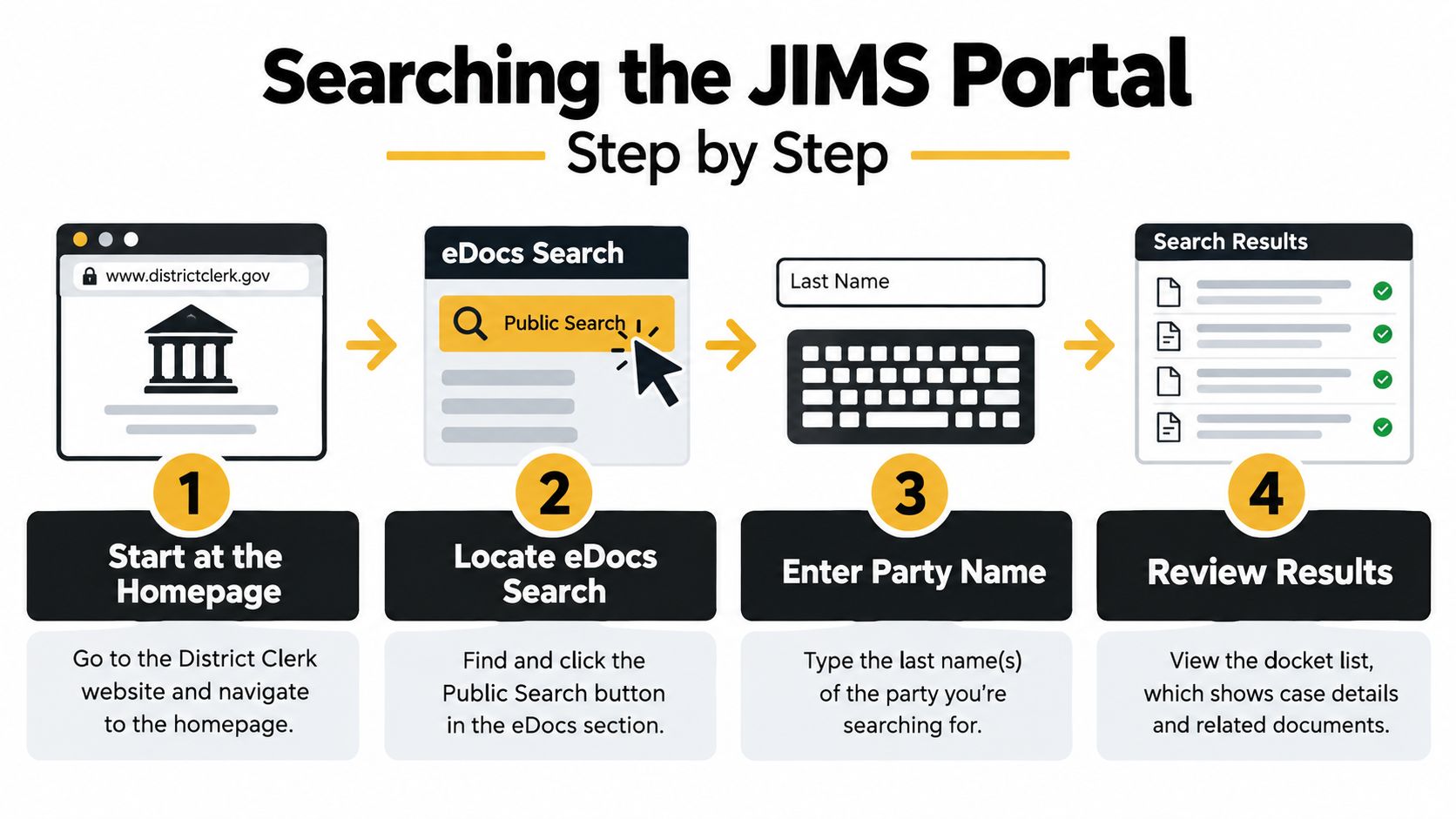
Begin at the Harris County District Clerk website and open the eDocs public search. Sign in if prompted. Before entering a name, check the Case Type selection. Choose Family rather than Civil or Criminal. A correct name entered under the wrong case category can produce no useful result.
Use the strongest identifier first
If you have the cause number, use it before trying a name search. A cause number is usually more reliable than a name because it points directly to one court file. Enter it carefully, including the correct letters, numbers, and punctuation shown on a notice, order, or prior filing.
If you don't have the cause number, search by party name. Enter the last name and first name as they were likely filed. Leave the middle-name field blank if you're uncertain. JIMS searches the party information as entered, so “Doe, John A.” and “Doe, John Allen” may not behave like the same record.
Use a date range when the name is common. The District Clerk advises that accurate searches depend on details such as the party name, filing year, plaintiff or defendant role, and case type. A narrow or incorrect range can create a false impression that no case exists. The Harris County Family Courts: A Humble Resident's Guide provides additional factual background on how family-law cases proceed in the courts serving Humble.
Narrow the results only after you have a reasonable match
The search screen may also allow filtering by filing date, court, and judge. Start broadly enough to capture the likely case, then narrow the list. Once the results table appears, compare the case style, filing date, court, and parties before opening a record.
Clicking the matching case should open the docket sheet. Review each entry by date and instrument type. Remember that an entry identifying a petition or order doesn't necessarily mean the document itself is available for public viewing.
Why Your Family Case May Show Up With Limited Detail
A case can be publicly indexed while its documents remain restricted. Texas court-record guidance explains that some records are sealed or limited to the parties, and family cases or matters involving minors commonly receive restricted treatment through the Texas State Law Library's court-record guidance.
That distinction matters in cases involving children, adoption, parentage, protected identifying information, mental-health material, or a document sealed by judicial order. You may see a docket entry with a filing date and instrument description, but the document-viewing option may be restricted or unavailable.
Public and restricted records are different categories
| Document Type | Default Visibility in JIMS | How to Obtain |
|---|---|---|
| Routine public case index information | Often available after login | Search by cause number, party style, or date range |
| Divorce-related documents without restricted information | May depend on the document and case circumstances | Ask the District Clerk about the appropriate copy process |
| SAPCR filings involving children | Often limited or restricted | Party or attorney access, court authorization, or another legally permitted process |
| Adoption and parentage records | Commonly restricted | Follow the specific court procedure governing access |
| Mental-health records or sealed filings | Restricted | Court order or another authorized legal process |
JIMS is therefore an index, not a vault. The docket can confirm that an instrument exists without giving you permission to inspect the instrument. A clerk's desk request won't automatically override confidentiality rules. Depending on the file, access may require a court order, a subpoena, or party or attorney-of-record access through eFileTexas.
Public access also varies by case status. The District Clerk's FAQ explains that many civil cases are public unless they're sealed, sensitive, or confidential. That's why two family cases can appear in the same portal but provide very different levels of detail.
Getting Certified Copies of Divorce Decrees and Family Orders
A screen print from JIMS usually isn't the same as a certified copy. A certified copy carries the clerk's certification and is intended for an agency, court, employer, or other institution that needs an official document. If you need to prove a divorce, custody order, or other legal status, ask specifically whether the receiving organization requires certification.
The District Clerk identifies Family Intake at 201 Caroline in Houston as the location handling family-related filings and case information. Before traveling from Humble, Atascocita, Kingwood, or Northeast Houston, confirm the current process, office hours, accepted payment method, and whether the record can be released to you.
Three possible request channels
In person: Go to the Family Law Intake area at 201 Caroline and provide the cause number, exact case style, document requested, and your contact information. A cause number makes the request easier to process because it identifies the file directly.
By mail: Use the District Clerk's request process and include enough information for staff to identify the case. A self-addressed stamped envelope may be required for the return of documents. Poorly identified requests can lead to delays or a request for more information.
Historical records: Older judgments, divorce decrees, and other court documents are available from 1837 to the present through the historical documents viewing room at 5900 Canal St. in Houston, according to the District Clerk's hours and locations information. The location lists free parking and welcomes walk-ins.
| Channel | Location | Typical Fee | Turnaround |
|---|---|---|---|
| In-person family request | Family Intake, 201 Caroline, Houston | Confirm current schedule with the clerk | Ask staff when placing the request |
| Mail request | District Clerk records office | Confirm current schedule and payment rules | Depends on the request and mailing process |
| Historical file request | Historical documents viewing room, 5900 Canal St., Houston | Confirm current schedule with the clerk | Depends on the age and condition of the file |
The public portal also distinguishes between a searchable index and document images available for purchase. If you need help understanding whether an order resolved your divorce, review what a final decree of divorce is before relying on a docket entry alone.
Common JIMS Search Errors and Quick Fixes
A zero-result search doesn't prove that a family case doesn't exist. It proves only that the information entered didn't produce a match under the portal's search rules, or that the record is unavailable through the public interface.
Check the name exactly
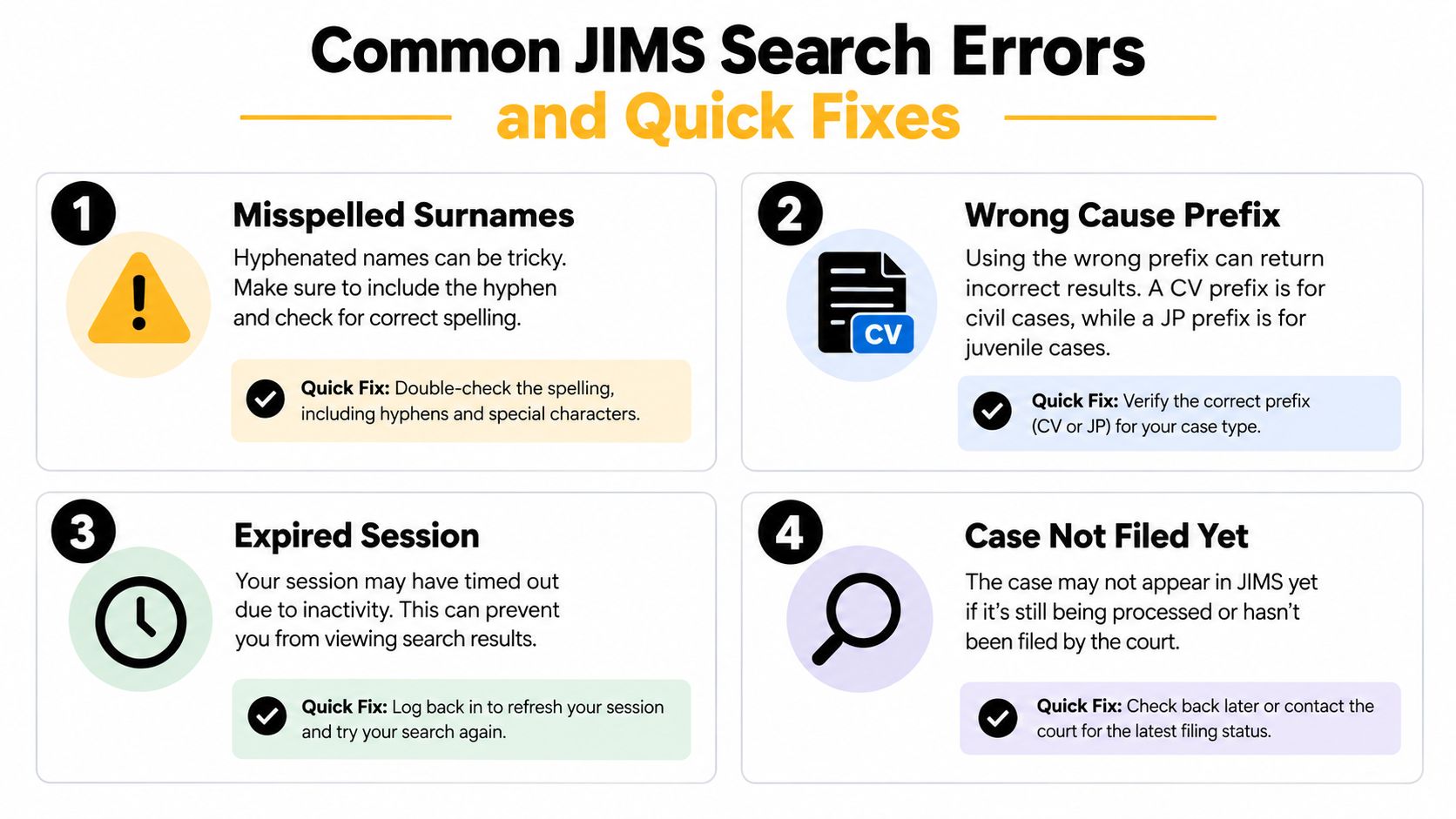
Hyphenated surnames, former names, spelling variations, and suffixes can interfere with a search. Try the surname without a suffix such as Jr. or III, then test the other known name format. If a party changed names after filing, search the name used in the original court paperwork.
Confirm the case category and number
A wrong cause-number prefix can send you to the wrong record group. Family, civil, and family-violence matters may use different identifiers, so compare the number against a court notice or filing rather than guessing. If you only know the parties, select the Family case type before searching.
Other quick corrections include:
- Broaden the date range: A case may have been filed earlier than you expect. Search a wider period first, then narrow it.
- Clear unnecessary filters: A judge or court filter can hide a case if the assignment changed or your assumption is wrong.
- Try both parties: One name may have been entered differently, while the other produces the record.
- Log in again: An expired session can interrupt the search before results load.
- Allow for filing processing: A recently submitted case may not appear immediately in the public index.
The District Clerk's guidance emphasizes precise fields, including party name, filing year, party role, and case type. Adjust one field at a time so you know which correction solved the problem.
Local Help for Humble and Northeast Houston Families
Online research works well when you have a cause number and only need to confirm basic case information. It becomes less effective when you need a restricted document, must understand a complicated docket, or face an enforcement, custody, adoption, or support issue that requires a legal response.
The District Clerk provides several ways to resolve administrative questions. Family Intake at 201 Caroline can assist with family case information and fees, while phone assistance may help when you have a specific cause number. The District Clerk's public FAQ explains that the office's systems are intended to provide case information, documents when available, court costs, parties, and file-location details, but confidentiality rules still limit what staff can release.
Know when the portal has reached its limit
A self-represented litigant can often handle a basic search by following the cause-number, party-name, and date-range process. You may need more help when:
- The case is sealed or confidential: A public search won't create access to restricted material.
- Children are involved: SAPCR and related records may include information that isn't open to general inspection.
- The file concerns adoption or protected identities: Special access rules may apply.
- An order was violated: Enforcement can require a new filing, proper notice, and evidence.
- You need to act, not just look: A docket entry may signal a deadline, hearing, or order that affects your rights.
The Harris County Law Library and self-represented litigant resources may help with general legal research and procedural questions. They can't represent you, interpret every docket entry as legal advice, or replace counsel in a contested case.
For residents who need in-person direction, the Harris County Family Law Center location guide can help orient you before making a courthouse visit. A Humble family law attorney can also help determine whether you need a certified copy, a motion for access, a response to a filing, or representation in the existing case. The Law Office of Bryan Fagan handles family-law matters for local families and can also discuss criminal defense, estate planning, wills, trusts, and probate when those issues overlap with your household's needs.
If JIMS confirms a case but you still can't obtain the document or understand what the docket means, schedule a free consultation with the Law Office of Bryan Fagan. Our Humble team can help you evaluate the record, identify the next procedural step, and protect your interests in a divorce, custody, support, criminal, or estate matter.