Skip to content

A lot of people in Humble first meet the family court system on a bad day.
Maybe you were served with divorce papers at home in Atascocita. Maybe you and your child’s other parent in Kingwood can no longer agree on pickup schedules. Maybe someone in your household needs protection right now, and the thought of driving downtown Houston while upset feels like too much.
If that is where you are, take a breath. You are not the first Northeast Houston family to feel confused by the words, forms, deadlines, and courthouse locations tied to harris county family court humble issues. The system can feel far away in every sense. It is physically downtown, and it also speaks a language many people do not use in daily life.
I have had many conversations with neighbors who ask the same basic questions. Which court handles this? Do I have to go all the way downtown? What do I file first? What if children are involved? What if I need help fast?
Those are fair questions.
The good news is that family court is not random, even when it feels stressful. There is a process. There are specific places to go. There are rules for filing, notice, hearings, and emergency requests. Once you understand the map, things usually feel much more manageable.
Facing a Family Law Issue in Humble? You're Not Alone
A common story goes like this. A parent in Humble gets into an argument about school choice, weekend possession, or child support. Someone says, “I’m taking this to court.” Then the search begins, usually late at night, with a phone full of tabs and a growing sense of panic.
The first surprise is often that your case is not handled in Humble itself. Families in Humble, Atascocita, Kingwood, and other Northeast Houston communities usually have to deal with a downtown Harris County court system. That alone can raise the stress level.
Why this feels harder than it should
Family law problems are personal. You are not just dealing with paperwork. You are dealing with your kids, your home, your money, and your daily routine.
On top of that, many people start out not knowing the difference between:
- A divorce case and a custody case
- Temporary orders and a final order
- Child support enforcement and a support modification
- A protective order and a temporary restraining order
That confusion is normal. Many people do not learn family court procedures until life forces them to.
A local way to think about it
If you live in Humble or Kingwood, the practical side matters as much as the legal side. You may need to plan time off work, arrange child care, figure out how early to leave for downtown Houston, and gather documents without missing something important.
The first step is usually not “go fight in court.” The first step is figuring out which kind of family law problem you have.
When people understand the court’s role, where the case will be heard, and what happens first, the fear usually drops. The rest of this guide is meant to do exactly that in plain language.
What is the Harris County Family Court?
Think of family court like a specialized legal clinic. A general courthouse handles many kinds of disputes, but family court focuses on problems involving family relationships, children, support, and safety.

In Harris County, these courts handle the main family law matters people in Humble usually face. The Harris County District Clerk explains that family courts handle divorce, child custody, child support, visitation rights, protective orders, and emancipation cases, and that they are located at 201 Caroline Street, Houston, TX 77002 in the Civil Courthouse on the Harris County Family Courts page.
What kinds of cases belong there
If you are searching for harris county family court humble, your issue probably falls into one of these groups:
- Divorce: Ending a marriage and resolving property, debt, and often child-related issues.
- Child custody: Deciding conservatorship, possession, and parenting responsibilities.
- Child support: Establishing support, changing it, or enforcing an existing order.
- Paternity: Establishing a legal father-child relationship.
- Protective orders: Asking the court for legal protection in family violence situations.
- Visitation disputes: Handling disagreements about when and how a parent sees a child.
Why your case goes downtown
Many people ask why a Humble family has to go to a courthouse in Houston. The short answer is that Harris County centralizes these family law cases in the downtown system.
That means the judge, clerk, filing process, and hearings are part of one countywide family court structure. It can feel inconvenient from Northeast Houston, but it also means there is one central place where family cases are administered.
The court is a decision-maker, not a counselor
This part trips people up. The court does not exist to referee every argument between parents. Its job is to issue enforceable legal orders.
That means the court looks at the paperwork, hears evidence, applies Texas family law, and enters orders people must follow. In many cases, the court also works with support offices and court staff to move the case forward.
If you are unsure whether your problem is a divorce, custody case, support issue, or emergency safety matter, that classification matters because it shapes everything that happens next.
Navigating the Downtown Courts from Northeast Houston
For families in Humble, Atascocita, and Kingwood, going to court is not just a legal task. It is a travel problem, a scheduling problem, and sometimes a parking problem all at once.

The Harris County court information shows that accessibility is a significant issue for Northeast Houston residents. The downtown courts at 201 Caroline St. are about 25-30 miles from Humble, and the drive can take 45-90 minutes by car in traffic according to the Harris County Family Courts listings.
What that drive really means
If your hearing is in the morning, you should think about more than mileage. You are dealing with commuter traffic, downtown navigation, elevators, security screening, and finding the right floor.
For someone already worried about a custody hearing or divorce setting, that extra friction matters.
A few practical truths help:
- Leave earlier than feels necessary. Downtown delays rarely happen one at a time.
- Build in time for security. Courthouse entry is not like walking into an office building.
- Know your exact courtroom if possible. “I’m going to family court” is not enough once you arrive.
Not every family matter is heard in the same place
Harris County family courts are mostly in the Civil Courthouse at 201 Caroline Street. But protective order matters can involve a separate location.
The county also has a Protective Order Court, the 280th District Court, at 1200 Congress, and the Family Violence Unit of the District Attorney’s Office is temporarily located at 1310 Prairie, 5th Floor, Suite 500, Houston, TX 77002, with phone number (713) 274-0212 as listed on the county’s family court information page.
That can be confusing if you assume every hearing happens in one building.
A simple planning table
| If you live in | What to plan for |
|---|---|
| Humble | Early departure, downtown parking search, building security |
| Atascocita | Extra travel cushion on high-traffic mornings |
| Kingwood | Longer route planning and backup time for delays |
Parking and stress management
Official court pages do not give Humble families much specific guidance on parking strategy. That is why many people feel frazzled before they even reach the courtroom.
A good rule is to avoid arriving “just on time.” Give yourself enough margin so that a wrong turn, full garage, or courthouse line does not throw off your whole hearing day.
If your matter is urgent, confirm the building address before you leave home. Family court at Caroline and protective order proceedings at Congress are not the same destination.
How to Start Your Family Law Case in Harris County
Starting a family case is usually less dramatic than people expect. It is a sequence of formal steps. Once you know the order, the process makes more sense.
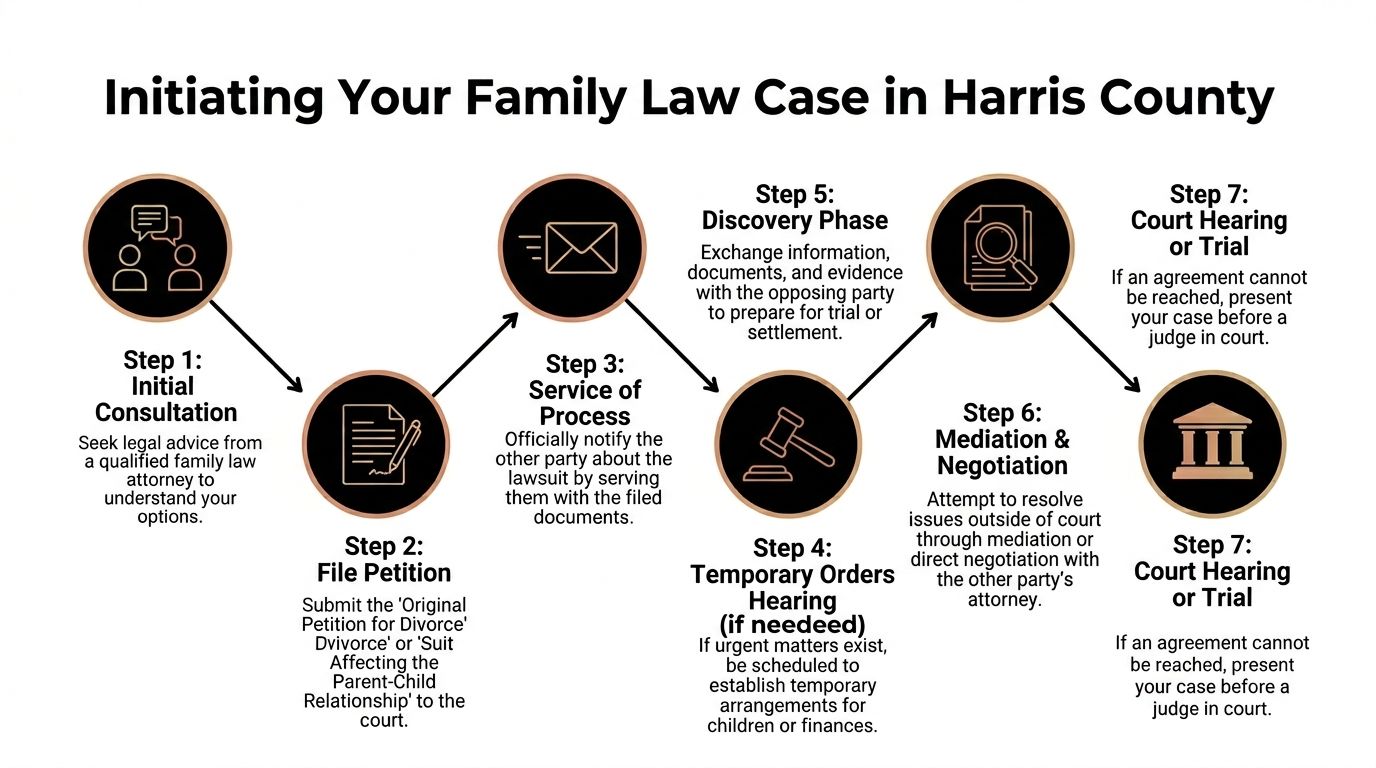
Step one is filing the right case
The first document depends on the problem.
If you are ending a marriage, the starting document is often an Original Petition for Divorce. If the issue is about children without a divorce, the case may begin as a Suit Affecting the Parent-Child Relationship, often shortened to SAPCR.
The document tells the court what you are asking for. It may request orders about children, property, support, or other family issues.
Filing creates the case
Once paperwork is filed, the court assigns the case into the Harris County family court system. The filing starts the formal process and creates a court record.
In Harris County, attorneys must use EFileTexas.gov. According to the court information summarized in the Harris County family court training video, e-filing through EFileTexas.gov has been mandatory for attorneys since 2014, and all 10 Family District Courts process filings 24/7 through the District Clerk’s Office, with urgent TRO matters handled by the Family Ancillary Clerk on the 17th floor of the Civil Courthouse as described in this Harris County family court video reference.
Then the other side must be notified
This part is called service of process.
In plain English, that means the other party must be officially notified that a case has been filed. You generally cannot tell them by text message and call it done. Family courts want proof that legal notice happened the right way.
That step matters because the court needs proper notice before making many decisions.
Temporary orders often set the ground rules
Many family cases do not wait until the end for structure. A judge may enter temporary orders while the case is pending.
Those temporary orders can address things like:
- who stays in the house
- who has the children on certain days
- how bills get paid during the case
- whether support should be paid while the case is ongoing
When a situation is urgent
Some cases need immediate action, especially if there is danger, harassment, or a risk that property or children will be moved improperly. In that kind of situation, a party may ask for a temporary restraining order.
A temporary restraining order is not the same as a final result. It is a short-term tool to stabilize things until the court can hold a hearing.
What the early path usually looks like
- Talk through the facts carefully. Identify whether the issue is divorce, custody, support, paternity, or safety.
- Prepare the opening filing. The pleading should match the legal issue and the relief requested.
- File with the court. In practice, lawyers use EFileTexas.gov in Harris County.
- Complete service. The other side receives formal notice.
- Address immediate concerns. If needed, request temporary orders or urgent relief.
- Begin gathering information. Documents, messages, school records, and financial material often matter early.
Some people handle pieces of this on their own. Others work with a family lawyer or use local legal resources. In Humble, one practical option is to speak with a local family law office such as the Law Office of Bryan Fagan, which handles divorce, custody, child support, and mediation matters for local residents.
Handling Child Custody, Support, and Protective Orders
These are the cases that keep people up at night. A parent worries about losing time with a child. Another worries support will never get paid. Someone else worries about safety at home.
Each problem moves through the court system a little differently.
When custody is the main issue
Take a common example. Parents in Kingwood separate, and their disagreement is not about divorce paperwork. It is about where the child should primarily live and how weekends should work.
In that kind of case, the court may need more than each parent’s opinion. The Harris County Domestic Relations Office, often called the DRO, can play an important role. The DRO’s mission information explains that its Family Court Services division conducts social studies to evaluate parental fitness, and its Alternative Dispute Resolution division helps settle approximately 65% of referred cases, often avoiding trial, according to the Harris County Domestic Relations Office mission page.
That means some custody disputes involve outside evaluation and structured settlement efforts, not just one quick hearing.
When support is the problem
Now consider a different situation. A parent in Atascocita already has an order, but the other parent is behind or the amount no longer fits current circumstances.
Support cases can involve establishing support, enforcing support, or asking the court to modify an existing order. In plain language, the court wants a clear paper trail. Orders, payment history, and financial records often matter more than emotion.
If the dispute is tied to a larger custody case, the court may look at both issues together.
When safety comes first
A family violence situation needs a different response. If someone in Humble needs immediate legal protection, timing and location matter.
Protective order matters may be handled through the Protective Order Court rather than the main downtown family court setting. If your facts involve immediate safety concerns, it also helps to understand the difference between a protective order and a TRO. This overview of what is a temporary restraining order gives a useful starting point.
Courts treat safety issues differently from ordinary scheduling disputes. If violence, threats, or stalking are involved, say that clearly from the beginning.
Three short examples
- Divorce with children: The court may need temporary schedules, support arrangements, and later a final parenting plan.
- Support enforcement: The key issue is whether an existing order has been followed and what remedy the court should impose.
- Protective order request: The focus shifts to immediate protection and legally enforceable boundaries.
Preparing for Your Day in Harris County Family Court
The day of court feels easier when you prepare for it like an appointment that matters, not like a last-minute errand.

What to bring
Bring documents in a way that lets you find them quickly. Loose papers stuffed into a bag make a stressful morning worse.
A simple checklist helps:
- Court papers: Petitions, motions, notices, and prior orders
- Important records: School records, payment records, calendars, or messages if they relate to the issue
- Identification: Bring a government-issued ID if you have it
- Notes: A short list of the points you need to remember
If your case involves children, this guide to a child custody hearing in Humble Texas can help you think through what may matter at the hearing.
How to present yourself
You do not need to dress like you are attending a gala, but you should dress neatly and conservatively. Court is formal. Judges and staff notice whether people take the setting seriously.
A few basics go a long way:
- silence your phone before entering
- do not interrupt the judge or the other side
- speak clearly and calmly
- answer the question asked
Expect some waiting
Many people think their hearing will begin exactly when listed. Sometimes that happens. Often it does not.
Harris County tracks court efficiency using the Age of Active Pending Caseload, and cases older than 180 days are considered part of the backlog, with those statistics made public so litigants can better understand timing, as described in the Harris County caseload reporting information.
That does not tell you exactly when your case will finish. It does tell you that delays and wait time are part of the court environment.
A practical court-day routine
| Before you leave | After you arrive |
|---|---|
| Check the building address | Go through security early |
| Put papers in order | Confirm floor or courtroom |
| Wear simple professional clothing | Stay close to your assigned area |
Bring patience with your paperwork. Even a short hearing can involve waiting, rescheduling, or last-minute docket movement.
How The Law Office of Bryan Fagan Can Help Your Case
Family court becomes more manageable when someone helps you sort the legal issue from the emotional noise.
For many Humble families, the hard part is not just the law. It is making sound decisions while dealing with a breakup, parenting conflict, or fear about what comes next. A lawyer can help identify the right filing, prepare for temporary orders, organize documents, and make sure you are headed to the right court in the first first place.
That local perspective matters. Families in Humble, Atascocita, Kingwood, and across Northeast Houston often face the same practical hurdles. Downtown travel, courthouse confusion, scheduling around work, and concern about children all show up at the same time. Good legal guidance should account for both the courtroom process and everyday life.
If you want to learn more about representation for divorce, custody, support, or related matters, review the firm’s Harris County family law attorneys page.
You do not have to figure out the Harris County system by trial and error. A clear plan usually lowers stress, protects your position, and helps you avoid mistakes that are hard to undo later.
If you are dealing with divorce, custody, child support, or a protective order issue, the Law Office of Bryan Fagan offers free consultations for families in Humble, Atascocita, Kingwood, and Northeast Houston. A conversation about your situation can help you understand your options, your next step, and how to move forward with confidence.