Skip to content

When you’re a parent in Humble, Texas, facing a child custody hearing, it can feel like your entire world is on the line. The legal language, the formal courtroom, and the weight of the decision are enough to overwhelm anyone. We understand.
At The Law Office of Bryan Fagan, we’ve walked this path alongside countless families right here in our community—from Humble and Atascocita to Kingwood and throughout Northeast Houston. We know what you're up against, and our commitment is to pull back the curtain on what really happens inside a Harris County Family Court, so you can face it with confidence.
Everything boils down to one guiding principle: the best interest of the child. While that phrase gets used a lot, it’s not just a vague idea. It’s a specific legal standard every judge in Texas uses to build a stable and nurturing future for your child.
The Court's Primary Focus: Your Child's Future
A common misunderstanding is that a custody hearing is about picking a "winner" or punishing a parent. That’s not the judge's role. Their focus is entirely on the future.
Their job is to piece together the best possible living situation for your child by looking at a handful of very real, practical factors. For our Humble families, think of it as the judge trying to answer these questions:
- Emotional and Physical Needs: Who has been the one primarily getting the child ready for school in Humble ISD, taking them to the doctor at a local clinic, and comforting them at night? The court looks at the history of caregiving.
- Parental Abilities: Can each parent provide a safe, stable home? The judge considers each parent's maturity and their ability to put their child's needs above their own.
- Potential Dangers: Any history of family violence, neglect, substance abuse, or criminal activity will be examined very closely. This is a significant red flag for the court.
- The Child's Desires: For children aged 12 and older, the judge has the option to speak with them privately to hear their preference. It’s important to know this isn't the deciding factor, but it is one piece of the puzzle the judge will consider.
Understanding this framework is the first step toward building a case that shows the judge how you fit into your child’s best future.
Our Commitment to You: This isn't about winning or losing. It's about demonstrating that the environment you provide gives your child the best chance to be safe, healthy, and happy. We are here to help you do just that.
JMC vs. SMC: Understanding Texas "Custody" Terms
In Texas, we don't technically use the word "custody" in our court orders. Instead, you’ll see the legal term conservatorship, which outlines who has the right to make key decisions for your child.
There are two main arrangements you'll hear about in a Humble courtroom:
- Joint Managing Conservatorship (JMC): This is the standard and by far the most common outcome in Texas. It means both parents share the rights and responsibilities of making important decisions. Usually, one parent is named the "primary" conservator, giving them the right to decide where the child lives and to receive child support.
- Sole Managing Conservatorship (SMC): This is much less common. SMC gives one parent the exclusive right to make almost all decisions. A judge typically only orders this in serious situations where there's a proven history of family violence, severe neglect, or chronic substance abuse by the other parent.
While the legal system can feel complex, understanding these core concepts gives you a significant advantage. Sometimes, in particularly tough cases, the court may appoint a neutral expert to represent the child's interests directly. To get a better handle on this possibility, you can learn more about what a Guardian Ad Litem does in Texas in our in-depth article.
Preparing for a custody hearing is not something you should do alone. As your local attorneys, we invite you to contact The Law Office of Bryan Fagan for a free consultation at our Humble office. Let's talk about your family and how we can help protect your future.
Kicking Things Off: Filing Your Custody Paperwork in Harris County
Your child custody case doesn’t start with a dramatic courtroom scene. It begins with paperwork. For families in Humble, this first step is filing a specific lawsuit with the Harris County District Clerk. Getting it right sets the stage for everything that follows.
This lawsuit is officially known as an Original Petition in a Suit Affecting the Parent-Child Relationship, or SAPCR for short (we pronounce it "sap-sir"). If you’re the one starting the case, the court calls you the Petitioner. The other parent, who needs to be formally notified, is the Respondent.
Filing the SAPCR officially opens your case. It tells the court who is involved and what you’re asking for when it comes to conservatorship (custody), visitation schedules, and child support.
Getting the Papers Served the Right Way
After filing the petition, you can't just text the other parent a picture of it or hand them the documents yourself. Texas law is very strict about this part. The formal delivery process is called service, and it’s a required step to protect the other parent's right to officially respond to the lawsuit.
Here in the Humble, Atascocita, and Kingwood area, service usually happens in one of two ways:
- Personal Service: This is the most common method. A certified process server or a Harris County sheriff's deputy will physically hand-deliver the lawsuit papers to the Respondent. It’s the most straightforward and legally solid way to prove they were notified.
- Waiver of Service: If you and the other parent are working together, they can sign a "Waiver of Service." This document must be signed in front of a notary. It basically says, "I've received the lawsuit and agree to skip the formal delivery process."
Once service is complete, a legal countdown begins. The Respondent now has a specific amount of time to file a formal "Answer" with the court.
You'll be gathering and sending a lot of sensitive financial and personal information. From the very beginning, it's vital to protect your documents and ensure compliance with privacy rules to keep your family’s data secure.
Your First Day in Court: The Temporary Orders Hearing
Soon after the case gets going, you’ll likely have your first major court date: the Temporary Orders Hearing. This isn't the final trial. Instead, its purpose is to put ground rules in place to create stability for your child while the full case moves forward, which can often take many months.
Think of it as a mini-trial. The judge will listen to both sides and make quick, temporary decisions on the most urgent issues.
This whole process can seem complicated, but a judge's thinking boils down to a simple framework: they identify the goal, filter it through the child's best interests, and then make a decision.
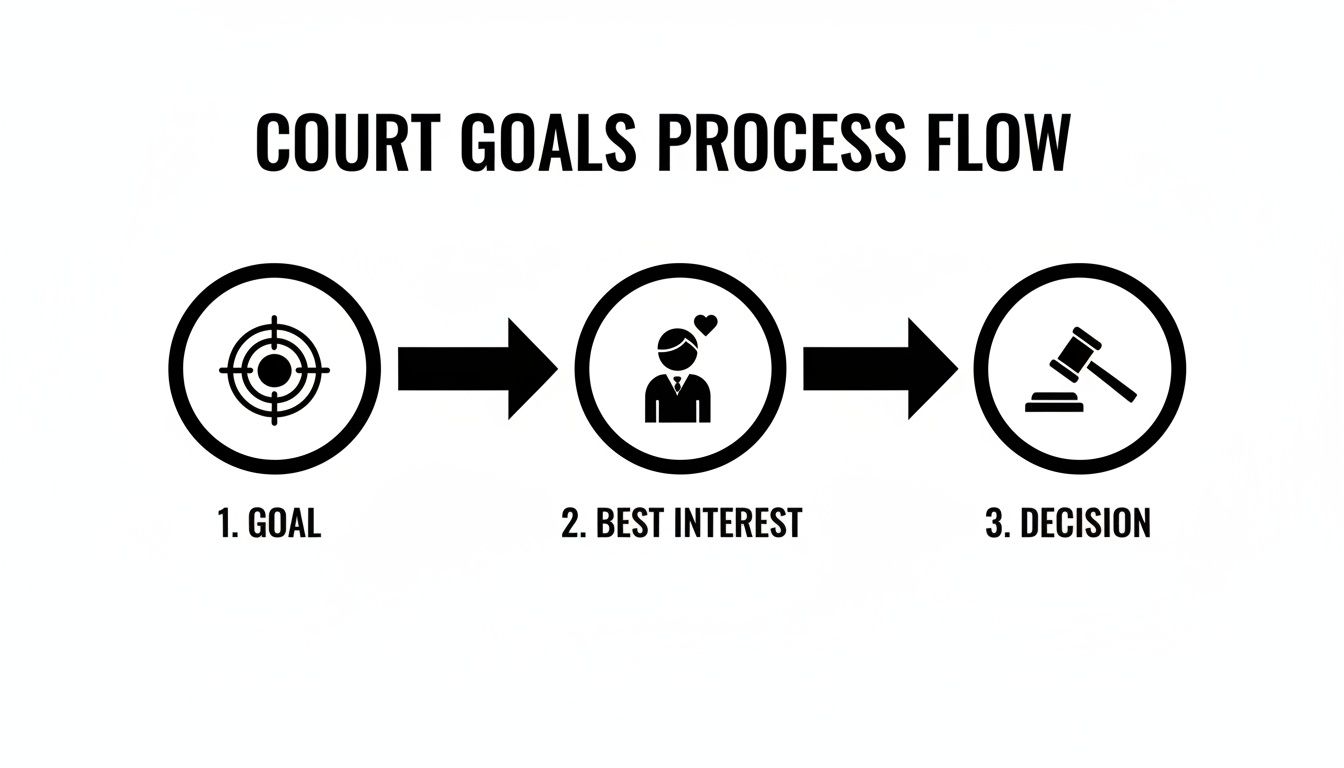
As you can see, every ruling a judge makes is guided by one single principle: what is in the best interest of the child.
At a Temporary Orders hearing, a Harris County family judge will typically decide things like:
- Which parent will have the right to decide where the child lives.
- A temporary visitation schedule for the other parent.
- Who pays temporary child support and provides health insurance.
- A geographic restriction, limiting how far the primary parent can move with the child (often to Harris and surrounding counties).
- Other rules (injunctions) about how parents communicate or behave toward each other.
These "temporary" orders are incredibly important because they often set a precedent for the rest of the case. This hearing is your first chance to make your case for a child custody hearing in Humble, Texas, and it’s crucial to make a strong, positive impression on the judge from the very start.
Navigating the initial filings and hearings can feel overwhelming, but you shouldn't have to guess your way through it. Our team at The Law Office of Bryan Fagan works in the Harris County family courts every day. We know the process and the people involved. If you’d like to talk through your specific situation, we offer a free consultation at our Humble office to help you build a solid strategy right from day one.
How To Build a Winning Case with Evidence and Witnesses
Walking into a child custody hearing in Humble, Texas, it’s completely normal to feel like you just need to tell the judge your side of the story. But as a local attorney, I’ve seen time and again in Harris County Family Courts that the parent who succeeds isn't the one with the most emotional story—it's the one who brings the most compelling evidence.
Your goal is to show the court you can provide for your child’s best interests, and that requires facts, not just feelings.

Think of it as building your case brick by brick. You need solid documents and credible testimony that paint a clear picture of you as a stable, involved, and dedicated parent. While your feelings are absolutely valid, the judge needs tangible proof to make a decision that protects your child.
Step 1: Gather Your Documentary Evidence
It's time to start gathering the paperwork that proves your parenting story. A Harris County judge needs to see real, tangible proof of your ability to care for your child. This goes way beyond just money; it's about your everyday involvement.
Start collecting any documents that show your role in your child's life. Good examples include:
- Communication Records: Printouts of texts, emails, or messages from co-parenting apps. The key is to show you communicating respectfully and always putting the child’s needs first.
- School and Medical Records: Report cards, attendance sheets, and doctor visit summaries are gold. They often show who is listed as a contact and who actually shows up for the appointments.
- Financial Statements: Your pay stubs, tax returns, and bank statements demonstrate a stable income and your ability to financially support your child.
- Photos and Calendars: A picture of you helping with homework or at a school play speaks volumes. Calendars showing your consistent presence at your child's activities can also be powerful visual proof.
Every single piece of paper helps tell your story. A solid report card shows you value their education, while a polite email to your ex-spouse proves you can co-parent effectively. Keep everything organized—it forms the very foundation of your case.
Key Insight: I can't stress this enough: judges see hundreds of cases. When you walk in with a well-organized binder of labeled exhibits, it shows you're prepared and you respect the court's time. That simple act makes a fantastic first impression.
A strong collection of evidence is crucial for demonstrating your fitness as a parent. The table below outlines some of the most impactful types of evidence you can present in a Humble custody hearing and what they help prove to the judge.
Key Evidence for Your Humble Child Custody Hearing
| Evidence Type | What It Proves | Practical Example |
|---|---|---|
| Communication Logs | Your ability to co-parent effectively and focus on the child's needs. | A series of respectful texts with the other parent coordinating holiday schedules. |
| School Records | Your involvement in the child's education and academic progress. | Attendance records showing you took the child to school, or report cards listing you as a primary contact. |
| Medical Documents | Your role in managing the child's health and wellness. | A summary from a pediatrician's visit that you attended, or receipts for prescriptions you filled. |
| Financial Stability | Your capacity to provide a secure home and meet the child's material needs. | Recent pay stubs, W-2 forms, or a bank statement showing consistent income. |
| Photos/Videos | Your active and positive presence in the child's daily life and special events. | A photo of you coaching your child's soccer team or helping them with a school project. |
| Witness Testimony | Third-party validation of your parenting skills and the child's bond with you. | A teacher testifying that you always attend parent-teacher conferences and are an engaged parent. |
Using this mix of documents, you can create a comprehensive and convincing picture for the court that is grounded in fact, not just opinion.
Step 2: Choose Witnesses Who Can Help Your Case
When it comes to witnesses, quality definitely trumps quantity. The most persuasive witnesses are neutral, credible people who can speak from firsthand experience about your parenting—not about your personal drama with the other parent. A judge is looking for unbiased observations.
As you consider who to ask, think about people in our Humble community who have seen you parent in different situations.
Some of the best choices are:
- Teachers or Daycare Providers: They can give an objective opinion on your child's happiness and your level of involvement at school.
- Neighbors or Mutual Friends: People who have seen your day-to-day life with your child can provide powerful, down-to-earth testimony.
- Coaches or Activity Leaders: Their testimony shows your commitment to being present at games, practices, and other important events.
Who should you avoid? I usually advise clients to steer clear of close family members, like a parent or sibling, and new romantic partners. While their support is wonderful, a judge might see their testimony as biased and give it less weight. A teacher’s statement that you never miss a conference often carries far more influence than a brother saying you’re a "great dad."
The whole point of evidence and witnesses is to show the judge what kind of parent you are, not just tell them. For a deeper look at the factors judges consider, you can read our guide on how to prove the best interest of the child in Texas.
Step 3: Organize and Present Your Story
Once you've gathered your evidence and identified potential witnesses, it's time to put it all together into a story that makes sense. Please don't just hand your attorney a messy folder of papers. You need to work together to build a clear timeline and a compelling narrative.
Think about the one or two main points you absolutely need the judge to understand. Are you showing that you're the more stable parent? That you've always been the one to handle school and doctor visits? Every text, photo, and witness should directly support these central themes.
It’s also worth noting that managing all this paperwork can be a job in itself. There are many legal use cases for document processing technology that can help organize everything from text logs to financial records, making them much easier to present clearly in court.
Building a strong case is a methodical process. For families in Humble, Atascocita, and Kingwood, presenting clear, organized, and relevant evidence is the single most powerful thing you can do to protect your child's future.
If you're facing a custody hearing and feel overwhelmed by the process of gathering evidence, we can help. The Law Office of Bryan Fagan offers free consultations at our Humble office to go over your case and start building a strategy that protects what matters most to you.
What to Expect on Your Day in a Harris County Courtroom
After weeks, maybe even months, of preparation, your day in court has finally arrived. Walking into the Harris County Civil Courthouse for a child custody hearing can feel incredibly intimidating. Let’s be honest, it’s not a place anyone wants to be. But knowing exactly what to expect and how to handle yourself can make a world of difference, helping you stay calm and present your case effectively.

Let's start with the basics: what you wear. I always tell my clients from Humble, Atascocita, and Kingwood to think of it like an important job interview. Business casual is the way to go. You’re showing the judge you take this matter seriously. This isn't the time for shorts, graphic t-shirts, or hats.
Courtroom Demeanor: The Unspoken Rules
Once you step inside the courtroom, a certain formality takes over. The rules are strict for a reason. Make sure your phone is completely powered off—not just on silent. When the judge enters or exits, everyone in the room stands. And when you speak to the judge, you will always address them as "Your Honor."
These aren't just empty gestures. They are small but powerful signs of respect that help establish your credibility. You’re signaling that you respect the court's authority and the seriousness of the decisions being made about your child. It's surprising how much of an impact simple courtesy can have.
When it's your turn to speak, whether you’re at the counsel table or on the witness stand, project your voice and be clear. The most important thing? Do not interrupt the judge or the other party's attorney, no matter how much you disagree with what’s being said. Your attorney will get the chance to set the record straight.
Taking the Witness Stand: Telling Your Story
For many parents, testifying is the most stressful part of the entire hearing. The key is to remain calm, be completely honest, and stay focused. This is your opportunity to tell your story, but it has to be the right one—a story about your child's best interests, not a list of complaints about the other parent.
I give all my clients this handful of tips before they testify:
- Listen to the Full Question. Don't jump to conclusions. Make sure you understand what's being asked before you answer. It's perfectly fine to say, "Can you please rephrase that?"
- Answer Only What Is Asked. This is a tough one. The natural tendency is to over-explain, but it often backfires. Stick to short, direct answers.
- Be Honest, Always. Never, ever exaggerate or lie. If you don't know an answer, "I don't know" is a complete and acceptable response. The same goes for "I don't recall."
- Stay Composed. During cross-examination, the other attorney will likely try to poke holes in your story or get you flustered. That’s their job. Don’t take the bait. Your calm demeanor demonstrates maturity and stability—two things every judge wants to see in a parent.
Your composure under fire speaks volumes. For a deeper dive into getting ready, check out our comprehensive advice on how to prepare for your custody hearing in Texas.
A Lawyer’s Insight: The biggest mistake I see parents make is using their testimony to air grievances against their ex. The judge is far more interested in how you help your child with their math homework or coach their soccer team than in hearing about your ex's new relationship. Always, always bring the focus back to your child.
Your day in court is your chance to show the judge that you are the responsible, composed, and loving parent you know you are. By understanding the process and mastering how you present yourself, you can build the strongest possible case for your child's future.
The process can feel overwhelming, but you shouldn't have to face it by yourself. The attorneys at The Law Office of Bryan Fagan are in the Harris County courts nearly every day, fighting for families across Northeast Houston. If you need a dedicated advocate in your corner, schedule a free consultation at our Humble office. Let us help you tell your story with confidence.
What Happens After the Hearing? The Judge's Decision and Final Order
Once all the testimony is finished and the last piece of evidence has been submitted, a hush falls over the courtroom. This is the moment you've been preparing for. A Harris County judge will now take everything they've seen and heard to make a final ruling—a decision that will lay the groundwork for your family's future.
What comes out of this is the Final Order. Think of it as the official rulebook for your co-parenting relationship. It’s a legally binding document that goes far beyond simply naming who "gets custody." It's a detailed plan designed to minimize conflict and provide a clear path forward.
The "Best Interest of the Child" is the Only Thing That Matters
In a child custody hearing in Humble, Texas, every single decision the judge makes boils down to one guiding principle: the best interest of the child. This isn't just a feel-good phrase; it's a specific legal standard defined by Texas law.
To figure out what’s truly best for a child, judges in Texas lean on a framework known as the "Holley Factors." These are the specific questions they ask themselves when weighing the evidence:
- What are the child's emotional, physical, and developmental needs right now?
- Which parent can provide a more stable and safe home?
- What are the demonstrated parenting skills of each person involved?
- Has either parent done something (or failed to do something) that could harm the parent-child relationship?
- Is there any potential danger to the child with either parent?
The judge’s job is to balance all these points to craft an order that gives the child the best shot at a safe, stable, and loving upbringing.
What's Actually in a Final Custody Order?
When you get your Final Order, it can look like a mountain of legal jargon. But it’s crucial to understand what each section means because you’ll have to live by it. The main parts you need to focus on are the possession schedule, geographic restrictions, and child support.
You might hear a lot of talk about fairness between parents, but legally, that's not the court's primary concern. The Texas Family Code, Section 153.002, explicitly directs judges to prioritize the child’s best interest above all else, without any regard to gender, race, or marital status.
So why do mothers still end up with primary custody more often? Nationally, it’s around 65% of the time. This is often less about judicial bias and more a reflection of who has historically been the primary caregiver. Judges in Humble's family courts look at the reality of the situation: who provides stability, who understands the child's needs, and who is willing to foster a good co-parenting relationship. For more background on these figures, you can review some insights on Texas divorce and custody statistics.
This is exactly why preparing your case is so important. You have to be ready to show the judge, with real evidence, your consistent involvement and ability to provide a stable home.
A Pro's Tip: Stop thinking about the Final Order as a "win" or a "loss." It's not a competition. It's a structured plan the judge creates to ensure your child has consistency, stability, and meaningful access to both parents.
Possession Schedules: Who Has the Kids and When?
A huge part of the order is the possession schedule, which is a detailed calendar of when the child will be with each parent. For most families in the Humble, Atascocita, and Kingwood areas, this means the Texas Standard Possession Order (SPO).
The SPO is the default schedule for parents living within 100 miles of each other because the law presumes it’s in the child's best interest. Here’s a quick look at how it generally works:
- Non-Primary Parent: Gets the child on the first, third, and fifth weekends of a month.
- Holidays: Major holidays like Thanksgiving and Christmas are split and alternated annually.
- Summer Vacation: The non-primary parent typically gets a 30-day extended period of possession during the summer.
Of course, this is just the "standard." A judge can and will customize the schedule if your family has unique needs, like a parent with an unconventional work schedule or a child with special activities.
Geographic Restrictions and Child Support
Two other critical pieces of the Final Order are geographic restrictions and child support.
A geographic restriction is a boundary that dictates how far the primary parent can move with the child. In most Humble cases, this is limited to Harris County and any adjoining (contiguous) counties. The reason is simple: it ensures the other parent can stay involved and maintain a consistent relationship without facing an impossible commute.
Finally, the order will clearly state the child support obligations. A judge calculates this amount using a formula set by Texas guidelines, which is based on the non-primary parent's net monthly income and how many children require support. This section also specifies who is responsible for carrying the child's health insurance.
Getting a handle on your Final Order is the first step to successfully navigating your new family dynamic. This document is the map for your co-parenting journey, and knowing it inside and out will save you a lot of headaches down the road.
If you have questions about what a final order might look like in your specific situation, The Law Office of Bryan Fagan is here to help. We offer free, confidential consultations at our Humble office to discuss your case and help you understand your options.
Common Questions We Hear About Humble Child Custody Hearings
When you're preparing for a child custody hearing, it feels like you have a million questions and no clear answers. We get it. As lawyers practicing right here in Humble, we've sat down with countless parents from Atascocita to Kingwood who are wrestling with the same fears and uncertainties you are right now.
Let's walk through some of the most pressing questions we hear every day. Getting a straight answer is the first step toward feeling less overwhelmed and more prepared to fight for your child.
Is Mediation Required Before I Can See a Judge?
In almost every case, yes. The family court judges here in Harris County are big proponents of mediation. In fact, most will order you and the other parent to try it before they’ll even consider scheduling a final trial. They want you to have every chance to solve this on your own terms.
Mediation is a private, confidential meeting with a neutral third-party—the mediator. Their job isn’t to take sides, but to help you and the other parent find common ground. If you manage to work out the details, you’ll sign what's called a Mediated Settlement Agreement (MSA). Once signed, an MSA is a powerful, legally binding contract that essentially becomes your final court order.
Think of it this way: In a courtroom, a judge who doesn't know you or your child makes the final call. In mediation, you get to keep control and craft an agreement that you can actually live with.
Can My Child Tell the Judge Who They Want to Live With?
This is a sensitive topic, and one of the most common questions we're asked. The straightforward answer is that a child does not get the final say. However, their preference can be a factor.
In Texas, once a child is 12 or older, your attorney can ask the judge to speak with them directly. If the judge agrees, they'll have a private conversation in their office—what we call their "chambers." The judge will listen to what the child has to say about their wishes.
It's absolutely critical to understand that the child’s preference is just one piece of a much larger puzzle. A judge will never let a child’s wishes put them in a bad situation. They are always focused on the child's best interest. For instance, a teen might want to live with the parent who has a later curfew, but the judge may see that the other parent provides a more stable and supportive home life.
How Do I Change a Custody Order if Our Situation Changes?
Final orders aren't always final forever. Life happens. You might get a new job and have to move, or your child's needs might completely change as they enter high school. Texas law allows you to ask the court to modify your custody, visitation, or child support order.
But it’s not as simple as just wanting something different. You have to prove two key things:
- There has been a "material and substantial change" in the circumstances of the child or one of the parents.
- The change you’re asking for is in the "best interest of the child."
So, what counts as a "material and substantial change"? It could be a parent's relocation, a major shift in work schedules, or new challenges with a child's health or education. Simply being unhappy with the current arrangement isn't enough to get back in front of a judge.
What if the Other Parent Stops Paying Child Support?
When a parent refuses to pay court-ordered child support, it puts a tremendous strain on the entire family. The Harris County Family Courts see these enforcement cases all the time. The numbers are frankly discouraging—statewide data shows only 23% of female-headed households receive the full child support they're owed, even though 88% have a legal order in place. Discover more insights about these child support factors and challenges.
Don't just let it go. You have the right to file an Enforcement Action. A judge has serious tools to compel payment, from garnishing wages and suspending their driver's license to, in the most severe cases, ordering jail time for contempt of court.
Going through a custody battle in Humble can feel isolating, but you don't have to figure it all out on your own. At The Law Office of Bryan Fagan, we're more than just attorneys; we're members of this community. We help families in Humble, Atascocita, and Kingwood protect what matters most. If you're ready to talk about your situation, schedule a free, no-pressure consultation with our Humble team at https://humbletxlawyers.com.