Skip to content

When you're navigating a child custody case, everything can feel uncertain. For families here in Humble, Kingwood, and Atascocita, the first step toward creating stability for your children—and for you—is understanding the possession schedule. In Texas, that schedule is typically the Standard Possession Order (SPO).
Think of the SPO not as a cold legal document, but as a predictable roadmap for your family. It's a court-ordered calendar that clearly lays out when your child will be with each parent. Its entire purpose is to prevent conflict and help your child maintain a strong, healthy bond with both of you after a divorce or separation. The Law Office of Bryan Fagan is committed to helping our neighbors in the Humble community understand this process, and we are here to offer clear, supportive guidance every step of the way.
Understanding the Humble Standard Possession Order
When a family in Northeast Houston separates, a judge's top priority is the child's well-being. A huge part of that is creating a consistent routine that allows the child to see both parents regularly. That's where the Texas Family Code comes in. It provides a default schedule—the Standard Possession Order—that Harris County judges presume is in the child’s best interest.
This schedule is the blueprint for your co-parenting life. It takes the guesswork out of weekends, holidays, and summer breaks, which cuts down on arguments before they can even start. For families in our community, from the growing neighborhoods of Humble Texas to the quiet streets of Kingwood and Atascocita, this structure provides essential predictability and peace of mind.
The Two Schedules You Need to Know
While most people use the umbrella term "Standard Possession Order," it actually refers to two different schedules. The one that applies to your family almost always boils down to one simple factor: how far apart the two parents live.
This distance is a critical detail because it dramatically changes how much time the non-primary parent (the parent who does not have the right to determine the child's residence) spends with the child.
The two schedules are:
- The Traditional Standard Possession Order (SPO): This schedule is for parents who live more than 100 miles apart. It generally gives the non-primary parent possession on one weekend a month, splits major holidays, and grants them the entire Spring Break every year.
- The Expanded Standard Possession Order (ESPO): This is now the automatic starting point for most families in Northeast Houston where the parents live 50 miles or closer to one another. It provides much more time with the non-primary parent, bringing the schedule very close to a 50/50 split.
The most important shift for Humble families in recent years is this: judges now automatically assume the Expanded Standard Possession Order is what's best for the child if parents live within 50 miles. You don't have to fight for it—it's the default.
To make this crystal clear, let's compare the key differences in how time is divided under each order for a local Humble parent.
Standard Possession Order (SPO) vs Expanded SPO (ESPO) at a Glance
| Possession Time | Standard Possession Order (SPO) | Expanded SPO (The New Default for Parents Within 50 Miles) |
|---|---|---|
| School Year Weekends | Begins when school is dismissed on Friday, ends at 6:00 PM on Sunday. | Begins when school is dismissed on Friday, ends when school resumes on Monday morning. |
| School Year Weekdays | No weekday possession. | Begins when school is dismissed on Thursday, ends when school resumes on Friday morning. |
| Summer Possession | 30 days of possession, often taken in one block. | 42 days of possession, which can often be broken up into multiple visits. |
As you can see, the Expanded SPO gives the non-primary parent significantly more time, including crucial overnight stays during the school week that help maintain routine and connection.
Why the Expanded SPO is Now the Default
The move to make the Expanded SPO the new standard reflects a modern understanding of co-parenting. Texas law now firmly recognizes what parents have known for a long time: kids do better when they have frequent, ongoing contact with both of their parents.
For a parent in Atascocita, this means your child isn't just visiting for a quick weekend. They get to settle in Thursday night and wake up in your home before school on Friday. They stay through Sunday night and you get to take them to school Monday morning. These "extra" moments are what build a true sense of home in both households, moving families much closer to a 50/50-like schedule without a messy court battle.
If you are starting a divorce or custody case in Harris County, you should operate on the assumption that the ESPO will be the framework for your final orders. At the Law Office of Bryan Fagan, our Humble attorneys live and breathe these schedules. We can help you understand exactly what this means for your family and plan for your future with confidence. We offer a reassuring, confident call to action: schedule a free consultation with our Humble office today.
How the Expanded Possession Schedule Works in Practice
The Expanded Standard Possession Order (ESPO) is now the default schedule for most Humble families living within 50 miles of each other, and it's a big step forward. It's one thing to read the legal language in a court order, but it’s far more important to understand what it actually means for your family’s calendar week after week.
What I've seen in my practice is that this schedule is designed to give the non-primary parent more consistent, meaningful time with their kids. It moves beyond just a "visit" and helps create a genuine, predictable routine for everyone. For many parents I work with in Humble, Atascocita, and Kingwood, the biggest and most welcome change comes on the weekends.
With the ESPO, the non-primary parent’s weekend time now starts the moment school lets out on Friday and ends when school starts back up on Monday morning. This applies to the first, third, and fifth weekends of any given month. Gone is the Sunday evening handoff and the mad dash to get homework done. It creates a much more natural, seamless weekend for your child.
The timeline below shows how Texas law has evolved, shifting from the old model to the ESPO as the new standard.
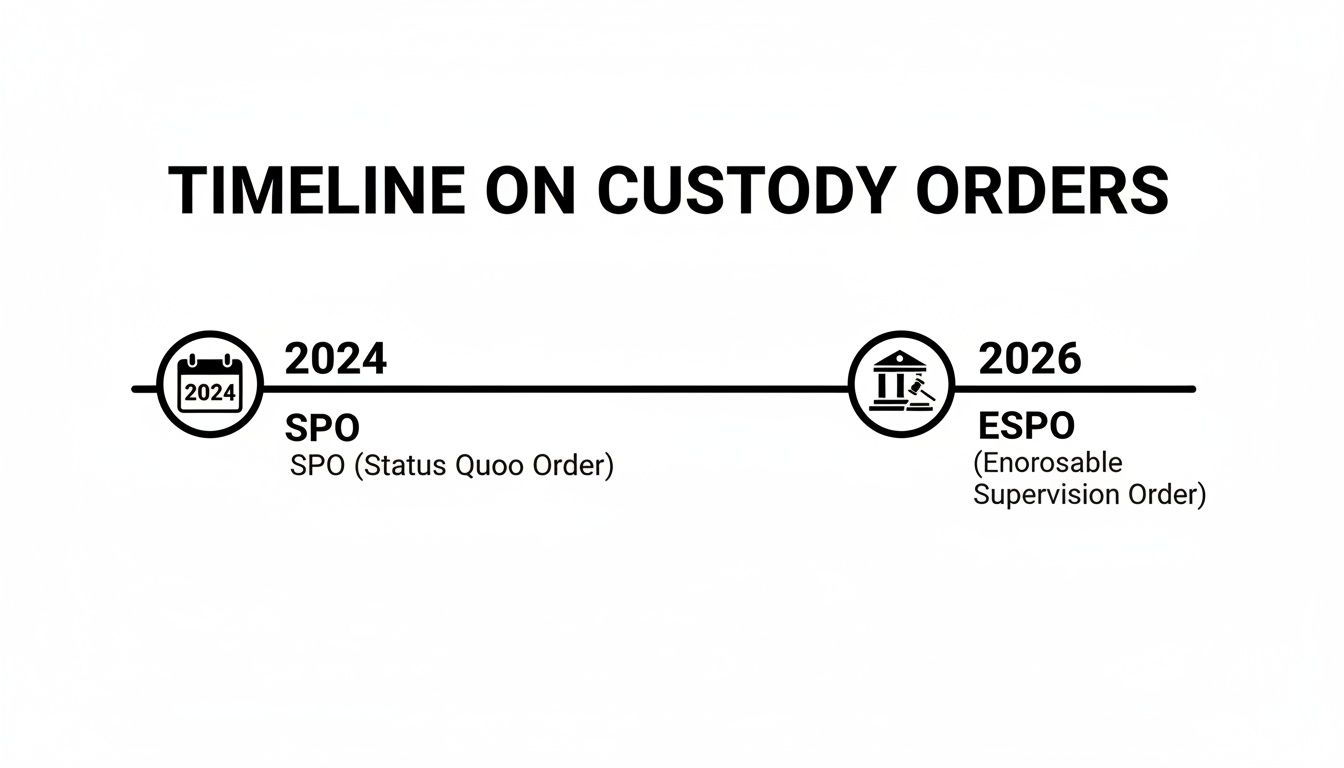
This change really underscores the state’s focus on encouraging more balanced and involved parenting from both sides.
The Mid-Week Connection
Another crucial part of the ESPO is the overnight visit during the school week. On every Thursday during the school year that isn't part of their designated weekend, the non-primary parent gets to have the kids.
This isn't just a quick dinner visit. The possession period runs from when school is dismissed on Thursday until school resumes on Friday morning. Think about what that really means. You get to be part of the regular school-night routine—helping with homework, having breakfast together, and dropping them off at school the next day. These are the small, everyday moments that are so vital for maintaining a strong bond.
Summer Possession Under the ESPO
Summer is another area where the ESPO provides a big advantage. The non-primary parent is entitled to 42 days of possession during the summer break, a significant increase from the 30 days offered under the older, traditional schedule.
The ESPO’s 42-day summer period gives families a ton of flexibility. You can break this time up into a few different visits—as long as you give proper notice—which is often much more practical than taking one single, long block of time.
This extended period allows for things like longer family vacations or visits with out-of-town relatives without the child being away from either parent for the entire summer. It’s a recognition that both parents have an important role to play all year long. Figuring out how to use this time is a major part of building a solid parenting plan. You can learn more about how to write a parenting plan in our detailed guide to get a head start.
A Real-World Example for an Humble ISD Family
Here is a practical, step-by-step example of how this all comes together for a local family with a child at an Humble ISD school.
- Step 1: The Weekend Exchange. On the first weekend of the month, the non-primary parent picks their child up from their elementary school in Atascocita on Friday afternoon. They have the whole weekend, and on Monday morning, that parent is the one who drops the child off at school.
- Step 2: The Mid-Week Visit. The following Thursday, since it's not their weekend, they pick the child up after school for an overnight visit and take them back to school on Friday morning.
- Step 3: Planning for Summer. By the April 1st deadline, the non-primary parent notifies the other parent that they will use 14 of their 42 summer days for a family trip in June and schedule the rest for later in July.
This kind of schedule creates a predictable rhythm that children can count on and parents can plan around. If you're wondering how a standard possession order in Humble, TX, might work for your unique circumstances, our team can walk you through it. The Law Office of Bryan Fagan offers free consultations to help you understand your options and secure your family’s future.
How the Possession Order Handles Holidays and School Breaks
For most parents in Humble, the question of who gets the kids for the holidays can be the source of incredible stress and conflict. Thankfully, the Texas Standard Possession Order (SPO) was created to head off these annual arguments before they even start. It provides a clear, predictable schedule for major holidays and school vacations.
The whole point is to establish fairness over the long run. Instead of leaving things up for debate each year, most major holidays simply alternate. If you have the children for Thanksgiving this year, the other parent will have them for Thanksgiving next year. It’s a straightforward system that applies to Thanksgiving and Christmas—often the two most contentious holidays. By putting this rotation in the court order, it removes the need for tense negotiations and gives everyone a roadmap to follow.

This level of predictability is a game-changer. It allows families in Kingwood, Atascocita, and the surrounding Northeast Houston areas to actually plan flights, coordinate with grandparents, and make reservations well in advance, bringing some much-needed calm to the season.
The Thanksgiving and Christmas Schedule
So, how does this alternating schedule work in practice? The non-primary parent (the parent who doesn't choose the child's primary residence) gets possession on a set rotation.
Here’s the typical breakdown you'll see in a standard possession order in Humble, TX:
- Thanksgiving Break: The non-primary parent has the children in even-numbered years (like 2024, 2026). The primary parent gets them in odd-numbered years (like 2025, 2027). This possession period starts the moment school lets out for the holiday and ends the Sunday before school starts back.
- Christmas Break (First Half): In even-numbered years, the non-primary parent has the children from the time school is dismissed until noon on December 28th. This ensures they get Christmas Eve and Christmas morning.
- Christmas Break (Second Half): In odd-numbered years, the non-primary parent's time starts at noon on December 28th and runs until school resumes in January.
This split schedule for Christmas ensures that even though the holiday itself doesn't alternate, both parents get a significant portion of the winter break with the kids every single year.
Mother’s Day, Father’s Day, and Spring Break
Now, some holidays are just too personal to alternate. The Standard Possession Order wisely carves out exceptions for these days, giving both parents and children a sense of consistency.
One of the most important things to remember is this: the holiday schedule always trumps the regular weekend schedule. If your normal first weekend of the month happens to fall on Thanksgiving, and it's the other parent's year for the holiday, the holiday schedule wins.
The SPO lays out these simple, non-negotiable rules:
- Mother’s Day: The mother always has possession of the children for the entire Mother's Day weekend. It doesn't matter whose "turn" it is for a weekend visit.
- Father’s Day: Likewise, the father is always entitled to have the children for the full Father's Day weekend.
- Spring Break: This week-long break gets the alternating treatment. The non-primary parent typically has the children for Spring Break in even-numbered years, while the primary parent has them in odd-numbered years.
The child's birthday is also given special consideration. While it might not mean a full day of possession, the parent who doesn't have the child on their birthday can usually arrange for a few hours of celebratory time in the evening, as long as they provide proper notice.
Getting a firm grasp on these holiday rules is a critical step toward a smoother co-parenting journey. At the Law Office of Bryan Fagan, our Humble attorneys can walk you through your calendar year by year so you know exactly what to expect. We invite you to schedule a free consultation with our team to get clear answers for your family's situation.
The 2025 Legal Changes Affecting Humble Custody Cases
If you're a parent in the Humble area, you need to know that the rulebook for child custody schedules got a major update starting in 2025. For a long time, the traditional Standard Possession Order (SPO) was the go-to, and if you wanted more time with your kids, you had to specifically ask the judge for an expanded schedule. Well, recent legal changes have completely flipped that script.
This whole shift was driven by a growing understanding in the Texas legislature that children benefit most when both parents have nearly equal time. The law has finally caught up to support more balanced, hands-on co-parenting right out of the gate.
The New Default: The Expanded Standard Possession Order
Here’s the biggest change for parents in Humble, Atascocita, and the surrounding parts of Northeast Houston: the Expanded Standard Possession Order (ESPO) is now the automatic, default schedule for parents who live within 50 miles of each other.
This means you no longer have to fight for this more generous schedule. The court is now required to start with the ESPO unless one parent can prove it’s just not practical or wouldn't be in the child's best interest.
This change officially kicked in with the 2025 legislative reforms, and Texas courts began implementing it as the new standard in early 2026. The expanded schedule extends weekends from the time school lets out on Friday until it starts back up on Monday morning. It also adds overnight visits every Thursday during the school year. All told, this automatically pushes the non-primary parent's time to nearly 45% possession. You can read the full details about the Texas Standard Possession Order reforms for more background on these updates.
For families in our community, this is a game-changer. The default schedule is now much closer to a 50/50 split, which often reduces the need for lengthy and expensive court battles over basic possession time.
What This Change Means for You
This legal update is more than just a new rule; it reflects a modern view of family life. It acknowledges that both parents are crucial to a child's day-to-day routine, from helping with homework to handling the Monday morning school drop-off. By making the ESPO the starting point, the law encourages a more cooperative and involved co-parenting relationship from day one.
We've already seen this trend play out in the Harris County family courts. Before this reform, most initial custody orders stuck to the old, more limited schedule. Now, the ESPO is the clear norm in cases where parents live close to each other, which empowers both parents and creates a more stable environment for their children.
Practically speaking, this change means:
- More Time by Default: The non-primary parent automatically receives more weekend and mid-week time without having to negotiate or argue for it in court.
- Reduced Court Conflict: With a nearly 50/50 schedule as the presumed starting point, there’s simply less to fight about when it comes to the basic calendar.
- Stronger Parent-Child Bonds: Consistent overnight stays during the school week are huge for maintaining routines and deepening the parent-child relationship.
This is a genuinely positive step forward, creating healthier family dynamics after a divorce or separation. It gives parents in Humble and Kingwood a much clearer and more balanced framework to build from.
If you're heading into a custody case, understanding these new rules is absolutely critical. The attorneys at the Law Office of Bryan Fagan are deeply familiar with these 2025 changes and, more importantly, how they are being interpreted and applied right here in Harris County courts. We're here to help you navigate your rights and secure a stable, predictable future for your family. Contact our Humble office for a free, confidential consultation to discuss your specific situation.
When a Standard Schedule May Not Be Appropriate
While the Expanded Standard Possession Order (ESPO) is the default starting point for most Humble families, it's crucial to understand that it's just that—a starting point. Texas law isn't rigid; it’s designed to be flexible. The single most important guiding principle for any Harris County judge is what's in the "best interest of the child."
This means that even though the standard schedule is presumed to be best, it’s not a one-size-fits-all solution. There are very real, important situations where a judge will set aside the standard order to better protect a child or fit a family's unique circumstances. Knowing these exceptions is key, because it shows the court’s priority is your child's well-being above all else.
Custody Schedules for Children Under Three
Think about the standard possession order for a moment—long weekend visits, extended summer possession. It's built for school-aged kids who have a solid concept of time and routine. For infants and toddlers under the age of three, that same schedule can be incredibly disruptive. Little ones thrive on frequent, predictable contact with both parents, and long separations can create unnecessary anxiety.
Because of this, a Harris County judge will almost always create a "step-up" plan for very young children. This is a custom-built schedule that gradually increases the non-primary parent's time as the child gets older and more comfortable with the transitions.
A typical step-up plan often looks something like this:
- Phase 1 (Birth to 18 months): The focus is on consistency, not duration. This might mean several short visits during the week for a few hours each time, without any overnights.
- Phase 2 (18 to 36 months): As the toddler grows, the visits can get longer. The judge might introduce one overnight stay, either during the week or on a weekend, to help the child adjust.
- Phase 3 (Age 3 and up): The schedule fully transitions to the regular Expanded Standard Possession Order, as the child is now developmentally ready for it.
This approach is all about ensuring the child builds a strong, secure bond with both parents without the stress of being away from their primary caregiver for long stretches at a very young age.
When Family Safety Is a Concern
The most serious reason a judge will completely disregard the standard schedule is to protect a child from harm. If there's a documented history or a present danger of family violence, neglect, or substance abuse involving a parent, the court's priority shifts entirely to safety.
In these situations, a standard possession order is off the table. A judge will instead put protective measures in place, which could include:
- Supervised Visitation: This is a common solution where the parent can only see the child while being monitored by an approved third party, often at a professional agency.
- No Possession or Access: In the most severe cases where a child's physical or emotional safety is at risk, a judge has the power to deny a parent any and all contact.
This is exactly why understanding how to prove the best interest of the child is so critical. The court needs solid evidence to create a truly safe environment. While the standard order is the norm, it's not a given. You can read a detailed analysis of Texas possession order calendars for more context.
If you have a strong reason to believe a standard possession order is not right for your child, you need to make your voice heard. The attorneys at The Law Office of Bryan Fagan are dedicated to protecting Humble families and fighting for what’s right. We can help you gather the evidence and present a compelling case to the court for a possession order that truly serves your child’s best interests. Call our Humble office today for a free, confidential consultation to talk about your situation.
How to Change or Enforce Your Custody Order

Life doesn’t stand still, and a possession order that made perfect sense a few years ago might feel completely unworkable today. On the flip side, few things are more infuriating than when the other parent treats a court-ordered schedule like a casual suggestion. For families here in the Humble, Atascocita, and Kingwood area, it's good to know you have clear legal options for both problems.
A standard possession order isn't carved in granite. You can ask a Harris County court to update it, but you'll need to prove your case. This legal process is called a modification. When the problem isn't the order itself, but one parent's refusal to follow it, you can ask the court to step in and compel them to comply. This is known as an enforcement action.
How to Request a Custody Modification
To change your current custody order, you have to show a judge that there’s been a “material and substantial change” in the circumstances of your child or one of the parents. This is a significant legal hurdle. We’re not talking about minor inconveniences; the change has to be significant enough to make the old order impractical or not in the child’s best interest anymore.
Here is a practical, step-by-step process for thinking through a modification:
- Step 1: Identify the Change. Has a parent relocated? Is there a major job change with a new schedule? Have a teenager's needs evolved? Or has the child, now over 12, expressed a clear preference? These are the kinds of changes Harris County judges consider.
- Step 2: File a Petition. The official process begins by filing a Petition to Modify the Parent-Child Relationship with the court.
- Step 3: Gather Evidence. You will need to gather and present solid evidence to back up your claim that the change is material and substantial.
For a detailed breakdown of what that entails, you can learn more about seeking a custody modification in our in-depth guide.
One word of caution: You must continue to follow your current court order until a judge signs a new one. A simple verbal agreement with the other parent isn't legally binding and can create a world of trouble if one of you later changes your mind.
How to Enforce Your Custody Order
What do you do when the other parent is a no-show for an exchange? Or when they refuse to bring your child home at the end of their weekend? This isn’t just frustrating; it’s a violation of a direct court order, and you have the right to take legal action.
The process starts by filing a Motion for Enforcement in your Harris County court. In this document, you will need to list every single violation of the possession order with specific dates and times. If a judge finds the other parent has willfully ignored the order, the consequences can be severe—including fines, being forced to pay your attorney's fees, and even jail time for repeated or serious violations.
In a true emergency, like when your child has not been returned to you as ordered, you can file for a writ of habeas corpus. This is an emergency order that forces the other parent to show up in court immediately with the child.
Whether you're looking to modify an old order or enforce the one you have, navigating the rules for a standard possession order in Humble, TX, requires a solid strategy. The attorneys at the Law Office of Bryan Fagan are here to protect your parental rights and focus on what's best for your child. Schedule a free consultation with our Humble team to get the clear, confident guidance you deserve.
Common Questions We Hear About Custody Orders
Once the ink is dry on your custody order, you start bumping into real-world situations that weren't so obvious on paper. As local attorneys who care about our community, we want to provide clear answers. Here are some of the most common questions we get from parents in the Humble, Atascocita, and Kingwood communities as they begin to navigate their new schedules.
What Happens if a Possession Weekend Falls on a Holiday?
This is a big one, and the rule is simple: the holiday schedule always trumps the regular weekend schedule. The Texas Family Code sets it up this way specifically to prevent arguments.
For instance, let’s say it's the other parent's first weekend of the month, but it also happens to be Memorial Day weekend. If your order says it's your year for the Memorial Day holiday, you get the kids for that entire holiday period. Their regular weekend possession is simply skipped. An experienced Humble family lawyer can help you map out the whole year so you can see these overlaps coming and avoid any last-minute confusion.
Can My Teenager Decide Who They Want to Live With?
Many parents wonder about this, especially as their kids get older. The short answer is no, a child can’t simply make that choice on their own. In Texas, a judge may agree to speak with a child who is 12 or older to hear their thoughts, but that preference is not the deciding factor.
The judge’s final decision is always guided by the "best interest of the child" standard. A child's wish is just one piece of a much larger puzzle the court considers. It’s incredibly important to avoid putting your child in the middle or making them feel like they have to choose a side.
What if We Live About 60 Miles Apart?
The Expanded SPO is the automatic starting point for parents who live 50 miles apart or less. But what happens when you’re in that gray area between 50 and 100 miles, a common scenario for families in Northeast Houston?
In these cases, a Harris County court will often grant a possession schedule that looks very similar to the Expanded SPO but might remove the Thursday overnight visit to make the travel less burdensome. Of course, you and the other parent are always free to agree on a custom schedule that works better for your specific situation. If you can't come to an agreement, the judge will step in and create an order that serves the child’s best interest given the distance involved.
Figuring out the ins and outs of a standard possession order in Humble, TX, can be overwhelming, but you aren’t on your own. The experienced, community-focused attorneys at The Law Office of Bryan Fagan are here to give you the clear answers and confident representation your family needs. We are proud to serve our neighbors in Humble, Atascocita, Kingwood, and across Northeast Houston. Schedule your free, no-obligation consultation with our Humble office by visiting us at https://humbletxlawyers.com.