Skip to content

Life changes. It's a simple fact. What worked for your family in Humble or Atascocita when your divorce was finalized might not work at all today. When your original custody order no longer fits your family's reality, you can ask the court to change it. As a law firm deeply committed to our neighbors in Humble, we want to help you understand this process.
To get a custody modification in Humble, TX, you can't just tell a judge you're unhappy. You have to prove two things: that there has been a "material and substantial change" in circumstances and that changing the order is in your child's best interest. We're here to explain what that means for families right here in our community.
When to Consider a Custody Modification in Humble
A court order is a snapshot in time, reflecting your life on the day it was signed. But what happens when life moves on? A new job, a move, or a child’s changing needs can quickly make that old order feel stressful and impractical.
This is a common hurdle for co-parents, and Texas law provides a clear path for updating your custody arrangement. For families across Northeast Houston, from Humble to Kingwood, the first step is figuring out if your situation qualifies as a legitimate reason to go back to court.
What Is a Material and Substantial Change?
This legal phrase—"material and substantial change"—is the cornerstone of any modification case. It simply means that whatever has changed in your life, the other parent's life, or your child's life must be significant. It can't be a minor inconvenience or a temporary issue.
A Harris County judge needs to see that the circumstances your original order was based on are now fundamentally different.
Your reason for changing the order is only half the battle. The judge’s number one priority is, and always will be, the child's best interest. You have to show that your proposed change is a necessary and positive move for your child.
To help you picture what this looks like in the real world, here are some common scenarios we see with Humble-area families that often justify a custody modification.
Common Scenarios for Humble Families
- A Parent's Job or Schedule Changes: Maybe you landed a new job with a much longer commute, or you switched to a role with frequent travel. If your work schedule makes the current pickup and drop-off times impossible, that's a classic reason for a modification.
- One Parent Needs to Relocate: This is a big one. If a parent gets a great job offer in Austin or needs to move to another state to care for an aging relative, the existing order becomes unworkable. A move outside your court-ordered geographic restriction almost always requires a modification.
- The Child's Needs Evolve: A toddler's needs are very different from a teenager's. As kids get older, they get involved in competitive sports, advanced academics, or after-school jobs that the old schedule can't support. In Texas, once a child is 12 or older, they can speak with the judge about their preference, which can be a powerful factor.
- Concerns About the Child's Environment: This is a serious situation. If you have evidence that the other parent is struggling with substance abuse, has an unstable living situation, or has brought a new partner into the home who poses a risk to your child’s physical or emotional well-being, the court will take it very seriously.
The table below breaks down some of these common life events and explains why a Harris County court might consider them a "material and substantial change."
Common Reasons for Custody Modification in Harris County
| Change of Circumstance | Why It Matters to the Court | Example for a Humble Family |
|---|---|---|
| Parent Relocation | A move can disrupt the child's stability, schooling, and relationship with the other parent, making the current possession schedule impossible. | One parent, living in an apartment near Deerbrook Mall, gets a promotion that requires moving to The Woodlands, outside the "Harris County" restriction in the order. |
| Job Loss or Major Career Change | A new work schedule (e.g., overnight shifts, frequent travel) can directly conflict with a parent's ability to care for the child during their designated times. | A father who worked a 9-to-5 job in Humble now works 12-hour shifts as a first responder, making weekday possession impractical. |
| Child's Preference (Age 12+) | Texas law allows a child 12 or older to confer with the judge in private. While not binding, the judge gives significant weight to a mature child's wishes. | A 14-year-old in Humble ISD expresses a strong desire to live primarily with their dad to be closer to their high school and friends. |
| Remarriage or New Household Member | The introduction of a new person into the home (stepparent, partner) can significantly impact the child's life, for better or worse. | The mother remarries, and her new spouse's work schedule allows for more consistent after-school supervision than the father's, potentially justifying a schedule flip. |
| Endangerment or Neglect | If a parent's behavior (substance abuse, neglect, family violence) puts the child's physical or emotional well-being at risk, this is an urgent reason for modification. | Evidence emerges that one parent is abusing alcohol during their periods of possession, creating an unsafe environment for the child. |
| Change in Child's Needs | A child may develop special medical, educational, or emotional needs that one parent is better equipped to handle, requiring a change in primary custody. | A child is diagnosed with a learning disability, and one parent's home is much closer to the specialized school and tutoring services the child needs. |
As you can see, a judge won't make a change lightly. They will look at the big picture and weigh all the factors to determine what is genuinely best for the child. If you believe your family's situation has changed this significantly, your next step is to understand the legal process for filing a modification suit.
The Texas Court Process for Modifying Custody
Walking into a courtroom to change your family's life can feel overwhelming. We understand. But knowing the process, step by step, can turn that anxiety into a feeling of control. For our neighbors in Humble, Kingwood, or anywhere in Northeast Houston, think of this as your guide to navigating a custody modification in Harris County. We're going to break down the legal jargon and procedures into a clear, actionable plan.
The legal system has its own language and rules, and our goal is to translate that for you, so you know exactly what to expect when you need to change your child custody orders.
This flowchart maps out the core ideas a judge will consider. It all starts with a real-life event, has to pass a specific legal test, and ultimately, everything comes down to what's best for your child.
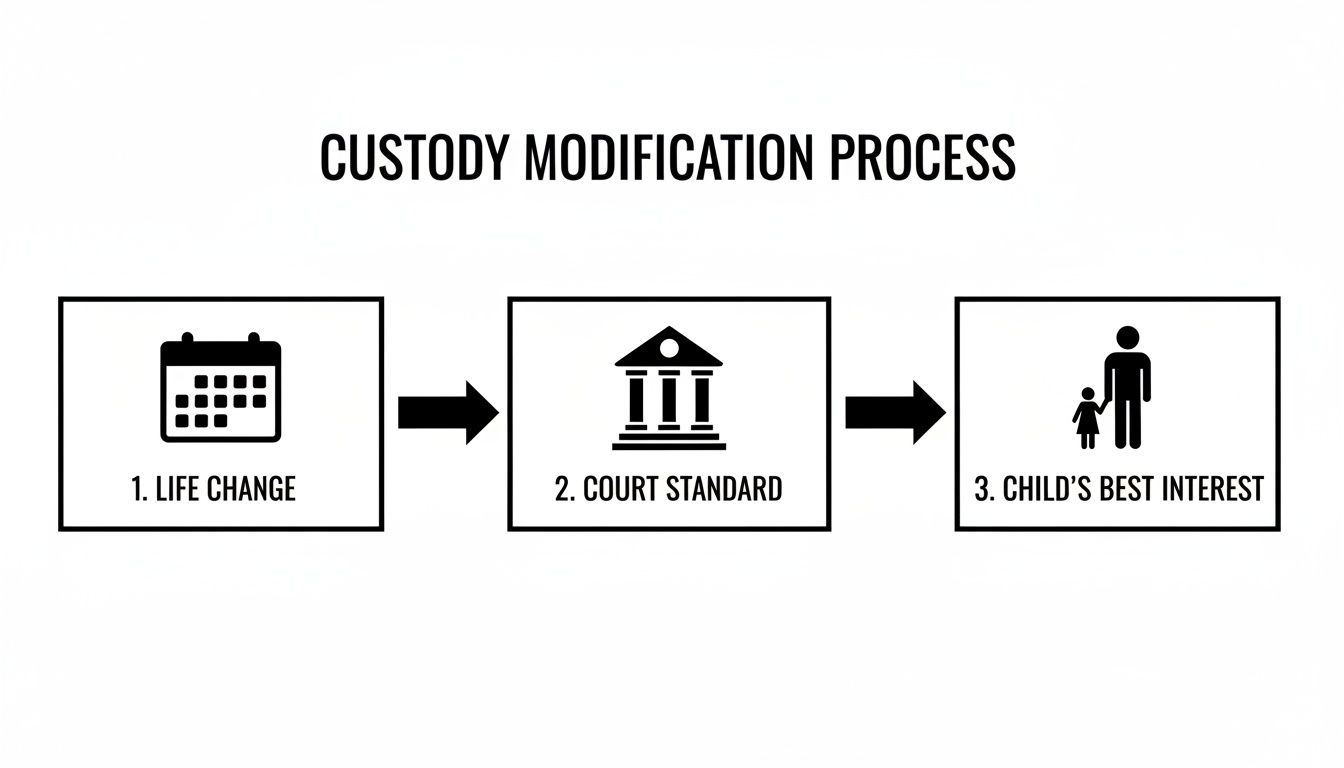
As you can see, it's a three-part test: a significant change in your lives must have occurred, that change must meet the court's standard, and your proposed solution must serve your child’s best interest.
Step One: Filing the Petition
Your first official move in a custody modification in Humble, TX, is filing a "Petition to Modify the Parent-Child Relationship." This is the document that gets the ball rolling and opens your case with the court.
Think of this petition as the foundation for your entire case. It needs to clearly tell the judge:
- Who you and the other parent are.
- That a prior custody order is already in place.
- How your circumstances have materially and substantially changed since that order was signed.
- What changes you’re asking for and, most importantly, why these changes are in your child’s best interest.
Getting this document right is critical. Once it’s filed with the Harris County District Clerk, your case has officially begun.
Step Two: Serving the Other Parent
Once your petition is filed, the other parent has to be formally notified about the lawsuit. This isn't optional; it's a constitutional right called "service of process." You can't simply text them a picture of the paperwork or drop it in their mailbox.
A neutral third party—usually a private process server or a sheriff's deputy—must physically hand-deliver a copy of the petition and a legal notice called a "citation" to the other parent. This delivery is what legally puts them on notice and starts the clock for them to file a response with the court.
Without proper service, the judge has no authority over the other parent, and your case will stall. It’s a non-negotiable step that ensures the process is fair for everyone involved.
Step Three: Navigating Your Case in Harris County Court
After the other parent is served and files their "Answer," the case moves into what we call the litigation phase. What happens from here really depends on whether you and the other parent can agree on the changes.
If you’re not on the same page, you can expect the case to move through several stages:
- Discovery: This is the fact-finding part of the case where both sides exchange information. This can involve written questions (Interrogatories), requests for documents like pay stubs or report cards (Requests for Production), and depositions, where people answer questions under oath.
- Temporary Orders Hearing: Life doesn’t wait for the court. If you need a judge to make immediate decisions about visitation or child support, your attorney can ask for a hearing to get temporary orders in place while the case moves forward.
- Mediation: In Harris County, judges will almost always require you and the other parent to try mediation before you can go to a final trial. It's a structured negotiation where a neutral third party helps you work toward an agreement.
If you can find common ground in mediation, your attorney will draft a final order for the judge to sign. If not, the case gets set for a final trial, where you'll both present your evidence and let the judge make the final call.
Every document filed, every piece of evidence gathered, and every conversation had is a chance to build your case. The key is to stay organized, communicate with your attorney, and never lose sight of what truly matters: your child's well-being.
Trying to manage this on your own is a heavy burden. If you're in Humble, Atascocita, or the surrounding area and feel it's time to modify your custody order, our team can help you navigate the path forward. We invite you to Schedule a free consultation to talk about your family’s specific situation with our Humble office.
Building Your Case for a Successful Modification
To win a custody modification in Harris County, your feelings and opinions aren't enough. A judge needs clear facts. To get your current custody order changed, you have to do more than just tell the court that circumstances are different. You have to prove it with compelling evidence that clearly shows why the change is necessary and, most importantly, how it’s in your child's best interest.
For parents here in Humble or Atascocita, this means you need to get organized and start thinking like an investigator for your own case.

The idea of gathering evidence against your child's other parent can feel uncomfortable, but it's a necessary part of the process. Your job is to construct a story—backed by proof—that a judge can easily understand. This story needs to paint a vivid picture of your family's new reality and justify your request for a custody modification in Humble TX.
The Undeniable Power of Documentation
Judges in our local courts operate on facts and tangible proof, not on "he-said, she-said" disputes. The better your documentation, the stronger your argument. We advise our clients to create a dedicated folder—physical or digital—and start collecting everything.
Here’s the kind of paperwork that truly makes a difference in a Harris County courtroom:
- Financial Records: If money is the reason for the change, this is critical. Gather recent pay stubs, W-2s, tax returns, and any job offer letters. This applies whether you're seeking more child support or arguing that a new work schedule requires a possession change.
- School and Medical Records: This is where you show the real-world impact on your child. Report cards, attendance logs showing frequent tardies, emails from the teacher about missed homework, and doctor's notes can all illustrate that a child is struggling under the current arrangement.
- Communication Logs: Save everything. Every text, every email, every message in co-parenting apps. These records are invaluable for showing patterns of behavior—like chronic lateness for pick-ups, refusal to cooperate on scheduling, or hostile communication.
A single frustrated text can be explained away. But a six-month log showing a consistent pattern of uncooperative behavior tells a story that's hard to ignore.
Finding Credible Witnesses
Sometimes, the most compelling proof comes from others who have seen what's going on firsthand. You need people who can offer an objective perspective on your child's life or the specific changes that have occurred.
Think about the people in your community—right here in Humble, Kingwood, or Northeast Houston—who can vouch for your situation. This could be:
- Teachers, school counselors, or coaches who have noticed a shift in your child's attitude, behavior, or schoolwork.
- Neighbors who may have witnessed concerning arguments or can confirm the other parent's new partner moved in.
- Family members or trusted friends who can testify to your stable home environment and consistent parenting.
When you approach a potential witness, be specific. A formal, factual statement or their willingness to appear in court is infinitely more valuable than a generic "character letter."
Addressing the Other Parent's Conduct
This is often the most challenging part of a case, but if the other parent's choices are the reason you're going to court, you must address it with credible evidence. A judge will not alter a child's life based on your personal feelings or accusations you can't back up.
A judge’s primary duty is to protect the child. Any evidence you present about the other parent must be directly tied to how their conduct creates an unstable or unsafe environment for your child.
Your focus must be on provable facts. This might mean presenting public criminal records, police reports, photographs, or testimony from a professional, like your child’s therapist. If you suspect substance abuse, the court can be asked to order a drug test. If the issue is instability, you can use evidence of their multiple moves or a string of short-lived jobs. To dig deeper into this, you can review our guide on how to prove what is in the best interest of the child.
Building a persuasive case for a custody modification is a detailed, demanding task. It requires meticulous organization and a deep understanding of what a Harris County judge needs to see to be convinced. You don't have to figure it all out on your own.
Using Mediation And Temporary Orders To Your Advantage
When you need to change your custody order, your mind might immediately jump to a dramatic courtroom battle. But that’s rarely the reality—or the best path forward. In fact, most families right here in Humble and Atascocita find that working things out before a final trial leads to better, more sustainable agreements.
Two of the most powerful tools we use to achieve this are mediation and temporary orders. They serve different purposes, but both can give you more control and create stability when your family needs it most. It’s all about shifting the focus from fighting to problem-solving, which is always the right move for you and your child.

So, how do these legal strategies actually work for a custody modification in Humble TX?
Finding Common Ground Through Mediation
Many people are surprised to learn that you usually can't even get to a final trial without first trying to settle your case. Most Harris County judges will require you and the other parent to attend mediation, and frankly, it’s a huge opportunity. Mediation is a confidential process where you, your ex, and your respective attorneys meet with a neutral mediator to hash out an agreement.
The benefits are significant:
- You Keep Control: In mediation, you and the other parent build the solution yourselves. If you go to trial, a judge who has known your family for a few hours makes the decision for you.
- It’s Private: The negotiations in mediation are confidential. This encourages honest discussion without the fear that something you say could be used against you in court.
- It Saves Time and Money: A single day of successful mediation can resolve your entire case. This helps you avoid the immense stress and expense of a drawn-out court fight.
For a family in Kingwood, this could mean creating a custom summer possession schedule that works around a child’s select baseball team—a level of detail a standard court order might never include. It puts the decision-making power back where it belongs: with the parents.
When You Need The Court To Act Now
But what if you can't wait months for a mediation date or a final hearing? When your child’s well-being or immediate stability is on the line, you need the court to intervene quickly. This is exactly what temporary orders are designed for.
By filing a motion for temporary orders, your lawyer can get you in front of a judge to ask for fast, enforceable rules that will govern your situation while the full modification case moves forward. This is a critical move in urgent circumstances.
Think of temporary orders as a legal "time-out." They press pause on a dangerous or unstable situation, protecting your child by establishing a safe new status quo while the bigger issues get sorted out.
Let’s say you live in Humble and find out the other parent has a new night-shift job and has been leaving your young child home alone. We can file for a Temporary Restraining Order (TRO) and request an emergency hearing. A judge has the power to immediately forbid that behavior and change the possession schedule to ensure the child is always supervised. You can learn more about how temporary custody orders work in Texas in our in-depth guide.
Whether your goal is a collaborative agreement or you need to take swift, protective action, these tools are essential. Navigating a custody modification in Humble TX is about having a smart strategy that uses every available legal option to secure the best outcome for your child.
Budgeting for Your Custody Modification Case
When you're thinking about changing your custody order, two questions almost always come up first: "How much is this going to cost?" and "How long will it take?" These are major concerns for any family in Humble, and you deserve straight answers.
The truth is, the biggest factor driving the cost and timeline of your custody modification in Humble TX is how much you and the other parent disagree. If you can find common ground, the process will be far quicker and less expensive than a case that has to be fought out in front of a judge.
The Real Costs of a Modification Case
Budgeting for a court case isn't just about attorney's fees. There are several other standard expenses you'll run into when you file in Harris County. Knowing what these are from the start helps you plan and avoids any surprises down the road.
Here are the key expenses you should anticipate:
- Court Filing Fees: The Harris County District Clerk charges a fee to officially start your case with a Petition to Modify. This fee is usually right around $350, though it can fluctuate.
- Service of Process Fees: The other parent has to be officially notified of the lawsuit. Using a private process server or a Sheriff's deputy to deliver the papers typically costs between $100 and $200.
- Mediation Costs: Most judges in our area require parents to try mediation. Mediators charge by the hour, and parents usually split the cost. A half-day session in the Humble area can run anywhere from $500 to $1,500 per parent.
- Attorney's Fees: This is the most variable part of the budget. A simple, agreed-upon change will cost much less than a complex case that involves a lot of back-and-forth and a full-blown trial. We’ll lay out a clear fee structure for you during our free consultation.
How Timelines Can Vary So Drastically
Just like the costs, the timeline hinges almost entirely on whether you and the other parent can work together. An uncontested case, where you both agree on the changes, can be finished in just a few months. A high-conflict case? That can easily stretch out for a year or even longer.
An agreement doesn't just save money; it saves your family time and emotional energy. Finding that common ground lets everyone move forward faster and with less stress, which is always what’s best for your child.
To give you a realistic idea of what to expect, the table below shows how a timeline can look for an uncontested modification versus a contested one here in Harris County. Remember, this is a general guide—your own situation will be unique.
Estimated Timeline for Custody Modification in Harris County
| Legal Stage | Uncontested Modification (Agreement) | Contested Modification (Disagreement) |
|---|---|---|
| Initial Filing & Service | 1-2 months | 1-2 months |
| Negotiation/Mediation | 1 month | 3-6 months |
| Temporary Orders Hearing | Not usually needed | 1-2 months after filing |
| Discovery Process | Not usually needed | 4-8 months |
| Final Order Signed | Within 3-4 months from filing | 9-18+ months from filing |
As you can see, the path of a contested case has a lot more steps, and each one adds time and expense to the process. This is exactly why we always aim to find a reasonable path to an agreement whenever possible. But when that's just not in the cards, we're always prepared to build the strongest case for you to present to a judge.
Knowing the potential financial and time commitments helps you make the right decisions for your family. If you are considering a custody modification in Humble TX, don't let these questions stop you from taking the next step. Schedule a free consultation with our Humble office, and let's create a clear plan for your family's future.
Common Questions About Custody Modification in Humble
When you're facing a major life change that affects your kids, questions about modifying your custody order are bound to come up. It's a complex area of law, and as attorneys serving the Humble community, we’ve heard just about every question you can imagine from parents in your shoes.
Let's walk through some of the most common concerns we address every day, providing the kind of straightforward answers you need.
My Teenager Wants to Live with Me. Can We Change Custody?
This is probably one of the most frequent calls we get. The short answer is: maybe. In Texas, once a child reaches the age of 12, they have the right to speak with the judge in private to state their preference. A Harris County judge will absolutely listen and give a mature child’s wishes serious consideration.
However, and this is a big "however," it’s not the deciding factor. The judge's one and only legal standard is the child’s overall best interest. We can help you build a case that highlights your teen's preference while also showing how the move would genuinely benefit their emotional, social, and academic life.
If My Ex and I Agree on Changes, Do We Still Need the Court?
Yes. Without a doubt, yes. This is a huge mistake we see parents make. Even if you and your ex are on the best of terms and have hammered out a new schedule, that agreement is not legally enforceable until a judge signs off on it.
A handshake deal, a text message, or even a notarized document you both sign won't hold up. If one of you stops following the new plan, the court can only enforce the original order. Our Humble office can help you draft an Agreed Order to Modify and get it filed, making the new arrangement official. It’s a faster, cheaper, and far more secure path than leaving things to chance.
A verbal agreement is not a court order. Failing to have your new arrangement approved by a judge leaves your family vulnerable and your original order fully in effect.
Can I Stop the Other Parent from Moving Out of Humble?
This all comes down to the fine print in your current custody order. Most orders signed in Texas courts include what's called a geographic restriction. This clause usually limits the child's main residence to Harris County and any counties that touch it (contiguous counties).
If your order contains this restriction, your ex can't just pack up and move with your child. They need your written permission or a new court order allowing the relocation. In fact, a parent's plan to move away is often the very "material and substantial change" required to open a modification case. Time is of the essence here, so if you hear about a potential move, contact our Humble office right away so we can review your order and protect your rights.
How Do I Prove My Ex's New Partner Is a Danger to My Child?
To get a judge to act, you need to provide concrete evidence, not just your gut feeling or suspicion that a new partner is a bad influence. A judge needs to see objective facts that show how this person’s behavior directly threatens your child’s physical or emotional well-being.
Strong evidence might look like:
- Public criminal records showing a history of violence, DUIs, or drug offenses.
- Credible testimony from neutral parties like teachers, coaches, or neighbors who have seen concerning behavior firsthand.
- Police reports documenting domestic disturbances or other incidents involving the new partner.
- Evidence of current substance abuse, such as photos, videos, or witness accounts.
The goal is to draw a clear, undeniable line from the partner's actions to the potential harm to your child. Our attorneys can guide you on how to legally gather this kind of evidence to build a compelling case for a custody modification in Humble TX.
Of course, budgeting for your case means factoring in legal representation. Understanding how law firms in the area market themselves, using strategies like local SEO for lawyers, can help you find established and reputable attorneys in Humble.
Going through a custody modification can feel isolating, but you don't have to manage it on your own. The experienced attorneys at The Law Office of Bryan Fagan are here to offer the clear advice and determined representation you deserve. We're proud to serve families throughout Humble, Atascocita, and Kingwood. Call us today for a free, confidential consultation at our Humble office. Let us help you protect what matters most. Visit us online at https://humbletxlawyers.com.