 Skip to content
If you're reading this from Humble, Atascocita, Kingwood, or somewhere else in Northeast Houston, you may already be in the hardest part of a custody case. You're trying to parent through stress while also wondering what a Harris County judge will want to see. Most parents don't struggle because they care too little. They struggle because they don't know how to turn everyday parenting into evidence the court can use.
A lot of people start with the wrong question. They ask, "What can I say in court?" The better question is, "What can I prove?" In Harris County, custody cases are rarely decided by one emotional story or one angry text message. They usually turn on organized records, third-party documents, deadlines, and whether your evidence matches the court's process.
That can feel intimidating at first. It can also be grounding. Once you understand the evidence needed for a custody case in Harris County, the situation starts to look less like chaos and more like a checklist.
Starting Your Custody Case Journey in Humble
A parent in Kingwood recently described the first weeks of a custody dispute like this: every school pickup felt important, every text felt risky, and every missed exchange felt like something that might matter later. That's a familiar feeling. When your child's schedule, stability, and daily life are under review, ordinary moments suddenly seem loaded with legal meaning.
Many of those ordinary moments do matter. The parent who keeps track of school communication, attends doctor visits, follows the routine, and stays calm in writing often has stronger proof than the parent who only shows up with accusations. Family courts want a reliable picture of the child's life, not just a dramatic snapshot.
Practical rule: Start thinking like a careful record keeper, not a detective. Your job is to document your parenting, preserve important records, and stay organized enough that the court can follow your story.
In Humble and nearby communities, parents often come into a case assuming custody evidence means proving the other parent is bad. Sometimes serious safety issues do need to be brought to the court's attention. But many cases are more ordinary than that. The fundamental question is which parent is consistently meeting the child's needs, supporting school and medical care, and making steady decisions.
That shift matters. It lowers the temperature and sharpens your focus.
Here are the first things to keep in mind:
- Your case is about the child: Judges look for evidence tied to the child's needs, routine, safety, and stability.
- Records usually carry more weight than memory: School records, medical records, and other documents often say more than a long argument in court.
- Procedure matters: Even strong evidence can lose value if it isn't organized or exchanged the way Harris County requires.
- Patterns matter more than isolated moments: A timeline of steady involvement is usually more persuasive than one explosive incident standing alone.
If you feel overwhelmed, that's normal. You don't need to solve everything today. You do need to begin preserving what already exists.
Understanding the Best Interest of the Child Standard
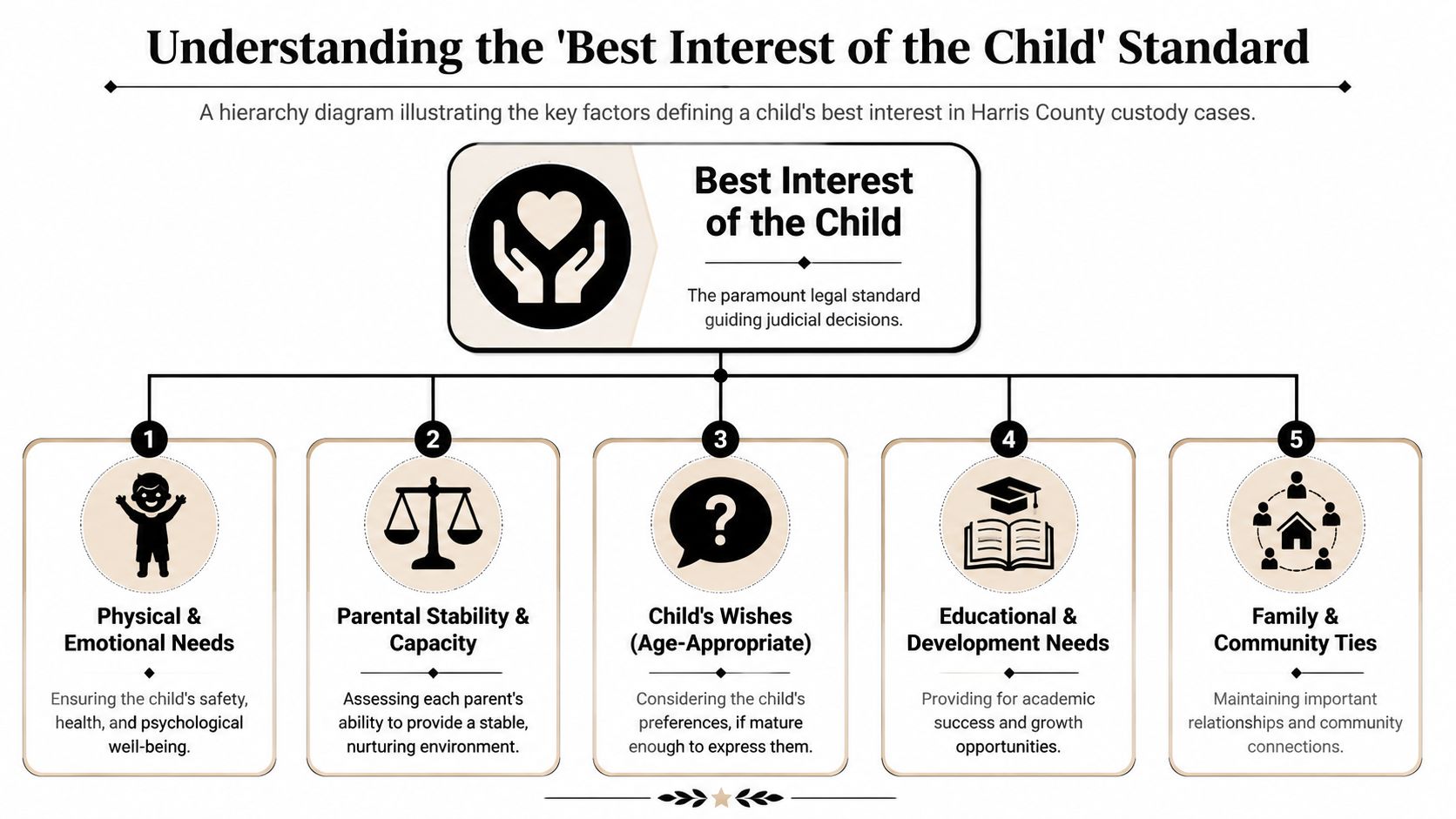
When a Harris County judge decides custody issues, the core question is the best interest of the child. That phrase sounds broad because it is broad. In everyday terms, the court is asking which arrangement supports the child's safety, routine, emotional health, development, and long-term stability.
Texas also starts from an important presumption. In many cases, the law presumes parents should be joint managing conservators, which means they share decision-making duties. That doesn't mean equal time is guaranteed, and it doesn't mean the court ignores evidence about what arrangement works best for a particular child. The Texas child custody and support guidance also notes that many custody cases filed on or after May 1, 1997 require a co-parenting course, and parties must typically produce the last 2 years of tax returns and 2 recent pay stubs.
What judges are really looking for
A judge isn't grading who sounds more upset or who has the better speech. The judge is trying to answer practical questions such as:
- Can this parent provide day-to-day stability
- Who keeps up with school, health care, and routines
- Which home better supports the child's emotional and physical needs
- Can the parents cooperate enough to make decisions
- How will the child's life work in practice
Those questions help explain why evidence matters so much. If you say you're the parent who handles homework, pickups, medications, and appointments, the court will want something concrete behind that claim.
Why financial records show up in custody cases
Many parents get confused when custody paperwork asks for income information. They think, "This is about my child, not my paycheck." But the court often looks at parenting evidence and financial evidence side by side. Support, household stability, and credibility are connected.
That's one reason a Child Support Attorney in Humble may become relevant in the same case. Child support proceedings in Harris County often overlap with custody disputes because the same family facts affect both.
For a closer look at how courts evaluate these issues, this guide on how to prove best interest of the child can help you connect your records to the legal standard.
The strongest custody evidence doesn't just show that you love your child. It shows how you care for your child in ways other people can verify.
The Most Powerful Types of Evidence for Your Case
The best custody cases aren't built from one type of proof. They're built from layers. A text message might support your timeline. A school record may confirm your involvement. A medical record may show who took the child to appointments. A journal can connect all of it into a steady narrative.
One of the most useful tools is a date-stamped parenting journal. A Harris County custody evidence reference describes a detailed journal documenting daily parental involvement, such as school pick-ups, homework help, and doctor visits, as a critical tool. That same guidance notes that school attendance logs and medical records often help verify which parent actively manages the child's welfare.
Build a pattern, not a pile
Many parents collect too much and organize too little. They save hundreds of screenshots but can't explain what any of them prove. A better approach is to connect each item to one theme: stability, caregiving, cooperation, follow-through, or concern.
Digital evidence can help, but it works best when it's supported by something else. This article about text messages as evidence in Texas family court is useful because it helps parents think past the screenshot itself and focus on what the message proves.
Key Evidence for a Harris County Custody Case
| Evidence Type | What It Proves | Collection Tip |
|---|---|---|
| Parenting journal | Your daily involvement, consistency, missed exchanges, school support, medical participation | Write entries by date, keep them factual, and include times, locations, and what happened |
| School records | Attendance, performance, parent contact, who participates in school matters | Request report cards, attendance records, and school communications you received |
| Medical and mental health records | Appointments, treatment follow-through, healthcare involvement | Keep appointment summaries, insurance records, and proof of who attended visits |
| Texts and emails | Communication style, co-parenting efforts, scheduling, refusals, threats, or cooperation | Save complete threads, not isolated screenshots, and preserve dates and names |
| Photos and short videos | Routine caregiving, living conditions, school events, activities | Keep original files when possible and note when and why the image matters |
| Witnesses | Third-party observations from teachers, relatives, coaches, daycare staff, or counselors | Choose people with direct knowledge, not people who only know what you told them |
| Financial records | Income, support issues, household transparency, and credibility | Keep returns, pay information, and any required court disclosure documents together |
What usually helps most
The most persuasive evidence often has three traits:
- Independent: A school, doctor, counselor, or other third party can verify it.
- Consistent: It shows a pattern over time, not one isolated incident.
- Specific: It ties to dates, responsibilities, and the child's actual needs.
A simple example helps. Suppose one parent says, "I always take our son to the pediatrician." That's a statement. If that parent also has appointment confirmations, after-visit paperwork, calendar entries, and messages about scheduling follow-ups, the statement becomes proof.
Screenshots can start the conversation. Records and corroboration usually finish it.
Navigating Specific Harris County Court Procedures
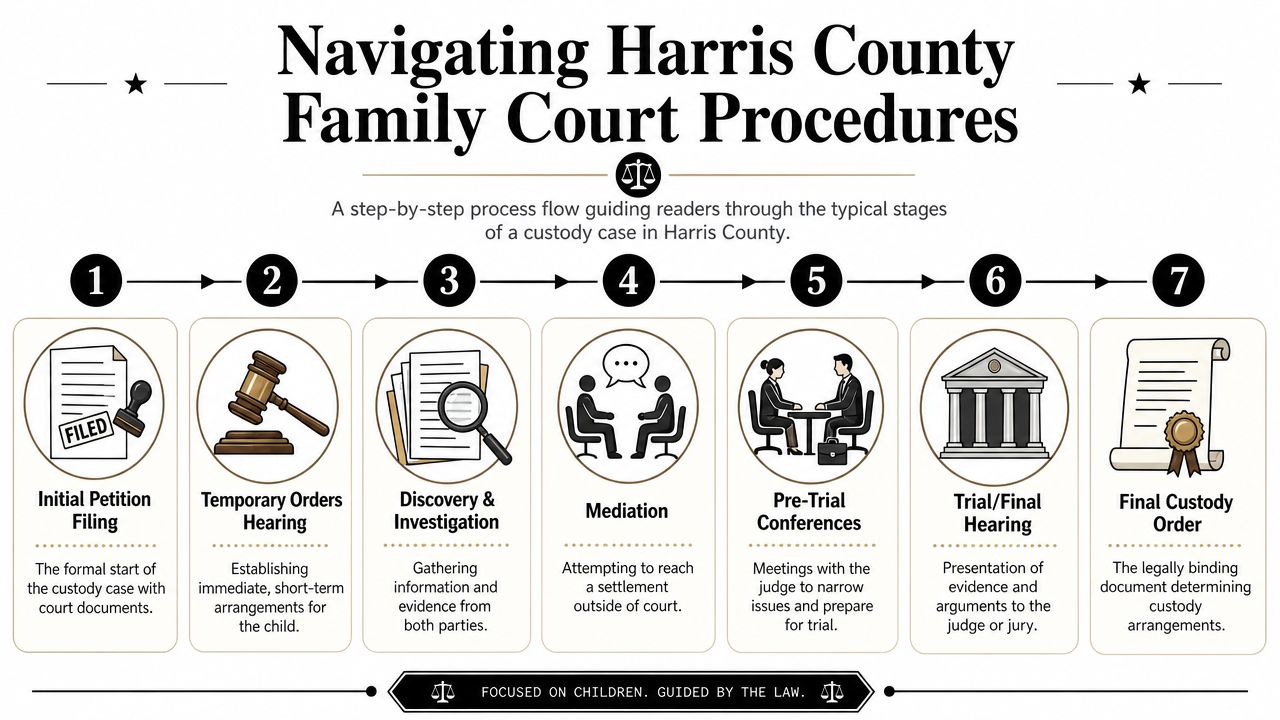
Strong evidence can still be sidelined if it isn't handled the way Harris County requires. This often blindsides many parents in Humble and Northeast Houston. They spend weeks gathering records, then learn the court has strict rules about exchange, formatting, financial disclosures, and mediation.
A Harris County Domestic Relations Office page on custody evaluations and related family-court procedures states that exhibits must be exchanged electronically through a cloud-storage link 10 days before final trial and 2 days before a hearing. That same guidance is why organization matters so much. If evidence isn't exchanged correctly and on time, the judge may not consider it.
Exchange rules are not a technicality
Some parents still assume they can just email exhibits at the last minute or bring a stack of papers to court and sort it out there. Harris County's local process doesn't work that way. The exhibit exchange deadlines are part of the case, not an administrative side issue.
That means you should think about presentation early:
- Create folders by topic: school, medical, communications, finances, journal, photos.
- Label files clearly: use dates and short descriptions so someone else can follow them.
- Use a cloud-storage link when required: local guidance says exhibits should be provided electronically that way rather than by emailing the court.
- Prepare your exhibit list carefully: the court's process also involves an exhibit list before hearing or trial.
Mediation and financial disclosure affect custody outcomes
Harris County custody cases also involve procedure before the final hearing. Local guidance indicates mediation is required before temporary orders, and parties are expected to exchange items such as a Financial Information Statement, payroll information, and inventory-related financial documents before trial. That matters because custody cases are often argued through both parenting facts and economic facts.
If one parent doesn't produce updated financial information, the court may view that parent's financial picture as unclear. If one parent refuses to participate in required mediation steps, that can become part of the record too. In real life, judges often learn a lot about a case from how each parent handles process, not just from what each parent says.
Custody evaluations can reshape the case
In contested conservatorship or possession disputes, the court may order a custody evaluation. According to the Harris County Domestic Relations Office guidance linked above, that evaluation may include interviews with parents, the child, significant others, and collateral witnesses. It may also involve review of school, medical, and mental health records, home visits, criminal histories, child-protective history, and personal references.
That tells you something important. In Harris County, custody evidence is often a structured package built from records and third-party review. It's not just courtroom testimony.
If you expect your case to be decided by who tells the better story, Harris County procedure can be a surprise. The process often favors the parent who documented, disclosed, and organized better.
A Practical Checklist for Collecting and Preserving Proof
On a Tuesday night, your child gets home late, homework is missing, and the exchange did not happen the way the schedule says it should. Three months later, that same night may matter in court. If you rely on memory alone, the details blur fast. A simple record made that evening can carry much more weight.

Your working system at home
Start with a system you can keep using on busy days. A custody file works a lot like a well-labeled pantry. If everything has a place, you can find what you need quickly, and nothing important gets buried behind something less important.
Many parents in Humble do well with two parts. First, one running journal. Second, one digital folder with clearly named subfolders. If you want ideas for setting up those folders safely, the same habits used in modern legal document management are useful at home too. Clear file names, one main storage location, and saved original versions reduce confusion when exhibits have to be exchanged later under Harris County procedures.
Use a routine like this:
- Keep a dated parenting log: Write down exchanges, school contact, doctor visits, activities, and any missed or shortened periods of possession.
- Save full conversations: Keep the entire text or email thread so no one can say the context is missing.
- Create folders by topic: Use labels such as school, medical, communication, possession issues, and finances.
- Download records early: Schools, clinics, and daycare programs often need time to respond.
- Back up everything: Save copies in a secure cloud account or external drive so a broken phone does not wipe out your proof.
Short entries usually work best. Write facts the same day if you can. Include dates, times, who was present, and what occurred. A judge can follow a clean timeline much more easily than a stack of emotional notes.
What to collect, and how to keep it usable
Good evidence is often ordinary. Attendance records. Report cards. appointment summaries. Messages about pickup times. Calendars showing who took the child to tutoring or practice. These pieces fit together like tiles in a floor. One tile may not show much. A pattern of tiles does.
When you ask a school, doctor, counselor, or daycare for records, keep the request short and specific. Ask for the actual documents, not a general opinion. If the records arrive electronically, save the original file first. Then make a working copy if you want to highlight or sort it. That matters in Harris County because documents may need to be exchanged electronically before a hearing, and original file details can help avoid arguments about accuracy.
If your concern involves denied visitation, late returns, or repeated interference, this guide on how to document custody violations in Texas shows how to turn a frustrating pattern into a clear record.
A short visual explanation can also help if you're trying to create a system from scratch.
Prepare with Harris County procedure in mind
Collection is only half the job. Organization matters because Harris County cases often involve mediation, required disclosures, and exhibit sharing before trial. If your phone contains 200 screenshots with vague names like "IMG_4432," you have proof, but you may not have usable proof.
A better approach is to label files so another person can understand them quickly. Try names like "2026-03-14 school attendance report" or "2026-04-02 text exchange about pickup." Keep one folder for documents you may share in mediation and another for items your lawyer may review for possible exhibits. Separate parenting records from financial records so required financial disclosures do not get mixed into your child-related timeline.
Choose witnesses who add firsthand facts
Witnesses should fill gaps your documents cannot fill. Teachers, coaches, daycare staff, medical providers, and other neutral adults often help because they can describe what they personally saw. That could be who attended parent conferences, who brought the child to appointments, or how each parent communicated during a problem.
Friends and relatives may still matter, but firsthand knowledge is the key. A grandparent who regularly handled exchanges may be useful. A relative repeating your side of the story usually is not.
Some families in this area also consult the Law Office of Bryan Fagan for family-law case management and court preparation when the evidence file starts getting harder to organize.
Common Evidence Mistakes That Can Harm Your Case
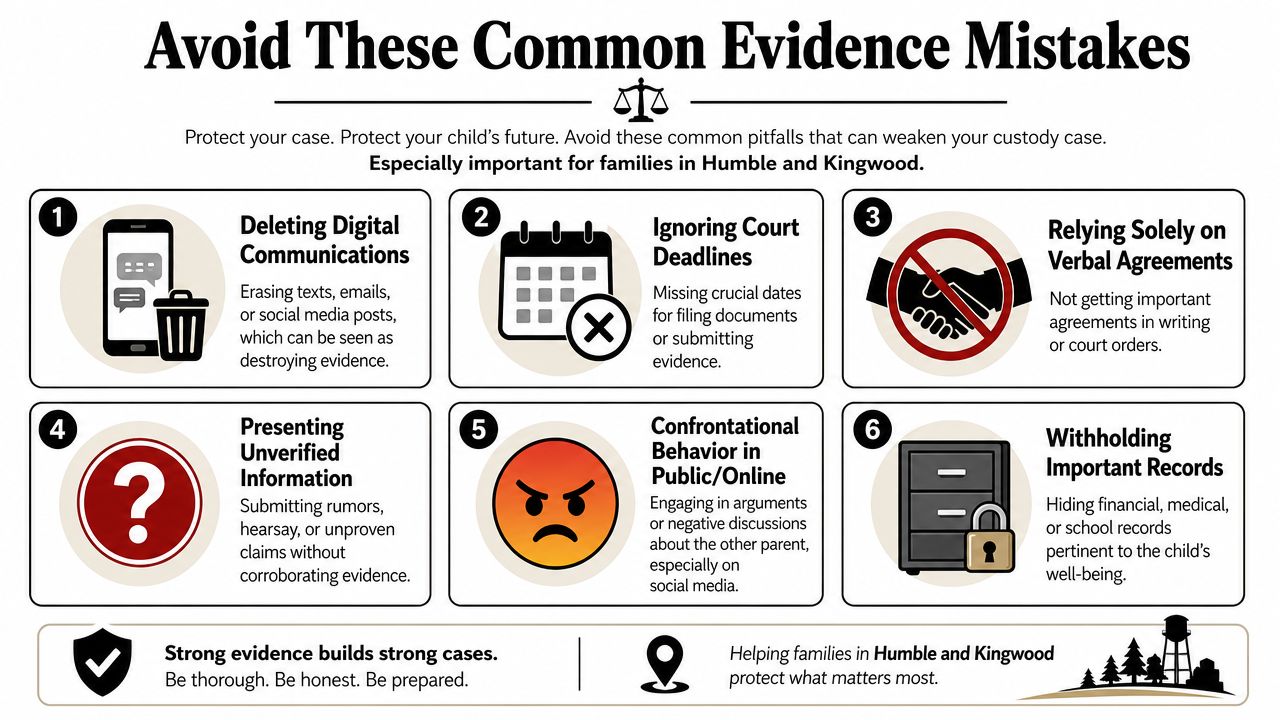
Parents often think bad evidence only means false evidence. In custody cases, bad evidence also includes evidence that's incomplete, poorly preserved, emotionally charged, or handed over too late to be useful.
One common mistake is building your whole case around the other parent's worst moments. Judges do care about harmful conduct. But if your file contains nothing showing your own routine, your own follow-through, and your own efforts to co-parent, your case can feel one-dimensional.
Mistakes that quietly weaken credibility
A few problems show up again and again in Harris County family cases:
- Cherry-picking messages: If you only save the sentence that helps you and ignore the rest of the conversation, the court may question your reliability.
- Posting online while the case is active: Angry posts, vague threats, or mocking comments can make co-parenting look harder than it needs to be.
- Failing to preserve originals: Cropped screenshots and forwarded snippets often raise avoidable questions.
- Withholding records: If you sit on school, medical, or financial documents, the judge may wonder why.
- Missing deadlines: Even useful material can lose value if you don't exchange it properly.
A parent's credibility can rise or fall based on small choices. Calm communication, complete records, and steady follow-through often speak louder than outrage.
Be careful with recordings and edited media
People also get into trouble trying to "clean up" evidence. If you have an audio file, don't cut it into a dramatic highlight reel without legal advice. If the recording is hard to hear, you may want a technical tool that explains how to remove background noise, but keep the original version too. The cleaner copy may help with clarity. The original protects authenticity.
Another mistake is assuming every rumor belongs in court. It doesn't. Courts care more about what you can verify than what you've heard from someone else.
Don't confuse emotion with proof
Parents in Humble, Atascocita, and Kingwood are often carrying real hurt into these cases. That's understandable. But judges don't award custody based on who feels more wronged. They respond to proof that connects to the child's life.
That usually means your evidence should answer practical questions:
- Who handled school communication
- Who attended appointments
- Who stayed reliable with exchanges
- Who followed the court's rules
- Who behaved in a way that supports healthy co-parenting
If your materials don't answer those questions, you may need to rethink what you're collecting.
When to Partner with a Humble Family Law Attorney
At a certain point, custody evidence stops being just a pile of documents and becomes a strategy problem. Which records matter most. What should be left out. How should a journal be summarized. Which witness proves helpful. What needs to be disclosed before the court date. Those aren't easy calls when you're also trying to protect your child and manage daily life.
That's where legal guidance can make a real difference. An attorney doesn't just file forms. They help match your evidence to the best-interest standard, prepare your materials for Harris County procedure, challenge weak or improper claims from the other side, and keep the case moving in a way that protects your credibility.
For families in Humble, Kingwood, Atascocita, and Northeast Houston, that local perspective matters. Harris County family court has its own rhythm, deadlines, and expectations. A parent who understands the evidence needed for a custody case in Harris County is in a stronger position. A parent who has help organizing and presenting that evidence is often in an even stronger one.
If you're unsure where to begin, start with what you have today. Save the records. Write the facts down. Keep your communication calm. Then get advice before avoidable mistakes harden into case problems.
If you're dealing with a custody dispute in Humble or anywhere in Northeast Houston, the Law Office of Bryan Fagan offers free consultations through its Humble office. You can sit down with a local family law attorney, talk through your evidence, and get clear guidance on the next step for your child and your case.


