Skip to content
You may be sitting in a parking lot in Humble, Atascocita, or Kingwood right now, watching the clock on your dashboard and wondering whether this is just another frustrating delay or something the court will truly care about. Your child may be in the middle of it, missing dinner, homework, practice, or even the comfort of a predictable routine. That kind of uncertainty wears people down fast.
When custody exchanges keep going wrong, most parents feel two things at once. Anger, and helplessness. The anger makes sense. The helplessness is where mistakes happen. Parents fire off emotional texts, argue in front of the child, or assume the judge will “just know” who is telling the truth later.
That’s not how Harris County family courts work.
Judges want specifics. They want dates, times, places, messages, receipts, and clear proof that ties a violation to your actual court order. If you're searching for how to document custody violations texas, the answer starts with a mindset shift. Documentation is not busywork. It is how you turn a painful pattern into something the court can act on.
That Sinking Feeling When a Custody Exchange Goes Wrong
A common scene looks like this. You arrive at the exchange spot a few minutes early. Maybe it’s a gas station near FM 1960, a restaurant parking lot in Kingwood, or the front of a school in Atascocita. You wait. You text. No answer. Your child’s other parent finally responds much later, or not at all. Then the next day you get a message acting like nothing happened.
That moment matters more than most parents realize.
What hurts families in Northeast Houston is not always one dramatic event. Often it’s repeated disruption. Missed pickups. Late returns. Last-minute refusals. A child who starts asking whether plans are “really happening this time.” Those facts can become legally important, but only if you preserve them correctly.
What most parents do first
Many parents make one of these moves:
- They argue by text: That usually creates more noise than evidence.
- They rely on memory: By the time a hearing arrives, details blur.
- They vent to friends instead of logging facts: Support helps emotionally, but it doesn’t prove a violation.
- They accept a side agreement with no record: If you modify plans informally, keep a written trail. If you ever need help understanding whether a transmitted document can count as an agreement, this overview of legal requirements for faxed agreements gives useful context about what makes written exchanges matter.
The first goal is control
When a custody exchange fails, your first job is not to “win” the argument in the moment. Your first job is to create a clean record. That means staying calm, showing up where the order requires, documenting what happened, and avoiding edits later.
Practical rule: If a judge reads your notes six months from now, they should be able to understand exactly what happened without guessing.
That’s especially important in local courts serving Humble and greater Harris County, where details often decide whether a complaint sounds credible or sounds like two parents blaming each other.
If the issue is that the other parent won’t return your child at all, that can move beyond a routine exchange problem quickly. This guide on what to do if the other parent won't return a child in Texas walks through that situation in more detail.
You’re not powerless here. You just need a method that holds up under pressure.
Understanding What Legally Constitutes a Custody Violation in Texas
A custody violation in Texas is not “anything unfair.” It’s conduct that breaks a court order. That distinction matters because family court enforcement is built around the actual wording in your signed order, not around what either parent thinks was implied.
Texas courts decide custody issues under the best interest of the child standard in Texas Family Code §153.002. Documentation has become more important over time. According to a Texas Bar source discussing Texas custody law developments, evidence of stability and parental reliability, proven through records, tips the scales in 65% of cases in a 2022 Texas Supreme Court review of 2,300 appeals, and after post-2005 revisions emphasizing geographic accessibility, documentation of exchange failures surged 38%, with Harris County seeing 1,092 enforcement suits in 2023 (Texas Bar article on family law developments).
What usually counts as a violation
Here are common examples courts take seriously when they conflict with the written order:
- Denied possession: You arrive at the required place and time, ready for pickup, and the child is not produced.
- Late return: The other parent keeps the child past the return time in the order.
- Exchange interference: The other parent changes the location, refuses to appear, or makes the exchange impossible.
- Communication interference: In some cases, blocking court-ordered communication with the child may matter.
- Decision-making outside the order: If the order requires joint involvement in certain decisions and one parent repeatedly acts alone, that may become relevant.
A violation needs to tie back to a specific paragraph or provision in your order. If the order says “6:00 PM Friday at the residence of the managing conservator,” then “I was there at 5:58 PM and nobody answered” is useful. “They always play games” is not.
What usually does not justify enforcement by itself
Texas judges know real life happens. Traffic, a school event running late, a child getting sick, or a one-time scheduling mix-up may not lead to enforcement if the issue was isolated and handled reasonably.
That doesn’t mean you ignore it. It means you document it and watch for a pattern.
Think of it this way:
| Situation | Likely court view |
|---|---|
| One late arrival with prompt communication | Often treated as a minor issue |
| Repeated missed exchanges with excuses that shift each time | More likely viewed as a pattern |
| Child returned late once because of an emergency | Context matters |
| Child returned late over and over, causing school or activity problems | Stronger basis for court action |
Pattern matters more than outrage
Texas enforcement law is practical. Judges want to know whether the other parent’s conduct shows noncompliance, not just conflict. That’s why a parent in Humble or Kingwood should stop asking, “Was this rude?” and start asking, “Did this violate a written term, and can I prove it happened more than once?”
The court is not grading who feels more offended. The court is deciding whether one parent failed to follow a valid order in a way that affects the child’s stability.
Many cases turn on this point. A parent who calmly documents repeated violations often comes across as the more reliable parent. A parent who only brings emotional complaints often loses traction, even when the underlying frustration is real.
Local reality in Humble and Northeast Houston
In courts handling family cases for this area, judges tend to focus on practical proof. If an exchange was supposed to happen in Atascocita, be ready to show you were there. If the child missed a baseball game in Kingwood because of a late return, be ready to show the schedule and the actual impact.
When people search how to document custody violations texas, what they really need to understand first is this: the court doesn’t enforce disappointment. It enforces orders.
Your Evidence Toolkit for Documenting Custody Violations
Good evidence is boring in the best way. It is specific, time-stamped, and hard to argue with. In Texas family courts, that kind of proof carries real weight. A 2023 Texas Judicial Branch report found that substantiated records influenced outcomes in over 70% of contested modification cases, and in Harris County from 2020 to 2024, 62% of enforcement motions succeeded when parents presented time-stamped logs through tools like OurFamilyWizard, compared with 28% for parents relying on verbal testimony alone (Texas evidence overview for family court).
Start with the order itself
Before collecting anything else, print your signed order and mark the exact provisions that govern:
- pickup times
- return times
- exchange locations
- holiday schedules
- communication rules
- any special conditions
If your documentation isn’t anchored to the order, the record becomes less useful.
Keep this in mind: The best evidence does two jobs at once. It proves what happened, and it shows exactly which part of the order was violated.
Evidence Cheat Sheet for Texas Custody Violations
| Evidence Type | Example | Preservation Tip |
|---|---|---|
| Text messages | “I’m not bringing him tonight” | Screenshot the full thread with date and time visible. Don’t crop out surrounding context. |
| Emails | Parent refusing pickup or changing plans | Save the full email, including header details if available. Export to PDF. |
| Co-parenting app records | OurFamilyWizard or TalkingParents message logs | Use the app’s export feature rather than individual screenshots when possible. |
| Photos | You at the exchange location, child’s condition on return | Keep original files. Don’t edit, filter, or annotate the image itself. |
| Receipts | Store receipt near exchange site | Keep the paper copy and photograph it the same day. |
| School records | Absences, tardies, missed activities | Request official records and keep them in a dated folder. |
| Medical records | Missed appointments or treatment concerns | Save provider paperwork exactly as received. |
| Witness information | Grandparent, coach, neighbor, or family friend present at exchange | Write down the person’s full name, contact information, and what they observed. |
| Audio recordings | Call with the other parent where you are a participant | Save the original file and note the date, time, and context. |
| Police or incident reports | Civil standby or welfare-related contact | Request the report number and keep copies of all related paperwork. |
Digital records that usually matter most
Texts, app messages, and emails are often the backbone of a custody enforcement file. They show timing, tone, and whether one parent communicated truthfully or tried to rewrite events later.
Use these habits:
- Capture the whole conversation: A single screenshot can look selective. Include enough context to show the exchange.
- Preserve timestamps: If the time isn’t visible, the screenshot loses value.
- Avoid edits: No highlights, arrows, emojis, or crop marks.
- Back up immediately: Store copies in cloud storage and on your phone or computer.
If phone calls are part of the problem, learn the technical and practical issues before trying to preserve them. This article on legal tips for recording calls is a useful primer on what recordings may or may not capture.
Texas is a one-party consent state for recordings under Penal Code §16.02, which means the law generally allows you to record a conversation if you are one of the participants. That can be helpful, but only if you store the original file and can explain when and why it was made.
Physical proof that supports your timeline
A receipt from a convenience store near the exchange point can matter. So can a geotagged photo showing you at the location. So can a screenshot of your map arrival time if it remains unedited and consistent with the rest of your record.
These details seem small until the other parent says you never showed up.
A strong exchange record often includes:
- A location marker: receipt, photo, or check-in type proof
- Your arrival note: exact time you arrived
- Your departure note: exact time you left
- Your action: knocked, called, texted, waited
- Any response: no answer, refusal, excuse, delay
Third-party evidence carries extra weight
Parents naturally think first about their own notes, but independent records often strengthen a case. Consider whether any of these exist:
- School attendance records when the child missed class after a late return
- Activity schedules showing a missed game, recital, or tutoring session
- Medical records if a delay or neglect issue affected an appointment
- Witness statements from adults who were present
- Police report numbers if officers were called to document a non-criminal incident
Texas courts prefer neutral proof when available. If a teacher, coach, daycare worker, or doctor’s office record confirms the impact on the child, your documentation becomes harder to dismiss.
What works and what backfires
Here is the trade-off many parents need to hear.
What works:
- factual notes
- original records
- app exports
- full message threads
- proof you appeared and complied
- child-focused details
What doesn’t:
- edited screenshots
- emotional labels
- social media rants
- long narratives with no exhibits
- threats
- “everyone knows” testimony
If the issue involves manipulation of the child’s view of you, evidence collection may overlap with a different kind of custody dispute. This page on how to prove parental alienation in court explains that category more fully.
One useful local option
Some parents build and maintain their documentation on their own. Others use tools like OurFamilyWizard, TalkingParents, or direct attorney guidance to set up a workable system. The Law Office of Bryan Fagan helps clients identify the violated order language, preserve records, and organize supporting material for possible enforcement in Harris County courts.
You don’t need a perfect file on day one. You need a disciplined one.
Organizing Your Evidence into a Powerful Story for the Court
A stack of screenshots is not a case. A timeline is a case.
Texas courts prioritize neutral, child-focused logs. According to a family-law-focused source discussing court benchmarks, judges often dismiss one-sided logs lacking external proof, while consistent records sway outcomes 3:1 in favor of the reliable parent, and cases with 6+ months of organized logs win primary custody 55% of the time, compared with 25% for those without (child custody documentation benchmarks).
Build a parenting journal that a judge can follow
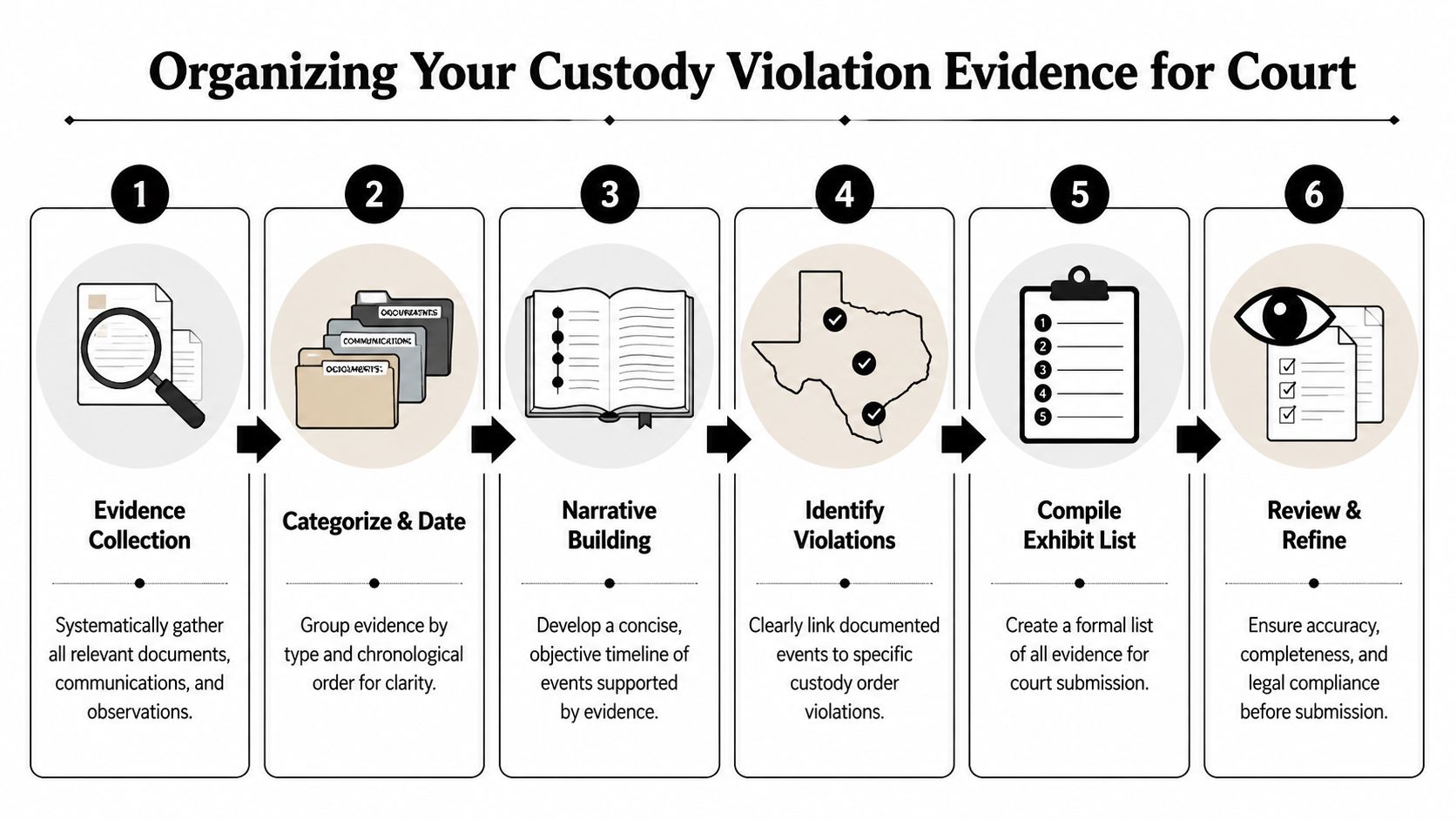
Your journal should be plain, chronological, and easy to scan. A spreadsheet works. So does a typed document with one entry per event. Co-parenting apps can also help because they create time-stamped records automatically.
A useful entry format includes:
- Date and time
- Order provision involved
- What happened
- Impact on the child
- Evidence attached
- Witnesses or corroboration
For example:
- Date and time: March 8, 6:00 PM
- Order provision involved: First weekend possession exchange
- What happened: Arrived at exchange location at 5:57 PM. Sent text at 6:01 PM. No response. Left at 6:28 PM.
- Impact on the child: Missed scheduled dinner and overnight transition.
- Evidence attached: receipt, screenshots, photo
- Witnesses: maternal aunt present
That entry is useful because it is calm. It doesn’t argue motive. It records facts.
Write like a witness, not a prosecutor
Parents often hurt their own case by writing entries as if they are drafting closing arguments. The court doesn’t need your anger explained in every line. The court needs a reliable record.
Compare these two entries:
- “He was late again because he only cares about himself.”
- “Returned child at 8:12 PM. Order required return at 6:00 PM. Child missed soccer practice scheduled for 6:30 PM.”
Only one of those helps you.
A good log sounds almost plain. That’s often why judges trust it.
Use categories so the pattern is visible
If you’ve been dealing with repeated problems for months, sort your records into folders. Parents in Humble, Kingwood, and Northeast Houston often benefit from a structure like this:
Exchange failures
Store late pickup records, no-shows, wrong-location incidents, and denied possession records together.
Child impact records
Keep school notices, attendance records, coach messages, and appointment records in a separate folder.
Communication trail
Save texts, app exports, voicemail files, and emails in date order.
Court-ready exhibits
Create a final folder with labeled files such as:
- Exhibit 1. March 8 receipt
- Exhibit 2. March 8 message thread
- Exhibit 3. April 1 school absence note
Many self-represented parents often fall behind. They have the proof, but not the organization.
Co-parenting apps can reduce disputes about authenticity
Apps like OurFamilyWizard and TalkingParents can reduce “that’s not what I said” arguments because they preserve communications in a more formal format than scattered text messages. They also make exporting records easier when your attorney prepares a hearing packet.
If you’re getting ready for court in Harris County, this guide on how to prepare for a custody hearing can help you think through presentation as well as proof.
A simple standard for every entry
Before you save an entry, ask:
- Does this tie to the court order?
- Would a neutral person understand it?
- Can I back it up with something attached?
- Does it explain the child impact without exaggeration?
If the answer is yes, keep it. If not, revise it while the event is still fresh.
Navigating Legal Boundaries and Immediate Safety Concerns
Documentation helps, but it has limits. Sometimes the issue is an ordinary enforcement problem. Sometimes it points to immediate danger. A parent needs to know the difference.

One common courtroom fight is authenticity. Parents often hear the other side say the records are “inaccurate, incomplete, or edited.” Texas courts prioritize original, unaltered records such as app exports and emails with headers, and parents improve their position when they stay calm and explain their documentation process clearly (guidance on defending co-parenting records in Texas court).
Protect the integrity of your records
If you want your records taken seriously, follow a few hard rules:
- Keep originals: Don’t overwrite files or save over the same screenshot.
- Avoid edits: No markup, no cropping for style, no cleaning up the image.
- Save context: If a text thread matters, preserve more than the single angry message.
- Explain corrections openly: If you later add a clarifying note, label it as a later note rather than pretending it was part of the original entry.
That last point matters. Judges don’t expect parents to be perfect. They do expect honesty.
If your notes need clarification, say so directly. Transparency is better than trying to make a record look cleaner than it is.
Recording conversations in Texas
Texas is a one-party consent state, which means a participant in the conversation can generally record it. That can help in custody disputes where one parent makes threats, admits they won’t comply, or changes stories.
Still, legal permission does not automatically equal strategic wisdom. Recordings can also capture your own frustration, interruptions, or comments you later wish you had not made. If you choose to record, speak as if a judge may hear every second.
Know when to stop documenting and call for help
Not every violation should be handled as a paperwork problem.
Call police or seek immediate legal help if you have reason to believe the child is facing:
- Physical abuse
- Serious neglect
- Exposure to violence
- Impaired supervision tied to alcohol or drug use
- Threats of concealment or refusal to return the child
In those situations, your first job is safety. Document what you can, but don’t sit in a parking lot trying to build a perfect file while a dangerous situation unfolds.
For abuse-related concerns, outside records such as police reports, medical records, and photographs often matter most. They carry more weight than a parent’s suspicion alone.
Stay credible under pressure
Parents in Humble and Northeast Houston often feel they must do everything at once. Preserve evidence, calm the child, respond to the other parent, and plan court action. The better approach is simpler. Secure the child. Preserve originals. Write down the facts. Then get legal guidance before the record gets messy.
That discipline protects both your evidence and your credibility.
Taking Action with Your Evidence The Motion to Enforce
At some point, documentation needs to become action. In Texas, that usually means a Motion to Enforce. This is the formal request asking the court to hold the other parent accountable for violating the possession or access terms of your order.
To file a Motion to Enforce under Texas Family Code §157.002, you must show a pattern of noncompliance. According to TexasLawHelp guidance summarized in the verified data, motions lacking specifics such as times and locations are dismissed 70% to 80% of the time in Harris County, while pattern-proven cases with 5+ documented instances secure enforcement orders, makeup time, or contempt findings more often, and sending a certified demand letter first helps show you tried to resolve the issue amicably (TexasLawHelp guidance on enforcing a visitation order).
What the motion must do
A strong enforcement filing does not speak in generalities. It should:
- identify the exact order language violated
- list each incident separately
- state the date, time, and location of each violation
- describe what you did to comply
- attach exhibits that support each allegation
This is where your parenting journal, receipts, app exports, and witness information start doing real work. Each incident becomes a paragraph with proof attached, not just a complaint.
Why local detail matters in Harris County
Parents in Humble, Atascocita, Kingwood, and the surrounding Northeast Houston area often underestimate how much presentation matters. Harris County courts expect precision. If your motion says only that the other parent “kept violating visitation,” it is weak. If it says:
- on March 8, exchange due at 6:00 PM in Kingwood
- on April 5, return due at 6:00 PM in Atascocita
- on April 19, denial of scheduled pickup in Humble
and each event has matching exhibits, the court has something concrete to evaluate.
That’s the trade-off. Filing fast feels satisfying. Filing accurately is what helps.
Possible outcomes if the court agrees
When a judge finds a violation, the court may order remedies such as:
- Makeup possession time
- Compliance with the existing order
- Attorney’s fees and costs
- Contempt findings
- Other relief the court considers appropriate under the facts
In more serious cases, repeated violations may also support a larger request to modify custody or possession. Enforcement and modification are different proceedings, but a well-documented pattern can influence both.
The record you build today may matter beyond one hearing. It can shape how the court views reliability, stability, and follow-through over time.
Send the certified demand letter first if appropriate
In many cases, it helps to send a certified demand letter before filing. That step can show the court you attempted to resolve the issue without immediate litigation. Keep copies of the letter, the mailing receipt, and the delivery confirmation if available.
The letter should stay factual:
- cite the order
- list the dates of violation
- request compliance
- avoid insults or threats
When to get a lawyer involved
Some parents start documenting on their own and only call an attorney once the pattern is obvious. Others should call sooner. If any of these are true, earlier legal help is usually wise:
- the child is missing school or medical care
- the other parent is rewriting events in messages
- your order language is complicated
- there are claims of abuse, alienation, or concealment
- you already have several incidents and want to file correctly the first time
A local family law attorney can review the order, identify whether the facts support enforcement, help prepare exhibits, and make sure your filing matches what the court requires. That matters in Harris County, where a technically weak motion can fail even when the underlying facts are strong.
The hard part for many parents is not seeing the problem. It’s turning that problem into a court-ready case. If you’ve been living this in Humble, Atascocita, Kingwood, or Northeast Houston, careful documentation strengthens your position. A properly prepared Motion to Enforce gives you a path forward.
If you're dealing with repeated exchange problems, denied visitation, or a child who is getting caught in the middle, the Law Office of Bryan Fagan can help you evaluate your records, understand your options under Texas law, and prepare for action in Harris County court. We offer free consultations from our Humble office and work with families across Humble, Atascocita, Kingwood, and Northeast Houston.