Your child’s bag is packed. The pickup time is getting close. You’re standing in the kitchen in Humble, looking at the clock, and your stomach is in knots because something doesn’t feel safe.
Maybe the other parent sounded intoxicated on the phone. Maybe your child came home from the last visit upset and describing things that don’t sit right. Maybe there’s a new boyfriend, a new apartment, a new pattern of reckless behavior, or a long history of threats you’ve tried to manage for too long.
If that’s where you are, you’re not overreacting by asking hard questions. You’re doing what parents in Humble, Atascocita, Kingwood, and Northeast Houston do every day. You’re trying to protect your child without making a legal mistake that could hurt your custody case.
A Humble Parent's Guide to Child Safety and Visitation
A lot of parents call an attorney only after the situation explodes. I think that’s backwards. If you’re worried before the visit, that’s the time to get clear about your rights and your next step.
I’ve seen the same pattern again and again. A parent wants to follow the order. They also know something is wrong. They feel trapped between a signed court document and the instinct that says, “I can’t send my child into this.”
That conflict is real. It’s also common.
What local parents are usually dealing with
In the Humble area, these cases rarely start with one dramatic event. More often, they build over time.
One parent notices missed schoolwork after visits. Another sees erratic texts late at night. A child starts resisting exchanges in Kingwood or gets quiet every time the other parent’s name comes up. Sometimes the concern is physical safety. Sometimes it’s emotional harm. Sometimes it’s an unsafe home, unsafe people, or obvious substance abuse.
Those details matter. So does your response.
You don’t have to choose between protecting your child and respecting the court. Texas law gives parents legal ways to do both, but you have to use the right process.
At home, practical safety habits still matter too. If your concern involves home conditions, basic prevention can help you think clearly about what “safe” should look like. Parents often find Benny Bradley's childproofing advice helpful when comparing ordinary parenting issues with hazardous living conditions.
The question you really need answered
The search phrase can visitation be denied for safety concerns texas sounds simple, but the full answer isn’t “yes” or “no.” It’s this:
You usually can’t just block visitation because you’re worried. But if your child is at risk, Texas law gives you tools to act fast and ask the court for protection.
That distinction matters. It can keep you from making a panic decision that creates a second legal problem on top of the first.
The Parent's Dilemma Court Orders vs Child Safety
Texas courts expect parents to follow visitation orders. That’s the starting point. A signed order isn’t a suggestion, and judges in Harris County take possession schedules seriously.
But there’s an equally important rule. Child safety comes first. Texas recognizes safety-based reasons to deny or restrict visitation, including evidence of substance abuse, abuse, neglect, and dangerous behavior by the non-custodial parent. Texas also allows emergency remedies such as Temporary Restraining Orders, and judges can grant TROs the same day they are filed when a child faces immediate and irreparable harm, as explained in this Texas visitation safety overview.

Think of the order like a machine with a safety override
A standard visitation order works like a machine that’s meant to keep running. Parents exchange the child on schedule. Everyone follows the written terms. The system depends on consistency.
But machines have emergency shutoffs for a reason.
When there’s a real safety threat, Texas law allows a court to intervene and override the normal schedule. The key phrase there is a court to intervene. That’s where many parents get into trouble. They assume that because the fear is real, any unilateral action will be excused later. Sometimes it won’t be.
What the court wants from you
A Harris County judge usually wants to see two things at the same time:
- Respect for the existing order: You understand the order still controls until it’s changed.
- Prompt action about danger: You didn’t sit on serious concerns and hope the problem would disappear.
That’s why the right response is often legal action, not informal negotiation.
If your child may be in immediate danger, call law enforcement. If the threat is urgent but not unfolding second by second, talk to a family law attorney and move quickly on emergency relief. Waiting too long can weaken your credibility. Acting impulsively without asking the court for help can create enforcement problems.
Practical rule: If the issue is safety, get it in front of a judge fast. Don’t rely on text-message arguments to solve a dangerous visitation problem.
This short video gives a useful general overview of custody and visitation conflict:
What this means in real life
If the other parent is late to pickups, forgets homework, or follows a different bedtime routine, that usually isn’t enough to justify blocking visitation. If the other parent is driving drunk with the child, exposing the child to violence, leaving the child with unsafe people, or creating a dangerous environment, that’s different.
The law doesn’t force parents to ignore danger. It does require them to handle danger the right way.
What Counts as a 'Safety Concern' in a Texas Court
Not every parenting problem is a legal safety concern. Texas courts separate ordinary co-parenting frustration from evidence that a child may be harmed.
That line matters. If you’re going to ask a Harris County judge to limit visitation, you need more than suspicion and more than anger. You need facts that point to a real risk.
Concerns that courts take seriously
Texas Family Code §153.004 requires courts to restrict possession and access when there is credible evidence of physical or sexual abuse. Courts have broad discretion in applying that standard, and the other parent does not need a criminal conviction before restrictions can be imposed, as discussed in this review of supervised visitation under Texas Family Code §153.004.
That standard reaches beyond only one type of case. In practice, judges may also examine patterns such as:
Active substance abuse
If a parent is using drugs or abusing alcohol in a way that affects judgment, driving, supervision, or home stability, the court may treat that as a safety issue.Family violence or threats
Violence in the home matters even if the child wasn’t the direct target. Children who witness violence are still exposed to danger.Neglect or reckless supervision
Leaving young children alone, failing to provide basic care, or letting dangerous adults supervise the child can support restrictions.Untreated mental illness tied to unsafe conduct
A diagnosis by itself isn’t enough. Courts care about behavior. If untreated mental illness creates instability, threats, or impaired parenting, it can become relevant.Dangerous living conditions
Exposed weapons, severe filth, drug activity, unsafe sleeping arrangements, or a revolving cast of risky people in the home can all matter.
What credible evidence actually means
“Credible evidence” is where many parents get confused. It doesn’t mean you must already have a criminal case, a final CPS finding, or a hospital record for every concern. It does mean your allegation needs support that looks reliable and specific.
A judge is more likely to take action when the concern is backed by details such as dates, messages, photos, witness observations, school reports, medical records, or police involvement.
Courts react to documented facts. They react poorly to broad labels like “he’s unstable” or “she’s a bad parent” without proof.
What usually does not qualify
Parents often feel dismissed when they hear this, but it’s important. The following issues may be frustrating and still not rise to the level of denying visitation on safety grounds:
- different household rules
- messy but not dangerous living conditions
- a new romantic relationship you dislike
- occasional communication failures
- parenting choices that are annoying but not unsafe
That doesn’t mean those issues never matter. It means they usually support a request for clarification or modification, not emergency restriction.
A quick gut-check for parents in Humble and Kingwood
Ask yourself:
- Can I describe the danger without exaggeration?
- Can I connect it to a specific risk to the child?
- Can I back it up with something a judge can review?
If the answer is yes, you may have a safety-based issue. If the answer is mostly emotion and assumptions, slow down and get legal guidance before you act.
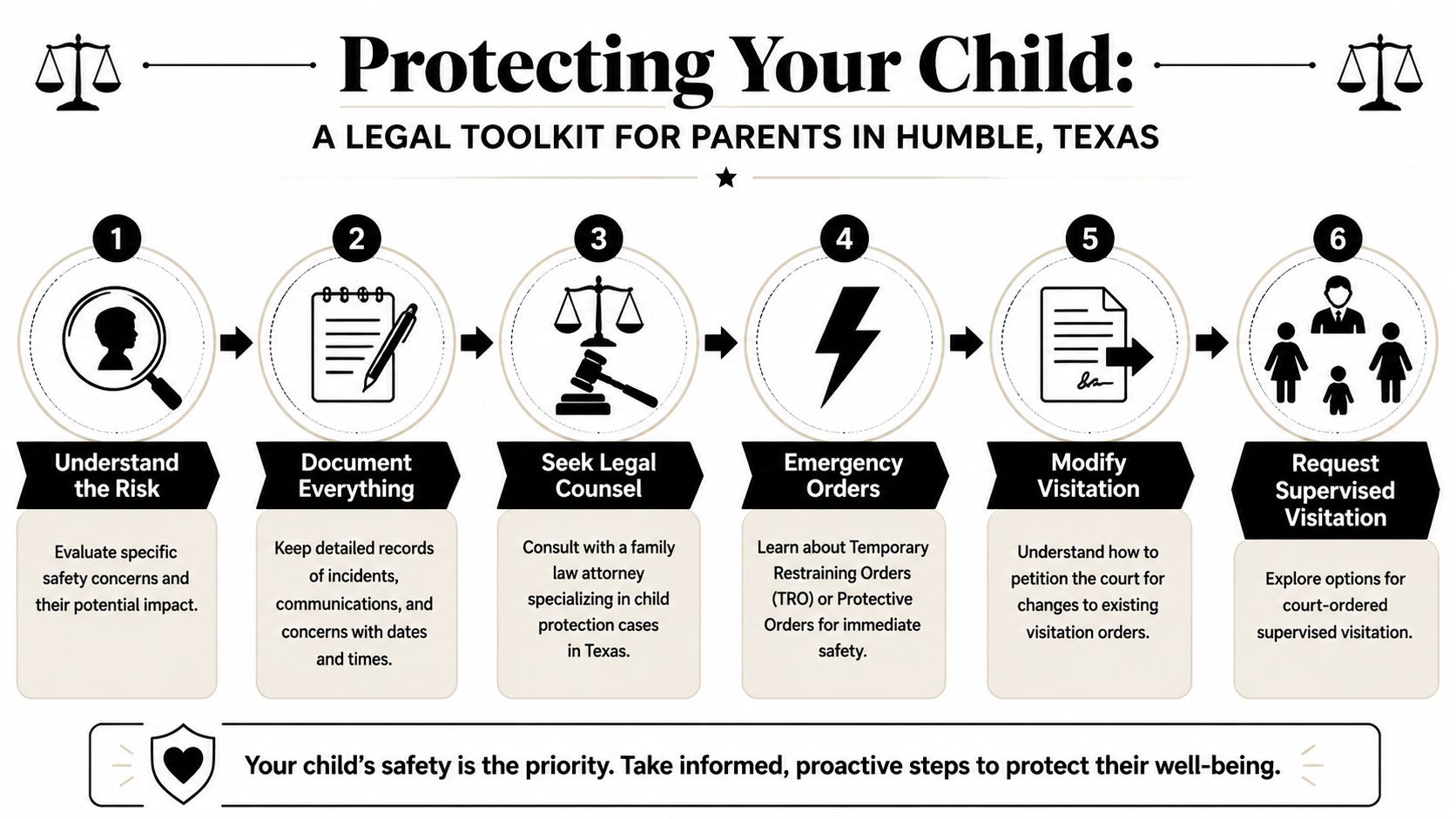
Your Legal Toolkit for Protecting Your Child in Humble
When safety is the issue, you need the right legal tool for the job. Parents often use the wrong one. They stop visits informally when they needed emergency court relief, or they file a broad modification when the actual problem called for immediate protection.
The better approach is targeted action.
The main options available
Some cases need an emergency filing. Others need a longer-term custody change. Others call for structured visitation instead of a complete stop.
Comparing Legal Options for Child Safety
| Legal Tool | Primary Purpose | Typical Duration | Who It's For |
|---|---|---|---|
| Temporary Restraining Order | Immediate short-term protection when the child faces urgent risk | Short-term emergency relief while the case moves forward | Parents who need the court to act quickly |
| Protective Order | Protection in cases involving family violence or serious threats | Depends on the court’s order and case facts | Parents and children facing violence, stalking, or credible threats |
| Modification with Supervised Visitation | Changes the existing order so visits happen under controlled conditions | Ongoing, subject to future court review | Parents who want contact to continue but in a safer format |
When a TRO makes sense
A Temporary Restraining Order is the emergency option. If you believe the child faces immediate danger, this is usually the fastest route into court.
Good candidates for a TRO often involve recent violence, credible threats, active intoxication around the child, attempted abduction, or an abrupt escalation in dangerous conduct. The point is to stabilize the situation long enough for the court to hold a fuller hearing.
File fast. Bring specifics. Judges don’t grant emergency relief because a situation is tense. They grant it because the facts show immediate risk.
When a protective order is the better fit
If the danger includes family violence, a Protective Order may be the stronger tool. This is about more than exchange logistics. It addresses personal safety, contact restrictions, and broader protection for the child and the protected parent.
If violence is part of your case, treat it that way. Don’t reduce a violence case to a routine visitation dispute.
When supervised visitation is the smartest solution
Many parents assume the only options are “send the child” or “refuse the visit.” That’s too narrow. Supervised visitation often gives the court a middle path that protects the child while preserving the parent-child relationship.
This can work well where the concern is serious but manageable with oversight, such as substance abuse concerns, unstable conduct, or a need to rebuild trust after unsafe incidents. If you want a closer look at how this works, review the firm’s page on supervised visitation representation in Humble.
A good safety strategy is usually the least restrictive option that still protects the child.
A workable action plan for local parents
If you live in Humble, Atascocita, or Kingwood, take these steps in order:
Write down the immediate concern
Keep it factual. Date, time, people present, what happened, what the child experienced.Preserve anything already in your possession
Save texts, voicemails, screenshots, school notices, and photographs.Decide whether the issue is emergency-level
If there is immediate danger, seek emergency help. If not, prepare to file for modification quickly.Ask for a remedy that fits
Don’t overreach. If supervision solves the problem, request supervision. If violence is involved, seek stronger protection.Prepare for the hearing early
Your first filing matters, but your hearing presentation matters just as much.
One practical option for families navigating this process is legal guidance from a local firm that handles visitation modifications, supervised access requests, and emergency child-safety filings. The Law Office of Bryan Fagan works on those issues in the Humble area.
Gathering Evidence a Harris County Judge Will Take Seriously
Parents hear “document everything” all the time. That advice is incomplete and, frankly, not very helpful. The key question is what kind of documentation is significant in court.
Texas parents often don’t get clear guidance on how to preserve evidence in a way family courts expect. The uncertainty around text logs, school notes, medical records, and GPS screenshots leaves many parents anxious about whether they’re collecting the right proof, as explained in this Texas family-court safety documentation discussion.

Build a judge-friendly evidence file
A Harris County judge doesn’t want a pile of chaotic screenshots with no dates or explanation. The court wants organized, credible information that ties directly to safety.
Use a checklist like this:
Communication records
Save texts, emails, call logs, and voicemails that show threats, intoxication, missed pickups tied to dangerous behavior, or admissions.School and medical records
Attendance notes, counselor concerns, nurse reports, injury records, and discharge papers can carry weight.Photos and videos
Unsafe home conditions, visible injuries, alcohol or drug evidence, or dangerous surroundings may matter if they’re authentic and dated.Third-party reports
Police reports, CPS documents, and statements from teachers, doctors, or counselors often help because they don’t come only from one parent.Your own incident log
Keep a running timeline with dates, times, locations, witnesses, and what happened before and after each event.
Organize it like you expect a hearing
Don’t just save evidence. Sort it.
Create folders by issue, such as “alcohol,” “missed medications,” “unsafe driving,” or “threatening messages.” Put documents in chronological order. Label screenshots clearly. If you end up with a large packet, simple document control helps. Some parents even use tools that customize Adobe Bates numbers so each page is easy to identify during attorney review and hearings.
Courtroom shortcut: If a judge can’t follow your evidence in a few minutes, your strongest proof may get lost in the noise.
What your incident log should include
Your log should sound boring. That’s a good thing.
Write entries like this:
Date and time
Be precise.What happened
“Other parent arrived for exchange smelling strongly of alcohol and speaking unclearly.”Who saw it
Name neutral witnesses when possible.What you did
“Saved text messages. Child reported no car seat on prior trip. Contacted attorney next morning.”Any follow-up
“School counselor contacted after child described fear during visit.”
Avoid editorial comments. Don’t write that the other parent is crazy, evil, manipulative, or always high unless you have proof tied to a specific event.
When emergency evidence needs immediate action
If your documentation points to urgent danger, don’t keep collecting for weeks while the child remains exposed. Move.
Parents who need emergency protection often start by reviewing how to file for emergency custody in Texas so they understand what the court may require and how quickly a filing needs to happen.
What not to do
A few mistakes hurt good cases:
Don’t coach the child
Judges and investigators can spot rehearsed statements.Don’t edit screenshots
Preserve originals.Don’t trespass or record illegally
Bad evidence can create new problems.Don’t dump hundreds of pages without structure
More paper is not the same as more proof.
The strongest cases usually look calm, organized, and specific.
Responding to a Denial or Restriction of Visitation
If you’re the parent who has been denied visitation or served with a motion to restrict your access, your first reaction may be anger. That’s understandable. It’s also dangerous if it leads you to ignore the court, show up in violation of an order, or unload on the other parent by text.
Take this seriously from the first minute.
Your first job is compliance
If a TRO or temporary order is in place, obey it. Don’t test the boundaries. Don’t ask relatives to work around it. Don’t show up at the school, house, or exchange point if the order says otherwise.
Judges notice who stays disciplined under pressure. They also notice who escalates.
False or exaggerated allegations do happen. The best response is documented stability, not emotional retaliation.
Build your defense with proof, not outrage
If the allegations are inaccurate, answer them with evidence that speaks to safety and parenting ability.
Useful items may include:
Negative drug or alcohol testing
If substance abuse is alleged, objective testing can matter.Housing proof
Lease records, photos of the residence, and testimony about living conditions may help.Parenting records
School involvement, medical attendance, and consistent communication with the child can support your position.Witness statements
Neutral adults usually help more than friends who sound rehearsed.Treatment records
If there was a past problem, proof of treatment and compliance may support a return to access, often beginning with a graduated plan.
Prepare for the hearing like the details matter
They do.
Write your timeline. Match documents to each allegation. If recordings or calls need to be converted into usable written form for attorney review or court prep, some firms and litigants look at details on legal transcription for firms to understand how spoken content gets turned into organized text for case work.
If the current order needs to be changed because the facts are different from what the court heard initially, you may also need to review the legal path for changing a Texas custody agreement.
Don’t make the mistake that sinks your own case
Parents lose credibility fast when they focus only on attacking the other side. A better argument is simple:
- the allegation is unsupported, exaggerated, or outdated
- your current circumstances are stable
- a less restrictive arrangement can protect the child while preserving the relationship
Sometimes that means asking the court to deny the restriction. Sometimes it means accepting temporary supervision while you clear the issue. That’s not surrender. It can be a strategic step toward restoring normal possession.
How New Texas Laws Impact Visitation Disputes
Parents in Humble need to understand that Texas has changed the legal risk around visitation interference. Texas Senate Bill 2794 took effect on September 1, 2025 and created the “Three Strike Rule,” which increases penalties for custodial parents who intentionally interfere with court-ordered visitation or parenting time, as explained in this discussion of SB 2794 and Texas visitation interference.
That matters because informal denial is now even riskier.
What the law changes for parents with safety concerns
The practical message is straightforward. If you’re worried about danger, don’t just withhold the child and hope the court understands later. Move through legal channels quickly.
The same SB 2794 discussion also makes an important point. Even under the stricter framework, parents still retain the legal right to take protective measures when visitation would put a child’s safety or well-being at risk, including filing for protective orders or temporary custody modifications.
The real strategic takeaway
This law doesn’t eliminate safety-based action. It raises the cost of acting casually.
For families in Harris County, that means your timing matters more than ever. If you have a valid safety concern, treat it like a legal emergency, not a co-parenting argument. Document the issue, seek legal advice, and put the matter before the court. That’s how you protect your child without creating avoidable exposure for yourself.
If you don’t have enough evidence yet, be careful. You may still need urgent legal guidance on whether the facts justify emergency action now or a fast-filed modification with a request for supervision.
Your Next Steps with a Humble Family Law Attorney
If you came here asking can visitation be denied for safety concerns texas, the honest answer is this: yes, safety concerns can justify denying or restricting visitation, but you need to handle it through the proper legal process.
That’s the part parents in Humble, Atascocita, Kingwood, and Northeast Houston can’t afford to get wrong. Waiting too long can leave a child exposed. Acting without a plan can put you at risk with the court.
Start with the facts. Write down what happened. Preserve your evidence. Decide whether the danger is immediate. Then get legal advice that fits the situation you have, not the one you hope will go away on its own.
If you’re the parent raising the safety concern, the goal is protection backed by proof. If you’re the parent facing restrictions, the goal is disciplined compliance and a credible response backed by evidence.
Either way, these cases move fast and the details matter.
If you need clear guidance from a local team, contact Law Office of Bryan Fagan to schedule a free consultation with our Humble office. We help families in Humble, Kingwood, Atascocita, and Northeast Houston understand their options, protect their children, and take practical next steps in custody and visitation disputes.