Skip to content

You open the envelope, read the words supervised visitation, and your stomach drops.
For many parents in Humble, Atascocita, Kingwood, and Northeast Houston, that moment feels like a judgment on who they are. You may be wondering if the court thinks you're dangerous, whether you'll still get to see your child, or how you're supposed to afford yet another legal problem while trying to keep life steady.
I understand that reaction. In Harris County family court, these cases are emotional from the first day. Parents often come in scared, angry, embarrassed, or are overwhelmed. Most are not trying to fight for a legal theory. They want to know what this means for next weekend, the next school pickup, and the long-term relationship with their child.
A supervised visitation case needs calm, practical planning. It also needs clarity. If you're searching for a supervised visitation lawyer humble tx, you probably need answers in plain English, not courtroom jargon. You need to know why judges order supervision, how the process works in Harris County, what the visits may look like, and what steps you can take right now to protect your rights and your child.
Your Guide to Navigating Supervised Visitation in Humble TX
A parent in Humble gets served with court papers after a difficult breakup. The other parent claims the child shouldn't be alone with them right now. There may have been an argument, a relapse concern, a mental health episode, or just a breakdown in trust that turned into litigation. The parent reads the request for supervised visitation and immediately assumes the worst.
That reaction is common. So is confusion.
Some parents think supervised visitation means they're about to lose all contact with their child. Others believe the judge has already made a final decision. Neither assumption is always true. In many cases, supervised visitation is a temporary safety measure while the court gathers more information and tries to protect the child without cutting off the relationship completely.
In Harris County, these cases move through a process. Judges look closely at facts, documentation, and the child's best interests. They also expect parents to follow orders exactly, even when the order feels painful or unfair.
Supervised visitation can feel personal, but the court's focus is usually safety, structure, and stability for the child.
For families in Atascocita, Kingwood, and the rest of Northeast Houston, the hardest part is often not knowing what happens next. That's why a steady, step-by-step approach matters. You need to understand the order, prepare for the practical realities, and avoid mistakes that can make the case harder.
A good plan starts with two questions. What is the court trying to protect against, and what can you do to show that safe parenting time is possible? Once you answer those, the situation becomes easier to manage.
What Supervised Visitation Means for Your Family
Supervised visitation means a parent can spend time with a child, but another approved adult or provider must be present during the visit. That supervisor watches the interaction and helps make sure the visit follows the court's rules.
For many families, it helps to think of supervision as training wheels for parenting time. It isn't the same as losing visitation altogether. The court is allowing contact, but only in a structured setting while concerns are addressed.

Why judges order supervision
Texas courts usually don't order this lightly. A judge needs a specific safety concern, not just general frustration between co-parents. One Texas family law source explains that supervised visitation typically addresses five primary risk categories: parental substance abuse, a history of child abuse, untreated mental health conditions, domestic violence, or a situation where a parent has no prior relationship with the child. That same source notes that supervision often costs $25-75 per hour through Texas supervised visitation guidance.
Those categories matter because they help parents understand the difference between a strained co-parenting relationship and a true supervision issue. Being late for exchanges, arguing over schedules, or having different parenting styles can create conflict. But those issues alone don't automatically justify supervised visitation.
What a supervised visit usually looks like
The details depend on the order. Some visits happen at a center. Others happen in a neutral location with an approved third-party supervisor. The order may spell out:
- Who supervises: This might be a professional monitor or another person the court approves.
- Where visits happen: A visitation center, public setting, or another monitored location.
- How exchanges work: The court may limit direct parent-to-parent contact to reduce conflict.
- What conduct is prohibited: The supervisor may stop discipline, arguments, or attempts to involve the child in the case.
Practical rule: Supervision is usually about preserving the parent-child bond in a safer setting, not erasing that bond.
The emotional and financial side
Many online articles fall short in addressing this aspect. Supervised visitation isn't just a legal label. It changes routines, transportation, work schedules, and monthly budgets. Parents in Humble and nearby communities often discover that the logistics are as stressful as the legal hearing.
That cost pressure matters because missed visits can create new problems. If supervision has been ordered, the court expects the order to be followed. A parent who treats it casually can damage their position later, even if they feel the arrangement is unfair.
The Legal Process for Supervised Visitation in Harris County
When you live in Humble, your case typically moves through the Harris County family court system. That can feel intimidating until you break it into pieces. Most supervised visitation matters follow a pattern, even though every family's facts are different.
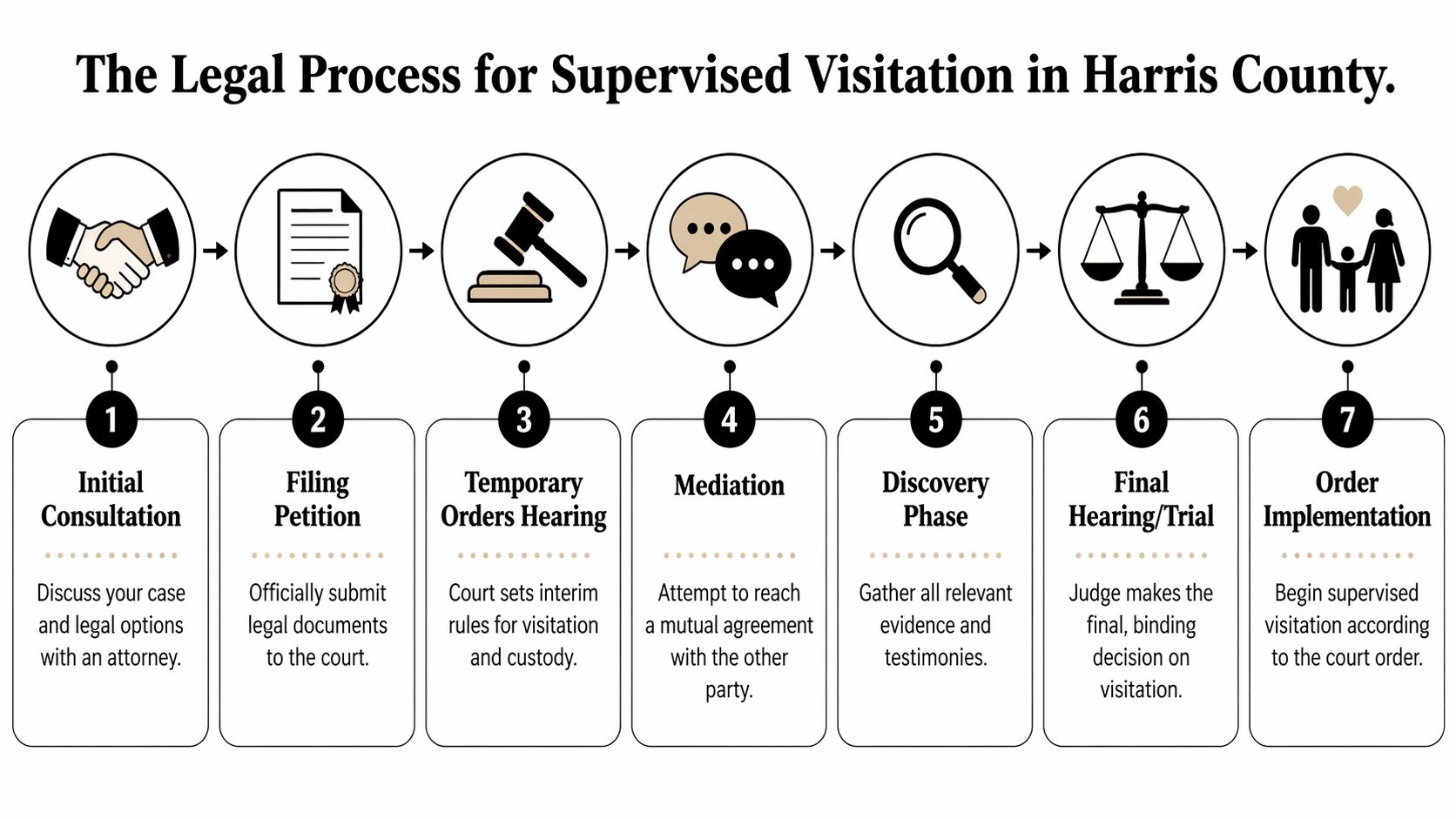
How the case usually unfolds
A petition or motion is filed
One parent asks the court to create, change, or restrict visitation. The filing usually includes allegations and a request for specific protections.Temporary orders may be requested
If the concern is urgent, the court may address visitation early in the case. Temporary orders can shape what happens until a final resolution.The court reviews evidence
Judges look for specifics. Police reports, medical records, messages, treatment records, witness statements, and other documents may become important.The parties may mediate
Some families resolve parts of the dispute outside a final trial. If you want a broader sense of how family cases progress emotionally and practically, this overview of divorce legal processes can be useful alongside legal advice.A final hearing or trial happens if needed
The judge decides whether supervision is necessary, how it should work, and what must happen before any change is considered.
For a local overview of the court system serving this area, many parents benefit from reviewing the Harris County family court resources for Humble residents.
Who may be involved
A Harris County judge makes the final ruling. The parents' attorneys present evidence and challenge weak claims. In some cases, the court may involve another professional to focus on the child's interests.
That part often surprises parents. They assume the case will turn on who tells the better story. In reality, these hearings often turn on who brings clearer evidence, more organized records, and a workable plan.
When a parent walks into court with dates, messages, attendance records, and a proposed visitation structure, the judge has something concrete to evaluate.
If the other parent breaks the order
Enforcement is its own part of the case. Texas law allows remedies for non-compliance with visitation orders, including civil contempt to enforce future visits and criminal contempt to punish past violations, according to Texas visitation enforcement guidance. That same source explains that enforcement actions depend heavily on carefully documented evidence of denied visits.
Parents often get tripped up. They know the other parent blocked contact, but they didn't keep records. Courts want details. Dates. Times. What the order said. What happened. Who was present. Whether messages confirm the denial.
A vague complaint rarely carries the day. A documented pattern might.
Practical Steps for Parents to Take Right Now
The hours after learning about supervised visitation matter. What you do next can either steady your case or make it harder to fix later.

Start with your paperwork and your calendar
Get a copy of every court document and read the requested relief carefully. If an order already exists, follow it exactly. Don't rely on memory, and don't assume the other parent's description of the order is accurate.
Then build a simple case file. Include messages, emails, prior orders, names of witnesses, treatment records if relevant, and a calendar of all visitation dates. If there have been cancellations or denied visits, write down what happened while it's still fresh.
If you need help understanding a current order or planning for exchanges, this guide to a child visitation schedule in Humble can help you organize the basics.
Focus on conduct, not arguments
Parents hurt their cases when they react emotionally in ways the court can later review. A few rules help immediately:
- Don't discuss the lawsuit with your child: Children shouldn't carry adult legal stress.
- Don't attack the other parent in writing: Texts and emails often become exhibits.
- Don't skip a visit casually: If the order requires supervised contact, treat every session seriously.
- Don't improvise with the supervisor: Follow the rules of the center or approved monitor.
The safest habit is to act as if a judge will read every message and review every missed exchange.
Prepare for the money side
One major problem in this area is the lack of practical cost information online. A resource discussing custody and visitation options for Humble notes a significant gap in local cost information and states that supervisor fees can reach thousands per year, while 40% of self-represented litigants may lose rights due to non-payment issues in the source's discussion of affordability concerns for Humble custody and visitation matters.
That means budgeting isn't optional. Ask early who pays for supervision, when payment is due, what happens if a session is canceled, and whether lower-cost arrangements may be acceptable to the court. Parents in Northeast Houston often wait too long to ask those questions.
Keep the visits child-centered
Bring appropriate snacks, activities, patience, and emotional control. Don't use the visit to gather evidence from the child or ask where the other parent lives, who they're dating, or what happens in the other home. Use the time to be steady, affectionate, and appropriate.
Supervised visitation often becomes easier to modify when a parent shows consistency over time.
How a Humble Lawyer Protects Your Parental Rights
A parent walks into my Humble office with the same fear I hear every week. "If visits have to be supervised, does that mean I've already lost?" In Harris County, the answer is often no. Supervision is usually a control measure, not the final word on your relationship with your child.

A lawyer's job in these cases is partly legal and partly practical. The legal side is presenting evidence clearly and asking for terms a judge can sign. The practical side is just as important. Who can supervise. What location is realistic for a Humble or Northeast Houston family. How fees will be paid. What happens if a work schedule changes. A visitation order works like a set of instructions. If the instructions are vague, families end up back in court.
Why specialized family law experience matters
Family court is its own system with its own habits, especially in Harris County. Judges want specifics. They want a plan that protects the child and can be carried out week after week. General statements such as "I just want fairness" rarely solve the underlying problem.
In Texas, less than 1% of attorneys are Board Certified in Family Law (discussion of supervised visitation and family law credentials in Texas). That does not mean every parent needs the same kind of representation. It does mean supervised visitation cases benefit from a lawyer who regularly handles custody orders, temporary hearings, modifications, and enforcement issues.
What legal help often changes
Parents often assume the hearing is the whole case. Usually, the outcome is shaped earlier by preparation, documentation, and the wording proposed for the order.
A Humble lawyer can help by:
- Testing the allegations for detail and proof: Judges usually give more weight to specific records, dates, messages, and witness accounts than broad accusations.
- Drafting terms that fit real life: That includes supervisor approval, pickup and drop-off logistics, holiday schedules, cancellation rules, and who pays which costs.
- Building a step-by-step path to expanded access: If the goal is unsupervised time later, the order should spell out what progress matters, such as completed classes, clean testing, or a review hearing.
- Reducing preventable violations: Parents get into trouble over missed notices, late arrivals, side agreements, or using the wrong supervisor.
- Pointing you to practical support tools: For some families, even basic information such as the Texas access and visitation hotline for parents can make the process less confusing.
Cost matters here too. A lawyer cannot make supervision free, but good legal drafting can prevent expensive repeat hearings, rejected supervisors, and orders so unclear that every visit turns into an argument. For many families in Humble, Kingwood, and Atascocita, that kind of planning saves more money than people expect.
If you are also sorting out which papers matter outside a court filing, this article on notarized child custody agreements gives helpful background on a topic many parents ask about.
A short video can also help you hear these issues explained more conversationally:
Local help in Humble and Northeast Houston
Local court knowledge matters because small procedural choices can affect whether a parent gets a workable order or one that creates constant friction. In my experience with Harris County family courts, judges respond better to calm, organized presentations than to raw frustration, even when the frustration is understandable.
The Law Office of Bryan Fagan is one option families may consider for help with establishment, enforcement, and modification issues involving parenting time. What matters most is choosing counsel who can turn your concerns into clear facts, realistic visitation terms, and a plan you can afford to follow.
Finding a Supervised Visitation Center Near Humble
For families in Humble, Kingwood, Atascocita, and nearby Northeast Houston communities, the practical question is often simple. Where will these visits happen?
The answer depends on the court order. Some families use professional visitation centers. Others use an independent court-approved supervisor. In some cases, the court may allow a neutral third party if both sides agree and the judge approves. The right fit depends on safety concerns, transportation, cost, and whether the family needs a more formal environment.
Humble also has a meaningful local legal market around custody issues. Avvo lists 9 lawyers specifically specializing in child custody in Humble, supported by over 732 reviews, in its Humble child custody lawyer directory. That gives parents several nearby starting points when they need help reviewing provider options or drafting workable terms into an order.
Comparing supervised visitation options in the Humble area
| Provider Type | Typical Cost (per hour) | Best For | Notes |
|---|---|---|---|
| Professional visitation center | $25-75 | High-conflict cases or cases needing formal monitoring | Structured setting, written rules, often better for disputed allegations |
| Independent professional supervisor | Varies | Families needing scheduling flexibility | Ask about travel rules, reporting style, and court acceptance |
| Court-approved neutral third party | Varies | Lower-conflict situations with a trusted neutral adult | Only works if the court approves and the order is specific |
Questions to ask before choosing
Not every provider works the same way. Before agreeing to one, ask:
- Will the court accept this provider: Approval needs to match the order.
- How are cancellations handled: Fee policies can affect affordability fast.
- Is there a written report process: That can matter in later hearings.
- Are exchanges handled on site: This helps in tense co-parenting situations.
Some parents focus only on hourly fees, but the bigger issue is whether the setup is reliable enough to survive court scrutiny.
If you have questions about access rights while searching for a workable arrangement, the Texas access and visitation hotline overview for Humble families is another useful local resource.
Your Path Forward with The Law Office of Bryan Fagan
Supervised visitation can feel like the ground shifted under your feet. But it isn't the end of your relationship with your child, and it doesn't have to define your case forever.
What matters now is how you respond. Clear documentation, steady behavior, realistic budgeting, and informed legal strategy can make a major difference in how the court views your situation. Parents in Humble, Atascocita, Kingwood, and Northeast Houston often feel less anxious once they understand that there is a process, and that process can be managed.
You don't need to guess your way through Harris County family court. You need a plan that protects your rights and keeps the focus where it belongs, on your child's well-being and your ability to build safe, consistent parenting time.
If you're dealing with supervised visitation, questions about affordability, or concerns about enforcement or modification, a free consultation can help you understand your options and your next move with more confidence.
Frequently Asked Questions About Supervised Visitation
Can supervised visitation be temporary
Yes. In many cases, it is temporary. The court may use supervision while concerns are being evaluated or while a parent completes certain steps that show safer parenting time is possible.
Can I choose my own supervisor
Sometimes, but only if the court allows it. A judge may require a professional provider or may approve a neutral third party. The exact wording of the order matters.
What if I can't afford the visits
That issue should be addressed early, not after missed sessions begin. Cost can affect compliance, and judges generally expect parents to raise practical barriers promptly through proper legal channels rather than stop attending.
Will supervised visitation hurt my custody case forever
Not necessarily. Courts look at current safety, consistency, and the child's best interests. A parent who follows the order, behaves appropriately, and addresses the court's concerns may be in a stronger position later than a parent who reacts with anger or refuses to participate.
What if the other parent keeps blocking my visits
Keep records. Save messages. Track dates, times, and what the order required. Enforcement cases usually depend on detailed proof, not broad complaints.
Should I go to court without a lawyer
You can, but it carries risk. Supervised visitation cases often involve facts that need to be documented carefully and presented in a way the court can act on.
If you need help with a supervised visitation case in Humble, Atascocita, Kingwood, or Northeast Houston, schedule a free consultation with the Law Office of Bryan Fagan. Our Humble office can help you understand the order, prepare for court, and take practical steps to protect your parental rights and your child's future.