Skip to content

If you're reading this with your phone in your hand, trying to decide whether to book a meeting with a family lawyer, you're probably already carrying a lot. Maybe you're thinking about divorce. Maybe you're worried about your children, your home, or how you'll pay the bills if life changes fast. Maybe you're in Humble, Atascocita, Kingwood, or somewhere else in Northeast Houston, and you need answers before things get worse.
That feeling is normal. Individuals don't come to a family law consultation on a calm, ordinary day. They come because something in the family has shifted, and they know they need guidance. The good news is that preparation can turn a stressful first meeting into a useful one.
Knowing how to prepare for a consultation with a family lawyer doesn't mean having every paper perfectly sorted or every answer ready. It means showing up with the clearest picture you can give. That helps your lawyer focus on what matters under Texas law, including child custody, child support, property issues, temporary orders, and immediate risks that may affect your next steps.
Your First Step Towards Clarity and Confidence
The first call usually happens on a hard day. You may be sitting in your car outside work in Humble, waiting for school pickup in Atascocita, or trying to make sense of a tense night at home in Kingwood. In that moment, many people assume they need every answer before they speak with a lawyer. They do not.

A better first step is simple. Write down the facts you know, the questions keeping you up at night, and any deadlines or recent events that feel important. That short note helps turn fear into something you can work with.
I see this often in family law meetings. A parent comes in upset, embarrassed, or worried they will leave out something that matters. Once the main points are on paper, the conversation gets clearer. We can sort urgent problems from background noise, and we can address the issues that matter most under Texas family law.
That matters even if your documents are incomplete. Many Northeast Houston residents come in with only part of the picture. Maybe the other spouse handled the accounts. Maybe papers were left behind when someone moved out. Maybe you have screenshots, text messages, school notices, or nothing more than a list of dates. That is still a workable starting point.
The goal for this first step is clarity, not perfection.
Start with four categories on one page: what happened, what is happening now, what worries you most, and what result you want if the case goes well. If emotions are running high, keep the wording plain. "He moved out on March 3." "The children have been with me since Tuesday." "I do not know where our tax records are." Simple statements are easier to explain than a long retelling of every argument.
It also helps to protect what you already have. If you are gathering papers, photos, or digital records, use reliable methods for secure document storage so nothing gets lost or accessed by the wrong person.
Choosing the right lawyer is part of preparation too. You need someone who can explain the trade-offs clearly, listen without judgment, and tell you what can be done now versus what may take time. If you are still comparing options, this guide on how to choose a family lawyer in Humble, Texas is a good place to start.
A good consultation should leave you steadier than when you arrived. That begins before the meeting, with a page of honest notes and a willingness to talk about what is hard.
Gathering Your Key Information and Documents
Most family law meetings are more useful when the lawyer can see the basic shape of your finances, your family situation, and any existing legal paperwork. In Texas cases, that matters because decisions about children, support, and property often depend on records, not memory alone.
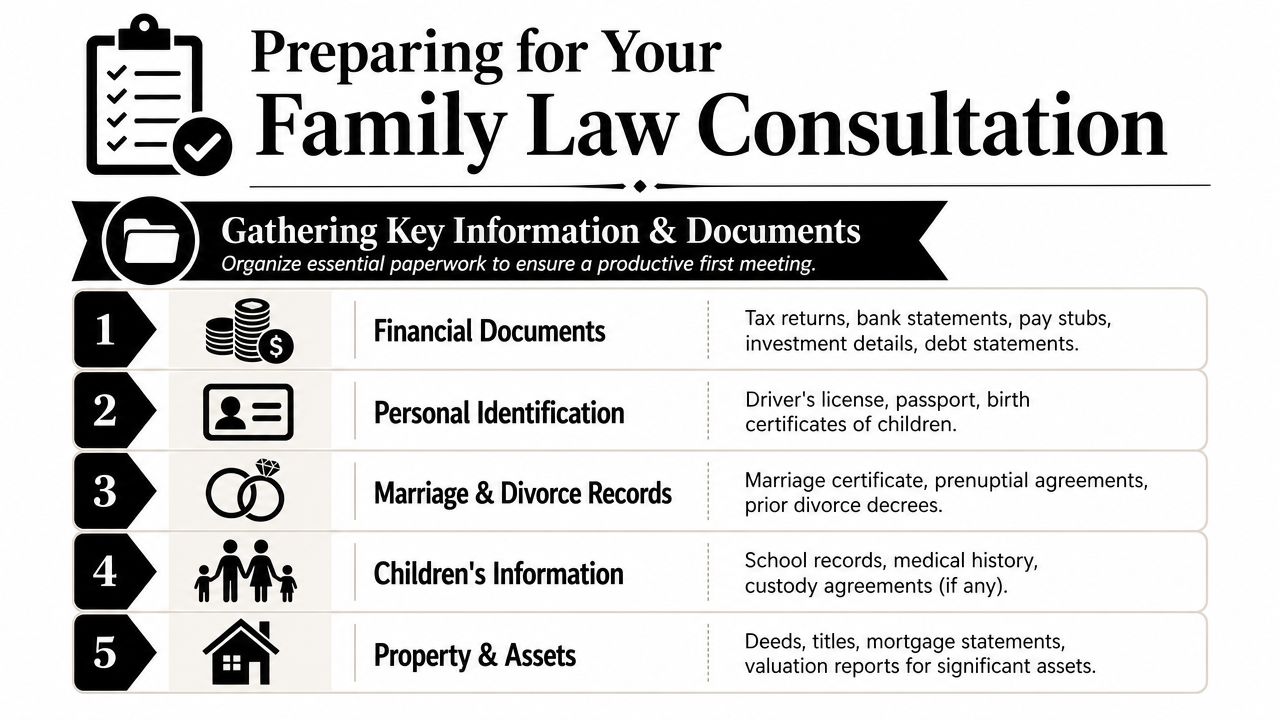
A strong intake packet is usually built around financial disclosure. One family-law checklist advises bringing the past 3–5 years of tax returns and W-2s, plus 1–3 years of bank, investment, and debt statements, along with recent pay stubs and retirement records, according to this guidance on what to bring to your first consultation with a DFW family lawyer.
Financial records that answer the hard questions
When people hear "bring your financial documents," they often think that means only tax returns. That's too narrow. A lawyer usually needs enough information to see income, debts, major assets, and how the household functions on paper.
Bring first if you can: recent tax returns, pay stubs, bank statements, and debt information.
These records help address questions that come up early in Texas family cases:
- Income and support. Pay stubs, tax returns, and business income records help frame support issues.
- Property division. Mortgage statements, deeds, titles, retirement statements, and account records help identify what exists and what may need to be divided.
- Debt allocation. Credit card balances, personal loans, car loans, and other obligations matter because debts often become part of the larger property discussion.
If your records are partly digital and partly paper, don't dump loose screenshots into your phone and hope for the best. Put them into labeled folders by category. If you're still figuring out a safe way to keep sensitive records together, these methods for secure document storage can help you organize without making the process more stressful.
Personal and child-related information
In custody and parenting matters, the details that feel routine at home can become central in a legal consultation. Your lawyer may need to understand where the children live, who handles school and medical decisions, and whether there are concerns about stability or safety.
Helpful items include:
- Identification documents such as your driver's license and basic identifying information for the other parent
- Child-related records like school notices, medical information, counseling records, and existing schedules
- Communication records including emails, texts, or app messages if they relate to parenting disputes, threats, missed exchanges, or important agreements
If you're trying to understand what proof may matter in a parenting case, this article on what evidence helps in a child custody case in Texas gives a useful overview.
Prior legal papers matter more than people think
Clients often bring stacks of financial records but forget the document that changes everything. An older order. A filed petition. A protective order. A notice with a deadline.
A practical family-law workflow is to gather prior court orders or filed papers, recent tax returns from the last 2–3 years, and detailed debt information before the meeting, because those materials help the lawyer assess deadlines, income, and asset or debt issues more accurately, as described in this quick-start guide to the family law process.
Existing court papers often answer the first question a lawyer needs to ask. What has already been ordered, filed, or scheduled?
If you have limited records, bring what you do have. Partial information is still useful. A single bank statement, a recent pay stub, or a screenshot of a court notice can be enough to start building the bigger picture.
Organizing Your Story and Defining Your Goals
Documents help. Your story still matters. The strongest consultations usually come from clients who can explain what happened in a simple timeline without getting lost in every painful detail.
Build a timeline your lawyer can scan
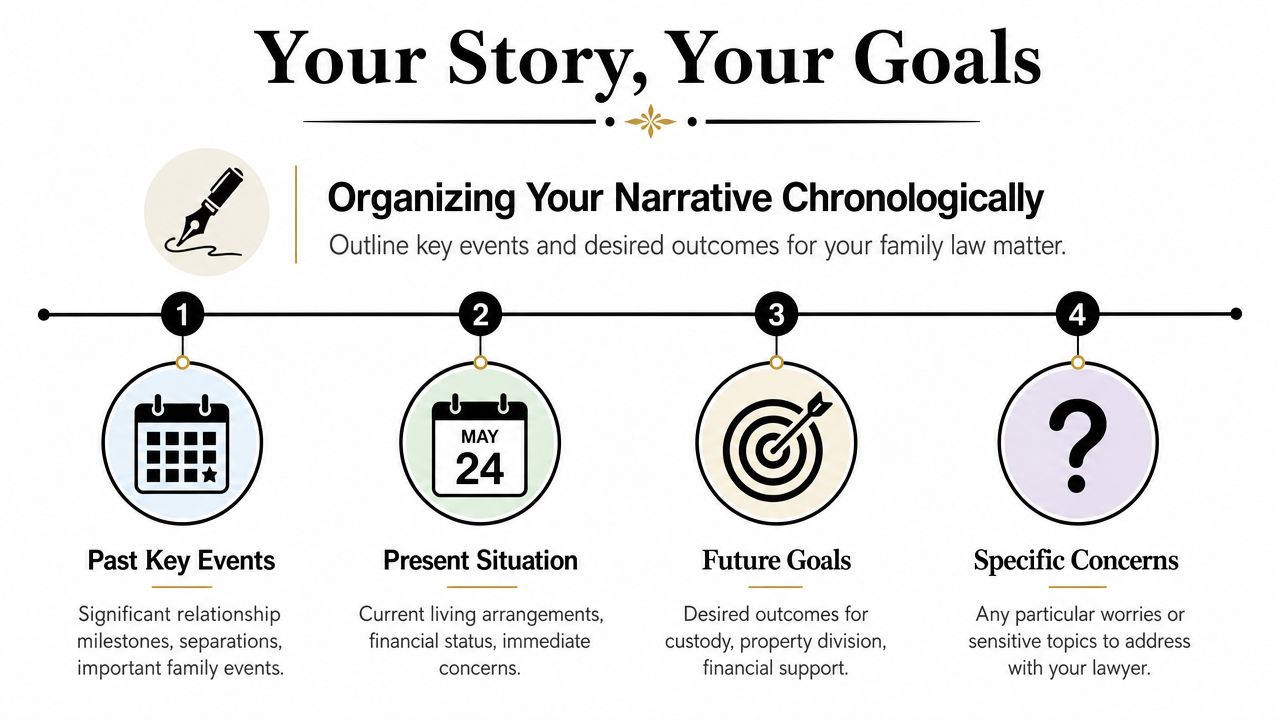
Think of this as a one-page summary, not a memoir. Write down milestone dates such as marriage, separation, birth of children, moves, major incidents, prior filings, and any emergency events. In divorce and custody matters, this kind of chronology helps a lawyer quickly assess support issues, property concerns, and whether temporary orders may be needed.
Family law attorneys commonly recommend an issue map before the meeting. That means writing down your top questions, a realistic wish list, important dates, employment and income details, and key child or property facts. They also warn that arriving without a clear objective can force a second meeting before meaningful strategy can be developed, as explained in this article on how to prepare for a consultation with a family law attorney.
A useful timeline usually includes:
- Relationship milestones such as marriage, separation, or when someone moved out
- Child-focused events like school changes, medical issues, counseling, or schedule disputes
- Legal and financial markers including prior filings, account closures, property purchases, or job changes
Decide what success actually looks like
People often struggle with this aspect. They know what they're upset about, but they haven't yet defined what they want the lawyer to help them accomplish.
Try finishing these sentences before your meeting:
- My top priority is
- My biggest concern about my children is
- I need immediate help with
- I can compromise on
- I cannot accept
That exercise often changes the consultation for the better. It keeps the conversation grounded in outcomes instead of only conflict.
For readers facing divorce in Humble, Atascocita, or Kingwood, a focused goal list also helps the lawyer explain which requests are realistic under Texas family law and which issues may need more proof, patience, or negotiation. If divorce is already on the table, The Law Office of Bryan Fagan offers family law consultations where clients can discuss those priorities and the steps required to move forward under Texas procedure.
Preparing Questions to Ask Your Family Lawyer
A good consultation leaves you less foggy than when you walked in. The right questions help you get there.
This part matters as much as the paperwork. In family law, two lawyers can hear the same facts and suggest different paths based on timing, risk tolerance, the judge, and what proof is available right now. Your questions should help you understand both the legal strategy and whether this is someone you can trust with a hard season of your life.
Questions that reveal strategy and fit
Start with the questions that show how the lawyer thinks.
What are the realistic options in a case like mine?
Listen for a clear explanation of likely paths such as informal negotiation, mediation, temporary orders, or filing suit quickly if there is a safety or custody concern.What facts will matter first?
That answer tells you what to focus on after the meeting. It also shows whether the lawyer is sorting through noise or chasing every grievance.What mistakes do you want me to avoid right now?
This can be the most valuable question in the room. A rushed text, a social media post, or a cash transfer can create problems fast.If I do not have all my records yet, what can we still do?
Many Humble and Northeast Houston clients come in with gaps. A practical lawyer should explain what can be evaluated now and what can be gathered next.
For a more detailed list focused on divorce cases, review these questions to ask a divorce lawyer in Humble, TX.
Questions about process, cost, and communication
Stress makes people remember the painful parts of a meeting and forget the logistics. Write these questions down before you go.
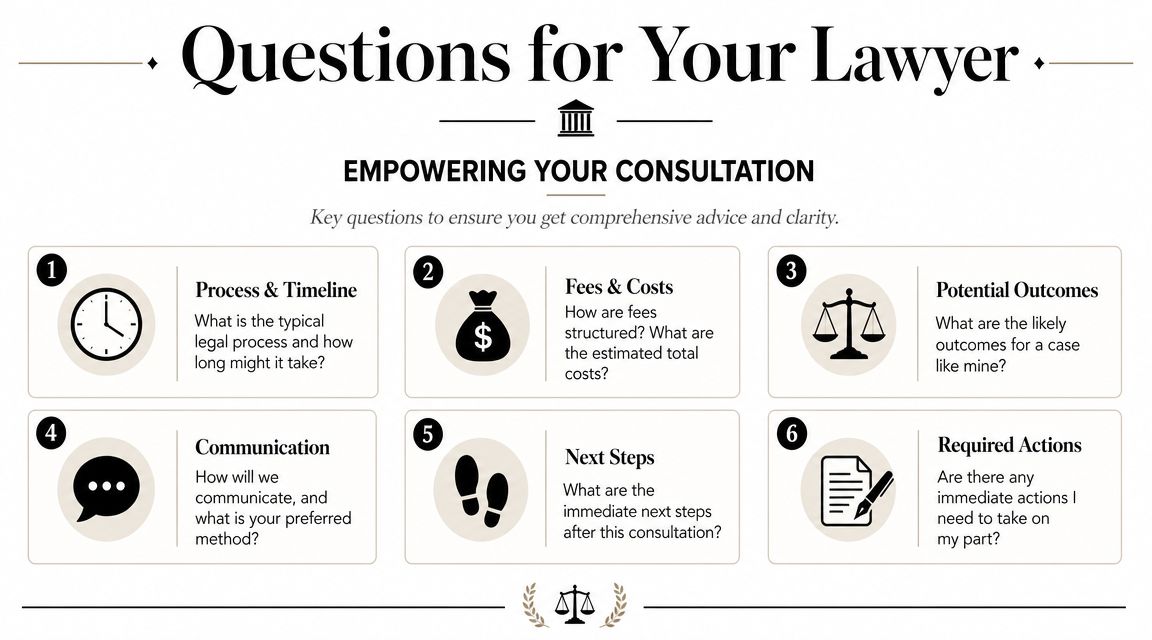
Ask who will contact you, what happens after the consultation, and what documents can wait. Those answers shape your experience almost as much as the legal advice does.
| Topic | Question to ask |
|---|---|
| Process | What is the first legal step if I hire you? |
| Urgency | Is there anything that needs attention this week, especially involving children, support, or access to money? |
| Fees | How do you bill, and what usually drives cost up or down in a case like this? |
| Communication | Will I hear from you, a paralegal, or both, and how quickly should I expect replies? |
| Evidence | If I have limited paperwork, what should I try to get first? |
One more question often helps people protect themselves outside the courthouse. If the other side is posting online, contacting friends, or trying to shape the story publicly, ask what your lawyer wants you to do and not do. These divorce reputation management strategies can also help you think through that issue before you respond emotionally.
This short video can also help you think through what to ask and how to approach the meeting.
If you leave the consultation with a clearer sense of risk, options, and your next task, the meeting did its job. If you still feel confused, ask one more direct question until the answer makes sense.
Navigating Confidentiality and Sensitive Topics
Many people hold back during a first meeting because they're embarrassed, afraid of being judged, or worried that the truth will make them look bad. That's understandable. It also makes it harder for a lawyer to protect you.
Attorney-client conversations are confidential. In plain English, that means you should be able to speak openly about the facts, including the uncomfortable ones. If alcohol, prescription misuse, anger, infidelity, hidden spending, family violence, or mental health concerns are part of the story, your lawyer needs to know. Surprises rarely help a family case.
How to talk about painful facts without spiraling
You don't need to explain every detail in the first five minutes. Start with direct statements.
- Safety concerns. Say if you're afraid to go home, afraid for your children, or concerned about retaliation.
- Substance use or instability. Say what you've seen, when it happened, and whether children were present.
- Financial secrecy. Say if accounts were moved, passwords changed, or records blocked.
Plain facts are easier to evaluate than emotional conclusions. "He emptied the joint account" is more useful than "He's trying to ruin me." Both may reflect the same event, but one gives your lawyer something concrete to act on.
If you have little or no paperwork
Many guides often miss a critical point. A major underserved issue in family-law preparation is what to do when you have little or no paperwork, especially if you're leaving a high-conflict relationship or can't access joint accounts, as noted in these tips on getting ready for your family law attorney consultation.
Practical rule: if you don't have the documents, bring the facts you do know. Names, dates, account names, employers, addresses, and the last information you saw are all useful.
When documents are missing, bring a substitute summary:
- A memory-based timeline of major events
- Known identifiers such as bank names, employer names, property addresses, vehicle details, or case numbers
- Urgent concerns involving protective orders, child exchanges, threats, or upcoming hearings
If the conflict has spilled online, public posts and digital smears can create extra stress during divorce and custody disputes. In those situations, some people also look at divorce reputation management strategies to think through how online activity may affect privacy and peace of mind.
For families across Northeast Houston, safety comes first. If gathering records puts you at risk, tell the lawyer that immediately. A consultation can still be productive without a perfect file.
Your Free Consultation at Our Humble Law Office
A first consultation often starts with a person sitting down, taking a breath, and saying, "I do not even know where to begin." That is normal. Family law problems rarely arrive in a neat folder. They usually show up in the middle of work schedules, school pickups, missed payments, angry texts, or fear about what happens this week, not six months from now.
At our Humble office, the goal of the meeting is simple. Get the facts clear, sort out what needs attention first, and explain what Texas family law is likely to require. If you brought records, those help. If you only have notes, screenshots, or a rough timeline, that still gives us something useful to work with.
Local details matter. A case involving Humble, Atascocita, Kingwood, or the larger Northeast Houston area can involve practical questions about where the children are staying, how exchanges are working, whether support is being paid, and whether a court filing needs to happen quickly. In divorce matters, the focus may turn to the house, bank accounts, debts, retirement funds, and whether one spouse has better access to financial information than the other.
You do not need to speak in legal terms. Clear facts are enough. If something is hard to say, say that too. A good consultation makes room for the human part of this. Shame, anger, grief, and confusion often sit right beside the legal issue, especially in custody fights and high-conflict separations.
Expect honest discussion about trade-offs. Pushing for immediate court action can bring protection or temporary structure, but it can also raise conflict and cost. Waiting can give more time to gather records or calm a co-parenting dispute, but delay is not always safe or wise. The right next step depends on your facts.
You should leave the meeting with a better sense of three things. What your options are. What problems need prompt attention. What information would help if you decide to hire counsel.
The consultation does not obligate you to hire anyone. It should give you clarity, not pressure.
If your family is dealing with divorce, custody, child support, enforcement issues, or a sudden change at home, schedule a free consultation with the Law Office of Bryan Fagan. Our Humble office helps clients across Humble, Atascocita, Kingwood, and Northeast Houston take the next step with a clearer plan and steadier footing.