Skip to content

If you're searching late at night for what evidence helps in child custody case texas, you're probably not looking for theory. You're looking for something solid you can do tomorrow morning.
A lot of parents in Humble, Atascocita, Kingwood, and across Northeast Houston sit in that same place. They know their child needs stability. They know they love their child. What they don't know is how to prove that in a custody case.
That's where evidence matters. In Texas family court, the judge doesn't know your daily routine unless you show it clearly. The court won't see the school drop-offs, the therapy appointments, the bedtime routines, or the messages where you tried to work things out unless those details are documented and presented the right way.
A custody case can feel personal and emotional because it is. But the strongest cases are usually built on calm, organized proof. School records. calendars. medical notes. communication logs. witness information. Official reports when safety is an issue. Those pieces tell the court a story grounded in facts instead of accusations.
Families in Harris County often move through temporary orders, mediation, and, if needed, a final hearing. At each step, good evidence can shape the outcome. That's why parents in Humble and nearby communities need more than general advice. They need practical guidance that fits Texas law and local court reality.
What follows is a plain-English guide to the evidence that tends to matter most, how to collect it, and how to avoid common mistakes that can weaken your case.
Navigating Your Child Custody Case in Humble Texas
A parent in Atascocita might have a phone full of texts, a stack of school papers on the kitchen counter, and a sinking feeling that none of it is organized enough to help in court. Another parent in Kingwood may know they've been the one taking the child to doctor visits and helping with homework, but they haven't kept records. Both parents usually have the same fear. "What if the judge doesn't see what I've done for my child?"
That fear is understandable. Custody cases don't turn on who sounds more upset or who tells the longest story. Courts look for reliable proof.
In real life, that often means the difference between saying, "I'm always there for my child," and being able to show a calendar with pickups, report cards you've signed, appointment confirmations, and messages showing you coordinated with the other parent. One is a claim. The other is evidence.
Practical rule: Start with what you can verify. If a fact can be backed up by a document, a date, a message, or a third party, it becomes much more useful in court.
For families in Humble and Northeast Houston, this gets even more important because Harris County cases move through local procedures that can feel fast and formal. Temporary orders may shape parenting time early. Mediation may push both sides toward settlement. If settlement fails, the final hearing becomes the place where your records need to hold up under scrutiny.
Three ideas help most parents steady themselves at the beginning:
- Think in patterns: Judges usually care more about repeated conduct than one isolated good day or bad day.
- Think like a record keeper: Save documents in categories instead of leaving everything buried in your phone.
- Think child first: The evidence that helps most is the evidence that shows how your plan supports your child's daily life.
You don't need to become a lawyer overnight. You do need a system. Once you understand what the court is looking for, the process gets less mysterious and much more manageable.
The Legal Standard The Best Interest of the Child
Texas custody law starts from one central idea. The court must focus on the best interest of the child. That standard is written into Texas Family Code Section 153.002, and courts often structure decisions around the nine Holley factors from Holley v. Adams (1976), including the child's emotional and physical needs, parental abilities, and the stability of the home environment, as explained in this discussion of how Texas courts decide child custody.
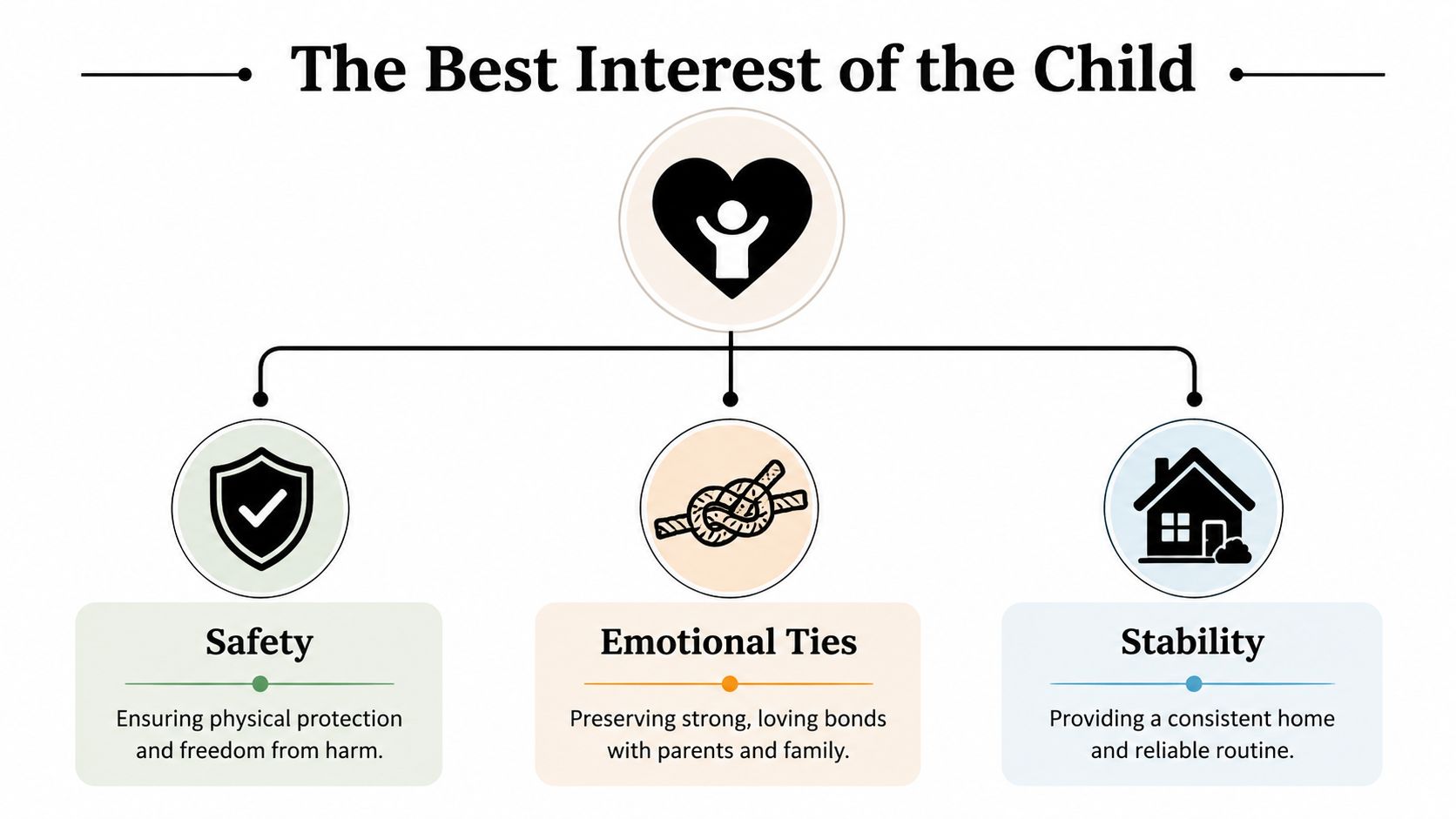
If that sounds broad, it is. But it isn't random. Judges usually sort the facts of your case into practical questions about safety, parenting ability, emotional connection, and stability.
What the court is really asking
In everyday terms, a judge is often looking at questions like these:
- What does this child need right now: A toddler's needs look different from a teenager's needs.
- Which parent has shown they can meet those needs: Not in theory, but in daily life.
- Which home is more stable: Routine matters. Predictability matters.
- Can each parent support the child's relationship with the other parent: Hostility and interference can hurt a case.
- Are there any safety concerns: Violence, substance abuse, neglect, and unsafe living conditions matter.
A Humble parent might read that list and think, "I don't know how to prove all of that." The answer is that you usually prove it through ordinary life records. School attendance. medical appointments. messages about schedule changes. Photos of the child's room. Witnesses who have seen your involvement firsthand.
The Holley factors in plain language
The Holley factors can feel abstract until you translate them into family life.
| Holley factor idea | What it can look like in daily life |
|---|---|
| Child's emotional needs | Who comforts the child, helps with routines, stays involved in school and therapy |
| Child's physical needs | Meals, sleep, hygiene, transportation, medication, healthcare follow-up |
| Emotional or physical danger | Documented violence, substance abuse, unsafe supervision, dangerous household conditions |
| Parental abilities | Helping with homework, communicating with teachers, attending appointments, handling discipline appropriately |
| Programs available to help the child | Therapy, tutoring, special education support, counseling, structured care |
| Plans for the child | A realistic parenting plan for school, holidays, transportation, and healthcare |
| Stability of the home | Consistent housing, reliable routine, predictable caregivers, low chaos |
| Acts or omissions by a parent | Repeated missed visits, ignoring medical needs, denying access, ongoing conflict |
| Excuses for those acts or omissions | Context may matter, but unsupported excuses usually carry less weight than records |
A judge isn't awarding points for being more persuasive at the dinner table. The court is looking for evidence that your home, your judgment, and your parenting decisions support your child's well-being.
Why this matters for parents in Northeast Houston
Parents in Kingwood, Humble, and Atascocita often get stuck on the wrong question. They ask, "How do I prove I'm the better parent?" Texas courts usually ask a narrower and more useful question. "What arrangement best serves this child?"
That's why the strongest evidence doesn't just praise you. It connects your actions to your child's actual needs. If your child has counseling, records showing you consistently participate in that process matter. If your child struggles in school, proof that you meet with teachers and follow through at home matters.
If you'd like a closer look at how courts apply this standard, this guide on how to prove best interest of child gives more detail in a Texas custody context.
Key Types of Evidence to Build a Positive Case
Good custody evidence usually answers one question clearly. What have you done to care for your child?
That's why positive evidence matters so much. It gives the court something concrete to rely on. Instead of focusing only on what the other parent did wrong, you build a record showing your own consistency, judgment, and involvement.
For parents in Northeast Houston, one point matters right away. A review of this issue explains that while sources discuss parental involvement, they don't quantify what counts as "enough." What courts tend to weigh more heavily is the quality and consistency of parental time, such as documented attendance at school events or regular phone calls, rather than a raw count of hours, as discussed in what evidence should I bring to family court in Texas.
Records that show daily parenting
Start with the basics of everyday care. These often carry more weight than dramatic one-time events.
- Parenting calendars: Keep a clear log of pickups, drop-offs, overnights, school transportation, and activity schedules.
- School involvement: Save report cards, attendance notices, emails with teachers, IEP or 504 paperwork, and notices for school events you attended.
- Medical involvement: Keep appointment reminders, discharge instructions, prescription records, therapy schedules, and records showing you participated.
- Activity support: Store schedules, registration confirmations, uniforms, receipts, and messages about practices or performances.
A parent in Kingwood who can show they regularly handle Tuesday and Thursday tutoring, dentist appointments, and soccer transportation is showing more than affection. They're showing structure and follow-through.
Communication that reflects cooperation
Family courts pay attention to how parents communicate because communication often predicts how co-parenting will work after the case ends.
Useful communication evidence can include:
- Texts or emails confirming plans
- Messages showing you offered reasonable schedule adjustments
- Written proof that you shared school or medical information
- Respectful responses during conflict
Messages don't need to sound perfect. They do need to sound child-focused. If your texts repeatedly show you trying to solve practical problems while the other parent escalates or refuses to respond, that pattern may help the court understand who is supporting stability.
Keep your messages short, factual, and polite. Write every message as if a judge may read it later.
Proof of a stable home and support system
Stability isn't only about income. It's about whether your child has a dependable living environment.
Consider gathering:
- Lease or mortgage records
- Utility bills showing an active residence
- Photos of the child's bedroom and common areas
- Childcare arrangements
- Emergency contact information
- Work schedule records that show availability
If you rely on help from a grandparent, sitter, or after-school program in Humble or Atascocita, document that support system. The court often wants to know whether your plan is realistic on ordinary weekdays, not just weekends.
Financial records that support your parenting plan
Money alone doesn't decide custody, but the ability to meet a child's needs matters. Financial documents can help show preparedness and reliability.
Examples include:
| Evidence type | Why it helps |
|---|---|
| Pay stubs or income records | Shows ability to contribute to housing, food, and daily care |
| Health insurance information | Shows access to medical coverage |
| Receipts for child expenses | Supports your involvement in actual needs |
| Child support payment records | Helps establish consistency and compliance |
Digital evidence needs extra care
Many parents make mistakes at this stage. They possess useful texts, social media posts, call logs, or screenshots, but they do not preserve them well.
The available guidance on Texas custody evidence identifies a real gap around digital evidence authentication and admissibility standards, especially for screenshots, messaging apps, and cloud-based records, as noted in this discussion of evidence in child custody cases. In plain language, that means your evidence may be important but still unusable if you can't show what it is, where it came from, and whether it was altered.
A safer approach is to:
- Save the full conversation, not just one screenshot.
- Preserve dates and contact information visible on the screen.
- Export records when possible from the app or device.
- Avoid editing or annotating the original image.
- Back up files in a folder by date and topic.
If you're using tools like TalkingParents, AppClose, iPhone message exports, Google Drive folders, or PDF printouts of emails, keep originals intact and organized. If you're working with an attorney, ask before forwarding, cropping, or printing anything important.
The Law Office of Bryan Fagan family law team can help parents organize school, medical, and communication records for use in a Texas custody matter, but the core principle stays the same no matter what tool you use. The evidence should show a steady pattern of responsible parenting.
Documenting Concerns About the Other Parent
There are times when your case isn't only about showing your strengths. You may also need to show why the other parent's conduct puts your child at risk or makes co-parenting harder.
This needs to be handled carefully. Courts usually respond better to documented facts than to emotional accusations.
A helpful summary of Texas custody evidence explains that courts want corroborated proof of parental fitness or unsuitability, and that patterns tracked through detailed logs can matter greatly. It also notes that texts or emails showing parental alienation or access denial, along with official records involving domestic violence or substance abuse, can be important, while unverified claims can seriously damage credibility, as discussed in what courts actually look for in Texas custody cases.
What to document and what to avoid
If you're concerned about the other parent, document behavior in a neutral format.
Good entries usually include:
- Date and time
- What happened
- Who was present
- What evidence exists
- How it affected the child
- What you did next
For example, "March 5, pickup was scheduled for 6:00 p.m. Other parent arrived at 7:15 p.m. Child had not eaten dinner. Neighbor Jane Smith was present." That's much stronger than, "They never care about our child."
Avoid adding labels like "abusive," "unstable," or "unfit" unless those descriptions are supported by official records or testimony. Let the documents carry the weight.
Serious issues that often require third-party proof
Some concerns need more than your personal notes.
| Concern | Stronger forms of proof |
|---|---|
| Family violence | Police reports, protective orders, medical records, witness testimony |
| Substance abuse | Arrest records, treatment records when legally available, court findings, test results if ordered |
| Neglect | School attendance records, teacher observations, medical follow-up gaps, photographs when appropriate |
| Access denial | Time-stamped messages, exchange logs, app records, witness confirmation |
| Unsafe cohabitants | Official records, criminal case documents, firsthand witness information |
If addiction is part of the family picture, parents often need support as well as documentation. For Houston-area families trying to understand treatment options, Altura Recovery's addiction help Houston resource may be useful alongside legal advice.
Stick to what you can prove. In custody court, clean documentation usually speaks louder than anger.
Why patterns matter more than one bad day
Most judges understand that parents are human. A late exchange once in a while may not decide a case. Repeated denials of visitation, repeated missed medical appointments, or repeated intoxication concerns can create a very different picture.
That's why your log should be consistent. If there's a problem, record it each time. If the issue improves, record that too. A balanced record looks more credible than a one-sided diary that only mentions the other parent's worst moments.
If you're dealing with repeated violations of an existing order, this guide on how to document custody violations in Texas can help you organize those facts in a way that's more useful to your lawyer and the court.
Making Your Evidence Count in a Harris County Court
A lot of parents assume that if they have evidence, the judge will automatically consider it. That's not how court works. Evidence has to get past the rules first.
Those rules often trip people up in Harris County family court. A screenshot may look persuasive to you and still draw an objection. A report may sound important and still be excluded if the proper witness isn't there to explain it.

The three gatekeepers
Most custody evidence problems come down to three issues.
- Relevance: Does this help answer a question the court must decide?
- Authentication: Can you show that the document, message, photo, or recording is what you claim it is?
- Hearsay: Are you trying to offer someone else's statement for its truth without a legal exception or proper witness?
One example matters a lot in custody cases. Texas evidence rules can block a standalone custody evaluation report because of hearsay. Admission generally requires the evaluator to testify live and sponsor the findings, and attorneys can use discovery tools like subpoenas to obtain financial and health records in a way that supports a best-interest presentation, as explained in this discussion of rules of evidence in family law.
Why digital proof needs planning
Parents often ask whether they should record calls or meetings. The answer depends on the facts and the law. If you're sorting through those privacy concerns, a plain-language overview of recording laws for remote teams can help you understand consent issues before you act. You should still get Texas-specific legal advice before relying on a recording in a custody dispute.
Here are safer habits for digital evidence:
- Preserve the original file if possible
- Keep messages in sequence
- Save metadata when available
- Don't crop out dates, names, or timestamps
- Write down where the file came from and when you saved it
A screenshot without context can invite arguments. A full thread, device backup, or export is often harder to challenge.
Discovery and courtroom preparation
Discovery is the formal process for getting information and documents from the other side or from third parties. In a custody case, that can matter when records aren't in your possession.
Examples may include:
- School records
- Medical records
- Counseling or therapy records where legally appropriate
- Employment records
- Financial documents
- Phone or app records when properly requested
This is also where self-represented parents often run into procedural trouble. The request has to be proper. The records have to be used properly. The witness may need to be available.
A short overview may help before a hearing:
If you're getting ready for temporary orders, mediation, or a final hearing in Harris County, this resource on how to prepare for custody hearing can help you think through exhibits, witnesses, and courtroom expectations.
Your Practical Evidence Collection Checklist
When parents feel overwhelmed, a checklist helps. You don't need to gather everything in one day. You do need to collect the right categories consistently and store them in a way you can effectively use later.
Some parents do well with a binder. Others use Google Drive, Dropbox, OneDrive, or a co-parenting app folder system. If you're trying to improve your process, this guide on modernizing your document gathering process offers practical ideas for organizing files without chasing paper across the house.
Good evidence is organized evidence. A strong document buried in a photo gallery or mixed into random text threads may not help when you need it fast.
Child Custody Evidence Checklist
| Evidence Category | Specific Item to Collect | Why It Matters (for the Court) |
|---|---|---|
| Parenting time | Calendar of pickups, drop-offs, overnights, missed visits | Shows consistency, reliability, and your actual role in daily care |
| School records | Report cards, attendance records, teacher emails, IEP or 504 documents | Reflects involvement in education and awareness of the child's needs |
| Medical care | Appointment records, prescription information, therapy schedules, discharge paperwork | Shows who follows through on health needs |
| Communication | Texts, emails, parenting app logs, voicemail records | Helps show cooperation, schedule coordination, or access problems |
| Home environment | Photos of child's bedroom, proof of residence, utility records | Helps show stability and a safe place for the child |
| Financial support | Pay stubs, insurance records, receipts for child expenses, payment confirmations | Supports your ability to meet needs and your history of doing so |
| Extracurricular life | Registration forms, schedules, team emails, recital or practice notices | Shows involvement beyond basic care |
| Childcare support | Babysitter records, daycare contracts, family support contacts | Shows your plan is realistic during work or school hours |
| Safety concerns | Police reports, CPS records if applicable, medical reports, protective orders | Documents serious risk issues with objective records |
| Witness list | Teachers, coaches, counselors, relatives, neighbors with firsthand knowledge | Helps your lawyer identify who can support your account |
| Order compliance | Copy of current court orders, notes on compliance, records of exchanges | Shows whether each parent follows court rules |
| Personal log | Neutral dated journal of major events, concerns, and follow-up actions | Helps create a clear timeline and preserve memory |
A simple filing method that works
Try one folder for each category and a subfolder by month. Name files in a way that makes sense later, such as "2026-03-Teacher-Email-ReadingSupport" or "2026-04-Pickup-Text-Delay." Consistent names save time when your attorney asks for records quickly.
If you prefer paper, use dividers and a running index. Keep originals safe. Print backups of the most important records before mediation or a hearing.
How a Humble Family Law Attorney Makes the Difference
Parents often think their custody case turns on who has the stronger emotions or the more compelling personal story. In practice, cases often turn on something more grounded. Which parent can present a clear, credible record that shows what arrangement serves the child.
That's hard to do alone. Not because you're not capable, but because custody evidence has two separate jobs. It has to be persuasive, and it has to be usable under court rules. A parent may have both truth and good intentions on their side and still struggle if records are disorganized, incomplete, or presented the wrong way.
Local knowledge matters in practical ways
A family law attorney serving Humble, Atascocita, Kingwood, and Northeast Houston doesn't just look at your documents and say "this is good" or "this is bad." The lawyer helps shape the record into something the court can follow.
That often includes:
- identifying what evidence supports the child's best interest
- spotting weak areas before the other side attacks them
- organizing exhibits and timelines
- preparing witness testimony
- using formal discovery tools when records are in someone else's hands
- helping you avoid credibility mistakes, especially in texts, logs, and accusations
For Harris County families, procedure matters as much as substance. Temporary orders can influence the rhythm of the case early. Mediation can reward the parent who shows preparation and reasonableness. A final hearing can turn on whether the judge receives a clean, supported explanation of your child's needs and your parenting plan.
A steady guide during a stressful process
The emotional side of custody cases can make people either overreact or freeze. Some parents send too many angry messages. Others do nothing because they don't know where to begin. An attorney helps create a middle path. Gather the right facts. Ignore distractions. Stay focused on the child.
The goal isn't to produce the biggest stack of papers. The goal is to present the most credible story, supported by records the court can trust.
If you're a parent in Humble or nearby, the right legal help can turn scattered records into a practical strategy. That can protect your time with your child, reduce avoidable mistakes, and help the court see the day-to-day reality of your parenting.
If you're facing a custody dispute and need clear guidance on what evidence helps, schedule a free consultation with the Law Office of Bryan Fagan. Our Humble office works with families across Humble, Atascocita, Kingwood, and Northeast Houston to organize records, prepare for Harris County court, and build a child-focused case grounded in facts.