Skip to content

If you're searching for how to win a custody hearing texas, you're probably not reading for curiosity. You're reading because your child's routine, your time together, and your role as a parent suddenly feel uncertain.
That's a hard place to be. Parents in Humble, Kingwood, Atascocita, and across Northeast Houston often come into a custody case thinking the hearing will turn on one dramatic moment. Most of the time, it doesn't. Custody hearings are usually decided by something less dramatic and more demanding: preparation, credibility, and proof that your plan gives your child the steadier life.
A Texas judge isn't grading who feels more hurt or who tells the more emotional story. The judge is looking for the parent who can show, with specifics, that they meet the child's needs, support the child's relationship with the other parent when appropriate, and bring order instead of conflict. That's where cases are won.
Understanding the 'Best Interest of the Child' in Texas
Texas custody law starts with one rule that controls everything else. Texas Family Code § 153.002 makes the best interest of the child the primary consideration in custody hearings, and Texas courts use considerations associated with Holley v. Adams when judging parental fitness, as explained by the Texas State Bar's discussion of custody and best-interest standards.
That means the court is not asking, “What feels fair to each parent?rdquo; The court is asking, “What arrangement best protects this child's emotional, physical, and developmental well-being?rdquo;

Think of the hearing as a filter
Every text message, school record, missed pickup, doctor visit, and courtroom answer gets filtered through that best-interest standard.
If a parent says, “I deserve more time,” that has limited value by itself. If that same parent can show regular school involvement, medical follow-through, a stable home, and calm co-parenting communication, the court has something useful to work with.
Practical rule: If a fact in your case doesn't help show safety, stability, involvement, sound judgment, or child-focused decision-making, it may not carry much weight.
The Holley factors in plain English
Judges don't usually hand parents a checklist in court, but the legal analysis often tracks familiar themes. Here is a plain-English version of what those factors usually look like in real life.
| Holley Factor | What It Means for Your Case |
|---|---|
| Child's emotional and physical needs | Can you consistently handle meals, sleep, school, medical care, supervision, and comfort? |
| Emotional and physical danger to the child | Is there evidence of unsafe conduct, neglect, substance issues, poor judgment, or instability? |
| Parenting abilities of each parent | Who actually handles routines like homework, bathing, appointments, transportation, and discipline? |
| Programs or support available | Do you use school support, counseling, family help, or community resources in a healthy way? |
| Plans for the child | Do you have a workable plan for school, exchanges, activities, holidays, and daily care? |
| Stability of the home | Is your housing steady, your routine predictable, and your schedule manageable for the child? |
| Acts or omissions by a parent | Have you abandoned responsibilities, failed to show up, or created unnecessary conflict? |
| Excuses for those acts or omissions | If something went wrong, do you have a credible explanation backed by conduct that improved afterward? |
For infants, the analysis gets even more concrete. Texas legal resources discussing child development point to basics like feeding, sleep, bathing, safety awareness, and responsive care for children from birth to 18 months. In other words, the court looks at who is doing the work.
What judges in practice tend to notice
In Harris County family court, broad claims don't land as well as patterns. “I'm the better parent” is weak. “I've taken our child to pediatric appointments, handled daycare drop-offs, and adjusted my work schedule to cover bedtime during the week” is stronger because it is specific and testable.
That's why parents should learn this standard early. Once you understand the lens the court uses, your choices change. You stop collecting random grievances and start building proof that connects directly to your child's needs.
A good deeper read on that issue is this guide on how to prove the best interest of the child in Texas.
What doesn't help much
Some facts matter less than parents expect:
- Moral scorekeeping: Judges rarely reward a parent for pointing out that the other parent is annoying, difficult, or immature.
- Old relationship arguments: Fights about the marriage or breakup often distract from the child-focused issues unless they affect parenting.
- Possession language: Talking like the child is property can hurt more than parents realize.
- Last-minute image repair: Sudden changes right before court often look staged if they aren't supported by a longer pattern.
The strongest custody cases feel less like an attack and more like a clear answer to one question: who is most ready to provide a stable, healthy daily life for this child?
Building Your Case Evidence and Documentation Strategy
Most custody hearings are shaped long before anyone walks into court. The parent who arrives with organized records, a clean timeline, and reliable witnesses usually has a major advantage. A 2026 analysis discussed in this Texas custody guide states that parents presenting well-documented cases secured primary custody in over 65% of contested cases.
That number makes sense in practice. Judges hear competing stories all day. Documents, timelines, and third-party records give them something firmer than accusations.
Start before the case feels urgent
One of the biggest mistakes parents make is waiting until they're served or until a hearing is set. Courts tend to trust patterns that began before litigation more than records built overnight after a fight started.
If you live in Humble or Kingwood and you're already worried that custody may become contested, begin documenting now. Don't dramatize it. Don't manufacture it. Just create a reliable record of your parenting life.
What to collect and why it matters
Think in categories, not in piles of paper. Your goal is to prove involvement, judgment, consistency, and stability.
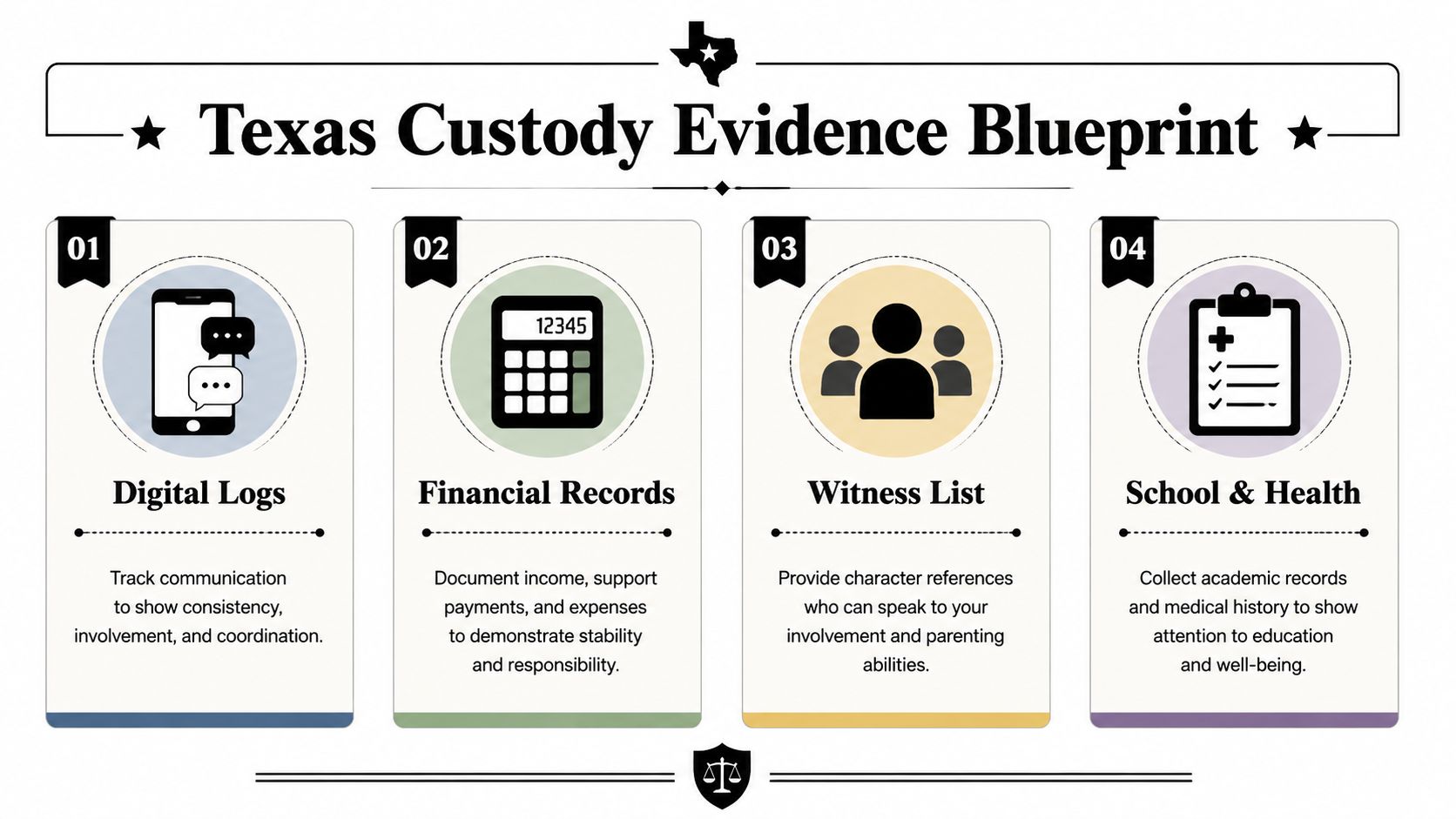
- Calendar records: Track school drop-offs, pickups, extracurriculars, doctor visits, counseling sessions, homework help, bedtime routines, and overnight care.
- Communication logs: Save texts and emails that show scheduling, co-parenting efforts, requests about school or health, and your responses.
- School material: Attendance records, teacher emails, report cards, disciplinary notices, school portal screenshots, and event participation.
- Medical records: Appointment confirmations, discharge instructions, vaccination records, therapy scheduling, prescription pickup records when relevant.
- Photos with context: Use images sparingly and only when they show something concrete, such as attending a school function or setting up a child's room.
- Parenting plan drafts: Written proposals for weekdays, weekends, holidays, transportation, and communication.
- Witness information: Teachers, coaches, daycare staff, neighbors, relatives, counselors, and others who have direct knowledge of your parenting.
Build a timeline that a judge can follow
A strong custody file is easy to follow. If your evidence is chaotic, the court may miss your best points.
Use a simple system:
Create monthly folders
Keep digital and paper copies by month.Use dated entries
If you took your child to a pediatrician in Atascocita, note the date, purpose, and outcome.Match claims to proof
If you say you handle school transportation in Kingwood, pair that claim with calendar entries, messages, and attendance-related records.Highlight child-centered facts
Focus on needs met, not personal frustration.
A hearing file should read like a steady record of parenting, not a scrapbook of anger.
The daily details that often decide cases
Parents sometimes overlook the ordinary work that matters most. Courts usually care less about big gestures than about repeated care.
Examples include:
- Morning routines: Who gets the child up, dressed, fed, and out the door on time?
- School continuity: Who talks to teachers, checks assignments, and attends events in Humble ISD or nearby districts?
- Health management: Who notices symptoms, schedules appointments, and follows treatment instructions?
- Emotional regulation: Who comforts the child, handles transitions well, and keeps adult conflict away from them?
- Transportation reliability: Who makes sure the child gets where they need to go safely and consistently?
If your child is very young, note feeding schedules, sleep routines, bathing, safety practices, and who handles night wakings. If your child is older, note homework support, tutoring, sports, counseling, and peer-related concerns.
What good documentation looks like
Good documentation is neutral in tone and precise in detail.
Better example:
- “March 6. Picked up J. from school at 3:10 p.m. Teacher reported missing science packet. Completed it together that evening and returned it next morning.”
Weak example:
- “Other parent never helps with school and I do everything.”
One gives the court a fact pattern. The other is a conclusion without support.
Text messages can help or hurt
Many parents already have useful evidence in their phones. They also have material that can damage the case.
Save messages that show:
- your cooperation,
- your effort to share information,
- your attempts to confirm schedules,
- your calm responses to conflict,
- your focus on the child.
Be careful with messages that show:
- threats,
- sarcasm,
- insults,
- repeated accusations,
- pressure on the child through the other parent,
- refusals to comply without a legal basis.
If visitation problems or missed exchanges are part of your case, this guide on how to document custody violations in Texas is a useful companion piece.
Witnesses matter, but only the right ones
Not every supportive person is a strong witness. A judge usually gives more weight to people with firsthand knowledge than to people repeating what you told them.
The most effective witnesses often include:
- Teachers and school staff: They can speak to attendance, who communicates with school, and who shows up.
- Daycare providers: They often know pickup patterns, payment consistency, and parent involvement.
- Medical professionals or therapists: Their role is often narrower, but they may confirm attendance and participation if permitted.
- Coaches or activity leaders: They can describe presence, consistency, and the child's functioning.
- Neutral relatives or neighbors: Sometimes useful if they've directly observed exchanges or caregiving.
The least effective witnesses are usually friends or family members who sound like they're auditioning for your side. A witness should offer observations, not speeches.
A written parenting plan is more persuasive than a complaint list
Many parents spend all their energy proving the other parent is flawed. That's incomplete. Courts also want to see your plan.
A solid parenting plan should address:
- school-week schedules,
- holidays,
- summer possession,
- exchange locations,
- extracurriculars,
- medical decision-making,
- communication methods,
- makeup time when needed,
- how both parents will receive school and medical information.
That kind of planning shows maturity. It also tells the judge you're thinking beyond the lawsuit.
What usually backfires
Parents who are desperate sometimes make their own evidence worse. Common problems include:
- Recording everything without context: A mountain of screenshots is useless if nobody can tell what matters.
- Dragging the child into the case: Asking a child to report on the other parent usually looks manipulative.
- Posting online: Social media rarely helps and often creates exhibits for the other side.
- Editing reality: If one entry is exaggerated, your credibility can suffer across the whole file.
- Focusing only on the other parent: You still have to prove your own strengths.
The work that wins custody cases is repetitive and unglamorous. Keep the calendar. Save the messages. Gather the records. Stay organized. Parents who do that give the court a stable story to trust.
Strategic Decisions Mediation, Temporary Orders, and Your Game Plan
Early strategy shapes the rest of the case. Some parents need a negotiated path. Others need immediate court intervention. The right move depends on safety, urgency, and whether the other parent is acting in good faith.

Mediation and a contested hearing are different tools
Mediation can work well when both parents are capable of compromise and there isn't a serious safety concern. It gives families more control over the schedule, pickup logistics, holiday planning, and decision-making language than a judge may have time to craft from the bench.
A contested hearing is different. That's the route when one parent won't cooperate, facts are sharply disputed, or the child's stability is at risk.
Here's a practical comparison:
| Option | Often works best when | Main risk |
|---|---|---|
| Mediation | Both parents can negotiate in a reasonably productive way | A stronger or louder parent may push for terms that don't reflect the child's actual needs |
| Temporary orders hearing | Immediate structure is needed for possession, support, or decision-making | You have less time to prepare, so weak organization shows quickly |
| Final contested hearing | The court must resolve major disputes after evidence is developed | It can lock in impressions created much earlier in the case |
If you need a plain-language overview of the process, this article on what mediation means in family court is a helpful starting point.
Temporary orders often matter more than parents expect
Temporary orders can function like a preview of the final case. They establish where the child stays, who pays support, and how parenting time will work while the lawsuit is pending. Once a routine is in place, courts are often reluctant to disrupt a child's stable pattern without a strong reason.
That's one reason early preparation matters so much. According to a Texas custody procedure guide discussing contested hearings, Texas Family Code requires at least 45 days' notice before contested final hearings, which creates an important preparation window and makes the strategy around temporary orders even more significant.
Sometimes the most important hearing in a custody case is the first one that creates a workable status quo.
Choosing the right path in a real-world case
A parent in Atascocita who has generally decent communication with the other parent may benefit from mediation if both sides can agree on school logistics and possession terms.
A parent in Humble dealing with repeated missed exchanges, unstable conduct, or a sudden effort by the other side to seize control may need temporary orders quickly. In that setting, waiting for cooperation that never comes can cost valuable ground.
Good strategy is not about being aggressive for the sake of it. It's about matching the legal tool to the actual problem in front of you.
Navigating Your Day in a Harris County Courtroom
The hearing day feels intimidating for almost everyone. That's normal. What helps is knowing that judges are not looking for a polished performance. They're looking for calm, credible, child-focused behavior.

What to do before you speak
Arrive early. Dress neatly and conservatively. Bring your documents in order, not loose in a shopping bag or shoved into screenshots you can't find.
When the judge, staff, or opposing counsel speaks, listen fully. Don't interrupt. Don't react visibly to every statement you dislike. In court, self-control is part of your evidence.
The language you use matters
Courtroom strategy isn't only about what you prove. It's also about how you present yourself. Guidance on hearing demeanor in this courtroom strategy video discussing child-focused presentation notes that judges disfavor irresponsible conduct and even notice possessive framing such as saying “my child” instead of “our child,” because that can suggest a less child-centered approach.
That principle sounds small, but it matters. A parent who speaks as if the child belongs to them can come across as controlling. A parent who speaks about the child's needs and routines sounds more grounded.
Use language that shows shared responsibility where appropriate and steady concern for the child's well-being.
Do this, not that
A lot of courtroom mistakes happen in a few seconds. Here's what that looks like in practice.
Do answer the question asked.
Don't turn every answer into a speech about the breakup.Do stay factual.
Don't guess, exaggerate, or try to fill silence with extra details.Do acknowledge the other parent's strengths when they're real.
Don't act as if the other parent has never done one decent thing in the child's life.Do keep your face neutral.
Don't roll your eyes, sigh loudly, laugh, or shake your head during testimony.Do admit a mistake if one happened.
Don't defend the indefensible. Judges usually notice honest accountability.
A short video overview may also help you picture how these issues play out in court:
A better answer versus a damaging answer
Suppose opposing counsel asks why you want primary custody.
A damaging answer sounds like this: “Because the other parent is impossible, selfish, and never listens to me.”
A stronger answer sounds like this: “I'm asking the court to keep the school-week routine stable because I've been handling morning preparation, school transportation, homework, and medical scheduling, and I have a plan that keeps those responsibilities consistent.”
The second answer stays on the child. That's the habit to practice.
Conduct that can sink a good case
Some parents have solid evidence and still hurt themselves at the hearing by acting out their frustration.
Watch for these problems:
- Badmouthing in broad terms
- Arguing with the other parent in the hallway
- Talking over the judge
- Showing up late
- Blaming everyone else for every conflict
- Treating the case like a contest for personal victory instead of a decision about the child
In a Harris County courtroom, your composure tells the judge something important. It suggests how you'll behave during exchanges, school conflicts, medical disagreements, and stressful parenting moments after the case is over.
Special Considerations for Parents in Humble and Northeast Houston
Local knowledge matters in custody cases. Not because the law changes from one neighborhood to the next, but because the facts that persuade a court are often rooted in local routines, schools, judges, and filing patterns. A generic internet article won't tell a parent in Humble how to present a school-week schedule tied to Kingwood or Atascocita life. A local strategy will.
Mental health and substance abuse allegations need a plan
These allegations can change the direction of a case very quickly. If the issue is real, the court will focus on safety, judgment, treatment, and whether the parent is functioning consistently. If the issue is exaggerated or weaponized, the parent still needs a serious response.
A useful underserved point from a Texas family law discussion of custody strategy and evaluations is that courts may order psychological evaluations in contested cases, and some parents are caught flat-footed when concerns about emotional stability or untreated issues become central.
If you know mental health, prescription misuse, alcohol use, or similar allegations may appear in your case, waiting to “see what happens” is risky.
Consider practical steps like:
- gathering treatment records if appropriate,
- showing medication compliance when relevant,
- documenting sobriety efforts,
- demonstrating stable work and home routines,
- avoiding defensive texts that sound erratic or threatening,
- being ready for an evaluator or amicus attorney to look for consistency.
Local courts care less about labels and more about function. Can the parent safely, reliably, and calmly meet the child's needs?
Fathers in Harris County need a deliberate strategy
Fathers can and do win custody cases in Texas, but they shouldn't rely on broad statements about fairness. They need proof. That is especially important in contested cases where historical caregiving patterns are disputed.
According to Harris County-focused reporting on fathers and custody strategy, SAPCR filings in Harris County were up 15%, fathers secured sole managing conservatorship in 18% of contested cases in 2025, and 62% of Humble-area temporary sole custody grants to fathers converted to final orders. That same discussion points to an immediate practical lesson. Fathers who have a strong factual basis should think seriously about temporary orders instead of assuming they can sort everything out later.
Those numbers don't mean fathers should rush blindly into court. They mean timing matters when the father is already acting as the stable, hands-on parent.
Hyper-local facts can be persuasive
In custody litigation, local involvement is often easier to prove than abstract claims about love and commitment.
Examples that may matter:
- regular participation at a Humble ISD school,
- transportation tied to a child's actual route and start time,
- attendance at Kingwood or Atascocita extracurricular activities,
- reliable housing close to the child's school or childcare,
- a communication system that shows organized co-parenting.
Tools can help. Some parents use platforms like OurFamilyWizard to keep messages, calendars, and expense records in one place. A well-kept digital record can reduce the usual “he said, she said” problem and make your day-to-day role easier to show.
Why local counsel has an edge
A lawyer familiar with Humble, Kingwood, Atascocita, and the Harris County family courts can usually spot issues that national articles miss. That includes when a temporary orders hearing needs to happen quickly, what records are likely to matter most, and how to prepare for local courtroom expectations in a way that feels practical rather than theoretical.
That kind of local judgment doesn't replace evidence. It helps you present the right evidence at the right time.
After the Hearing Protecting Your Family and Your Future
A custody hearing doesn't just produce a winner and loser. It produces an order that will shape school mornings, holidays, exchanges, medical decisions, and communication for a long time. That's why the period after the hearing matters so much.
Read the order carefully and follow it exactly
When the court signs orders, read every section. Don't assume you understand the details from memory. Pay attention to pickup times, holiday schedules, notice requirements, geographic restrictions, child support terms, rights to school and medical information, and any special conditions.
Small violations can create big problems later. If the order says exchanges happen at a certain time and place, follow that language precisely unless both parents clearly agree otherwise in writing.
Shift from litigation mode to documentation mode
Even after the hearing, keep records. Not because you want another case, but because life changes and misunderstandings happen.
Keep track of:
- exchanges,
- school notices,
- medical updates,
- reimbursement requests,
- agreed schedule changes,
- significant parenting concerns.
If things improve, great. If they don't, organized records will matter if enforcement or modification becomes necessary later.
Build a co-parenting structure that reduces friction
Not every family becomes friendly after a custody case. Many can still become functional. That's enough.
A workable post-hearing routine usually includes:
- written communication for important topics,
- child-focused scheduling,
- neutral exchange locations when needed,
- quick notice of school or health issues,
- avoiding emotional debates in front of the child.
The long-term goal isn't to keep winning arguments. It's to create a stable life your child can count on.
If circumstances change, the order may need to change
Custody orders aren't always permanent in practical effect. A major change in a parent's schedule, relocation, school needs, health concerns, or the child's development may justify a modification. The key is not self-help. Don't just stop following the order because your situation changed. Get legal advice and address it the right way.
Parents who approach custody with preparation and discipline usually put themselves in a stronger position both during and after the hearing. That's true whether you're facing your first case in Humble or trying to stabilize a difficult situation in Northeast Houston.
If you're dealing with a custody dispute in Humble, Kingwood, Atascocita, or anywhere in Northeast Houston, Law Office of Bryan Fagan can help you build a clear, child-focused strategy. Our team offers free consultations and practical guidance designed for your family, your court, and your next step. If you need help preparing for temporary orders, organizing evidence, responding to custody allegations, or planning for a final hearing, schedule a confidential consultation with our Humble office today.