Skip to content

You may be reading this after a hard night. Maybe the other parent just said they're “going for full custody.” Maybe you live in Humble, Atascocita, Kingwood, or somewhere else in Northeast Houston and you're staring at texts, school emails, and a calendar, trying to figure out what matters and what doesn't.
Here's the blunt answer. If you want to understand how to win a custody case in Harris County Texas, stop thinking like this is a popularity contest between parents. It isn't. Harris County judges care about whether your evidence shows a stable, child-focused plan that serves your child's life day to day.
That's good news for parents who are doing the work.
If you've been getting your child to school, handling doctor visits, keeping a safe home, and trying to keep conflict from spilling onto your child, you may already have the foundation of a strong case. The problem is that many good parents lose ground because they don't organize proof, miss local court requirements, or walk into court assuming the judge will “just see” what's obvious. That's not how these cases work in Harris County.
You need a record. You need a plan. You need to know what the local court process expects from you. If you're trying to reduce conflict while separating, some families also benefit from resources on mindful relationship uncoupling, especially when the goal is protecting the child from adult fallout. But once a custody case is active, goodwill alone won't carry you. Procedure matters.
Families from Humble often find the Harris County process confusing because the case may be local to your life but still move through a larger county court system with its own rules, deadlines, and expectations. If you need a practical overview of where these cases are handled, this guide to Harris County family court for Humble families is a helpful starting point.
Understanding the Road Ahead in Your Custody Case
A lot of parents come in with the same question: “How do I win?” I understand why they ask it that way. Custody cases are emotional, personal, and frightening because the outcome shapes your child's daily life.
But the word win can lead you in the wrong direction.
What winning actually means
In Harris County, winning usually means proving that your proposed order makes better sense for your child's routine, development, and safety than the alternative. Judges aren't grading who feels more hurt. They're deciding what arrangement they can sign that best supports the child.
That changes how you should prepare.
Practical rule: Build your case around what you do for your child consistently, not around how angry you are at the other parent.
If you live in Kingwood or Atascocita and your child's life already has a rhythm, school drop-offs, homework, meals, medical appointments, bedtime, activities, your case should show that rhythm clearly. The parent who can present a calm, documented picture often stands on much firmer ground than the parent who shows up with accusations and no paper trail.
What usually hurts parents early
Some mistakes show up again and again:
- Assuming truth is enough: If something happened, you still need records, messages, school notes, calendars, or witnesses that support it.
- Talking too much about the other parent: Courts care about your child's needs. Keep bringing the focus back there.
- Ignoring local procedure: Harris County expects parents to follow specific steps. Sloppiness can undercut a strong position.
- Acting out during the case: Angry texts, missed exchanges, or open disrespect toward the other parent can damage your credibility fast.
The roadmap that matters
Your custody case usually turns on four things:
- The legal standard the judge must apply
- The quality of your documentation
- Your compliance with Harris County procedure
- How clearly you present your request
That's the road ahead. It may feel intimidating right now, but it's manageable when you break it into pieces and start acting with discipline instead of panic.
The Foundation of Your Case The Child's Best Interest
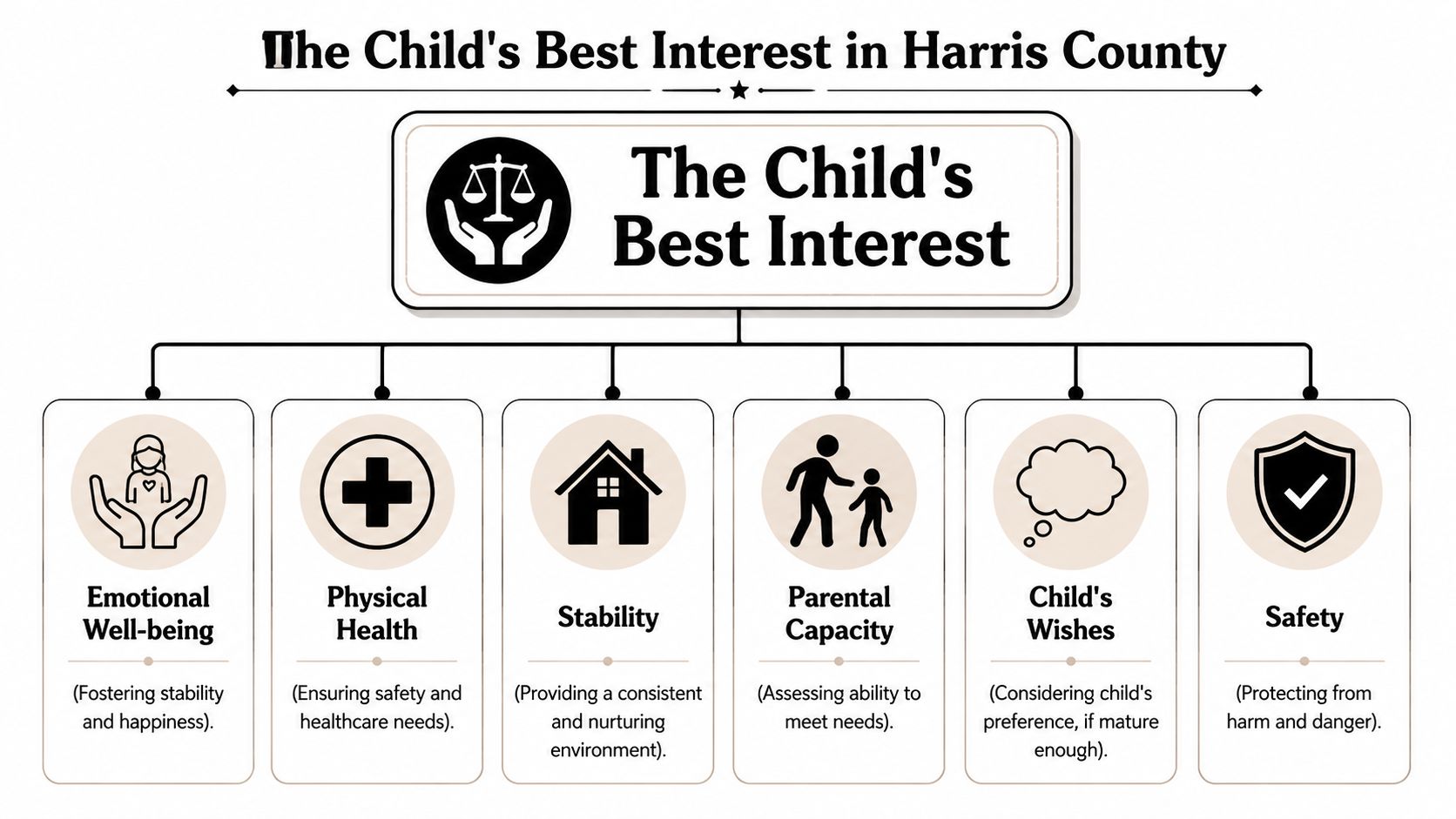
Texas custody law doesn't ask which parent is “better” in some abstract sense. It asks what arrangement serves the best interest of the child, and Texas courts use the Holley factors to evaluate that question. The State Bar of Texas explains that judges look at concrete parenting behavior, including who can meet the child's developmental needs such as eating, sleeping, bathing, emotional care, and safety, along with related child-welfare concerns in family court cases involving custody and visitation (State Bar of Texas guidance on the Holley factors).
What that means in real life
Judges are looking for facts they can use. Not slogans. Not vague claims. Facts.
A parent in Northeast Houston who can show they handle school communication, medical follow-up, meals, hygiene, transportation, and emotional support is speaking the court's language. A parent who says “I'm the better mom” or “I'm the better dad” without records is not.
Here's how that usually plays out:
- Daily care matters: Who gets the child ready in the morning, manages bedtime, and handles basic needs?
- School involvement matters: Who communicates with teachers, tracks attendance, and supports learning?
- Medical involvement matters: Who schedules appointments, follows treatment instructions, and responds to health concerns?
- Home stability matters: Is the home consistent, safe, and suitable for the child's routine?
- Co-parenting matters: Does the parent support the child's relationship with the other parent when appropriate?
- Safety matters: If there are real safety concerns, the court wants objective proof, not broad character attacks.
The judge wants specifics
The best-interest standard sounds broad until you put it into plain English: can you show that your plan gives the child reliable care, emotional steadiness, and a workable home life?
That's why I tell parents to stop preparing speeches and start preparing examples.
Use examples like these:
| Issue the court cares about | Strong proof |
|---|---|
| Daily caregiving | Calendar entries, school pickup records, childcare messages |
| Medical involvement | Appointment confirmations, discharge instructions, pharmacy records |
| Education | Report cards, parent portal messages, teacher emails |
| Stability | Lease or mortgage records, consistent address, child's sleeping space |
| Co-parenting | Civil message threads, proposals for exchanges, flexibility when appropriate |
The parent who ties every argument back to the child's day-to-day life usually sounds more credible than the parent who turns the hearing into a relationship autopsy.
Evaluations look for these same themes
Some custody disputes become more evaluation-driven than parents expect. If you want perspective on how professionals think about parental functioning in high-conflict situations, PPA's immigration assessment process offers a useful outside example of how structured parenting-capacity review can focus on behavior, caregiving, and functioning rather than emotion alone.
If you want a closer look at how courts and lawyers build arguments around this standard, this page on proving the best interest of the child in Texas is worth reading.
Your job is simple to say and hard to do. Show the judge, with evidence, that your proposed order helps your child live a safer, steadier, healthier life.
Building Your Case Before You File
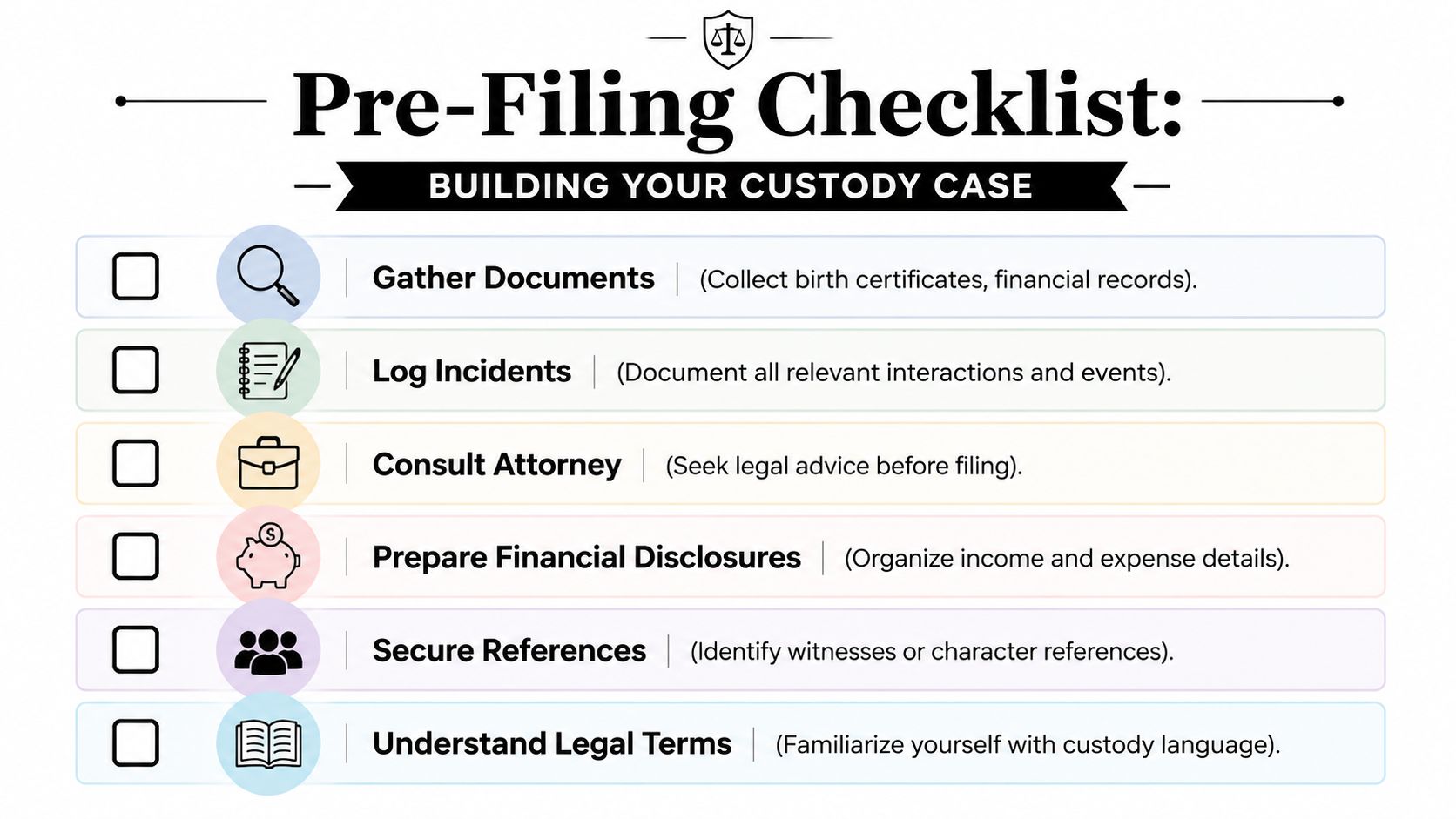
Before you file anything, start building your proof. Don't wait for a hearing date. Don't wait for the other parent to make the first move. In Harris County custody cases, evidence quality often shapes outcomes, and organized records like parenting calendars, communication logs, and proof of income put a parent in a stronger procedural position than testimony alone. Local guidance also warns that violating orders or showing instability can hurt credibility in court (Harris County custody process discussion on Avvo).
Start your documentation stack now
If you're serious about how to win a custody case in Harris County Texas, build a file that answers one question over and over: what have you done for this child?
Keep it organized. Date everything. Save it in one place.
- Parenting calendar: Track overnights, pickups, drop-offs, school events, doctor visits, homework help, and activities.
- Communication log: Save texts, emails, and app messages with the other parent. Keep the useful ones. Skip the temptation to editorialize.
- School records: Hold onto attendance records, grade updates, teacher messages, and notices that show your involvement.
- Medical records: Keep appointment reminders, after-visit summaries, prescriptions, therapy schedules, and insurance documents.
- Proof of stability: Gather pay stubs, housing documents, childcare receipts, and anything else that shows a steady home life.
- Incident notes: If something concerning happens, write a factual note with dates, times, and what you personally observed.
How to document without hurting yourself
Parents often sabotage their own case by creating records that sound emotional, sarcastic, or vindictive. Don't do that. Your notes may someday be reviewed by a lawyer, mediator, evaluator, or judge.
Use this approach instead:
| Bad recordkeeping | Better recordkeeping |
|---|---|
| “He's a terrible father and always irresponsible.” | “On Tuesday, he arrived late for pickup and the school called me to get the child.” |
| “She never cares about medical needs.” | “I scheduled the pediatric visit, attended it, and sent the after-visit summary the same day.” |
| “The other parent is unstable.” | “The child told me there was no adult present for a period of time. I noted the date and preserved the message exchange.” |
Case-building advice: Write like a witness, not like a frustrated ex.
File from a position of strength
A lot of people rush into filing before they've gathered basics. That's backwards. The filing starts the legal process, but your preparation starts the case.
Before you file, make sure you can quickly access:
- Identity documents: Birth certificates and identifying records
- Your timeline: A clear history of who has done what for the child
- Your proposed outcome: Where the child should live, what schedule you want, and why
- Your support documents: Income and household information that shows reliability
If you need more detail on the kinds of proof that help most, this guide on what evidence helps in a Texas child custody case gives a practical breakdown.
Good parents often think the truth will organize itself. It won't. You have to do that part.
Navigating the Harris County Court System
You file your case expecting a judge to focus on your child right away. Instead, the first problems are often procedural. A missed notice, an incomplete filing, a skipped class, or sloppy disclosures can slow your case down before anyone reaches the parenting issues that matter most.
That is the reality in Harris County. If you want to win, you need more than a good story. You need procedural discipline.
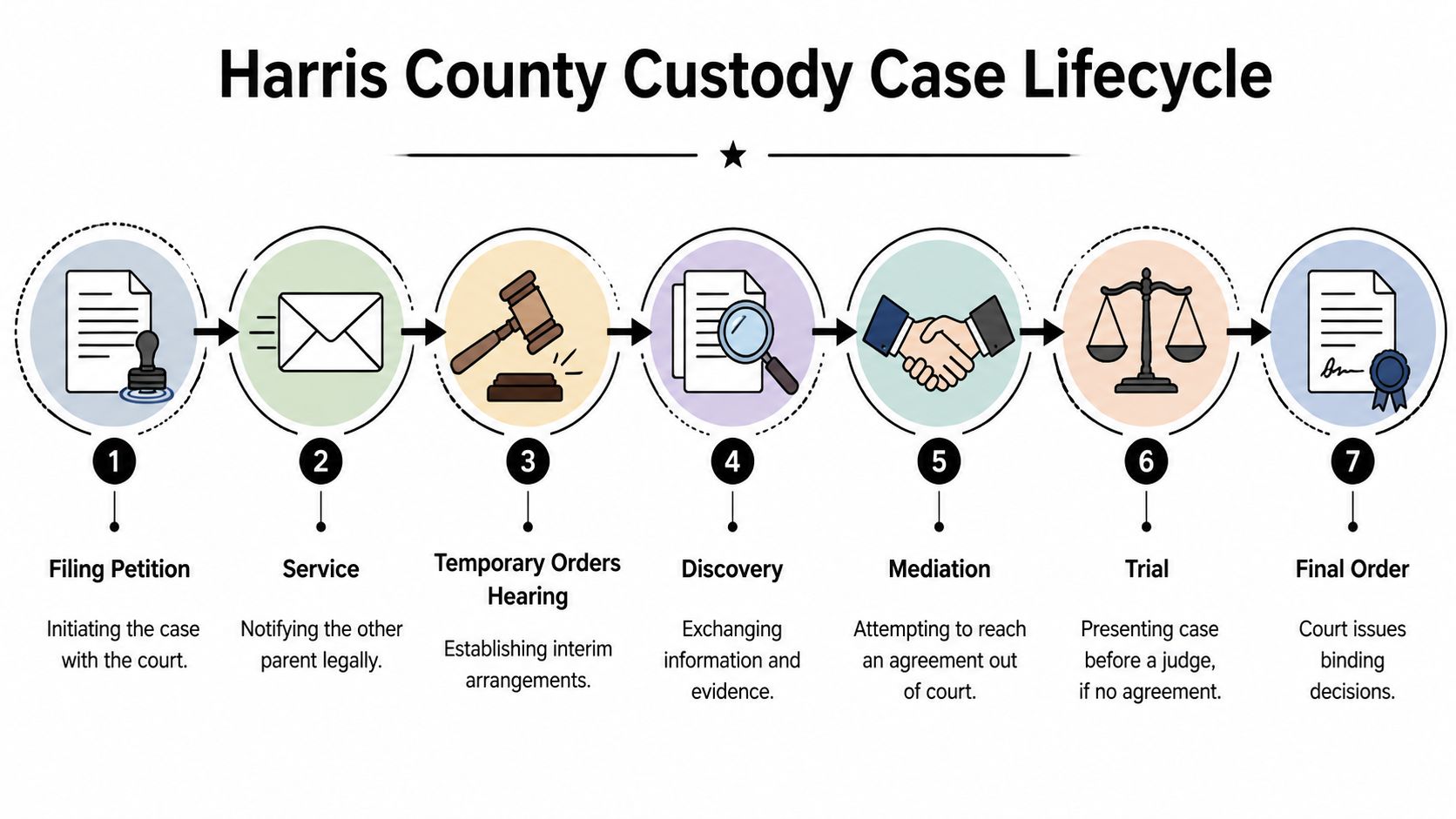
The case usually starts with a SAPCR
If there is no existing custody order, the case usually begins as a Suit Affecting the Parent-Child Relationship, or SAPCR.
That filing sets the boundaries of the case. It tells the court what orders you want on conservatorship, possession, support, and any immediate concerns affecting your child. If your paperwork is vague, rushed, or inconsistent with the facts you can prove, you create problems early.
Before anything is filed, you should already know the answers to basic questions. Where should the child live? What possession schedule are you asking for? Are there safety concerns? Do you need temporary restrictions, geographic limits, or child support orders? Harris County courts expect those requests to be organized, clear, and tied to the child's day-to-day life.
Temporary orders often shape the rest of the case
The first major hearing is often about temporary orders. That hearing matters because it can set the working rules for the months ahead.
Judges may decide where the child stays, how exchanges happen, who makes certain decisions, and what each parent must do while the case is pending. If the temporary structure goes badly, you may spend the rest of the case trying to correct a record that never should have been created.
Go into that hearing with a short timeline, clean exhibits, and a parenting proposal that solves practical problems. Bring school records, medical records, attendance issues, communication logs, and anything else that shows you are organized and focused on the child. Leave out speeches about the other parent's character unless the conduct directly affects the child's safety, stability, or care.
Later in the process, many parents find it helpful to hear a general explanation of custody issues in plain language:
Harris County has local requirements you cannot afford to ignore
Harris County family courts run on schedules, notices, deadlines, and local expectations. Parents who treat those details casually usually make their cases harder than they need to be.
Local guidance from a Harris County family-law source explains that co-parenting classes may be required in certain cases involving children, mediation is commonly required before temporary-orders hearings, and parties are often expected to exchange financial documents before trial, including tax returns, pay information, and financial statements (Harris County custody and divorce requirements summary).
Here is the practical advice I give Humble parents:
- Read every court notice the day it arrives. Deadlines get missed because people assume they will remember later.
- Calendar every hearing, class, and exchange deadline in one place. Use your phone and a paper backup.
- Complete required classes early. Judges do not like chasing parents for basic compliance.
- Prepare for mediation like it matters, because it does. Bring a proposed schedule, your calendar, school information, and your key documents.
- Get your financial paperwork together early. Late or incomplete disclosures make you look careless.
Procedure communicates character. In a custody case, that matters.
Custody evaluations can shift the entire case
In more contested cases, the court may order a custody evaluation through the Domestic Relations Office or another qualified professional. If that happens, the case stops being only about what each parent says in pleadings and hearings. It becomes about what a neutral evaluator sees over time.
That means your routine matters. Your communication matters. Your home environment matters. Your compliance with temporary orders matters.
Do not try to perform. Do not coach your child. Do not turn the evaluation into a campaign against the other parent. Keep your home appropriate, stay polite in writing, be on time, and answer questions directly. Evaluators notice consistency. Judges do too.
Harris County can feel impersonal at first. I understand that. But families from Humble and across the county get through this system every day by staying organized, following instructions, and documenting what matters. That steady approach wins more custody cases than courtroom drama ever will.
Your Strategy in the Courtroom and Beyond
You finally get your hearing date. You have a binder, a phone full of screenshots, and about five minutes to make the judge understand your family. In that moment, discipline matters more than emotion.
By the time you walk into a Harris County courtroom, you need a clear ask, a short explanation, and proof that matches it. Judges are deciding real scheduling, safety, and decision-making issues under time pressure. They respond to parents who are organized, specific, and child-focused.

What to say when the judge is listening
Keep your presentation simple and structured. Cover four points in this order:
- Your role in the child's daily life
- The specific orders you want
- How those orders help your child
- The documents, messages, calendars, or records that support your request
That is the job.
Do not spend your limited time trying to prove the other parent is a bad person. If there is a safety issue, say it plainly and tie it to facts. If there is no safety issue, stay with routines, school attendance, medical care, exchange history, and who handles the child's day-to-day needs.
Judges in Harris County hear accusations constantly. They pay attention to the parent who can answer direct questions with direct facts.
Keep your testimony concrete. Use dates, examples, and records. Anger is easy to ignore. Specifics are not.
Courtroom strategy starts before you speak
A strong hearing usually reflects weeks of quiet preparation. Bring a proposed parenting schedule that works on paper, not just in your head. Bring a short timeline of important events. Bring copies of anything you may need to hand to your lawyer or identify in court.
If your position is that you have been the steady parent, prove steadiness. Show school pickup logs, attendance records, medical appointment confirmations, message threads about homework, and a calendar showing actual overnights. Harris County courts deal in evidence, not impressions.
This is also where many parents hurt themselves. They ask for broad relief they cannot support. They interrupt. They volunteer extra details. They turn a narrow hearing into a rant. Do not do that. Answer the question asked, then stop.
Your behavior outside the courtroom can help or hurt your case
Your case record does not end at the courthouse door. It keeps growing through your messages, exchanges, social media posts, and your compliance with every order already in place.
I recommend four habits:
- Write every text as if it will be printed for a judge
- Follow temporary orders exactly, even when you are frustrated
- Keep your child out of adult conflict
- Put proposed terms in writing so there is less room for later fights
A good parenting plan should spell out regular possession, holidays, transportation, pickup times, communication rules, and who makes decisions about school and medical care. Vagueness creates conflict. Specific terms prevent it.
If you are at the point where the case is becoming more technical than you expected, the Law Office of Bryan Fagan handles family law matters involving custody, visitation, and related disputes for families in this area.
Protecting Your Family's Future with a Humble Attorney
A custody case can start with one argument and turn into something much more technical than most parents expect. Contested cases in Harris County may involve a child custody evaluation, and the county's Domestic Relations Office notes that courts can order one when conservatorship or access is disputed. Those evaluations can become a turning point because they review home life and co-parenting in a detailed, forensic way (Harris County Domestic Relations Office child custody evaluations).
That's why I'm opinionated about this. Good intentions are not a legal strategy.
If you're in Humble, Kingwood, Atascocita, or Northeast Houston, the parents who usually put themselves in the strongest position are the ones who do three things well. They stay child-focused. They document consistently. They take procedure seriously from day one.
When to stop trying to handle it alone
There's a point where online research stops being enough.
You should get legal advice quickly if:
- The other parent has already filed
- You're facing a temporary-orders hearing
- There are allegations about safety, substance use, or instability
- A custody evaluation may be ordered
- You're confused about what to ask the court for
- You know the facts are on your side, but you don't know how to present them
Straight answer: If the future schedule for your child may be decided soon, delay is expensive.
What you should do next
Start gathering your records today. Stop sending emotional messages. Write down the schedule you believe serves your child best. Think in terms of routines, school, medical care, and stability. Then get case-specific guidance from someone who knows Harris County family practice and understands the local realities facing families in Humble and nearby communities.
You do not need to walk into this process guessing. You do not need to rely on the hope that the judge will figure it all out without help. A well-prepared case gives the court something solid to act on, and that can make a real difference for your child's future.
If you're dealing with a custody dispute in Humble, Atascocita, Kingwood, or Northeast Houston, schedule a free consultation with the Law Office of Bryan Fagan. Our Humble office can help you understand your options, organize your evidence, and build a custody strategy focused on your child's best interests and the realities of Harris County court.