Skip to content

When that court notice lands in your mailbox, your stomach can drop fast. Maybe you're in Humble, Atascocita, Kingwood, or somewhere else in Northeast Houston, staring at legal language that feels cold and confusing while real life keeps moving around you. The kids still need dinner. Work still expects you tomorrow. But now there's a hearing date on the calendar, and everything suddenly feels heavier.
That reaction is normal. Family court is personal. Whether the hearing involves divorce, custody, child support, enforcement, or temporary orders, individuals typically don't walk in feeling calm and confident.
The good news is that Harris County family court follows a process. It may feel intimidating, but it isn't random. If you understand what happens at a family court hearing in Harris County, what the judge is looking for, and what paperwork matters most, you can prepare in a focused way instead of panicking.
That Official Letter Arrived What Happens Next
A lot of people call a lawyer after doing the same thing first. They open the envelope, read the first page twice, then text a family member a photo of it with one question: “What does this mean?”
If that sounds familiar, take a breath. A hearing notice usually means the court needs to address a specific issue in your case. It does not automatically mean you've done something wrong, and it doesn't mean the judge has already decided anything.

Start with the first page, not the panic
Look for a few basics right away:
- The hearing date and time: Put it on your phone calendar and on paper.
- The court number: Harris County family cases are assigned to a specific court, and that matters.
- The type of hearing: Temporary orders, enforcement, status conference, trial, and emergency hearings all work differently.
- Any deadlines before the hearing: Sometimes the hardest part isn't showing up. It's getting documents ready in time.
Practical rule: Don't rely on memory. Keep every court paper in one folder, in the order you received it.
Many neighbors in Humble and Kingwood think the hearing itself is the whole case. Usually, it isn't. It's one stage in a longer process. Your job now is to figure out what issue the judge will decide on that date and what information the court expects from you.
What to do in the first day or two
The first steps are simple, but they matter:
- Read every page carefully. The attached documents often explain more than the notice itself.
- Don't ignore the setting. Missing family court can create problems that are hard to fix later.
- Gather your existing records. Prior orders, petitions, text messages, school records, pay information, and notes can all become important.
- Get legal guidance early. If you're trying to make sense of procedure, deadlines, and local court habits, a family lawyer can help you sort out what is important.
For many families in Northeast Houston, the fear comes from not knowing what's next. Once you break the process into smaller pieces, it becomes much easier to handle.
Understanding the Different Types of Family Hearings
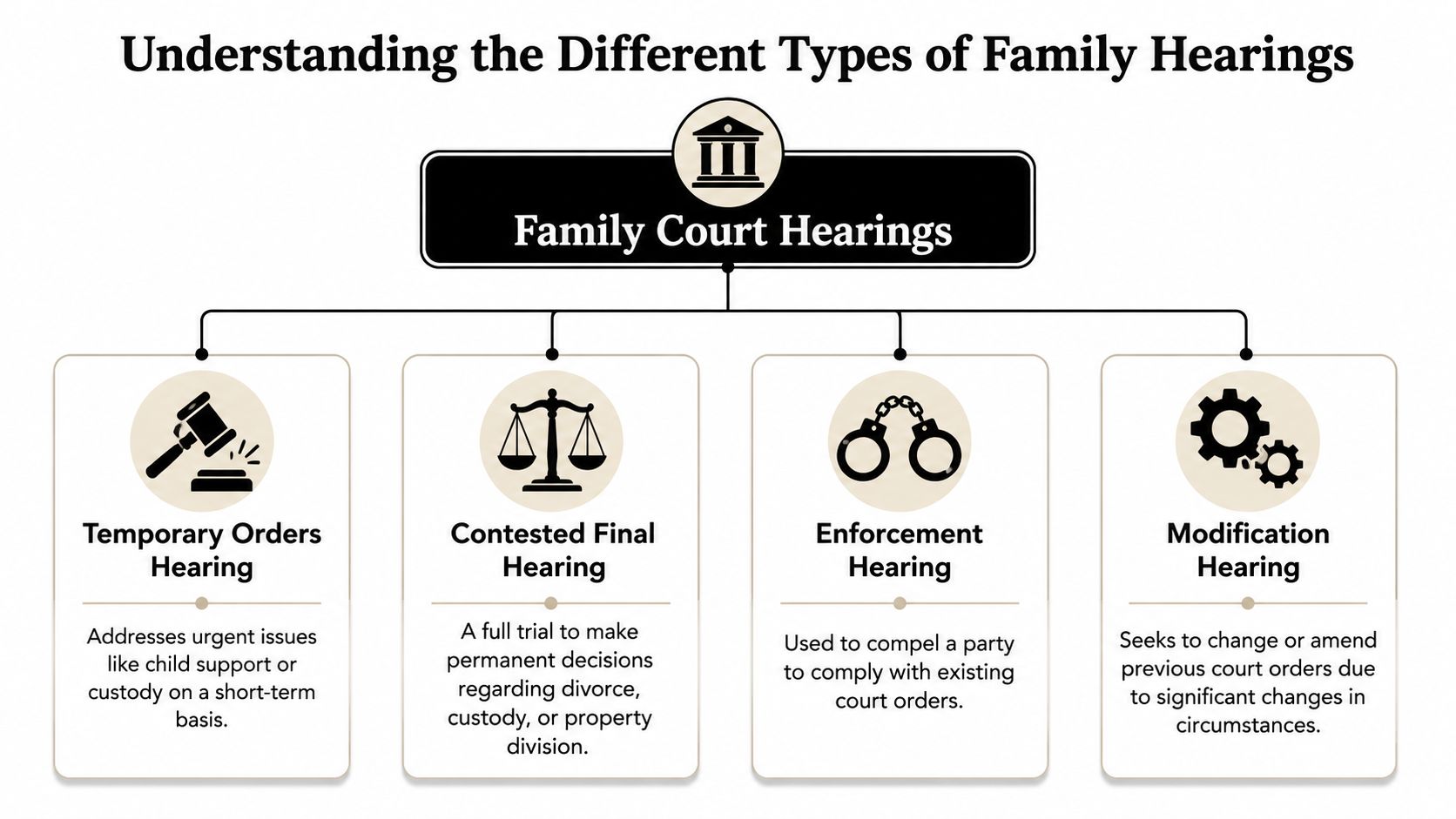
Not every court date has the same purpose. That's one of the biggest sources of confusion. People hear the word “hearing” and assume every appearance is a full trial. In reality, some hearings are short and narrow, while others decide major long-term issues.
Temporary orders hearings
Think of temporary orders as the court's way of creating rules while the larger case is still pending. In a divorce or custody case, the judge may address where the child stays, who pays support, who lives in the home, or how bills will be handled until final orders are entered.
These hearings matter a great deal because they often shape daily life right away. They can also influence the direction of the case.
Status conferences and short settings
A status conference is more like a progress check. The court may want to know whether documents have been exchanged, whether mediation has happened, or whether the case is ready for a later hearing or trial.
This kind of setting may feel less dramatic, but it still matters. If one side isn't prepared, the judge may issue deadlines or instructions that affect what happens next.
Final hearings and trials
A final hearing or trial is where the court makes lasting decisions. In a divorce, that can include property division and final orders involving children. In a custody modification, the judge may decide whether the current arrangement should change.
In Harris County family courts, docket settings depend on hearing type. According to Texas Law Help's Harris County family district court guide, temporary-orders hearings in contested custody matters are commonly scheduled for Tuesday or Wednesday at 10 a.m., while trial docket is Mondays at 10 a.m. That matters because the court's scheduling rules control when evidence, witness testimony, and settlement submissions must be ready.
If your hearing is set soon, don't assume you can finish gathering documents the night before. Court schedules shape preparation deadlines long before you stand in front of the judge.
Emergency and enforcement hearings
Some hearings are urgent. If someone is asking for immediate court action involving safety, access to a child, or other serious concerns, the court may hear that issue on an emergency basis.
An enforcement or contempt hearing is different. It focuses on whether someone followed an existing order. These cases often turn on specifics. What did the prior order say? What happened? What proof shows compliance or noncompliance?
Modification hearings
A modification hearing asks the court to change an existing order. These hearings are common when parents' circumstances shift, schedules stop working, or one side believes the child's needs are no longer being met under the current arrangement.
For families in Atascocita and Humble, the key question is simple. What is this hearing supposed to accomplish? Once you know that, your preparation becomes much clearer.
The Step-by-Step Flow of a Typical Courtroom Hearing
Individuals often feel better once they can picture the day. Court is still serious, but it becomes less mysterious when you know the basic rhythm.
Before the judge takes the bench
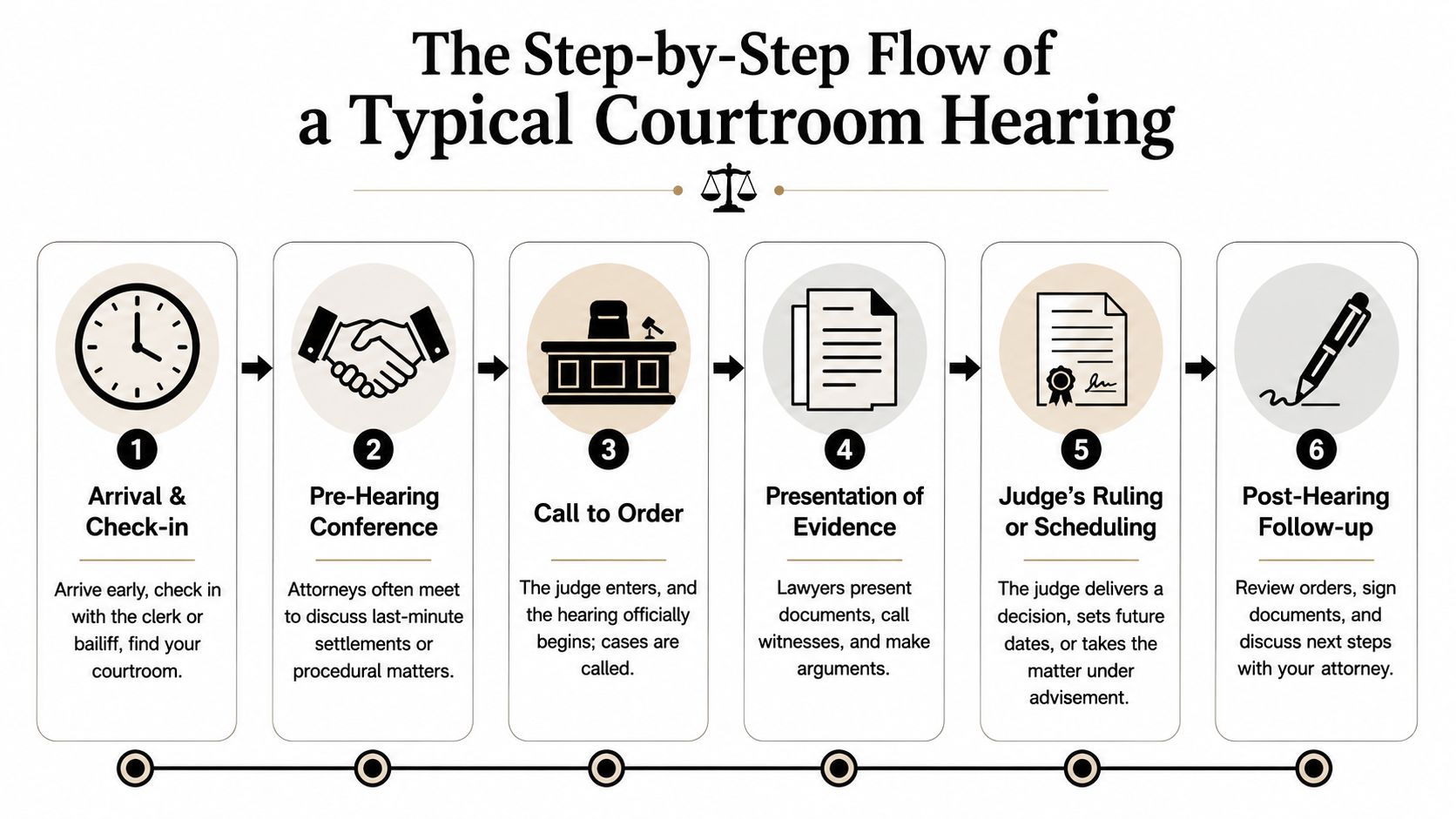
You'll usually arrive, go through security, find the courtroom, and check in. Depending on the court, you may check in with the clerk, the bailiff, or by following a posted instruction sheet outside the courtroom.
Once you're there, expect some waiting. Lawyers may speak in the hallway. Parties may sit on opposite sides of the room. The judge may be handling another case first.
When your case is called
When the court calls your case, the judge will identify the matter and confirm who is present. If you have a lawyer, your lawyer usually does the speaking first. If you're representing yourself, you'll need to speak clearly and briefly when the judge addresses you.
A typical hearing often follows this order:
- Call of the case: The judge or court staff announces the case.
- Appearances: Each side identifies who they are.
- Preliminary issues: The court may address agreements, missing documents, or procedural concerns.
- Evidence and testimony: This may include documents, witness statements, or short testimony from the parties.
- Arguments: Each side explains what result they want and why.
- Ruling or reset: The judge may rule immediately, request more information, or set another date.
Who is in the room and what they do
A courtroom has a few key players:
| Person | Role |
|---|---|
| Judge | Decides legal and factual issues |
| Bailiff | Helps maintain order and courtroom procedure |
| Court reporter | Creates the record of what is said |
| Clerk | Handles file and docket-related tasks |
| Attorneys | Present evidence and argue for each side |
You may also see witnesses, mediators in the hallway, or staff members helping move the docket along.
Speak to the judge respectfully, wait until it's your turn, and answer the question asked. Long speeches usually don't help.
What the hearing may end with
Not every hearing ends with a dramatic ruling from the bench. Sometimes the judge signs an order that day. Sometimes the court asks one side to draft the written order for review. In other situations, the judge may take the matter under advisement and rule later.
That can frustrate people, especially when emotions are already high. But a delayed ruling doesn't mean the hearing went badly. It often means the court wants to review the evidence carefully.
Essential Documents and Evidence You Must Prepare
Many people think family court is mostly about what they say in the courtroom. In Harris County, that's only part of the picture. A lot of hearings are shaped by what you hand over before the hearing ever starts.
The paperwork courts expect
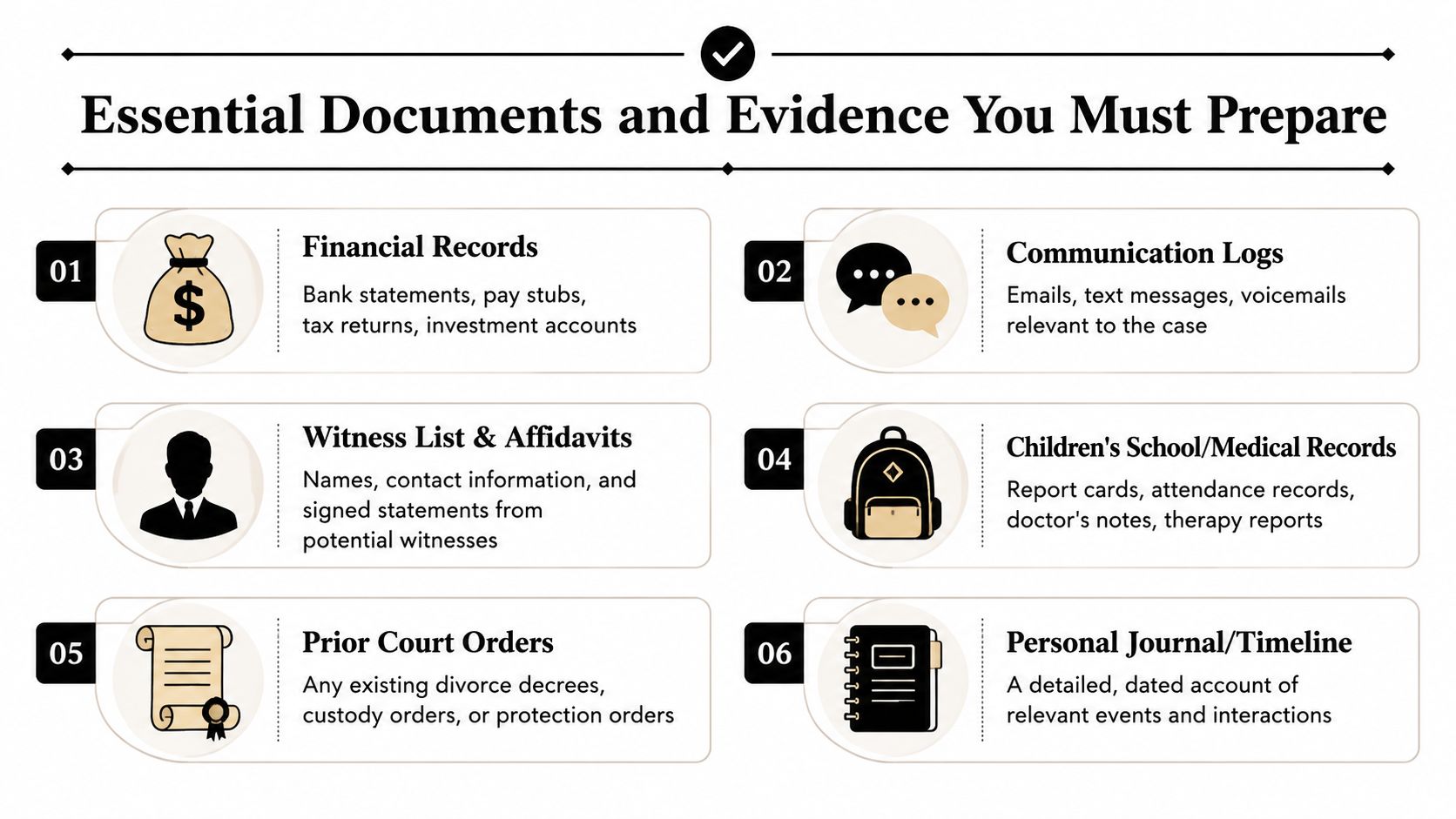
For temporary-orders and final-trial hearings involving child support or spousal support, Harris County local family rules require pre-hearing exchange of a Financial Information Statement, the last two years of tax returns, and the two most recent pay stubs, and failure to comply can trigger sanctions under Texas discovery rules, as explained in the Harris County local family rules.
That means the hearing may turn on whether your financial records are current, complete, and ready to present. If your income is disputed, vague estimates won't help much.
Why family hearings are often document-driven
In custody cases, the court may also consider material gathered long before the court date. The Walters Gilbreath discussion of custody and divorce in Harris County notes that the outcome of a hearing is often shaped by evidence collected before the hearing, and that a custody evaluation can include interviews, records, home visits, and collateral history. That's why many parents are surprised to learn the judge isn't only listening for who sounds more upset or more polished in court.
If you're getting materials ready, these expert tips for legal briefs can help you think more clearly about organization, chronology, and presenting facts in a way the court can follow.
What to gather besides required financial records
The strongest evidence is usually organized, dated, and tied to the issue the judge must decide. Depending on your case, that may include:
- Prior court orders: Bring the most recent signed orders, not just your memory of what they say.
- Communication records: Save texts, emails, and parenting-app messages that relate directly to the dispute.
- School or medical records: These can matter when a child's routine, attendance, health, or support needs are in question.
- A timeline: A simple dated list of events often helps more than a stack of loose papers.
- Proposed orders: If your side wants the judge to sign a specific form of relief, have it prepared if the court expects it.
For custody matters, our guide on what evidence helps in a child custody case in Texas can help you think through what documents and records may support your position.
Courtroom confidence can't replace missing records. Organized proof usually carries more weight than an emotional explanation with no backup.
Navigating Harris County Specifics and Local Logistics
Harris County has its own realities, and they affect strategy. If you're coming from Humble, Atascocita, Kingwood, or Northeast Houston, it helps to understand that a family hearing isn't happening in a small-town courthouse with plenty of open time on the judge's calendar.
Why timing feels slow and rushed at the same time
Harris County family judges carry very heavy dockets. According to Spofford Law's discussion of overwhelmed Harris County family courts, family court judges often manage 4,000 pending cases, while a typical civil district judge handles about 1,500 to 2,000. The same source explains that Harris County has nine dedicated family courts, and that the backlog means it can often take more than a year to reach a trial date in some matters.
That creates a strange experience for families. You may wait a long time for a major setting, then get only a short window in court to present your position. That's one reason preparation has to be tight and focused.
What that means for your case strategy
When a court is carrying that much volume, three practical things follow:
- Be ready before the hearing date: Last-minute scrambling is dangerous when the court expects your materials already exchanged and organized.
- Use your hearing time carefully: Judges often need direct answers, concise explanations, and clean exhibits.
- Take resets seriously: If a hearing gets moved, that can change momentum, school planning, possession schedules, and finances.
If you want a local overview of where many of these cases are handled, this page on Harris County family court for Humble residents gives helpful context.
Downtown logistics and courtroom manners
The trip itself can add stress. If your hearing is downtown, leave earlier than you think you need to. Give yourself time for traffic, parking, building entry, and security screening. Don't plan your arrival to the minute.
Once you're in court:
| Situation | Better approach |
|---|---|
| How to dress | Choose neat, conservative clothing |
| Where to sit | Follow staff instructions and stay attentive |
| How to address the judge | Use “Your Honor” |
| How to react | Stay neutral, even if the other side says something upsetting |
A Harris County hearing often rewards the person who is prepared, punctual, and easy for the judge to follow.
For families across Northeast Houston, that local reality matters just as much as the law on paper.
Key Tips for Parents and Pro Se Litigants
If you're a parent walking into court without much experience, your instincts may work against you. People often talk too long, interrupt, argue with the other side, or focus on every old grievance instead of the issue the judge must decide that day.
What judges usually respond to
Judges are looking for usable information. They want facts, documents, and clear requests. They also notice whether a parent seems focused on the child's needs or locked into attacking the other parent.
A better approach looks like this:
- Stay child-focused: Explain how your request helps the child's routine, stability, schooling, health, or safety.
- Answer the question asked: Don't turn every response into a history lesson.
- Keep your tone level: Calm people tend to sound more credible than angry people.
- Bring organized papers: If you can hand the court the right document quickly, that helps.
- Know what you want the judge to order: Vague frustration is not a legal request.
If you're representing yourself
Pro se litigants face a harder path because they're managing both emotion and procedure at once. That doesn't mean you can't present yourself well. It means you need structure.
Try this simple method before court:
- Write down the three most important facts you need the judge to hear.
- Match each fact to a document or exhibit if possible.
- Practice a short explanation of the result you're asking for.
- Remove side issues that don't affect the ruling.
If you're preparing for a custody-related setting, this guide on how to prepare for a custody hearing can help you organize your presentation.
The court doesn't expect perfection. It does expect respect, preparation, and a workable explanation of what you're asking the judge to do.
What not to do
This short list saves many people from avoidable mistakes:
- Don't interrupt the judge
- Don't speak over the other side
- Don't bring children unless the court requires it
- Don't rely on your phone if you need printed records
- Don't assume the judge has read everything in detail already
Parents in Humble and Kingwood often ask whether being nervous will hurt them. No. Nervousness is a common reaction. What matters is whether you can still stay respectful and organized while nervous.
Your Next Step A Free Consultation with Our Humble Team
A family court hearing can feel like one of the hardest dates on your calendar. The uncertainty, the paperwork, the waiting, and the emotional weight can all hit at once. But the process becomes far more manageable when you know what kind of hearing you have, what the court expects, and how to prepare your documents and testimony in a clear way.
That's the heart of what happens at a family court hearing in Harris County. The court looks at the issue before it, the evidence supporting each side, and whether the parties are prepared to help the judge make a workable decision. The more organized you are, the better positioned you'll be.
If you're dealing with divorce, custody, support, enforcement, or another family law matter in Humble, Atascocita, Kingwood, or Northeast Houston, legal guidance can take a lot of uncertainty off your shoulders. The Law Office of Bryan Fagan handles family law matters that regularly move through Harris County courts, including hearings involving children, finances, and existing court orders.
You don't have to sort through this alone. A free consultation can help you understand what kind of hearing you're facing, what documents you need, and what steps make sense next for your situation.
If you need help preparing for a Harris County family court hearing, Law Office of Bryan Fagan offers free consultations for families in Humble, Atascocita, Kingwood, and Northeast Houston. Our team can help you understand the process, organize your evidence, and take the next step with more clarity and confidence.