Skip to content
You may be sitting at your kitchen table in Humble, after the kids are asleep, scrolling through answers you never expected to need. Maybe you live in Atascocita and you're worried about the house. Maybe you're in Kingwood trying to figure out what happens to school pickup, retirement accounts, or the checking account your spouse controls. Maybe you're in Northeast Houston and you haven't decided whether divorce is certain, but you know the current situation can't keep going as it is.
That moment feels personal and private, but the legal process that follows is not casual. A divorce in Harris County moves through a busy court system, and the people who do best usually aren't the ones who react fastest out of anger. They're the ones who make sound decisions early, protect the right records, and focus on stability before conflict takes over.
Facing Divorce in Northeast Houston
A strong divorce strategy in Harris County Texas starts before anyone signs final papers. It starts when you stop asking only, “How do I file?” and begin asking better questions. Who has access to money right now? What schedule are the children already living? Which documents will matter if a judge has to make a quick decision?
For families in Humble, Kingwood, Atascocita, and the rest of Northeast Houston, those questions matter because Harris County isn't a small county where every case moves at the same pace. Texas divorce rates have generally trended downward and have stayed below the national average at around 1.5 divorces per 1,000 people, but Harris County still sees heavy case volume because of its size and urban concentration, and divorce patterns can vary significantly from one local community to another, as noted in Texas divorce reporting on local and state trends.
That means a local family may face two pressures at once. The marriage problem is personal, but the court process is crowded, procedural, and unforgiving when paperwork or preparation is weak.
What clients often feel first
Seldom do people walk into a divorce thinking about litigation posture. Their thoughts turn to immediate disruption.
- Housing fear means wondering whether you'll need to leave the home or whether your spouse can lock down access.
- Parenting anxiety shows up as concern over school routines, after-school care, and weekends.
- Financial uncertainty often starts with one practical question. Can I pay bills next month?
- Information imbalance happens when one spouse knows where the money is, and the other does not.
The first legal goal usually isn't “win the divorce.” It's create enough order that you can make good decisions.
A good lawyer in this setting doesn't add drama. They reduce it. They help you separate urgent problems from long-term ones and build a plan that fits your household, your county, and your judge's likely expectations.
What works and what usually backfires
Some choices help immediately. Discreetly collecting account statements, mortgage records, pay information, and school calendars helps. Keeping communication short and respectful helps. Writing down who handles daily parenting tasks helps.
Other choices create damage fast. Emptying accounts without advice, using children as messengers, hiding property records, or sending threatening texts rarely improves your position. Those actions often become the story the other side tells about you.
People in Northeast Houston don't need more noise. They need a roadmap that respects the realities of life here, from commutes and school schedules to the way Harris County courts handle temporary disputes and settlement pressure. That's where strategy matters most.
Your First 90 Days A Harris County Divorce Checklist
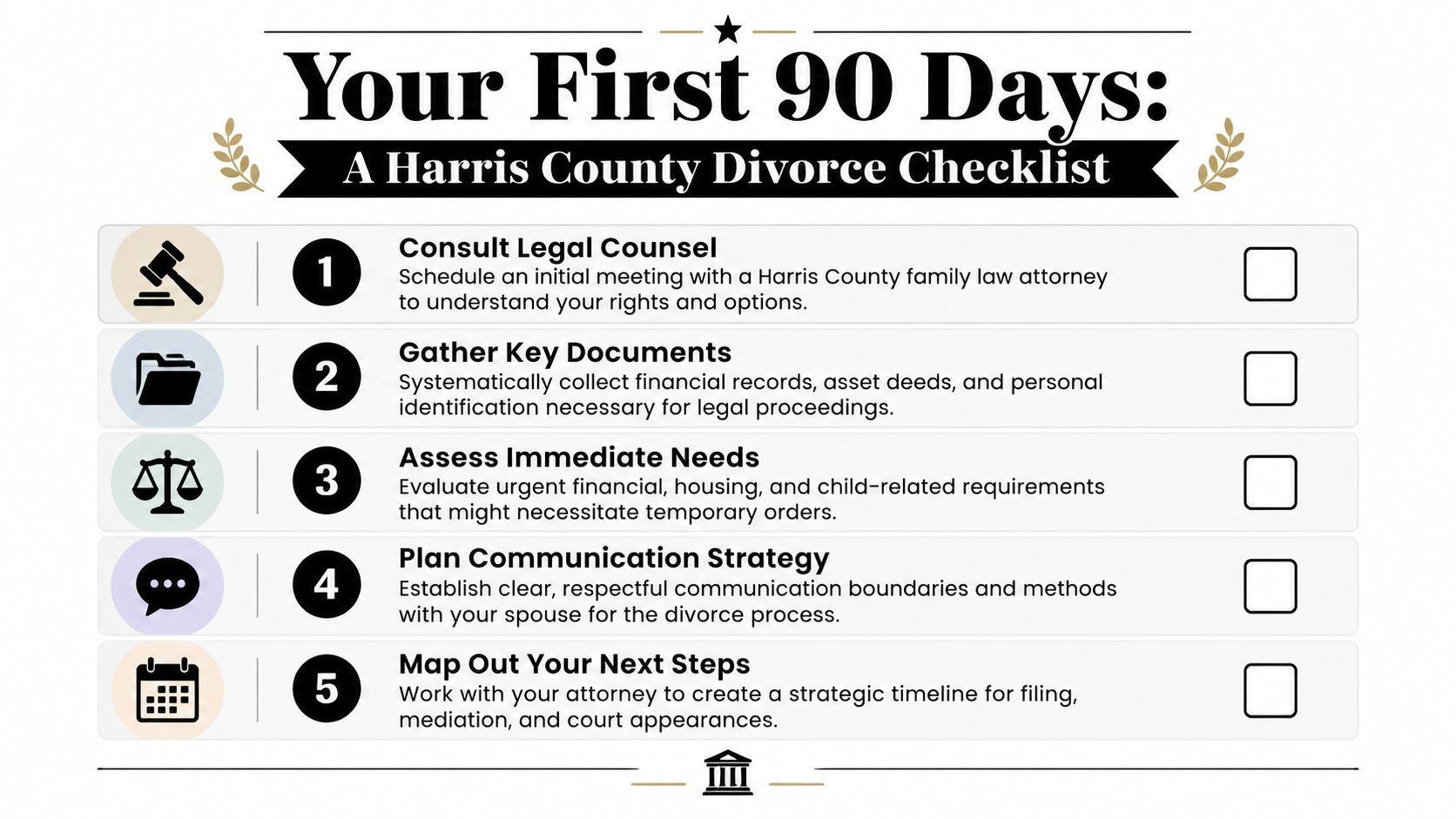
The first stretch of a divorce isn't just administrative. It's where you either secure an advantageous position or risk losing one. If you're in Humble or nearby, your early steps should focus on eligibility, records, and timing.
Start with residency and filing readiness
Texas law requires one spouse to have lived in the state for 6 months and the filing county for 90 days before filing. After filing, a 60-day waiting period begins. If both sides cooperate, an uncontested divorce can often finish in 3 to 6 months, while contested cases in Harris County often last 6 months to over a year because custody and property disputes slow the process, according to this Houston divorce process guide.
If you miss the residency issue, everything else can stall. If you file before your paperwork is ready, your case can lose momentum before it even starts.
Build your file before you build your argument
Before filing the Original Petition for Divorce, gather the documents that will shape every later decision.
Identity and family records
Pull together basic identifying information, marriage documents, and records tied to the children.Income proof
Pay records, tax returns, and anything showing regular income or irregular compensation matter early.Banking and debt records
Save statements for checking, savings, credit cards, and loan accounts.Property records
Deeds, mortgage statements, vehicle paperwork, retirement account statements, and business-related documents often become central.Parenting evidence
Keep calendars, school communications, medical records, and notes that show the actual routine your children live.
If you've already been served, the most important thing is not to freeze. This guide on what to do after being served divorce papers in Humble can help you avoid common early mistakes.
What the first 90 days should look like
The Original Petition is the document that opens the case. It doesn't resolve the marriage by itself. It places the case in the proper Harris County district court and starts the formal process.
A practical early checklist looks like this:
| Priority | Why it matters |
|---|---|
| Confirm residency | Filing in the wrong place or too early creates delay |
| Gather records first | Incomplete records weaken requests and slow disclosures |
| Identify urgent issues | Housing, parenting time, and bill payment can't wait |
| Plan service carefully | The way a spouse is served can affect tone and timing |
| Use the waiting period well | Negotiation and preparation should start immediately |
Practical rule: Don't treat the waiting period like dead time. Use it to organize, negotiate, and prepare for temporary issues before the case starts controlling you.
For many families in Atascocita or Kingwood, the smartest early move isn't dramatic. It's disciplined. Quiet preparation usually outperforms emotional escalation.
Gaining Stability with Temporary Orders
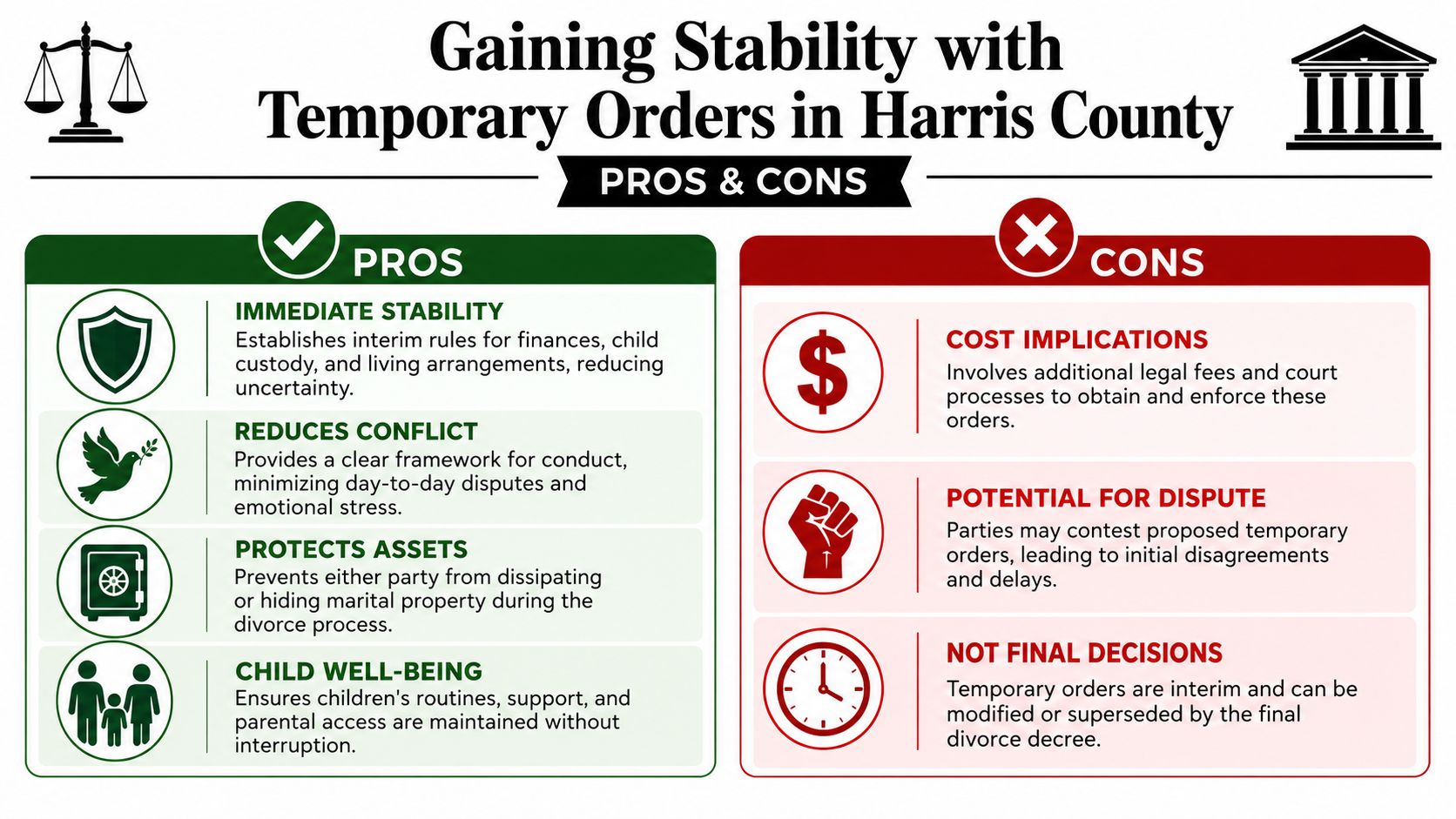
Many divorce guides mention temporary orders as if they're just another form to file. In practice, they often shape the entire case. If one spouse controls cash flow, stays in the home, or dictates access to the children, temporary orders can reset the situation into something a court can manage.
Why temporary orders matter so much
A key strategic gap in many divorce cases is not understanding how temporary orders create an advantage. The evidence needed to persuade a Harris County judge to grant exclusive use of the home, set temporary support, or establish a possession schedule can define bargaining power for the rest of the case, especially because local courts often push parties toward mediation early, as explained in this discussion of mediation and temporary orders in Harris County divorce.
That matters because people negotiate differently once a temporary framework is in place. The spouse who has clear access to children, stable housing, and enforceable bill-payment rules is no longer negotiating from panic.
What evidence actually helps
Judges usually need something more persuasive than “this feels unfair.” The strongest temporary-order requests are built on specific, organized proof.
For exclusive use of the residence
Show why staying in the home supports stability, especially for the children, and why the current arrangement isn't workable.For temporary support
Bring records that show who earns what, who pays what, and whether one spouse has cut off funds or controls accounts.For a temporary parenting schedule
Use calendars, school records, pickup logs, messages, and caregiving history to show what routine has been happening.For asset protection concerns
Gather statements and transaction history if you're worried property is being moved, hidden, or drained.
This short video gives useful context for how temporary issues can shape the bigger case.
The trade-off people need to understand
Temporary orders aren't magic. They can increase conflict at the beginning if the other side contests them. They can also add cost because they require focused preparation and hearings.
But in the right case, waiting too long costs more. If your spouse has already taken control of the practical parts of life, silence becomes its own strategy, just not one that helps you.
Early temporary orders often decide whether the rest of the divorce feels manageable or chaotic.
Parents dealing with immediate custody concerns can also review temporary custody orders in Texas to understand how interim parenting arrangements are commonly addressed.
For families in Northeast Houston, this is often the turning point. Once day-to-day life is stabilized, better settlement options usually become possible.
Navigating Custody and Property Division in Harris County
Most divorces eventually come down to two hard conversations. What arrangement is best for the children, and how should property be divided fairly? These aren't separate worlds. Housing, school continuity, debt load, retirement savings, and parenting schedules all interact.
Child custody is about daily reality
Texas courts focus on the best interest of the child. In real life, that means a judge is looking for a workable parenting structure, not speeches about who is the better parent.
For families in Humble, Atascocita, and Kingwood, custody questions often sound ordinary, but they're legally important. Who gets the child ready for school most mornings? Who attends appointments? How long is the commute between homes? Can both parents realistically support homework, extracurriculars, and consistent bedtime routines?
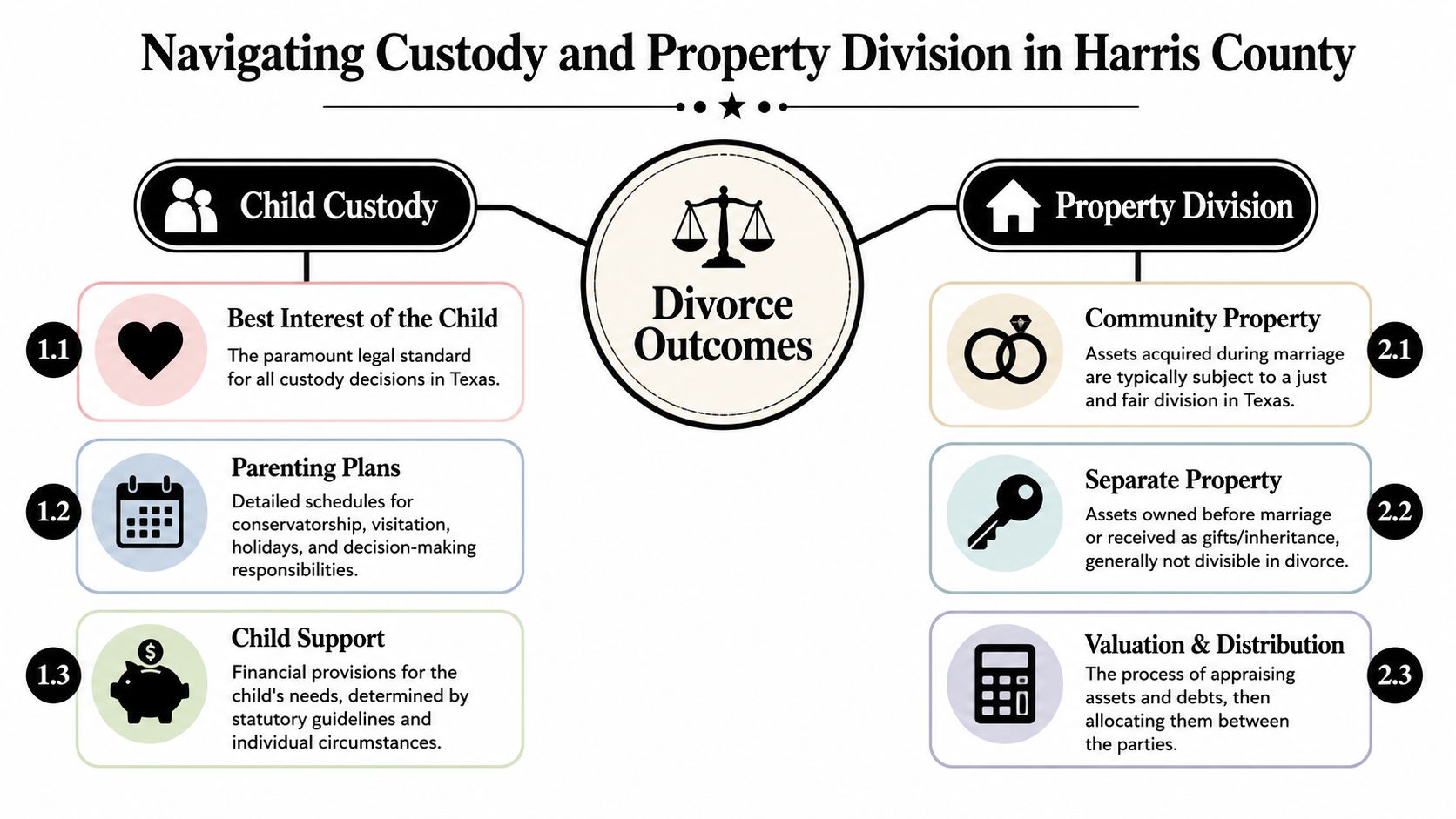
A parenting plan should address more than weekends. It should cover:
- Regular possession periods so each parent knows the weekly routine
- Holiday allocations to avoid annual conflict
- Decision-making roles for education, medical issues, and activities
- Exchange logistics that match work schedules and school locations
School routines usually carry more weight than last-minute promises. Courts care about what parents have actually been doing.
Property division is rarely just about one asset
Texas divorce law has changed with the way marriages have changed. A summary of Texas divorce history notes that rates peaked around 40% in 1980 and later declined, while modern judges increasingly see financially complex marriages involving real estate equity, retirement accounts, and business assets accumulated over longer periods, as discussed in this report on Texas divorce trends and modern case complexity.
That describes many Harris County cases well. A couple may have a home with equity, retirement accounts built during the marriage, one or two vehicles, business income, credit card debt, and questions about whether certain property is separate or community.
A simple way to think about property issues
| Property question | Why it matters |
|---|---|
| Was it acquired during the marriage? | That often affects whether it's part of the divisible estate |
| Was it owned before marriage, or received by gift or inheritance? | That often raises separate property issues |
| Has the asset changed over time? | Appreciation, payments, and commingling can complicate tracing |
| What is the asset worth now? | You can't divide what hasn't been valued carefully |
| Who can realistically keep it? | A fair decree must be workable after the divorce |
The legal phrase people hear is “just and right” division. What that means in practice is not always a clean split of every item. It means looking at the full estate, the debts attached to it, and what arrangement leaves both parties with an order they can follow.
When people rush this part, they tend to fixate on one asset, usually the house. Strong strategy looks broader. A house, retirement account, or business interest may matter, but so do tax consequences, refinancing ability, monthly obligations, and whether the final result supports a stable parenting plan.
The Path to Resolution Negotiation vs Trial
Spouses generally seek to avoid a courtroom battle. They want closure, protection, and an agreement they can live with. In Harris County, that usually means serious negotiation, often through mediation, with trial held in reserve if the other side won't act reasonably.
Mediation gives families more control
Mediation works best when both sides have enough information to negotiate from facts instead of fear. That's where preparation pays off. If documents are organized, temporary issues are stabilized, and each side understands the disputed points, mediation can produce detailed solutions that fit a real family better than a one-size-fits-all ruling.
For many families in Atascocita and Northeast Houston, mediation has practical advantages:
- Privacy because family details stay more contained than they would in open court proceedings
- Flexibility because parents can design schedules that reflect commute times, work hours, and school realities
- Ownership of the outcome because the parties, not the judge, shape the settlement terms
Discovery changes the quality of negotiation
If one spouse doesn't disclose enough, the case may need discovery. That's the formal exchange of information and documents. It may involve written questions, requests for records, and other tools that force clarity.
Discovery isn't only for trial preparation. It often improves settlement. Once missing financial records appear, arguments based on suspicion may get replaced by numbers, documents, and practical options.
A good settlement usually happens when both parties know what a trial could expose.
Trial is the backup plan, not the goal
Some cases don't settle. A parent may refuse a workable possession structure. A spouse may hide information, dispute asset characterization, or reject fair proposals. In those cases, trial becomes necessary.
That doesn't mean the case has failed. It means one side needs a judge to decide issues the parties can't resolve themselves.
A balanced strategy does both jobs well. It prepares thoroughly enough to try the case if needed, while still pushing for a negotiated resolution whenever that path protects the client better. For some local families, that may include working with counsel that handles family law litigation and mediation matters, such as the services offered by the Law Office of Bryan Fagan in Humble.
Find Your Local Advocate in Humble
Divorce is easier to manage when you stop viewing it as one giant crisis and start treating it as a series of decisions. File at the right time. Protect records early. Stabilize the home and children if temporary orders are needed. Negotiate from documented facts. Prepare for court even if you hope to settle.
That approach matters in Harris County because local procedure and courtroom expectations shape outcomes. A lawyer who regularly works with families from Humble, Kingwood, Atascocita, and Northeast Houston will understand the practical issues behind the paperwork. School schedules, long commutes, family-owned businesses, retirement planning, and pressure around the family home aren't abstract problems here. They're common parts of local divorce cases.
Why local context matters
A neighborhood-based divorce strategy isn't about slogans. It's about knowing what affects daily life after the decree is signed.
- Parents need realistic schedules that account for traffic, school zones, and work demands.
- Homeowners need grounded advice about possession, refinancing, and short-term housing stability.
- Professionals and business owners need organized planning when income and property aren't simple.
- Anyone facing a high-conflict spouse needs structure before emotion drives the case off course.
This contact page preview shows where many local residents start the conversation.

A clear next step
You don't need to have every answer before speaking with a lawyer. You only need enough clarity to take the next sensible step. A consultation can help you sort urgent issues from long-term ones, identify what documents to protect, and decide whether your case needs immediate action on custody, support, or the home.
If you're looking for a family law attorney in Humble, local experience can make the process feel less confusing and more manageable from the start.
The right strategy won't erase the emotional weight of divorce. It will give that weight structure, direction, and a plan.
If you're facing divorce in Humble, Atascocita, Kingwood, or anywhere in Northeast Houston, the next step is a conversation that gives you clarity. Schedule a free consultation with the Law Office of Bryan Fagan to discuss your situation, protect what matters most, and build a practical plan for your family and future.