Skip to content

If you're reading this in Humble, Atascocita, Kingwood, or Northeast Houston, there's a good chance you're carrying the same fear many parents bring into a custody case. You're not just worried about court dates or paperwork. You're worried about where your child will sleep, who will make school and medical decisions, and whether a judge who doesn't know your family will understand what daily life is like.
That anxiety is normal. Harris County family court can feel cold and procedural when your case is personal. But custody decisions are not random, and they are not supposed to turn on who sounds more emotional in a courtroom. Judges follow a legal standard, and in Harris County they often work within a structured process that includes formal filings, mediation, parenting education, and sometimes a detailed custody evaluation.
When people ask about how judges decide custody in Harris County, they usually want the practical answer, not just the legal phrase. The legal phrase is the best interest of the child. The practical answer is that judges look for credible, documented proof of stability, sound parenting, good judgment, and a child-focused plan.
Facing a Custody Case in Harris County
It is 9:30 p.m., your child is asleep, and you are scrolling through old texts trying to figure out what a judge would care about. That is where many Harris County custody cases start. A parent knows the day-to-day reality of raising the child, but does not yet know how to present that reality in a way the court will trust.
A custody case in Harris County is not decided by who feels more hurt or who tells the more dramatic story. Judges are asked to apply the best-interest standard, but in real courtrooms the parents who persuade the court usually do something more concrete. They show steady routines, reasonable judgment, and a workable plan for the child. They also follow local procedures, which often include mediation and, in some cases, a custody evaluation.
That practical gap matters. The law uses broad language. Judges make decisions from calendars, school records, messages, witnesses, temporary orders, mediation outcomes, and each parent's conduct while the case is pending.
For families in Humble, Kingwood, Atascocita, and nearby communities, the hardest part is often the stretch between filing and final orders. School still starts at the same time. Work still expects you to show up. Your child still needs dinner, homework help, and a calm home. The court notices which parent can keep those basics steady under pressure.
A common misunderstanding
A common misunderstanding is thinking custody turns on one advantage or one bad moment. It usually does not.
Higher income alone rarely decides conservatorship. One angry text usually does not decide it either. What tends to carry weight is the overall pattern. Who handles school communication. Who gets the child to appointments. Who follows temporary orders. Who can make decisions without turning every disagreement into a crisis.
I tell parents to stop asking, “How do I prove I'm the better parent?” and start asking, “What evidence shows my plan is better for my child?” That shift changes how a case is prepared. It also helps you focus on proof the judge can use, which is the same kind of proof discussed in this guide on how to prove best interest of a child in Texas custody cases.
Another mistake is treating the case like a private argument that the judge will sort out by instinct. Harris County family courts expect structure. If mediation is ordered, be prepared. If a parenting class is required, complete it on time. If the court appoints an evaluator or amicus, take that process seriously. Parents who ignore those steps often damage good facts by looking unreliable.
Practical rule: Judges are more persuaded by consistent behavior and organized proof than by accusations without backup.
What should reassure you
You do not need to be perfect. You need to be credible.
That usually means doing a few things early and doing them well:
- Keep routines stable: attendance, medical care, homework, meals, and bedtime show how your parenting works in real life.
- Document facts, not just conflict: save school records, calendars, medical information, and messages that show involvement and decision-making.
- Use a child-focused plan: proposals that fit the child's school, activities, and needs are easier for a judge to trust.
- Take local procedures seriously: mediation, temporary hearings, and evaluations are not side issues. They often shape the final result.
If you feel overwhelmed, that is normal. The process is formal, but it is also manageable once you know what the court is looking for.
The Best Interest of the Child Standard in Texas
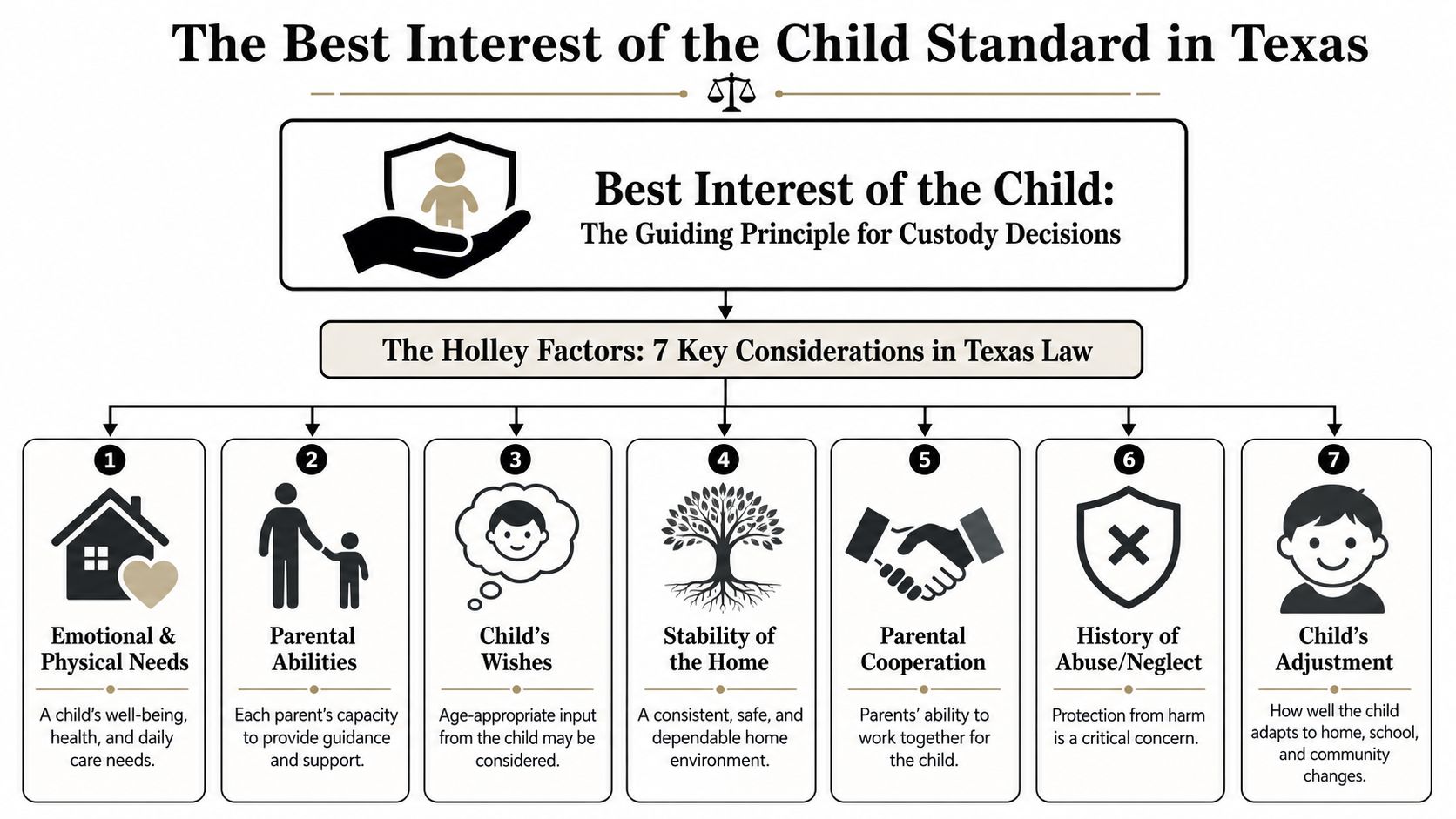
Texas law makes the child's best interest the controlling standard in custody decisions, and parents are often presumed to be joint managing conservators under the Texas best interest standard overview. In real Harris County cases, though, that legal standard is only the starting point. What matters in court is how well you can show a judge, with credible facts, that your proposed arrangement works for this child's daily life.
That gap surprises many parents. They expect the judge to sort out who has been more reasonable. Judges usually focus on something narrower and more practical. Which home is stable. Which parent follows through. Which plan reduces disruption for the child and makes sense in practice.
How the Holley factors work in real life
Texas courts often use the Holley factors to organize the best-interest analysis. Those factors include the child's wishes, present and future needs, possible emotional or physical danger, each parent's abilities, and the stability of each home.
On paper, that sounds broad. In practice, Harris County judges tend to ask grounded questions:
- Who gets the child to school and picks up the slack when routines break down?
- Which parent is more likely to support medical care, counseling, tutoring, or other ongoing needs?
- Is there evidence of unsafe conduct, untreated substance abuse, family violence, or chronic instability?
- Does each parent have a workable plan for exchanges, school nights, holidays, and communication?
- Will this parent encourage a healthy relationship with the other parent, or create more conflict for the child?
Those are the questions that turn a legal standard into a court decision.
If you want a clearer roadmap for building proof around these issues, this resource on proving the best interest of a child gives a useful breakdown.
The Holley factors at a glance
| Factor | What It Means for Your Case |
|---|---|
| Child's wishes | A child's preference can matter, depending on age and maturity, but it does not control the outcome by itself. |
| Present and future needs | Judges look at who can meet emotional, educational, medical, and day-to-day needs over time. |
| Emotional or physical danger | Claims about unsafe conditions, abuse, neglect, or harmful behavior carry more weight when backed by records, witnesses, or other proof. |
| Parental abilities | The court considers judgment, supervision, discipline, decision-making, and follow-through. |
| Stability of the home | A predictable home, steady routines, and fewer disruptions usually help a parent's position. |
| Plans for the child | Judges respond better to specific, workable plans than to broad promises. |
| Acts or omissions by a parent | Conduct that shows poor judgment, instability, or disregard for the child can affect conservatorship and possession terms. |
The standard is intentionally broad, allowing the court to consider the child's full situation rather than one bad exchange or one good weekend.
What this means for your case
Parents often come in ready to explain why the other parent has been difficult. That may be relevant, but standing alone it rarely carries a custody case. Judges want to know how the facts affect the child.
That is why the practical side of a Harris County case matters so much. If mediation is required, your proposal needs to sound reasonable there too. If a custody evaluation is ordered, your daily parenting habits will matter more than polished testimony. If text messages are part of the dispute, they need to be organized and presented the right way. This guide to digital evidence gives a plain-English explanation of how courts tend to treat messages and other electronic proof.
The strongest custody cases connect facts to outcomes. Better school attendance. More reliable medical follow-up. Less conflict at exchanges. More consistency during the week. That is how "best interest" becomes persuasive in a Harris County courtroom.
Key Evidence Harris County Judges Consider
The practical gap in custody cases is this. The law says “best interest,” but judges decide real cases based on evidence they can trust.
In Harris County, judges may listen to a child's testimony in suits involving custody or support, but that is uncommon. They may consider the opinions of children age 12 or older when deciding custody, and Harris County also applies a strict “no kids in the courtroom” policy, as discussed in this overview of custody practice in Harris County. So most of the time, the case turns less on what a child says in court and more on what adults can prove.

Evidence that usually helps
Judges tend to respond to facts that show a parent is reliable in ordinary life. That includes things like school involvement, medical follow-up, consistent exchanges, and a home environment that appears safe and organized.
Useful evidence often includes:
- School records and communication: Attendance patterns, teacher communications, and proof that you stay involved.
- Medical records: Documentation showing who schedules appointments, follows treatment plans, and responds to health needs.
- Parenting history: Calendars, messages, and other records that reflect who has handled routines over time.
- Home conditions: Photos and testimony can matter if living conditions are disputed.
- Co-parenting behavior: Judges notice whether a parent supports the child's relationship with the other parent when appropriate.
If you're collecting proof, this overview of evidence that helps in a Texas child custody case can help you focus on the kinds of materials courts tend to find useful.
What weakens a parent's position
Parents hurt their cases when they bring lots of anger and very little corroboration. Repeated accusations without records, witnesses, or consistent facts usually don't land the way people hope.
Digital evidence can also matter. Texts, emails, call logs, and app messages may support or undermine your position, especially if they show threats, refusal to cooperate, missed exchanges, or admissions. If you're unsure how courts typically look at those records, this guide to digital evidence offers a practical starting point.
Bring proof of parenting, not just proof of conflict.
A judge is not awarding points for who feels more wronged. The court is looking for which parent appears more dependable, more child-focused, and more likely to support a workable long-term arrangement.
Navigating the Harris County Family Court Process
You file the case because you need answers fast. The other parent has already changed the schedule, school pickup is becoming a weekly argument, and you want the judge to step in. Then the court process starts, and many parents are surprised by what matters most. In Harris County, custody cases are often shaped long before trial, through temporary orders, mediation, compliance with court requirements, and the paper trail each parent creates while the case is pending.
That practical gap matters. The legal standard is the child's best interest. What persuades a judge is usually much more concrete. Who followed the temporary schedule. Who showed up prepared for mediation. Who brought a realistic parenting plan instead of a list of complaints.
A visual overview helps many parents understand how the case unfolds.
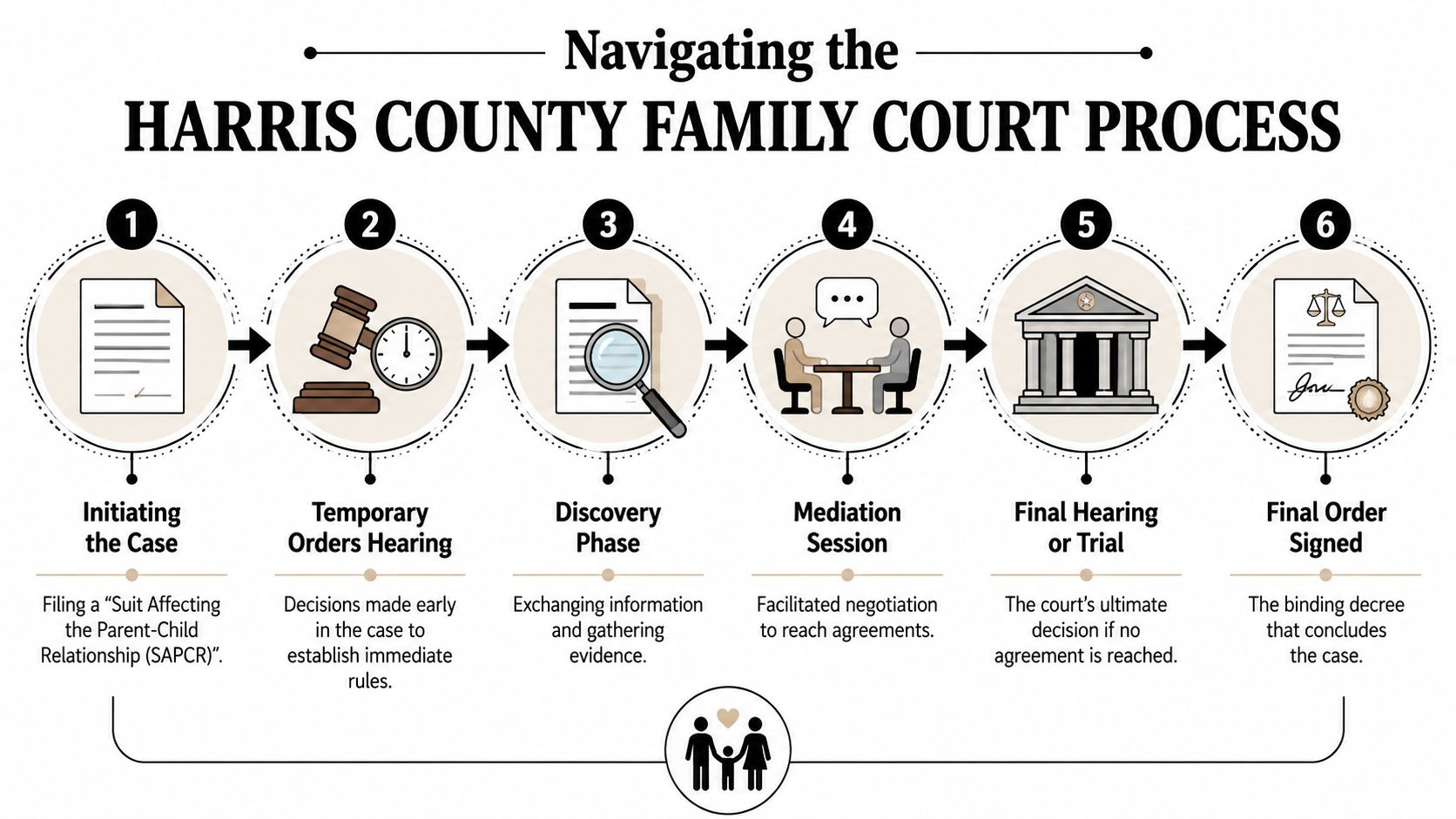
The usual path through the case
Filing the case
A SAPCR or divorce filing puts custody, possession, and decision-making before the court.Temporary orders stage
If immediate rules are needed, the court may set temporary arrangements for where the child stays, who makes certain decisions, and how exchanges will work while the case is pending.Exchange of information
Parents and lawyers gather school records, medical records, calendars, messages, and witness information. This stage often shapes settlement value because it tests whether each side can prove what they are alleging.Mediation
Harris County courts commonly expect parents to attempt mediation before asking the judge to decide contested issues. Many cases settle here, either fully or in part.Final hearing or trial
If the parents still disagree, the judge hears the evidence and decides the unresolved issues.Final orders
Once signed, the order controls possession, rights, duties, and the rules both parents must follow.
If you want a local orientation before your first setting, this Harris County family court guide for Humble residents gives a useful overview of where these cases are handled.
What actually moves a case forward
Parents often assume trial is where the case will be won. In reality, much of the case is shaped earlier.
Temporary orders matter because they create the first court-approved routine. Mediation matters because it forces both sides to put real terms on the table. Required classes and deadlines matter because judges notice who follows instructions and who creates extra problems. By the time a final hearing arrives, the court has often seen months of each parent's judgment in action.
I tell clients to treat the pending case as part of the evidence. That means every missed exchange, every hostile text, every refusal to share school information, and every practical effort to keep the child stable can end up affecting the result.
What to do while the case is pending
- Follow the temporary orders carefully: Even small violations can damage credibility.
- Prepare for mediation seriously: Bring a workable schedule, know your priorities, and understand where you can compromise.
- Finish required tasks on time: Parenting classes, document requests, and court deadlines all matter.
- Keep communication child-focused: Judges respond better to parents who solve problems than parents who escalate them.
- Stay organized: A clear calendar, saved messages, and complete records make your position easier to prove.
Case mindset: In Harris County, mediation is often where a custody case starts to take final shape, not a box to check before trial.
This video gives a useful overview of how family court proceedings work in practice.
The Critical Role of Child Custody Evaluations
In a contested case, one of the most influential pieces of evidence can be a forensic custody evaluation. This is not a quick interview and it is not a casual recommendation.
Harris County's Domestic Relations Office explains that a custody evaluation can include interviews with parents, children, significant others, and collateral witnesses, along with review of school, medical, and mental-health records, home inspections, and checks of court records, criminal histories, and Texas DFPS history through the Harris County child custody evaluations page. The point is corroboration. Evaluators compare what each person says against records, living conditions, and outside sources.
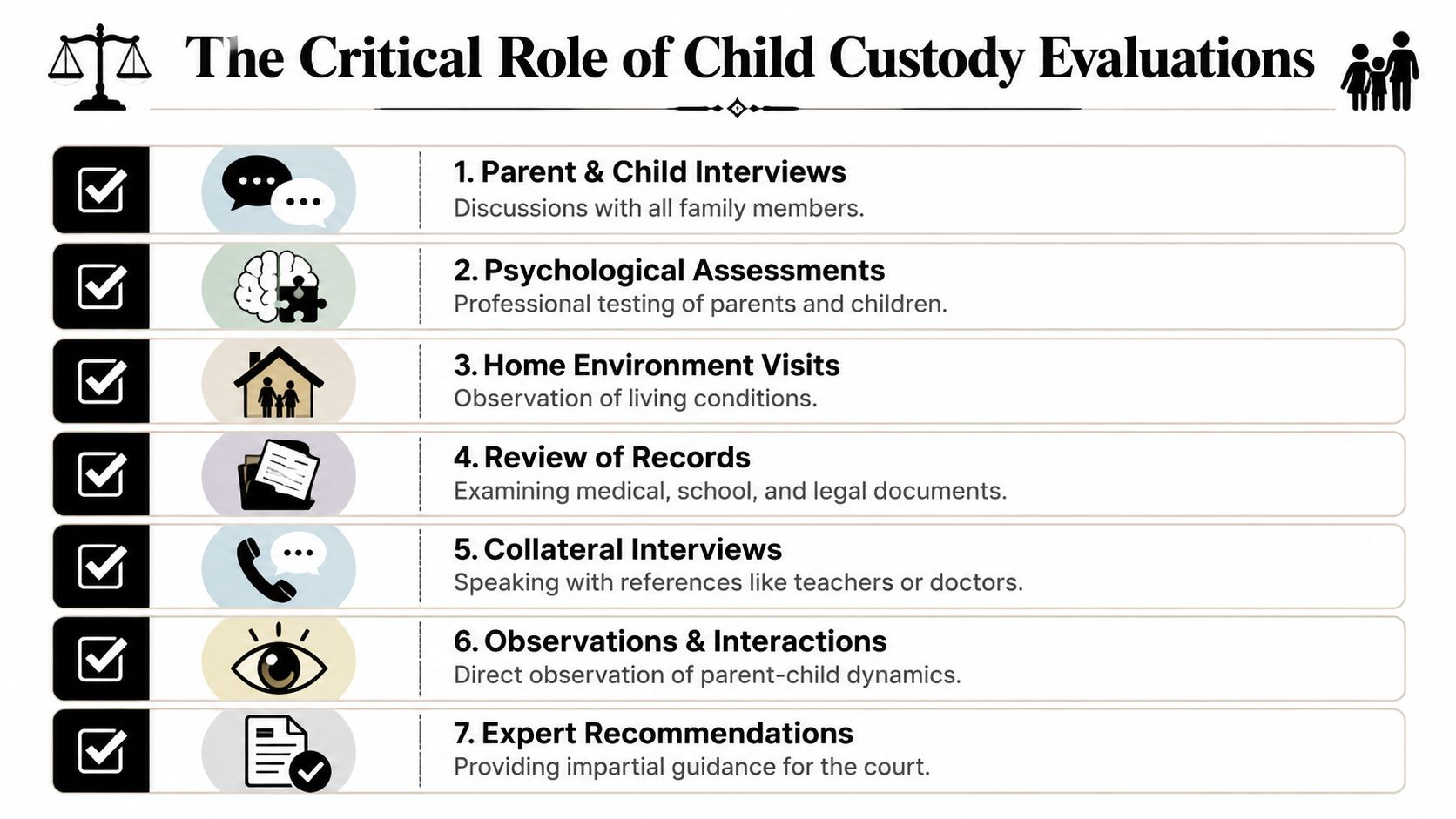
What evaluators are really testing
A custody evaluation often reveals whether a parent's presentation matches reality. If a parent claims to be involved but can't explain school routines, medical needs, or the child's day-to-day schedule, that inconsistency stands out.
Evaluators also look beyond the parent-child bond alone. They may examine:
- Consistency: Does your history match your statements?
- Judgment: Do you make decisions that protect the child and reduce conflict?
- Home environment: Is the setting safe, appropriate, and stable?
- Outside confirmation: Do records and witnesses support your account?
This is why preparation matters. In custody litigation, unsupported narratives weaken quickly when documents and third-party records point in a different direction.
The time pressure is real
Harris County's Domestic Relations Office states that contested custody evaluations are typically completed within 90 days of assignment through the Domestic Relations Office FAQ. That timeline changes strategy.
Parents should not wait until the evaluation is nearly complete to start gathering records or identifying helpful witnesses. The practical value of late-produced information drops when the evaluator has already done key interviews and formed impressions.
Start organizing records before the evaluation starts, not after the first interview.
How to prepare intelligently
Good preparation usually looks disciplined rather than theatrical.
- Build one organized file: Keep school, medical, counseling, and calendar materials in one place.
- List collateral contacts carefully: Teachers, doctors, counselors, or others should be people with direct knowledge, not just loyal supporters.
- Be accurate: If there are weaknesses in your case, address them directly rather than hoping they stay hidden.
- Prepare your home and schedule: Evaluators pay attention to how daily life functions.
For parents asking how judges decide custody in Harris County, this is one of the clearest answers. In hard-fought cases, judges often rely heavily on a structured investigation that tests each parent's credibility against multiple sources.
Common Custody Outcomes and Standard Schedules
Most parents want to know what the final order might look like. In Texas, the common framework starts with joint managing conservatorship, which means parents usually share certain rights and duties, even if one parent has more time with the child or one parent holds a particular exclusive decision-making right.
That doesn't mean everything is split evenly in practice. One parent may have the right to determine the child's primary residence. Another issue might be allocated differently. The exact order depends on the facts, the level of conflict, and what the court believes serves the child's interests.
The two broad custody frameworks
| Arrangement | What it usually means |
|---|---|
| Joint managing conservatorship | Parents generally share important rights and responsibilities, though not always in identical ways. |
| Sole managing conservatorship | One parent receives broader decision-making authority, usually because the facts support a more restrictive arrangement. |
A lot of parents assume “joint” means equal possession. It doesn't necessarily mean that. It means the court is not starting from the view that one parent should automatically be cut out of major decisions.
What possession often looks like
In many cases, families end up with a structured possession schedule. People often refer to this generally as a standard schedule or standard possession arrangement. The exact terms depend on the child's age, school schedule, geography, and the wording of the final order.
What matters most is that the order should be clear enough to reduce conflict. Ambiguous schedules create repeat arguments. Clear orders create predictable routines.
Common issues the final order addresses include:
- Pick-up and drop-off terms
- Holiday allocation
- Summer possession
- School-year routines
- Decision-making authority for medical, educational, and extracurricular issues
Realistic expectations help
A custody case is rarely about getting everything you want. It is often about securing a workable order that protects your child, preserves your relationship, and minimizes future fights.
That is especially true in Harris County. Judges often seek orders that families can follow. A parent who asks for an unrealistic schedule just to gain a negotiating advantage can lose credibility. A parent who proposes a practical, child-centered plan usually appears more reasonable.
How a Humble Attorney Protects Your Family's Future
A parent walks into my office after mediation has been ordered in Harris County. The other parent already has a proposed schedule, a stack of screenshots, and a story ready to tell. The parent sitting across from me usually has something more important, a real history of caring for the child, but no clear plan for proving it in a way the court will find persuasive.
That gap matters.
Texas law uses the best interest standard, but custody cases are often decided by what a judge can verify and what a parent can present calmly and clearly. In Harris County, that often means getting ready for mediation long before the session starts, organizing school and medical records before anyone asks for them, and treating a custody evaluation seriously if one is ordered. Good facts can get lost in a disorganized case. Modest facts can carry more weight if they are documented well and tied to the child's routine, safety, and stability.
For families in Humble, Atascocita, Kingwood, and Northeast Houston, local counsel should know more than the law on paper. Counsel should know how Harris County family courts expect parents to behave, what tends to damage credibility, and how to present a parenting plan that sounds practical instead of tactical. The Law Office of Bryan Fagan handles family law matters involving divorce, custody, child support, and related proceedings for local residents.
A lot of the work happens before any hearing.
That includes preparing a parent for mediation so anger does not derail a reasonable settlement. It includes reviewing texts and emails to remove the messages that make a parent look reactive. It includes helping a client stop arguing about adult grievances and start focusing on school attendance, medical follow-through, exchanges, homework, and communication about the child. Judges hear plenty of blame. They respond better to parents who bring records, specifics, and workable solutions.
I also tell parents to expect trade-offs. Pushing for every possible restriction can make you look unreasonable if the evidence does not support it. Agreeing too quickly can leave you with an order that creates conflict for years. The right approach is usually more measured. Protect the child where protection is needed, and propose terms that a judge can see this family following.
There's a useful parallel in how professional services build trust. Clear communication, preparation, and consistency usually matter more than flashy claims. If you want an outside example of that approach, this expert marketing blueprint for law firms offers a practical perspective.
If you are facing a custody dispute, start building your case now. Gather records. Save communications. Write down the parenting duties you handle. Early preparation gives your attorney more options in mediation, in evaluation, and in court.
If you need help with a custody case in Harris County, the team at Law Office of Bryan Fagan is available to talk through your situation in a free consultation. Our Humble office works with families across Humble, Atascocita, Kingwood, and Northeast Houston to explain the process, prepare for court, and protect what matters most, your relationship with your child and your family's future.