Skip to content

You usually start searching how to prepare for custody hearing in Humble TX at the worst possible moment. It happens after a blowup with the other parent, after service papers hit the kitchen counter, or late at night when you realize a judge in Harris County may soon make decisions about your child with very little time to hear your story.
That pressure is real. So is the confusion.
Parents in Humble, Atascocita, Kingwood, and Northeast Houston often assume the hearing will turn on who sounds more sincere or who has the longer list of complaints. It will not. Harris County courts want clear facts, reliable records, and testimony tied to your child's daily life.
Start there.
The question is not whether you love your child. The question is whether you can show the court, in a clean and credible way, how you handle school, medical care, routines, safety, communication, and decision-making. That is the difference between walking in scared and walking in prepared.
A lot of online advice stops at "dress nicely" and "be respectful." Fine. Do that. But it will not carry your case. Real preparation for a Humble custody hearing means knowing what evidence matters in Harris County, how to organize it, how to handle text messages and app records, and how to stay disciplined when the other side tries to turn the hearing into a personal feud.
That is how you help the judge see your child's life clearly.
Your Guide Through the Humble Child Custody Process
A lot of parents I talk to in Humble say some version of the same thing. "I know I've been there for my child. I just don't know how to prove it." That's the core issue in most custody hearings. Loving your child matters. But in court, proof beats promises.

What parents usually get wrong
Many parents spend weeks preparing speeches about how unfair the other parent has been. They gather old grievances. They rehearse emotional points. Then they get in front of the judge and realize none of that lands the way they expected.
A custody hearing isn't therapy. It isn't a place to unload everything that happened in the relationship. It's a place to show the court what your child needs and how your conduct meets those needs.
Practical rule: If a fact doesn't help the judge evaluate your child's daily care, safety, stability, schooling, health, or routine, it probably doesn't deserve much hearing time.
What actually helps
The strongest preparation is practical. You need records. You need a timeline. You need a parenting calendar. You need to know what the judge is looking for in Harris County and how to present it without rambling.
That means being ready to show things like:
- School involvement with attendance records, pickup history, or school communication
- Medical involvement with appointment records, medication details, or provider notes
- Parenting consistency with calendars, exchanges, and daily caregiving logs
- Stability with housing, work, and a routine your child can rely on
In Texas custody cases, the governing standard is the child's best interest, and one widely cited framework comes from Holley v. Adams in 1976, which lists factors courts may weigh, including the child's emotional and physical needs, parental stability, and each parent's abilities. That is why documented proof of care carries more weight than emotional arguments, as noted in this Texas custody hearing guide.
Parents in Humble don't need more vague internet advice. You need a working plan for Harris County family court, especially if your case involves digital messages, high conflict, or last-minute accusations. That's where focused preparation makes the difference.
Understanding the Harris County Best Interest Standard
You walk into court ready to tell the judge everything the other parent has done wrong. The judge keeps bringing the focus back to your child. That shift decides a lot of custody hearings in Harris County.
Texas judges decide custody based on the child's best interest. The legal framework often cited is Holley v. Adams, which gives the court a set of practical factors to weigh. In plain terms, the judge wants to know which parent is more likely to protect the child's safety, support the child's development, and provide a stable routine that works.
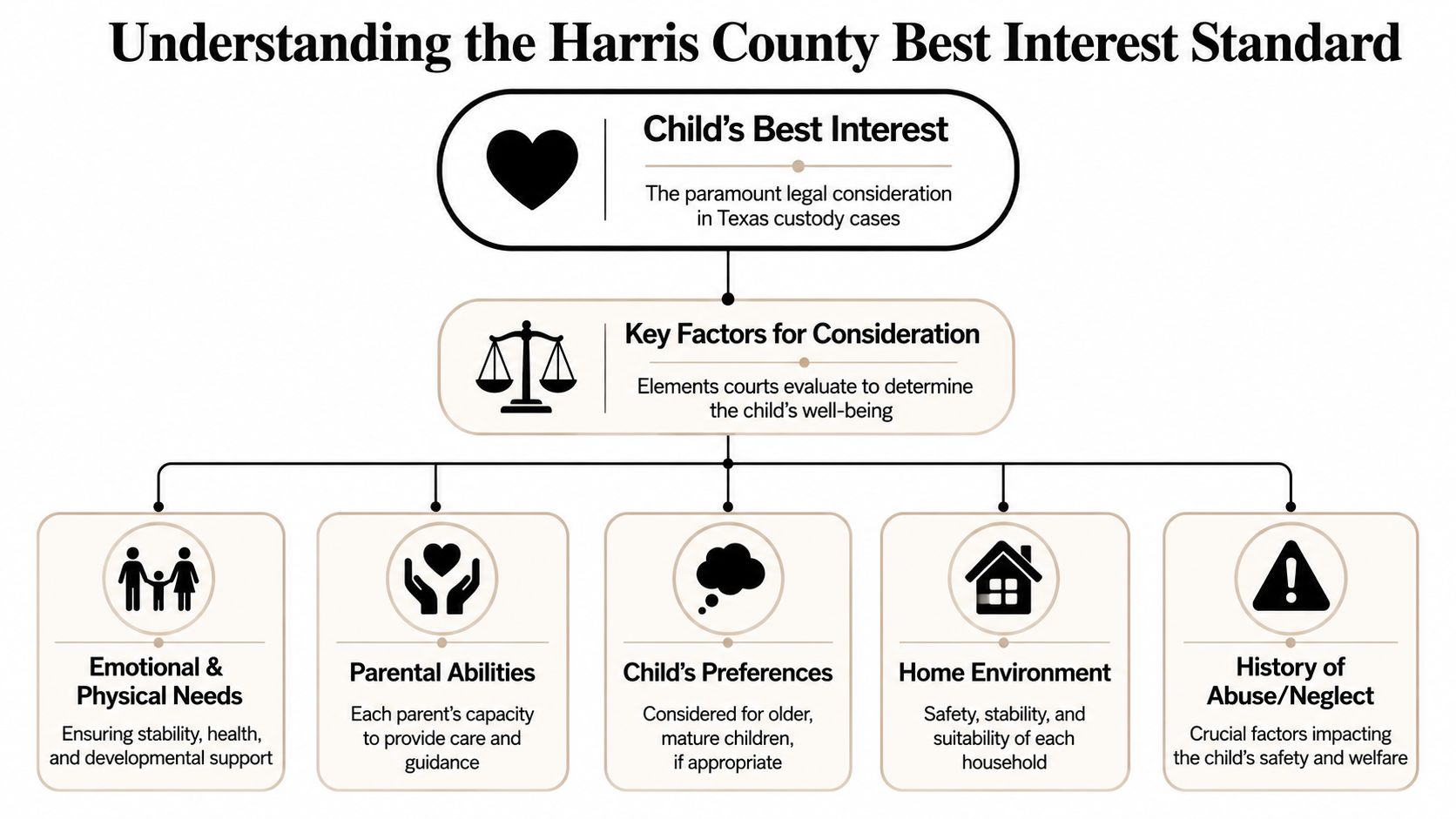
What Harris County judges actually care about
Start with the basics. Can you meet the child's day-to-day needs without chaos, excuses, or constant conflict?
That usually comes down to a few recurring questions in court:
- Who gets the child to school, appointments, and activities consistently?
- Who communicates with teachers, doctors, and caregivers?
- Which home offers a steadier routine?
- Which parent makes sound decisions under stress?
- Is either parent exposing the child to danger, instability, or adult drama?
- If the child is old enough, what does the evidence show about the child's needs and adjustment?
Notice the pattern. These are parenting questions, not popularity questions.
A Harris County judge is not grading who sounds more hurt, more angry, or more convincing in the hallway. The judge is sorting out who has shown good judgment over time. If your evidence proves calm, steady parenting, you are speaking the court's language.
Turn the standard into proof
Best interest is not an abstract idea. It has to show up in records, messages, schedules, and testimony.
Use this approach:
| Best-interest issue | Proof that usually helps |
|---|---|
| Daily care and supervision | parenting calendars, exchange logs, childcare records, meal or bedtime notes if disputed |
| School involvement | attendance records, report cards, teacher emails, parent portal screenshots |
| Medical care | appointment summaries, prescriptions, insurance records, provider instructions |
| Stability | lease or mortgage documents, work schedule, childcare plan, proof of transportation |
| Judgment and co-parenting | civil text messages, email threads, app communications, records showing follow-through |
| Safety concerns | police reports, protective orders, photos, medical records, third-party observations |
Digital evidence matters here more than many parents realize. Screenshots can help, but sloppy screenshots create credibility problems. Save full message threads with dates, names, and context. If you need a clean way to organize phone screenshots and message images for your file, use secure image to PDF conversion so the court can review them in order.
Stop bringing facts that do not help your child
A lot of parents waste hearing time on conduct that feels offensive but does not move the legal issue. New relationships, rude comments, and old arguments usually matter only if they affect the child directly.
Ask a harder question: does this fact show something about safety, stability, parenting ability, or decision-making?
If yes, keep it and document it well. If no, cut it.
That discipline matters in Harris County courts serving Humble because crowded dockets reward clarity. The parent who presents relevant, organized proof often comes across stronger than the parent who tries to dump every grievance into the record.
For a closer look at matching your evidence to what the court weighs, read this guide on how to prove best interest of child.
Assembling Your Humble Custody Hearing Evidence Binder
Most custody hearings are shaped before anyone says a word in the courtroom. They are shaped at the kitchen table, with folders, printouts, notes, and a clear system. If your paperwork is a mess, your argument will be a mess.
Texas Law Help recommends bringing originals plus at least three copies of all evidence for court use and rehearsing a concise outline of what you'll tell the judge so your testimony stays fact-based and organized, as explained in Texas Law Help's family court guide. That's not busywork. That's how you make your case usable to the court.
Build the binder by category
Don't dump everything into one folder. Organize it in sections with labels the judge can follow quickly.
| Essential Documents for Your Custody Evidence Binder | Specific Examples | Why It's Important |
|---|---|---|
| Court documents | prior orders, notices, filed pleadings | shows the legal posture of the case |
| Parenting records | calendar, exchange notes, possession schedule | proves day-to-day involvement |
| Communication logs | texts, emails, co-parent messages | shows coordination, conflict, or reliability |
| School records | attendance, teacher messages, report cards | demonstrates educational involvement |
| Medical records | appointment summaries, immunization records, prescriptions | shows health-related caregiving |
| Financial records | expense receipts, childcare payments, insurance records | reflects support and planning |
| Witness information | names, contact details, short topic summary | helps present relevant testimony |
| Chronology | dated summary of major caregiving events | gives the judge a clean timeline |
What belongs in the parenting section
Many parents in Northeast Houston either win credibility or lose it at this point.
Include:
- A detailed parenting calendar showing overnights, pickups, drop-offs, school events, doctor visits, and extracurricular involvement
- A short chronology that tracks major events in order, especially if the schedule changed over time
- Communication excerpts that show cooperation, reminders, confirmations, or missed responsibilities
Don't overstuff the binder with repetitive texts. Choose messages that prove a point. If you have fifty screenshots saying the same thing, use the strongest few.
A judge doesn't need your entire phone. The judge needs a clean set of exhibits that show a reliable pattern.
Handle digital records the right way
A lot of modern custody evidence starts on a phone. Texts, school-app messages, screenshots, photos, and emails can matter. But random screenshots scattered across your camera roll won't help much.
Create a digital folder first. Sort items by topic, then by date. Once you've cleaned that up, convert image files into a single organized PDF for each topic. If you're pulling screenshots from your phone, a tool for secure image to PDF conversion can help you turn loose images into a cleaner packet that's easier to label and print for court.
That doesn't make the evidence automatically admissible. It does make it easier to review, share with counsel, and match to your timeline.
Prepare for the hearing, not just the file
Your binder needs a front-page outline. Keep it short. List the main points you want the judge to hear, and tie each point to a tab in the binder.
Try a structure like this:
My child's current routine
School, home, medical care, and exchange schedule.My role in daily caregiving
Specific tasks you handle consistently.Why my requested orders support stability
Focus on the child's needs, not revenge.Documents that support each point
Point the court to the exact exhibit.
A blunt warning about sloppy exhibits
If your records are blurry, out of order, missing dates, or impossible to follow, they won't help much. The same goes for pages covered in highlighting and handwritten side comments. Keep exhibits clean.
If you're working with counsel, your attorney can help decide what to include and what to leave out. If you're gathering documents before hiring counsel, a practical next step is reviewing what evidence helps in child custody case Texas so you don't waste time collecting records that don't move the issue.
Courtroom Conduct and Preparing Your Testimony
You can have solid evidence and still hurt your case by how you act in court. Judges watch everything. They watch whether you listen. They watch whether you interrupt. They watch whether you answer the question asked or launch into a speech.

Legal guidance on custody hearings advises parents to create multiple copies of every exhibit, notes that some local courts require exhibit and witness lists about a week before trial, and emphasizes answering questions directly and briefly because judges notice whether a parent stays calm under pressure, as described in this custody hearing preparation article.
What calm looks like in court
Calm doesn't mean robotic. It means controlled. It means you don't fight every point. It means you don't treat the witness stand like an argument with your ex.
Use these rules:
- Listen first. Wait until the full question is asked.
- Answer only that question. Don't volunteer extra material unless your attorney directs you to.
- Speak plainly. Judges prefer direct answers over dramatic ones.
- Admit what you don't know. Guessing damages credibility fast.
- Keep your body language steady. Eye rolls, muttering, and visible frustration don't help.
Here's a helpful walkthrough to watch before a hearing.
Rehearse your testimony the right way
Don't memorize a script word for word. That usually makes testimony sound stiff. Instead, rehearse your main points in outline form.
A useful outline often includes:
- Your child's routine and your role in maintaining it
- Your concerns, stated briefly and tied to facts
- Your requested outcome, framed around stability and care
- Your supporting exhibits, so you can refer to them quickly
Courtroom reminder: Short answers sound more credible than speeches, especially during cross-examination.
Prepare your witnesses too
If someone is going to testify for you, don't just tell them the hearing date and hope for the best. Make sure they understand the narrow topic they are there to address.
Good witnesses usually help with specific observations, such as:
- A teacher discussing school involvement
- A family member describing regular caregiving they personally observed
- A childcare provider confirming pickup routines or attendance
- A medical contact addressing attendance or parental participation, if appropriate and available through proper process
Don't use witnesses to pile on character attacks. That's a common mistake. The better witness is the one who can say, clearly and credibly, what they personally saw.
If you're working with a lawyer, this is often the point where legal strategy matters as much as the facts. The Law Office of Bryan Fagan provides family law consultation and custody representation for Humble-area families who need help organizing exhibits, preparing testimony, and presenting a focused case in Harris County court.
Navigating High-Conflict and Digital-Age Issues
Basic custody advice only gets you so far. If your case involves accusations of abuse, unsafe conduct, substance concerns, supervised visitation requests, or a flood of digital messages, basic advice isn't enough.
A practical warning from recent custody-prep guidance is that many parents spend too much time trying to appear likable and not enough time preparing for high-risk issues like supervised visitation requests, child-safety testimony, and digital evidence. In Harris County, readiness means anticipating judicial questions around safety and consistency, as discussed in this article on preparing for a child custody hearing.
Preserve digital evidence before it disappears
If texts, call logs, school-app messages, location history, or social media posts matter, preserve them early. Don't rely on memory. Don't assume the content will still be there later.
Use a simple discipline:
- Capture the full screen when possible, including dates and names
- Save records in date order inside folders by topic
- Keep originals on the device if possible
- Avoid editing or cropping unless you also keep the original version
If social media is an issue in your case, you also need to think carefully about your own online footprint. Parents often underestimate how online content can be framed in custody disputes. For a niche example of how adult-platform activity can affect family court arguments, this PartnerScanX OnlyFans child custody guide shows the kind of issues that can come up when online conduct becomes part of the custody conversation.
Treat allegations like legal problems, not personal insults
If the other parent accuses you of unsafe behavior, don't answer with outrage alone. Build a response with records, witnesses, and a timeline.
That may include:
- Contradicting the timeline with dated messages or calendars
- Showing compliance with school, medical, or exchange routines
- Presenting third-party records that support your version of events
- Staying disciplined in your own communication after the allegation is made
Serious allegations change the hearing. The judge may care less about who sounds pleasant and more about who can answer safety questions with records and consistency.
Stop trying to win on personality
A lot of parents think, "If the judge meets me, they'll know I'm the reasonable one." Maybe. But that's not a strategy.
In a high-conflict case in Humble or greater Northeast Houston, preparation means anticipating the hardest questions before they're asked. If safety is in dispute, act like that issue will dominate the hearing. If digital evidence matters, organize it like you'll need to explain every screenshot. That's how serious cases are handled.
You Don't Have to Face This Alone Here in Humble
By the time a custody hearing gets close, most parents are trying to do three jobs at once. You're parenting. You're managing stress. And you're trying to build a legal case with rules, deadlines, exhibits, and testimony standards that aren't obvious unless you've done this before.
That's why so many good parents feel overwhelmed. Not because they don't care. Because the process is demanding.
Why legal help matters in a custody hearing
A custody case isn't just about telling your story. It's about telling it in a way the court can use. That means choosing the right exhibits, cutting the bad ones, preparing for objections, organizing witnesses, and keeping the hearing focused on the child's best interest instead of the history of the relationship.
If you're in Humble, Atascocita, Kingwood, or anywhere in Northeast Houston, local context matters too. Harris County family court practice has its own pace, expectations, and procedural pressure points. A lawyer who handles these cases regularly can help you prepare for what transpires, not what generic websites say should happen.
The smartest next step
If your hearing is coming up, don't spend the next few days guessing whether your binder is enough or whether your testimony is too long. Get a professional read on your case.
You may need help with:
- Temporary orders hearings that move fast
- Evidence organization when the documents are there but not usable yet
- Witness preparation so testimony stays relevant
- High-conflict allegations that need a tighter response than "that's not true"
- A realistic custody strategy based on your facts and your child's needs
If you need local representation or want to talk through your next move, start with a child custody lawyer in Humble TX. A focused legal consultation can help you sort out what matters, what doesn't, and what to do before you walk into court.
If you're facing a custody hearing in Humble, Atascocita, Kingwood, or Northeast Houston, schedule a free consultation with the Law Office of Bryan Fagan. Our Humble office helps parents understand Texas custody law, organize evidence, prepare for court, and protect what matters most: your child, your rights, and your future.