Skip to content

A custody case often starts with something that feels small. A late pickup. A missed exchange. A frustrated text sent after bedtime that says too much. By the time a parent in Humble, Atascocita, or Kingwood walks into court, that message may no longer look small at all.
In Texas family cases, phones often hold the most honest record of what happened between two people. They show who asked about the child. Who ignored the question. Who threatened, insulted, stalled, or stayed calm. If you're dealing with divorce, conservatorship, or enforcement issues, text messages as evidence in family court texas can help your case or hurt it, depending on how you preserve and present them.
More Than Words Why Your Texts Matter in a Humble Family Court
A lot of Harris County family cases involve the same kind of exchange. One parent asks, “Are you bringing her back after practice?” The other replies with sarcasm, accusations, or refuses to answer at all. Or a spouse sends messages that point to an affair, hidden spending, or repeated verbal abuse during the marriage.
That kind of digital communication isn't just personal history. It can become courtroom evidence.
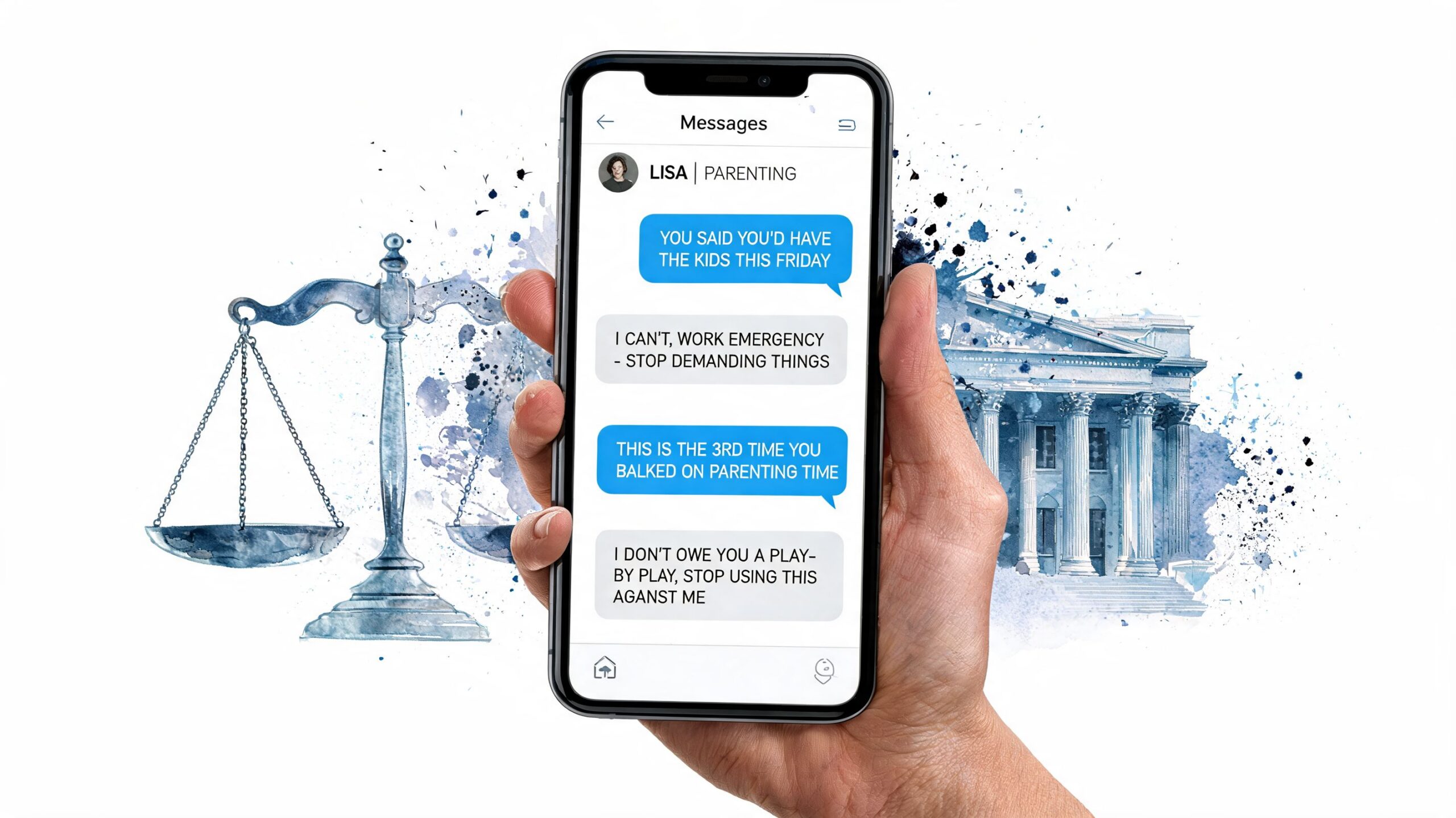
Texas family-law guidance has emphasized that digital messages can affect core issues in a case, including custody, property division, and fault-based divorce claims under Texas divorce and custody rules for digital evidence. That matters because Texas law allows fault grounds like adultery or cruelty to influence property division, and the Family Code places the child's best interest at the center of conservatorship decisions.
How texts show up in real family cases
In practice, texts often get used to show things like:
- Refusal to co-parent: One parent won't share school information, medical updates, or exchange details.
- Threatening conduct: A message contains intimidation, insults, or pressure tied to the children.
- Adultery or secret conduct: A thread reveals a relationship or hidden activity relevant to divorce claims.
- Parental alienation concerns: A parent uses messages to undermine the other parent's relationship with the child.
A single thread can matter. A long series of messages can matter even more.
Practical rule: If a message helps prove how someone acted as a spouse or parent, assume it may end up in front of a judge.
Why this matters locally
Families in Humble and Northeast Houston often come to court carrying weeks or months of phone records, screenshots, and app messages. Judges don't want drama for drama's sake. They want evidence that helps them decide what happened and what arrangement protects the child.
That means your messages aren't background noise. They're part of the factual record.
If you're sorting through divorce or custody issues, it helps to start with a clear legal plan instead of reacting text by text. Our family law representation in Humble page gives a broader view of how these issues fit into a Texas case.
First Steps to Preserving Text Message Evidence
Many individuals make mistakes in the first hour after receiving an important text. They crop the screenshot. They fire back an angry reply. They delete their own message because they regret it. Those choices can damage a case before it even gets filed.
The better approach is simple and disciplined. Preserve first. React later.
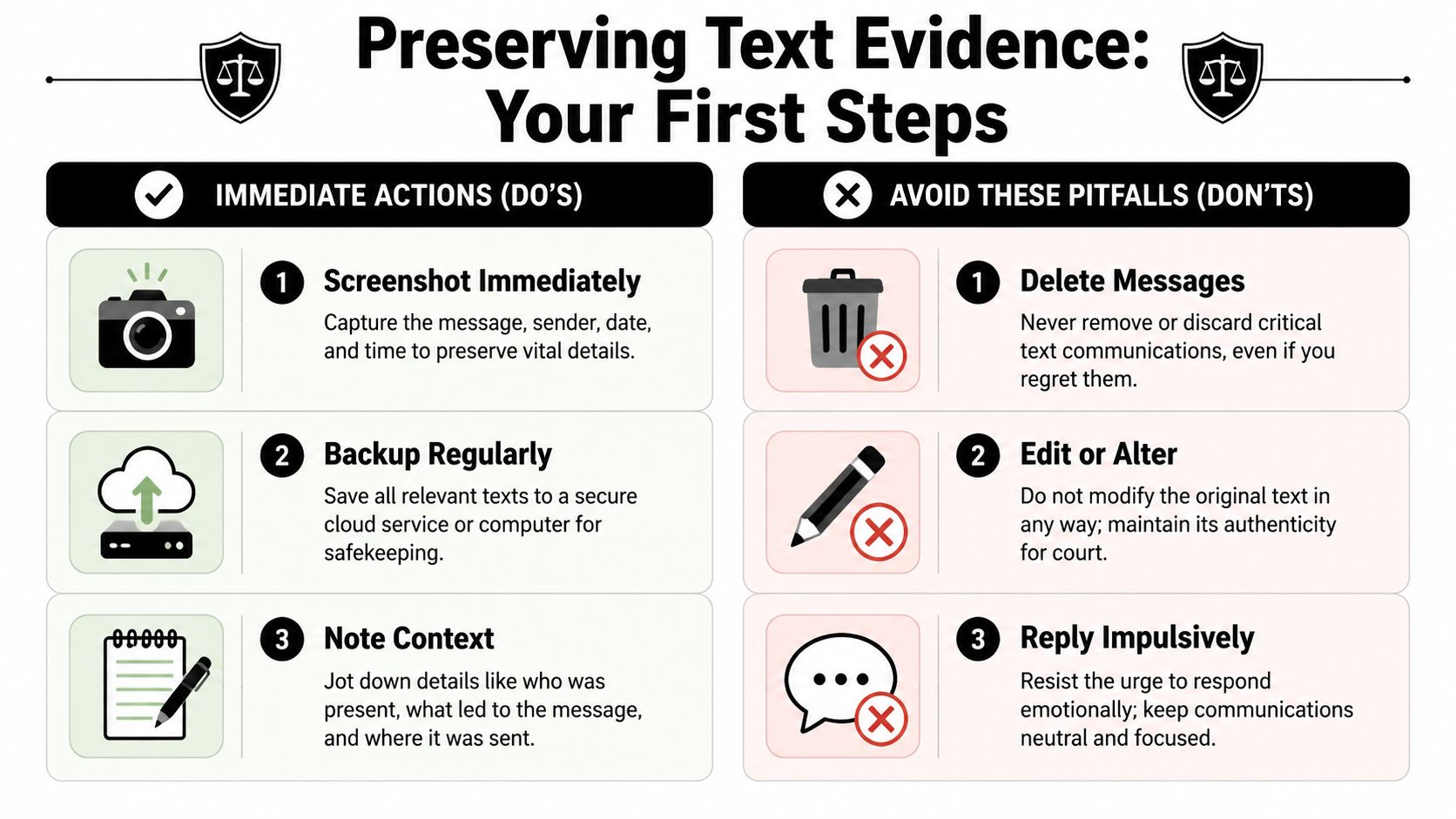
What to capture right away
When you take a screenshot, make sure it shows as much identifying information as possible. A useful screenshot usually includes the contact name or phone number, the body of the message, and the visible date and time.
If the conversation is longer than one screen, don't grab only the worst line and stop there. Capture the surrounding messages too. Context often decides whether a judge sees a text as meaningful, misleading, or incomplete.
Use the phone you received the message on. Avoid retyping the text into a note, messenger app, or email body as your main record. A typed summary is not the same thing as preserving the message.
Better preservation habits
These habits help protect the evidence and your credibility:
- Screenshot the full thread: Include surrounding messages when possible, not just the line that helps you.
- Use screen recording for long exchanges: A slow scroll through the conversation can show continuity better than scattered screenshots.
- Back up the material: Save copies to a secure computer, cloud folder, or email archive you can access later.
- Write down the context: Note what was happening that day, who was present, and why the message matters.
- Keep the original phone: If litigation is likely, don't trade it in, reset it, or let the thread disappear during an upgrade.
For parents using co-parenting platforms instead of standard SMS, message preservation may work differently. If that applies to your case, this guide on using parenting apps in custody cases in Texas can help you think through records from app-based communication.
A short walkthrough can also help if you're trying to preserve messages without getting lost in the technology.
What hurts your evidence
People often damage good evidence by trying to make it look cleaner.
| Do | Don't |
|---|---|
| Capture the sender, date, and time | Crop out identifying details |
| Save the conversation in order | Cherry-pick only favorable lines |
| Back up screenshots and recordings | Rely on one phone with no backup |
| Preserve the original device | Reset, replace, or wipe your phone |
| Stay calm in your replies | Send emotional responses that create new problems |
If you think a message may matter in court, preserve it as if someone else will examine every pixel later.
A few practical warnings
Don't edit images. Don't highlight or draw on the original file. If you want to mark up a copy for your lawyer, keep the untouched original separately.
Don't delete embarrassing messages from your own side of the thread just because you're worried they look bad. A partial record can create bigger problems than a messy but honest one.
And don't assume your divorce case is too early for evidence preservation. If you're already searching for legal help, it may also be time to review divorce guidance for Texas families and start protecting the record now.
Understanding the Legal Hurdles for Admissibility
Saving texts is only step one. A judge still has to decide whether those messages can come into evidence. In family court, the two hurdles that usually matter most are authentication and hearsay.
Those words sound technical, but the ideas are straightforward. First, can you show the message is real and tied to the person you say sent it? Second, is there a rule that allows the court to consider what the message says?
Authentication means proving the text is what you claim it is
Texas courts use Rule 901 principles to decide whether digital evidence has been properly authenticated. A major milestone came in Tienda v. State, 358 S.W.3d 633 (2012), where the Texas Court of Criminal Appeals held that electronic messages can be authenticated through circumstantial evidence and distinctive content, not only by getting the sender to admit authorship. That framework matters in family court too, as explained in this discussion of Texas authentication of texts and WhatsApp messages under Tienda.
In plain English, that means you may be able to connect a message to the other person by showing details such as:
- The phone number or saved contact
- The subject matter that only that person would know
- Nicknames, phrases, or writing style
- Related calls, photos, or follow-up messages
- The fact that the message fits into an ongoing conversation
You don't always need a dramatic admission like, “Yes, I sent that.” Sometimes the content and surrounding circumstances do the work.
Hearsay isn't always the barrier people think it is
People hear “hearsay” and assume the message is automatically out. That's not how it works.
If the opposing party wrote the message, that often changes the analysis because statements by a party can be treated differently from third-party statements. Other messages may be offered not to prove every word in them is true, but to show notice, effect on the listener, the existence of conflict, or the course of communication between the parents.
The trial judge still has discretion, and context matters. A reliable, relevant message has a much stronger chance than a confusing screenshot with no foundation.
A judge doesn't have to trust your screenshot just because it's on a phone. You have to connect it to a real person, a real conversation, and a real issue in the case.
A simple foundation often works better than overlawyering
When clients prepare text evidence, I usually tell them to think like a witness, not a tech expert. Can you explain where the message came from, when you received it, how you saved it, and why you believe it came from that person?
A basic authenticity statement often covers points like these:
- Identity of the device: “These screenshots came from the phone I used during the marriage and after separation.”
- How the messages were received: “I received these texts in the ordinary course of communicating with the other parent.”
- How they were preserved: “I screenshot the full thread and kept the original files on my phone.”
- Why the sender is identifiable: “The number was the number the other parent used regularly, and the content refers to our child, schedule, and events known to both of us.”
That isn't a substitute for legal advice, and it isn't a magic script. But it shows the kind of factual groundwork courts look for.
Presentation matters too
Even strong evidence can get bogged down if it's disorganized. For hearings and trial prep, many clients benefit from clean printed exhibits with page numbers, labels, and full conversation sequences. If you're assembling binders or exhibit packets, services focused on professional court filing printing can help with presentation logistics, especially when you need readable copies for the court and opposing counsel.
For family cases involving children, the custody angle often shapes which messages matter most and how they should be framed. Broader guidance on child custody issues in Texas family law can help you connect the evidence to the legal issues the court is deciding.
Building Your Case with Text Message Patterns
One ugly text can be explained away as stress. A long run of texts showing the same behavior is much harder to dismiss.
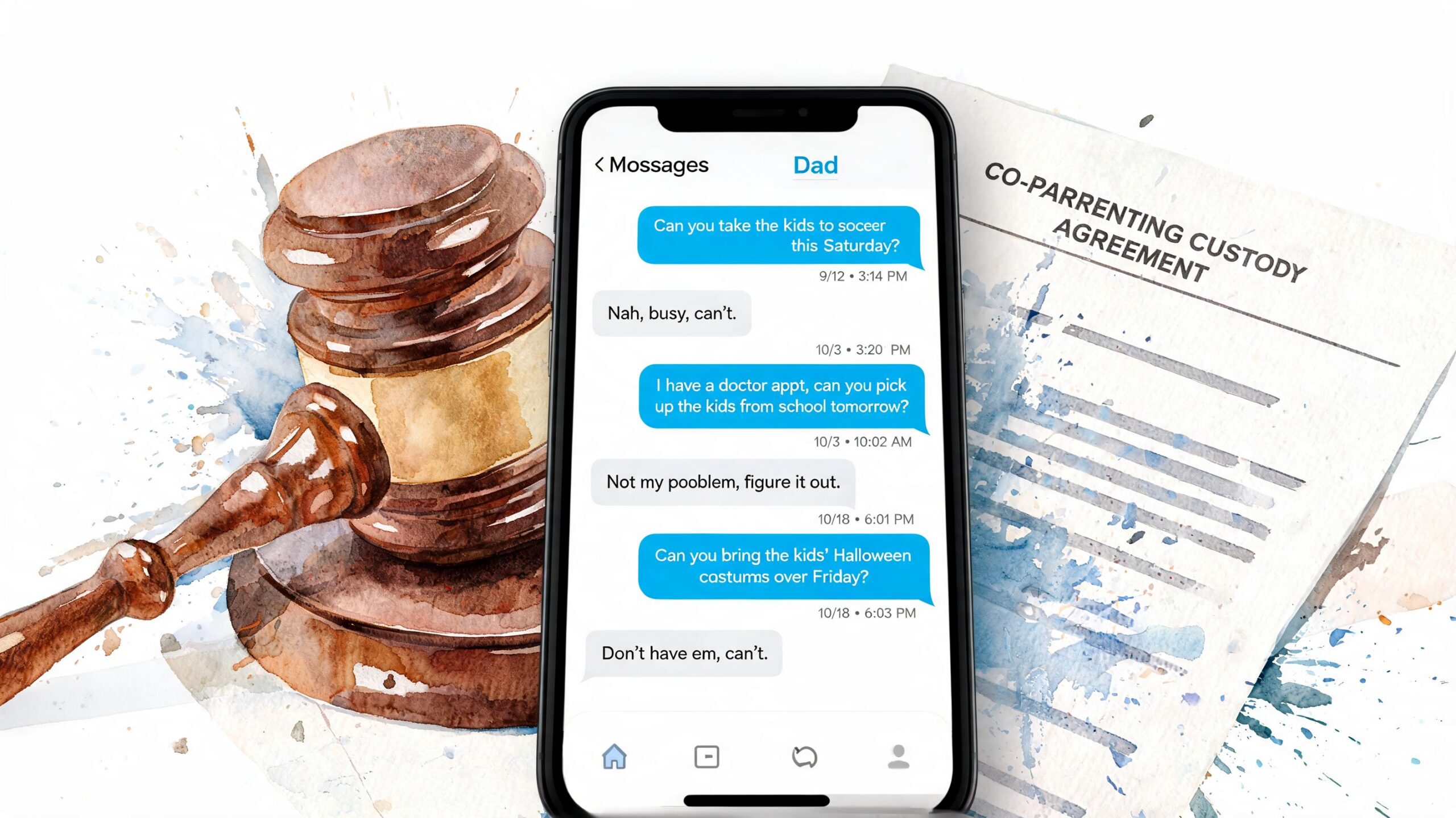
Texas family court resources often note that judges look at repeated harassment and patterns of behavior, but they don't give families much guidance on what that means in everyday case preparation. That gap is especially frustrating for parents in Humble and Northeast Houston who are trying to decide what to save and what to leave out. The problem is described in this discussion of patterns of behavior in Texas custody text evidence.
What a useful pattern looks like
A pattern isn't about volume alone. A pile of random screenshots doesn't persuade anyone. What helps is repetition tied to a clear issue before the court.
Examples include:
- Exchange interference: repeated late arrivals, no-shows, or refusal to confirm pickup details
- Communication breakdown: repeated ignoring of medical, school, or emergency questions
- Harassment: recurring insults, threats, or pressure tied to possession or support
- Undermining co-parenting: repeated efforts to block information, create conflict, or manipulate the child
Judges usually care less about whether the thread feels dramatic and more about whether it shows a reliable story over time.
How to organize messages so the judge sees the story
Don't hand over hundreds of screenshots with no order and expect the court to assemble your argument for you. Build a timeline.
A workable timeline often includes:
- Date of the incident or exchange
- Short label for the issue
- The relevant text sequence
- What happened next
- Why it matters to custody, enforcement, or credibility
That timeline can live in a binder, a folder of labeled PDFs, or a hearing notebook for your lawyer. The format matters less than the clarity.
Calm, complete records usually beat dramatic fragments.
If your case involves repeated missed exchanges, school interference, or refusal to follow temporary orders, this guide on how to document custody violations in Texas pairs well with text preservation and can help you build a record that makes sense in court.
Don't ignore the messages that help you
Parents sometimes save only the other side's worst messages and ignore their own good conduct. That's a mistake.
Your cooperative texts can support your case too. Messages where you confirm pickup times, share school updates, offer solutions, or stay polite under pressure can show stability and judgment. In contested custody litigation, that can matter as much as the hostile message from the other side.
A judge comparing two parents may notice which one communicates about the child and which one turns every thread into a fight.
A practical framework for selection
If you're overwhelmed by months of texts, sort them into three groups:
| Group | What belongs there | Why it matters |
|---|---|---|
| Core exhibits | The clearest threads tied to major issues | These form the backbone of your courtroom presentation |
| Support files | Additional examples showing repetition | These reinforce that the conduct wasn't isolated |
| Background only | Messages with emotion but little legal value | These may stay with your lawyer but not become exhibits |
This keeps your evidence from becoming cluttered.
What usually backfires
Three habits weaken otherwise solid evidence.
- Saving only the most explosive lines: That can make the record look curated.
- Mixing parenting issues with unrelated relationship drama: Judges want relevance, not every grievance.
- Flooding the court with duplicates: Repetition without structure can make strong evidence look sloppy.
If you live in Kingwood, Atascocita, or the Humble area, think of your text file like a witness statement. It should answer a question the court has. It shouldn't read like a diary of every bad day since separation.
Advanced Methods Subpoenas and Forensic Experts
A common Humble custody problem looks like this. One parent says, "Those screenshots are fake." The other says, "The old phone broke, but I know what was there." At that point, the case is no longer about what the texts say alone. It is about whether you can prove where they came from, whether anything was deleted, and whether spending more money on proof will help the judge decide the issue in Harris County family court.
What a subpoena can actually get you
A subpoena is a court-backed request for records from a third party. In family cases, that may mean a cell carrier, an employer, a school, or a company that controls an account tied to the messages.
Clients are often surprised by the limits. A phone carrier may confirm that messages were sent between two numbers at certain times, or identify who held the account. In many situations, the carrier will not have the message content you hoped to recover. That makes the goal of the subpoena matter.
Use a subpoena when it helps prove a specific point, such as:
- The timing of communications between two phone numbers
- Who owned or controlled an account
- A timeline that matches other evidence, like school records or pickup logs
- Whether a third party has records your spouse does not control
If the dispute is about the exact words in a deleted text thread, a subpoena may only solve part of the problem.
When a forensic expert is worth considering
A forensic expert examines a phone, backup, export, or related data source in a way that preserves the original information and documents the process. In a family case, that usually matters when authenticity is under attack or someone claims key messages are gone.
That kind of help may be appropriate if:
- Important messages were deleted before you could preserve them
- The other side claims screenshots were edited
- A device contains original app data that should be collected carefully
- You need more than your own testimony to answer an authenticity objection
Judges do not expect every family case to turn into a technical fight. They do expect parties to be realistic. If the disputed texts are central to allegations of threats, harassment, hidden relationships affecting the child, or repeated interference with possession, expert work may be money well spent. If the texts are only cumulative, the cost can outweigh the benefit.
Broader reading on navigating the evolving digital crime landscape can help explain why deleted or disputed phone evidence is often harder to prove than people expect.
Protect the device early. A trade-in, factory reset, cracked screen replacement, or automatic backup overwrite can erase the best source of proof before your lawyer ever gets to review it.
The cost-benefit question families often miss
This is the part many online guides skip. Forensic work and subpoena practice can be useful, but they also cost time, money, and attention. In a Harris County divorce or custody case, I usually tell people to ask one practical question first: if the court never sees this exact text, can we prove the same point another way?
Sometimes the answer is yes. A school email, OurFamilyWizard log, witness testimony, calendar record, or police call record may do the job with less expense and less room for a side fight over authenticity.
Sometimes the answer is no. If one message thread is the clearest proof of a threat, an admission, or a pattern of refusing to return the child, then stronger technical proof may be justified.
Here is the trade-off in plain terms:
| Option | Best use | Trade-off |
|---|---|---|
| Screenshots and witness testimony | Ordinary disputes where both sides agree the texts are real | Vulnerable if preservation was sloppy or context is missing |
| Subpoenaed records | Confirming dates, account ownership, and outside timelines | Often limited, and may not include full message content |
| Forensic review | Deleted data, altered-image claims, and device-level disputes | More expensive, slower, and usually unnecessary unless the texts are central |
Timing matters more than people think
Waiting until the week before a temporary orders hearing is how good evidence gets lost. If you suspect deletion, phone swapping, or tampering, raise it early with counsel so your side can decide whether to preserve a device, seek records, or request targeted relief.
That planning is especially important in fast-moving custody litigation, where hearing dates can arrive before families have sorted out their phones, backups, and app exports. If you are preparing for that kind of setting, this guide on how to prepare for a custody hearing in Texas can help you organize the bigger picture while your text evidence strategy is being evaluated.
The goal is simple. Use advanced proof methods only when they move the case forward. In Humble and the rest of Harris County, the strongest approach is usually the one that gives the judge reliable evidence without turning a family case into an expensive fight about phones.
Presenting Your Evidence in a Harris County Courtroom
A lot of anxiety comes from not knowing what the courtroom process will look like. Once families understand the sequence, the task becomes more manageable. You're not walking in to tell your whole life story. You're offering specific exhibits through organized testimony.
What to bring and how to prepare
If your text messages may be used at a hearing, prepare them as exhibits in a clean, readable format. That usually means printed screenshots or message exports arranged in order, with page labels and enough context to understand the conversation.
Bring copies for the court, for the opposing side, and for your own use if your lawyer asks you to follow along. Keep the original phone available if there may be an authentication objection.
A basic prep checklist looks like this:
- Label each exhibit clearly
- Group related messages together
- Remove duplicates
- Make sure dates and names are visible
- Know why each exhibit matters
If you're getting ready for a custody setting, this practical guide on how to prepare for a custody hearing can help you think beyond the texts and prepare for the broader hearing process.
How evidence usually comes in
Most text exhibits come into evidence through testimony. That may happen by you identifying the messages, explaining how you received them, and confirming that the printouts fairly reflect the conversation. It may also happen through questioning the other party about the same thread.
The judge may hear objections. That's normal. An objection doesn't mean you've done something wrong. It means the court wants a legal basis before admitting the exhibit.
Try to answer the question asked. Don't argue with opposing counsel while you're on the stand. Don't give speeches about every wrong that happened in the relationship when the question is just whether you recognize the exhibit.
Speak to the judge through facts, not frustration.
Credibility matters as much as content
Some of the strongest witnesses aren't the most emotional ones. They're the most consistent ones.
If the text is ugly, let the text be ugly. You don't need to amplify it. Explain what it is, when you received it, and why it relates to the issue before the court.
That same principle applies to your own messages. If one of your texts looks impatient or sharp, don't pretend it doesn't. Acknowledge it, place it in context, and stay grounded. Judges in Harris County see conflict every day. What often stands out is the parent who remains focused on the child and the facts.
For families who want to know more about the people behind the local legal work, our Humble legal team and community approach page gives a sense of how local representation fits into that courtroom preparation.
Your Next Steps with The Law Office of Bryan Fagan
Text messages can be some of the most persuasive evidence in a Texas family case. They can also be excluded, misunderstood, or weakened if they're incomplete, altered, or poorly organized.
If you're in Humble, Kingwood, Atascocita, or elsewhere in Northeast Houston, the safest move is to act early. Preserve the full conversation. Keep the original device. Stay measured in your replies. Then get legal advice before you decide what to file, what to hold back, and what needs stronger authentication.
Family court is stressful enough without guessing your way through evidentiary rules. A careful legal strategy can help you avoid common mistakes and put the focus where it belongs, on your child, your rights, and the facts that matter.
If text messages are part of your divorce, custody dispute, enforcement case, or modification, schedule a free consultation with our Humble office and talk through the next step with someone who knows the local process.
If you need help using text messages as evidence in family court texas, contact the Law Office of Bryan Fagan to schedule a free consultation with our Humble office. We help families in Humble, Atascocita, Kingwood, and across Northeast Houston preserve digital evidence, prepare for Harris County hearings, and protect what matters most.