You pick up your child after a weekend visit in Kingwood or Atascocita, and something feels off. Maybe your child repeats an adult phrase no child should be carrying around. Maybe the other parent denied a schedule change you know happened. Maybe a handoff in a Humble parking lot turned heated, and now it's your word against theirs.
That's usually the moment parents ask a very practical question. Can recordings be used in Texas custody cases?
The short answer is yes, sometimes. But that answer misses the part that causes real trouble in Harris County family court. A recording can be legal to make and still be a bad idea to use. It can be relevant but still excluded. It can also make a judge wonder whether you were protecting your child or building a case in a way that harmed the child.
Parents usually aren't trying to play lawyer when they hit record. They're trying to protect their son or daughter. That instinct makes sense. Still, custody cases are full of traps, and recordings are one of the easiest places to step into one.
A Parent's Dilemma in Humble When Words Aren't Enough
A parent in Humble calls after a difficult exchange. The child came home upset. The other parent allegedly made promises about school, bedtime, or where the child would live. There may have been yelling during pickup. There may have been a comment from a grandparent or new partner that crossed a line.
The parent usually says some version of the same thing. “I need proof.”
That feeling is real. Family court can feel maddening when you know something happened but can't show it in a clean, simple way. In high-conflict custody disputes around Humble, Atascocita, Kingwood, and Northeast Houston, people often reach for the most available tool in their pocket. Their phone.

What makes this hard is that recordings feel objective. You can hear voices. You can hear tone. You can hear what was said. That seems stronger than a written note or memory. Sometimes it is. Sometimes it isn't.
Why parents get tripped up
A recording raises at least three separate questions:
- Was it legal to make under Texas law?
- Will the judge allow it into evidence?
- Will it help your custody position, or make you look reactive, invasive, or manipulative?
Those aren't the same question.
Practical rule: A recording is not automatically useful just because it exists.
In custody cases, the larger standard is always the best interest of the child. That means the court is not just looking at what happened in one conversation. The court is also looking at how each parent behaves, how conflict affects the child, and whether a parent exercises sound judgment.
So if you're sitting at your kitchen table in Humble wondering whether to record the next call, exchange, or conversation, slow down. The right move depends on who is speaking, whether you're part of the conversation, what you're trying to prove, and how you plan to preserve the file.
Understanding Texas's One-Party Consent Rule
Texas gives people more room to record conversations than many parents expect, but the rule is narrower than it sounds.
Texas is a one-party-consent state for audio recording. Texas Penal Code § 16.02 makes it a crime to record a conversation only when no party to the conversation has consented and there's a reasonable expectation of privacy. In everyday terms, if you are part of the conversation, you can generally consent to the recording yourself, as summarized in this discussion of Texas recording law in divorce and custody matters.
A simple way to think about it
Imagine it as a group photo. If you are standing in the picture, you know what is happening and can choose to save the image. If you are not in the photo and secretly use a device to capture other people, that is a different problem.
That analogy isn't perfect, but it helps.
If you are on the phone with the other parent, you can generally record that call. If you are standing in the driveway during a child exchange and the other parent starts arguing with you, you can generally record that conversation because you are part of it.
The trouble starts when a parent tries to capture a conversation between other people.
Where parents get confused
The most common misunderstanding is this: “Texas is one-party consent, so I can record anything involving my child.”
That's not how the rule works.
One-party consent usually helps when you are one of the parties to the conversation. It does not create a broad license to secretly monitor private communications between your child and the other parent. That's one reason the question “can recordings be used in texas custody cases” has to be answered carefully. The law on making the recording is only the first gate.
Here's a quick breakdown:
| Situation | General legal posture |
|---|---|
| You record a phone call you are on | Often legally safer |
| You record an in-person argument where you are present | Often legally safer |
| You record your child's private call with the other parent | Much more sensitive |
| You hide a device to capture other people talking without you | High risk |
Legal doesn't mean strategic
A lot of parents stop their analysis too early. They think, “If I can legally make the recording, I'm good.” In a custody case, that's not enough.
A Harris County judge won't care only about whether a recording squeaked past the criminal line. The judge may also ask:
- Does this recording prove something important?
- Is it complete, or is it clipped and selective?
- Was it obtained in a way that undermines the child's privacy?
- Does it show a parent trying to reduce conflict, or create it?
A lawful recording can still be weak evidence. It can also distract from stronger proof like texts, school records, or a clean parenting log.
The practical takeaway for Humble parents
If you are directly in the conversation, Texas law may allow the recording. If you are not part of the conversation, stop and get legal advice before doing anything.
That is especially true if the conversation involves your child, the other parent, a stepparent, a grandparent, a counselor, or any other third party. In custody cases in Humble and Northeast Houston, parents often damage good claims by collecting evidence the wrong way.
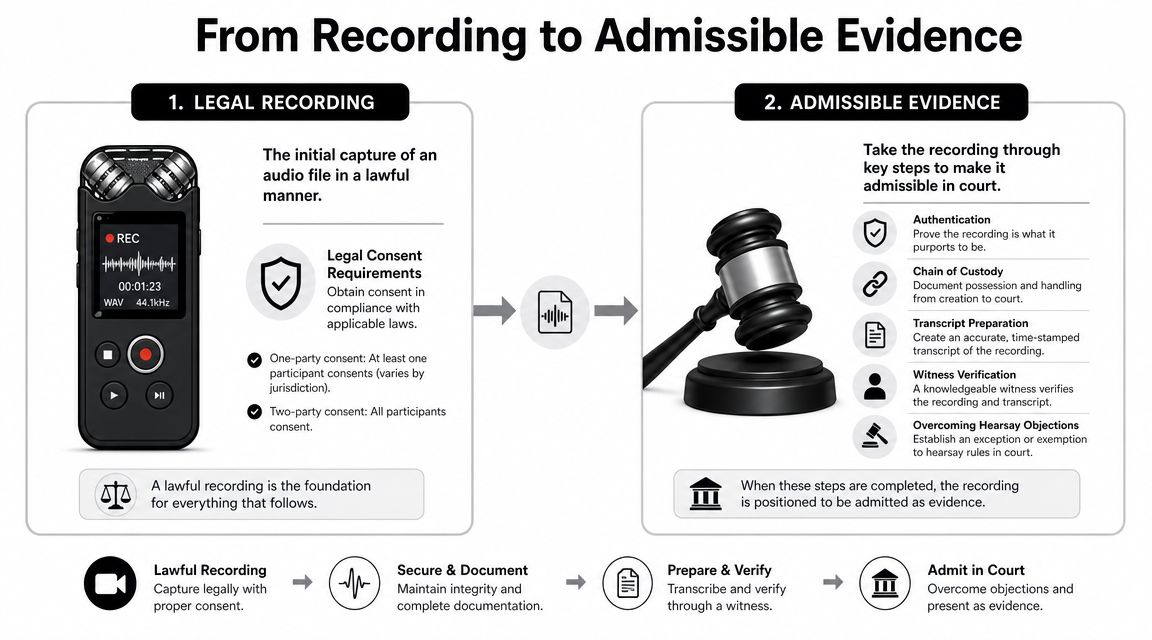
From Legal Recording to Admissible Evidence in Court
Family court has a frustrating habit of rejecting what feels important. A parent walks in with an audio file and thinks the hard part is over. Usually, the hard part is just starting.
To use a recording well, you need to think like a judge and like the other side's lawyer. They're not asking whether the file upset you. They're asking whether the file can be trusted, whether it matters, and whether the court should spend time on it.
Authenticity matters first
A judge has to know the recording is what you say it is. That means you should be ready to explain:
- when you made it
- who is speaking
- what device captured it
- whether it has been edited
- how you stored it afterward
If the file has been trimmed, renamed repeatedly, passed around, or uploaded and downloaded through several apps, the other side may argue it's unreliable.
Courts strongly prefer native files with metadata over edited clips, because metadata helps establish timestamp integrity. The strongest recording evidence is often a short, event-specific, date-stamped file tied to a discrete incident. That kind of file is easier to authenticate and less vulnerable to exclusion than a long composite recording, as discussed in this analysis of recording evidence and metadata issues.
Relevance decides whether the court even cares
A recording can be real and still be useless.
Family courts in Harris County focus on the child's best interest. So the recording has to connect to an issue the court is deciding. If the audio shows a parent discussing pickup times, threats, intoxication, harsh treatment of the child, or interference with possession, that may matter. If it mainly shows two adults sniping at each other without context, the judge may see it as heat without much light.
A practical question helps here: What exact point does this file prove?
If you can't answer that in one sentence, the recording probably needs more support before it becomes court evidence.
Hearsay is where many good recordings stall
Parents hear a file and think, “The recording speaks for itself.” Court doesn't always see it that way.
A recording often contains out-of-court statements. That raises hearsay questions. Some statements may come in. Some may not. Some may require a legal exception or a non-hearsay purpose. That analysis depends on the exact words, who said them, and why you are offering them.
Here's a simple way to frame it:
| Issue | What the judge may ask |
|---|---|
| Authenticity | Is this the original, reliable file? |
| Relevance | Does this help decide a custody issue? |
| Hearsay | Why is this statement being offered? |
| Completeness | Am I hearing enough context to be fair? |
If your recording includes your child repeating what another adult said, the hearsay problem can become even more layered. That doesn't mean the recording is worthless. It means your lawyer needs a careful plan.
The original file is usually better than the polished one
Parents often make the evidence weaker by trying to improve it.
They cut out silence. They isolate the “important part.” They boost audio. They send the clip to relatives. They upload it into a social platform. Every one of those choices can create a fight over integrity and context.
If you need help understanding how legal teams handle remote evidence, file preservation, and secure presentation, this guide on digital tools for legal teams gives a useful big-picture look at how technology intersects with legal process.
Save the original first. Share copies only when your lawyer tells you to.
A better preservation habit
If you think a recording may matter later, do this instead of editing it:
- Keep the original file on the device if possible.
- Note the date, time, location, and people involved in a separate written log.
- Do not splice clips together from different days or events.
- Do not add commentary into the file name like “proof he lied again.”
- Send it to your attorney in the least altered form available.
For similar reasons, parents should think beyond audio. Texts, emails, app messages, and screenshots often create a cleaner record. If that's part of your case, our article on using text messages as evidence in Texas family court can help you see how written proof is evaluated differently.
Why short clips often work better than big archives
Judges have limited time. They want focused evidence tied to a specific event.
A short file of a single exchange is often easier to understand than a giant folder of recordings from months of conflict. Long recordings can also create side disputes about missing context, cumulative proof, and whether the material wastes the court's time.
That doesn't mean long recordings are always bad. It means they're harder to use well. In practice, the cleaner your chain of handling and the narrower your purpose, the better your chances.
Special Rules for Recording a Child in a Custody Case
A Humble parent hears their child come back from visitation upset, quiet, and using phrases that sound far too adult. The parent wants proof. The instinct is understandable. But cases involving recordings of children have a trap many people miss. A recording can be legal to make in one setting and still be a poor choice to use in a Harris County custody case.

A child is not just another source of evidence. The court sees a child as someone whose privacy, emotional health, and bond with both parents need protection. That changes the analysis.
When a parent may consent on a child's behalf
Texas law has recognized a narrow idea called vicarious consent. In some circumstances, a parent may be able to consent on the child's behalf to the recording of the child's conversation if the parent has a good-faith, objectively reasonable belief that recording is necessary to protect the child's best interests, as discussed in the Texas case Allen v. Mancini.
That rule is a small doorway, not an open gate.
Courts are more receptive when a parent can point to specific facts suggesting a real safety concern, such as threats, coercion, or other serious harm. Courts are much less receptive when the recording looks like monitoring the other parent, gathering impeachment material, or trying to draw the child into the dispute. In a high-conflict Texas custody case strategy discussion, this same principle shows up again and again. Judges watch for whether a parent is protecting a child or building a case at the child's expense.
The difference between a protective step and a litigation mistake
Here is the practical way to look at it.
A parent who records because the child may be in danger is standing on very different ground from a parent who records because they are suspicious, angry, or curious about what happens in the other home. Both parents may say they are acting for the child. Only one may be able to explain facts that make the recording reasonable.
That difference matters because family court is not a simple pass-fail test on legality. Judges also weigh judgment, motive, and the effect on the child. A recording that seems clever at home can sound invasive in court.
Formal child interviews are treated differently
Texas has also moved toward more formal recording practices in child-related cases. Effective September 1, 2023, House Bill 4062 requires certain child custody evaluators to create an audio or video recording of each child interview in suits affecting conservatorship or possession and access, as reflected in the text of HB 4062 from the Texas Legislature Online.
That does not give parents permission to do the same thing on their own.
An evaluator works in a structured role, under professional standards, with a defined purpose and a record the court can examine. A parent recording a child at home is in a completely different position. One setting is part of a formal process. The other can look like private surveillance, coaching, or pressure, even if that was not the parent's intent.
Be careful with edited or enhanced child recordings
Parents sometimes want to clean up hard-to-hear audio involving a child. That can create a new problem fast. Once a file is enhanced, filtered, clipped, or processed, the fight may shift from what the child said to whether the file still fairly reflects the original conversation.
If you want a plain-English example of how much software can change audio, Diffio's guide on audio restoration for podcasters shows the kinds of processing available outside the legal setting. In custody court, that is exactly why you should be cautious. With recordings involving children, the safer course is to preserve the original file and get legal advice before doing anything that changes it.
Questions to ask before recording a child
Before you hit record, slow down and ask:
- What specific harm am I trying to prevent?
- What facts would I be able to explain to a judge, under oath, that made recording necessary?
- Am I protecting my child, or am I trying to prove the other parent is a bad parent?
- Would a less intrusive source, like school records, medical records, counseling records, or parenting app messages, document this concern better?
- If this recording is played in court, will it make me look careful and child-focused, or reactive and invasive?
Those questions help separate fear from strategy. In many Harris County cases, that gap decides whether a recording helps, gets excluded, or causes the court to worry about the parent who made it.
How Secret Recordings Can Backfire in Your Custody Case
A secret recording can feel like insurance. In court, it can turn into the opposite.
The biggest danger is that parents focus on the thrill of “catching” something and ignore how the judge will view the method. In family court, method matters. Judges are deciding not only what happened, but also what kind of parent each person is.

The highest-risk mistake
One of the most dangerous choices is secretly recording conversations between your child and the other parent when you are not a participant.
While one-party consent is the rule, it only applies when the recorder is a participant. Secretly recording conversations between a child and the other parent can expose the recording parent to criminal liability or severe judicial disapproval, as explained in this discussion of documenting co-parenting and the risks of recordings.
That kind of conduct can look less like protection and more like intrusion. It can also suggest that a parent is willing to undermine the child's relationship with the other parent to gain an advantage in litigation.
How a judge may see it
A family court judge may ask questions like these:
- Why didn't this parent use a safer form of documentation?
- Was this recording really about safety, or about control?
- Did this parent put the child in the middle?
- Can this parent respect boundaries and foster a healthy co-parenting relationship?
Those questions can change the whole tone of a custody case.
Four ways recordings hurt good cases
Legal exposure
If the recording falls outside lawful consent rules, you may have created a separate legal problem while trying to solve a custody one.Exclusion from evidence
Even if you think the content is powerful, the court may keep it out.Damage to credibility
A judge may distrust a parent who records recklessly, edits clips, or appears to manufacture conflict.Harm to co-parenting claims
If you're asking the court for expanded rights, decision-making authority, or a modification, your conduct matters. Secret surveillance can cut against your request.
Some evidence wins the point and loses the case.
Third parties create another layer of risk
Parents sometimes forget that exchanges involve more than the co-parent. New spouses, grandparents, babysitters, and family friends may be around. Recording those conversations can raise privacy and fairness concerns quickly, especially if you are not participating.
In some disputes, online conduct also enters the picture. If concerns involve a parent's public-facing digital activity, lawyers may use outside verification tools instead of risky homegrown surveillance. For example, this overview of evidence of active creator profiles shows the broader idea that digital evidence should be gathered carefully and with a clear legal purpose.
If your case already involves repeated conflict, the right strategy matters more than “more evidence.” Parents dealing with persistent accusations, baiting, or constant motion practice often benefit from a focused plan like the one discussed in our guide to high-conflict custody cases in Texas.
A better question than “Can I record this?rdquo;
Ask this instead: If this recording becomes Exhibit A, what does it say about my judgment as a parent?
That question usually leads to better decisions.
How to Properly Document Your Concerns and Protect Your Child
Most custody cases are not won by one dramatic piece of audio. They are built through calm, organized, credible documentation over time.
That's good news for parents in Humble and Northeast Houston, because safer evidence usually exists. You do not need to turn your home into a surveillance project to protect your child or present a strong case.
Start with a clean timeline
Keep a dated journal. Make entries promptly. Stick to facts.
Write down the basics:
- Date and time of the incident or exchange
- Who was present
- What happened
- What your child said, if relevant, without embellishing
- What you did next
A useful entry sounds like this: “Friday, 6:10 p.m., pickup at school parking lot in Humble. Other parent arrived late. Child said he had not eaten dinner. I texted to confirm drop-off for Sunday.”
A weak entry sounds like this: “He's always selfish and irresponsible.”
Use written tools that create their own timestamps
Written communication is often easier to present than secret recordings.
If your co-parenting relationship is tense, move as much communication as possible into a structured channel. Parents often use tools such as OurFamilyWizard, TalkingParents, or organized email threads because they create a clearer record of what was said and when. Text messages can also help, especially if you preserve the full thread instead of isolated screenshots.
Save records in categories
Messy evidence is hard to use. A simple folder system helps.
Try categories like these:
| Folder | What goes in it |
|---|---|
| Exchanges | pickup and drop-off notes, location details |
| School | attendance notices, teacher emails, report issues |
| Medical | appointment records, discharge papers, medication notes |
| Communication | texts, emails, app exports |
| Incidents | dated summaries, photos, related documents |
You don't need a fancy system. You need a consistent one.
Look for stronger third-party proof
Neutral records often carry more weight than parent-versus-parent accusations.
Useful examples can include:
- School records that show absences, tardiness, or behavior issues
- Medical records if there are treatment concerns
- Counselor or therapist records, when lawfully available
- Police reports if law enforcement responded
- Witness statements from people with direct knowledge
Those records don't replace your story. They support it.
Good documentation is calm, dated, and easy for another person to verify.
Follow up verbal conversations in writing
If the other parent insists on phone calls or in-person conversations, send a brief written confirmation afterward.
That can be as simple as: “Confirming our conversation today, you'll pick up at 5:30 p.m. on Sunday at the usual location.” This turns a disputed verbal exchange into a documented record without creating a new recording issue.
Get legal advice before you act, not after
This is the place where a lot of trouble can be avoided. If you are thinking about recording, sharing a file, confronting the other parent with a recording, or using a child's statements in court, speak with a family law attorney first.
For parents trying to build a reliable record, our resource on how to document custody violations in Texas is a useful starting point. Some families also choose to have a lawyer review their existing notes, texts, and app records before a hearing. The Law Office of Bryan Fagan handles family law matters involving custody disputes, evidence preparation, and case strategy for families in this area.
If you live in Humble, Atascocita, Kingwood, or nearby Northeast Houston, the smartest move is often the least dramatic one. Preserve what you already have. Stop collecting risky material. Build a careful paper trail. Then get advice specific to your facts.
If you're worried about what's happening during your child's time with the other parent, you don't have to guess your way through the evidence rules. The team at Law Office of Bryan Fagan works with families in Humble, Atascocita, Kingwood, and Northeast Houston on custody disputes, documentation strategy, and courtroom preparation. Schedule a free consultation with our Humble office to talk through your situation, protect your child, and make a plan that helps your case instead of hurting it.