Skip to content

If you're reading this in Humble, Kingwood, Atascocita, or somewhere else in Northeast Houston, there's a good chance your custody case already feels bigger than paperwork. Every text turns into an argument. Exchanges feel tense. Small parenting decisions become legal disputes. You may be worried that the other parent is trying to bait you into reacting, or that the court won't see what has really been happening.
That fear is common in high conflict cases, and it's also where strategy matters most. A strong high conflict custody cases texas strategy isn't about being the louder parent or filing the most motions. It's about showing a Harris County judge that you can provide stability, follow orders, protect your child from adult conflict, and make sound decisions even when the other parent won't.
For families in Humble and nearby communities, generic Texas advice only goes so far. Harris County courts expect structure. Judges want specifics. Orders need to be clear enough to reduce future disputes, not just resolve today's fight. That local reality changes how these cases should be prepared from the start.
Understanding High-Conflict Custody in Texas
A lot of parents call a case "high conflict" when communication has broken down. Sometimes that's true. Sometimes it's just a difficult phase in an already stressful separation. Texas courts look for something more specific.

Under Texas law, the court's guiding rule is the best interests of the child standard in Texas Family Code § 153.002. In practice, that means the judge isn't deciding who feels more offended. The judge is deciding which arrangement protects the child and promotes stability. In a discussion of Texas high-conflict custody disputes, high-conflict custody cases in Texas are described as involving persistent disputes over visitation, major decisions, parental alienation, fitness concerns, and court order violations, with courts responding under the best-interests standard.
What pushes a case into high conflict
The pattern matters more than any single bad day. A high conflict case usually involves repeated conduct such as:
- Chronic order violations that keep forcing one parent back into court
- Interference with visitation or using possession periods for manipulation
- One parent making unilateral decisions about school, medical care, or activities
- Using the child as a messenger instead of communicating parent to parent
- Attempts to damage the parent-child relationship through alienating behavior
- Harassing or hostile communication that makes normal co-parenting unrealistic
A Harris County judge sees these facts through one question. How is this affecting the child?
That changes the tone of the entire case. Parents often arrive focused on fairness between adults. The court is focused on safety, consistency, emotional health, and the practical ability to parent.
High conflict doesn't mean the court gives up on structure. It usually means the court imposes more of it.
What Harris County judges tend to look for
In my experience, the parent who slows the case down and becomes reliable usually gains ground. Judges don't reward chaos well, even when that chaos started with the other side.
A judge may look closely at:
| Court concern | What it can look like in real life |
|---|---|
| Parental judgment | Do you make decisions with the child in mind, or to score points? |
| Follow-through | Are you complying with existing orders, school routines, and medical needs? |
| Communication style | Can you stay calm in writing, or do your messages escalate conflict? |
| Safety history | Is there evidence of violence, abuse, substance concerns, or instability? |
| Support for the child's relationships | Are you encouraging healthy contact where appropriate? |
That last point surprises many parents. Even when one parent is difficult, the court often values the parent who can support the child's relationship with the other parent, unless there is a genuine safety issue.
Difficult does not mean hopeless
Families from Humble to Kingwood often tell us they feel trapped in a cycle. The other parent files repeatedly, refuses to cooperate, or turns every exchange into a fight. Texas courts recognize those dynamics. They have tools for them, including detailed parenting plans, monitored communication, parenting coordinators, and neutral professionals who help the judge understand what is really happening.
If you're trying to understand how courts evaluate these disputes, our guide on proving the best interest of a child in Texas gives useful background.
What doesn't work
Parents under stress often make the same mistakes:
- Matching the other parent's tone
- Sending long emotional texts
- Arguing through the child
- Ignoring minor orders because the other side ignores them too
- Assuming the judge will "just know" who started the problem
Judges don't live with your case day to day. They see evidence, patterns, and credibility. If you want the court to understand the turbulence, you have to present it in a calm, organized way.
Your Strategic Playbook Before You File
The case often turns before anyone steps into a Harris County courtroom. A parent in Kingwood sends weeks of angry texts, files quickly, and expects the judge to sort out the mess. Another parent waits long enough to organize school records, map out exchange problems by date, and show a steady routine for the child. The second parent usually starts from firmer ground.
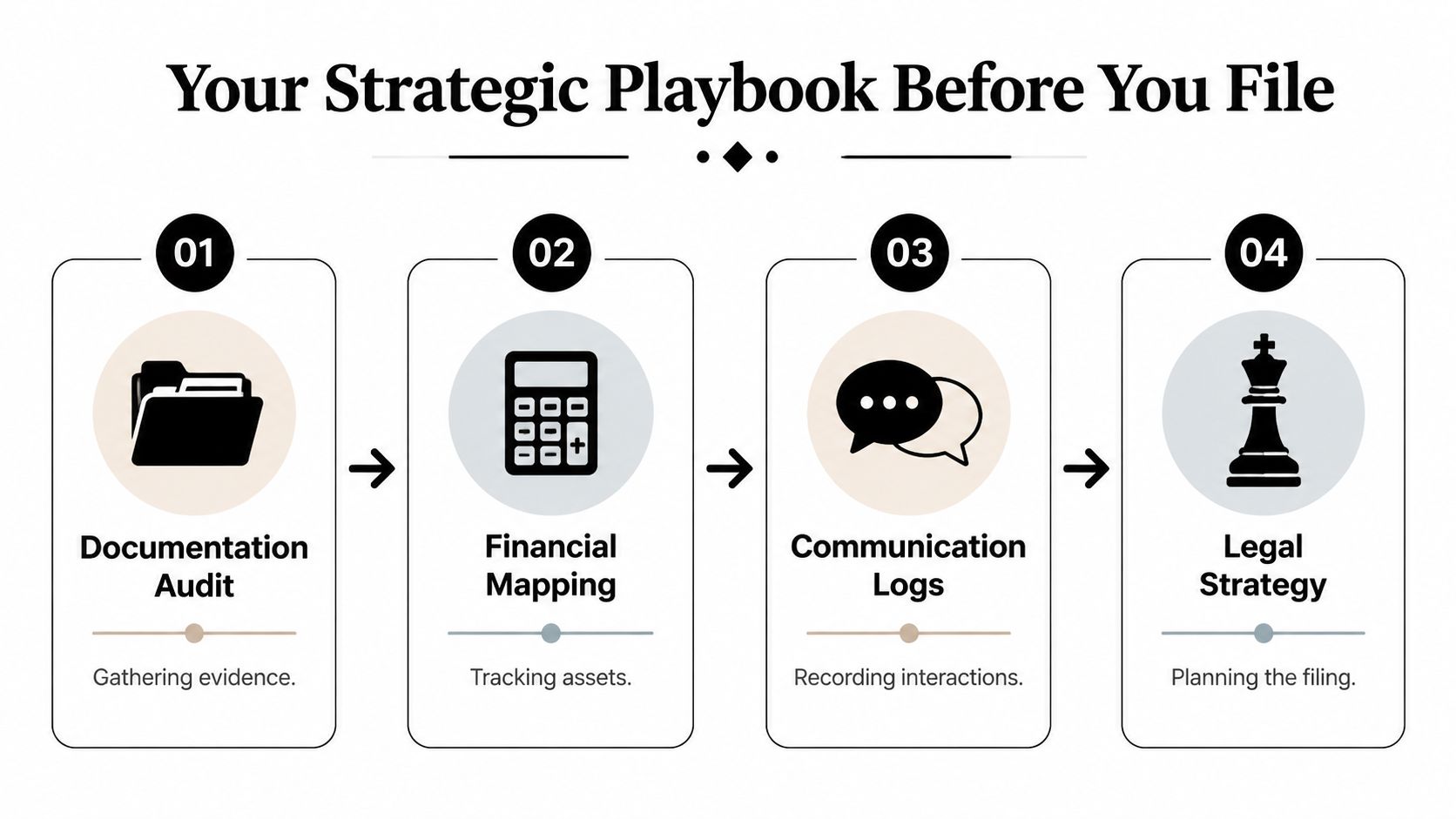
A Harris County filing should answer one practical question early. If the judge reads your first papers and hears your first request for temporary orders, will your presentation look organized, child-focused, and credible? In high-conflict cases around Humble, Atascocita, and Kingwood, that first impression matters because local courts often move fast once the case is active.
Start with a chronology, not a pile of screenshots
Screenshots without context rarely carry a case very far. Judges and court staff need a clear sequence they can follow.
Build a timeline with dates, times, locations, and short factual descriptions. Add the supporting item that matches each event, such as a text, school email, attendance record, police call reference, medical note, or witness name. If an exchange went badly at a restaurant parking lot in Atascocita, note where it happened, who was present, how long the child waited, and what happened next.
A useful chronology often tracks five categories:
Exchange problems
Missed pickups, late returns, refusal to release the child, or repeated conflict at handoffs.Communication problems
Harassing messages, refusal to answer about school or medical issues, or repeated accusations that block basic co-parenting.Decision-making disputes
Disagreements about counseling, medical care, school enrollment, tutoring, activities, or travel.Child-centered observations
Changes in sleep, behavior, school performance, anxiety around transitions, or concerns raised by teachers and counselors.Order compliance
The steps you took to follow the current order, even when the other parent did not.
Short, accurate entries carry more weight than long emotional summaries.
Show the court how you parent
Many parents spend months collecting proof that the other parent is difficult and almost no time collecting proof that they are dependable. Harris County judges usually need both sides of that picture, but your stability is what supports your request for conservatorship terms, possession, and decision-making rights.
Keep records that show daily parenting, including:
- School involvement, such as report cards, teacher emails, meeting notes, and attendance at conferences
- Medical follow-through, including appointments, medication instructions, therapy recommendations, and who took the child
- Routine and supervision, such as homework completion, transportation, meals, bedtime, and activity schedules
- Calm communication, especially messages where you stayed focused on the child despite provocation
A parent who can show steady care over time usually presents better than a parent who only brings conflict.
Use a system you can keep up for months
High-conflict cases are won with consistency. The recordkeeping system does not need to be fancy. It needs to be usable on a busy Tuesday.
A workable setup often looks like this:
| Tool | Why it helps |
|---|---|
| Digital folder by month | Keeps texts, emails, report cards, photos, and notices in one place |
| Written custody journal | Preserves dates and details while memory is still fresh |
| Calendar entries | Tracks possession periods, cancellations, school events, and late pickups |
| PDF exports of messages | Makes review easier for your lawyer and easier to present later |
If order violations are already part of the problem, this guide on how to document custody violations in Texas can help you tighten your proof before you file.
Prepare for temporary orders before the case starts
In many high-conflict cases, the first hearing shapes the daily reality for months. That is why pre-filing work should focus on the orders you may need right away.
For Harris County parents, that often means identifying the issues that need immediate structure, such as:
- exchange locations and times
- communication limits and approved platforms
- school and medical decision-making
- counseling or therapy issues
- geographic restrictions
- temporary child support
- safety terms if there has been family violence, substance abuse, or serious instability
This is also where local experience matters. Different Harris County courts may view communication tools, neutral professionals, and the level of detail in proposed parenting terms a little differently. A generic Texas checklist often misses those local preferences.
Preparation and retaliation are not the same thing
Good pre-filing strategy lowers confusion and reduces room for false claims later. It does not involve baiting the other parent, building a social media narrative, or trying to create a dramatic moment for court.
Helpful steps include:
- keeping written communication brief and child-focused
- following existing orders carefully
- preserving records in real time
- identifying teachers, counselors, doctors, or relatives who may have firsthand knowledge
- gathering documents you may need for a temporary orders hearing
Conduct that often backfires includes:
- treating every irritation like an emergency
- sending threats about court
- arguing through the child
- posting about the dispute online
- trying to prove your case through long text fights
The goal is control. Judges in high-conflict custody cases often notice which parent can lower the temperature and still protect the child.
A strong filing does not begin with outrage. It begins with records, a child-focused plan, and a realistic view of what a Harris County judge is likely to need from a family in Humble, Kingwood, or Atascocita.
Navigating the Harris County Court System
Harris County family court can feel confusing even in an ordinary divorce. In a high conflict case, the pace, pressure, and number of moving parts increase quickly. Parents in Humble, Atascocita, and Kingwood usually benefit when they understand not just what the court can do, but why judges use certain tools.

One Harris County-focused source explains that local family court rules require early mediation to curb escalation, judges in the 246th and 257th Districts prioritize parents who use communication apps and cooperate with parenting coordinators, those coordinators are appointed in about 60% of high-conflict cases, and litigating without a Harris County-specific plan fails 70% more often because these courts favor structured plans over trials.
Temporary orders shape the rest of the case
The first major court event often matters more than parents realize. Temporary orders create the rules everyone lives under while the case is pending. That can include possession schedules, decision-making rights, child support, communication rules, geographic restrictions, and safety protections.
If your case involves intimidation, erratic conduct, or repeated interference, waiting too long to request structure can make the situation worse. Judges often want the family operating under a clear framework as early as possible.
Common temporary order requests in high conflict cases include:
- Detailed possession terms so there is less room for argument
- Exclusive use of a communication app to reduce hostile texting
- Neutral exchange locations when direct contact is too volatile
- Supervised visitation if there are credible safety concerns
- Temporary restrictions on travel or certain conduct
The court's neutral professionals matter
Parents sometimes see court-appointed professionals as side issues. They aren't. In a high conflict case, they can shape the judge's understanding of your family more than either parent expects.
Three roles come up often:
Amicus attorney
An amicus attorney assists the court by investigating the child's circumstances and making recommendations. This person isn't the lawyer for either parent. In a practical sense, the amicus often becomes one of the most important voices in the case.
Custody evaluator
A custody evaluator usually conducts interviews, reviews records, and assesses family dynamics. If your case involves allegations about instability, alienation, or parenting capacity, the evaluator's impressions can carry serious weight.
Guardian ad litem
A guardian ad litem focuses on the child's interests and may be used in cases with significant concern about welfare or safety.
If a neutral professional is involved, assume everything matters. Your punctuality, your records, your tone, and your ability to answer questions directly all become part of the case.
How Harris County judges often read behavior
A parent in a high conflict case often wants the judge to punish the other side. That's understandable. But many Harris County judges focus first on management. They want a plan that lowers the family's overall temperature and protects the child from future instability.
That means judges may favor:
| Judicial preference | Why it matters |
|---|---|
| Specific communication rules | Reduces opportunities for arguments and distorted accounts |
| Structured exchange details | Prevents repeated fights over time, location, and logistics |
| Neutral involvement | Gives the court information that is less filtered by parental conflict |
| Mediation before trial | Encourages resolution before the case hardens into permanent litigation |
| Frequent compliance review | Lets the judge see which parent follows structure consistently |
For local families, this is why broad requests such as "I want primary because the other parent is impossible" often fall flat. A better approach is showing the court exactly what structure is needed and why.
What to do when safety is part of the case
Not every high conflict case involves immediate danger, but some do. If there are threats of violence, abduction concerns, serious substance issues, or conduct that puts the child at risk, emergency relief may be necessary. In those situations, the case changes from difficult to urgent.
The court may use short-term protective measures while gathering better information. If the problem continues, a parent may need to pursue longer-term changes through enforcement or modification.
Parents should be careful here. Emergency requests need clean facts and focused evidence. Inflated accusations can hurt credibility. So can waiting too long when the danger is real.
Mediation in a high conflict case
Many parents hear "mediation" and assume it means giving in. In Harris County, mediation is often part of the court's effort to impose structure before a trial becomes necessary. In a high conflict setting, mediation works best when the case is already well documented and both sides understand that vague terms won't survive.
A useful mediation strategy usually includes:
- A proposed parenting plan with detailed terms
- Communication rules already drafted
- A clear list of disputed decisions
- Evidence organized by issue, not emotion
- Realistic fallback positions
Families looking for broader divorce context in Harris County can review the firm's divorce representation information for Humble-area clients.
The mistake that keeps cases spinning
The biggest court-system error is assuming the judge will solve poor preparation. Harris County courts can impose order, but they won't build your case for you. If you show up with scattered screenshots, angry testimony, and no practical plan for the child, the court may see two fighting parents instead of one stable parent and one destabilizing one.
That is why local procedure isn't a side note. In these cases, procedure is strategy.
Building a Bulletproof High-Conflict Parenting Plan
In a low conflict case, a basic parenting plan may be enough. In a high conflict case, a vague order becomes an invitation to fight. If the order leaves room for interpretation, someone will use that space.

That is why one of the most effective parts of any high conflict custody cases texas strategy is a parenting plan written with precision. A Texas family law source notes that structured resolutions such as appointing a parent coordinator can reduce litigation by 40-60% and improve communication in 70% of cases, courts mandate monitored communication platforms in 40% of high-conflict matters, and cooperative, thoughtful parents are 75% more likely to secure joint conservatorship. The lesson is straightforward. Structure lowers friction.
Specificity protects children
A strong parenting plan should answer the questions parents usually fight about before the next fight happens.
That includes:
- Exact exchange times
- Exact exchange locations
- Who transports the child
- Holiday schedules
- Notice requirements for travel
- How medical and school information will be shared
- How make-up time is handled, if at all
- What happens if a parent is running late
If exchanges in Kingwood have been tense, the plan might require a neutral public location. If direct discussion always escalates, the order may require all non-emergency communication to go through a platform like OurFamilyWizard.
A parenting plan should not rely on goodwill when the case history shows goodwill is unreliable.
Clauses that often make the biggest difference
Not every case needs every clause. High conflict cases usually need more than parents first expect.
Communication rules
Set the channel, the subject matter, and the tone. A useful provision may require written communication only, limited to child-related issues, through one monitored app.
Decision-making procedures
If both parents share rights on medical or educational issues, the plan should say how notice is given, how long the other parent has to respond, and what happens when they don't.
Exchange protocol
Spell out who arrives where, who stays in the car, who can attend, and what happens if the child is not ready. These details can feel excessive until you need them.
Right of first refusal
This can be helpful in some families and a disaster in others. If every scheduling issue becomes a control dispute, adding another point of contact may create more litigation, not less.
A quick comparison
| Vague term | Better term |
|---|---|
| Reasonable visitation adjustments | Changes only by written agreement in the designated app |
| Parents will share school information | Parent receiving notice uploads it to the app within a stated time |
| Child will be exchanged at a mutual location | Exchange occurs at a named location in Humble or Kingwood |
| Parents will communicate respectfully | Communication limited to child issues, in writing, through one platform |
The parenting plan should match the family, not a template
A family with a child in therapy, a parent who travels for work, or a history of exchange conflict needs a plan built around those facts. Standard forms rarely do that well.
This is also where emotional maturity matters. Courts often notice which parent proposes systems that make the child's life easier and which parent uses details as a way to control the other side. The difference is not subtle.
Parents who want practical ideas outside the legal setting sometimes benefit from reviewing guidance for positive parenting from Soul Shoppe. It can help you keep your daily parenting choices aligned with the calm, child-focused posture the court expects.
Use the plan to reduce future contact
One overlooked goal of a high conflict parenting plan is reducing the number of moments where parents have to negotiate in real time. Every unresolved handoff, verbal debate, or last-minute text is another opening for conflict.
A better plan often includes:
- Automatic holiday rotations
- School pickup provisions
- Clear summer election deadlines
- Rules for extracurricular registration
- A dispute-resolution step before court, when appropriate
If you're drafting or revising terms, this guide on how to write a parenting plan can help you think through what should be included.
The best parenting plans in high conflict cases feel almost overbuilt. That's not a flaw. That's what makes them work.
Life After the Order and Local Support in Humble
The signed order brings relief, but it doesn't end the need for discipline. High conflict cases often calm down only when one parent decides to stop feeding the cycle and starts treating the order like an operating manual.
That means daily consistency. Follow exchange times. Use the approved communication method. Keep messages short. Save records. If the other parent violates the order, document it and respond through legal channels instead of trying to win the argument in the parking lot.
A cost analysis focused on Texas divorces reports that a litigated divorce involving child custody issues can average about $23,500, high-conflict cases often exceed $50,000, and one Houston case involved spending over $500,000, with courts using parenting coordinators and detailed plans to curb the escalation that drives those costs. That financial reality is one reason steady post-order conduct matters so much. Endless relitigation drains families fast.
What compliance looks like after court
Many parents think compliance means big things only. In truth, courts often learn the most from routine behavior.
Good post-order habits include:
- Responding through the approved system
- Showing up on time for exchanges
- Sharing school and medical information as required
- Avoiding side deals that aren't written down
- Keeping the child out of adult disputes
If the other parent does not comply, the answer isn't self-help. The answer is enforcement or, when circumstances materially change, modification. Those are different tools with different goals. Enforcement asks the court to require compliance with the order already in place. Modification asks the court to change the structure because the current order no longer fits the child's needs or the parents' real-world situation.
The order only works if you live by it consistently enough for the court to trust your version of events when problems return.
Support beyond the courtroom
Children in high conflict cases often need neutral adults around them. So do parents. A family therapist, child counselor, parenting coach, or neutral exchange setting can lower tension and give the child a steadier emotional environment.
For families looking outside their immediate area for ideas about what counseling support can look like, these Grande Prairie therapy options provide a useful example of how therapy services are often organized by need and family dynamic. Locally, parents in Humble, Atascocita, Kingwood, and Northeast Houston should consider asking their attorney, pediatrician, school counselor, or existing therapist for referrals to child-focused counselors, co-parenting therapists, and neutral exchange resources that fit the court order and the child's age.
A practical local checklist
After the order is entered, keep a short list in front of you:
- Store the final order where you can access it quickly
- Calendar every exchange, holiday, and notice deadline
- Move all communication into the approved channel
- Update schools, daycare providers, and doctors as needed
- Tell trusted caregivers only what they need to know
- Contact counsel early if noncompliance becomes a pattern
Families in Northeast Houston also do better when support is local. A counselor near Humble is easier to keep seeing. A neutral exchange point near Kingwood is easier to use consistently. A lawyer familiar with Harris County can usually assess whether a problem calls for patience, enforcement, or a fresh filing.
If you need local contact information and directions, the firm's Humble office page is the best starting point.
If you're dealing with a custody case that keeps escalating, a clear plan can change the direction of the case. The Law Office of Bryan Fagan works with families in Humble, Atascocita, Kingwood, and across Northeast Houston on custody disputes, parenting plans, enforcement actions, and modifications in Harris County. Schedule a free consultation with the Humble office to talk through your options, protect your rights, and build a strategy centered on your child's well-being.