Your phone buzzes at 6:42 a.m. It's a text about school drop-off. Before you can answer, another message lands about soccer practice, then one more about who forgot to send the lunch money. What should be a quick exchange turns into an argument about the marriage, the divorce, and everything that still hurts.
That's where many parents in Humble, Atascocita, Kingwood, and across Northeast Houston find themselves. They aren't arguing because they don't love their children. They're arguing because parenting from two homes is hard, and Texas law doesn't erase the emotional reality that comes with separation.
If you've been searching for answers about parallel parenting vs co parenting texas, you're probably trying to solve a practical problem: how do we raise our child without constant conflict? The answer depends less on labels and more on what your family can handle right now. Some parents can still work together. Others need structure, distance, and very clear boundaries.
Navigating Parenthood After Divorce in Humble
Monday morning in Humble starts fast. One parent is trying to get a child to school on time. The other is texting about a backpack, a medication refill, and whether Friday's pickup needs to change. By 7:15 a.m., a simple logistics problem can turn into a fight that has nothing to do with the child.

In my Humble office, I see that strain all the time. Parents are trying to do the right thing, but two households mean more transitions, more decisions, and more chances for old conflict to spill into everyday parenting.
What many local parents are dealing with
The pressure usually shows up in ordinary places. A parent wants to trade weekends for a birthday party in Kingwood. A Humble ISD teacher emails both parents about missing work. A child senses tension during an exchange in an Atascocita parking lot and goes quiet in the back seat.
Those are not small moments to a child. They are the atmosphere the child lives in.
Texas courts in Harris County do not aim to build a perfect relationship between former spouses. Instead, they seek to establish a structure where a child can live with reduced stress. This process involves examining how parents communicate, the frequency of conflict, and whether the routine provides the child with a steady sense of home. If you are still determining the practical aspects of time-sharing, a clear child visitation schedule in Humble can reduce confusion before conflict starts.
A helpful way to understand this is to picture two lanes on the same road. One lane allows parents to travel side by side, talk often, and adjust plans with some flexibility. The other keeps more distance between them, with firm rules and fewer direct interactions. Both lanes are still about getting the child safely where they need to go.
Why courts focus on reducing conflict
Children usually do better when the adults around them lower the temperature. That is not a moral lecture. It is a practical truth. A child should not have to decode angry texts, carry messages between homes, or worry that a school event will turn into a scene.
Parents do not need a warm friendship to give a child stability. They need a plan that fits the reality of their family.
That is why the difference between co-parenting and parallel parenting matters so much in Humble and Harris County. For some families, regular communication and shared decision-making are realistic. For others, more contact creates more conflict, and more conflict harms the child. In those cases, stronger boundaries can protect everyone involved.
The goal is not to force one ideal model on every family. The goal is to choose a workable model for right now, then adjust as trust, communication, and family routines change over time.
Co-Parenting and Parallel Parenting Under Texas Law
A lot of Humble parents sit in my office with the same question: “Do we have to work together on everything?rdquo; Under Texas law, the answer is no. The law does not require a close personal relationship between parents. It requires a plan that serves the child's best interest.
That standard guides how Harris County courts look at conservatorship, possession, decision-making, and communication. In plain terms, the court wants an arrangement a family can follow without pulling the child into adult conflict.
What co-parenting means
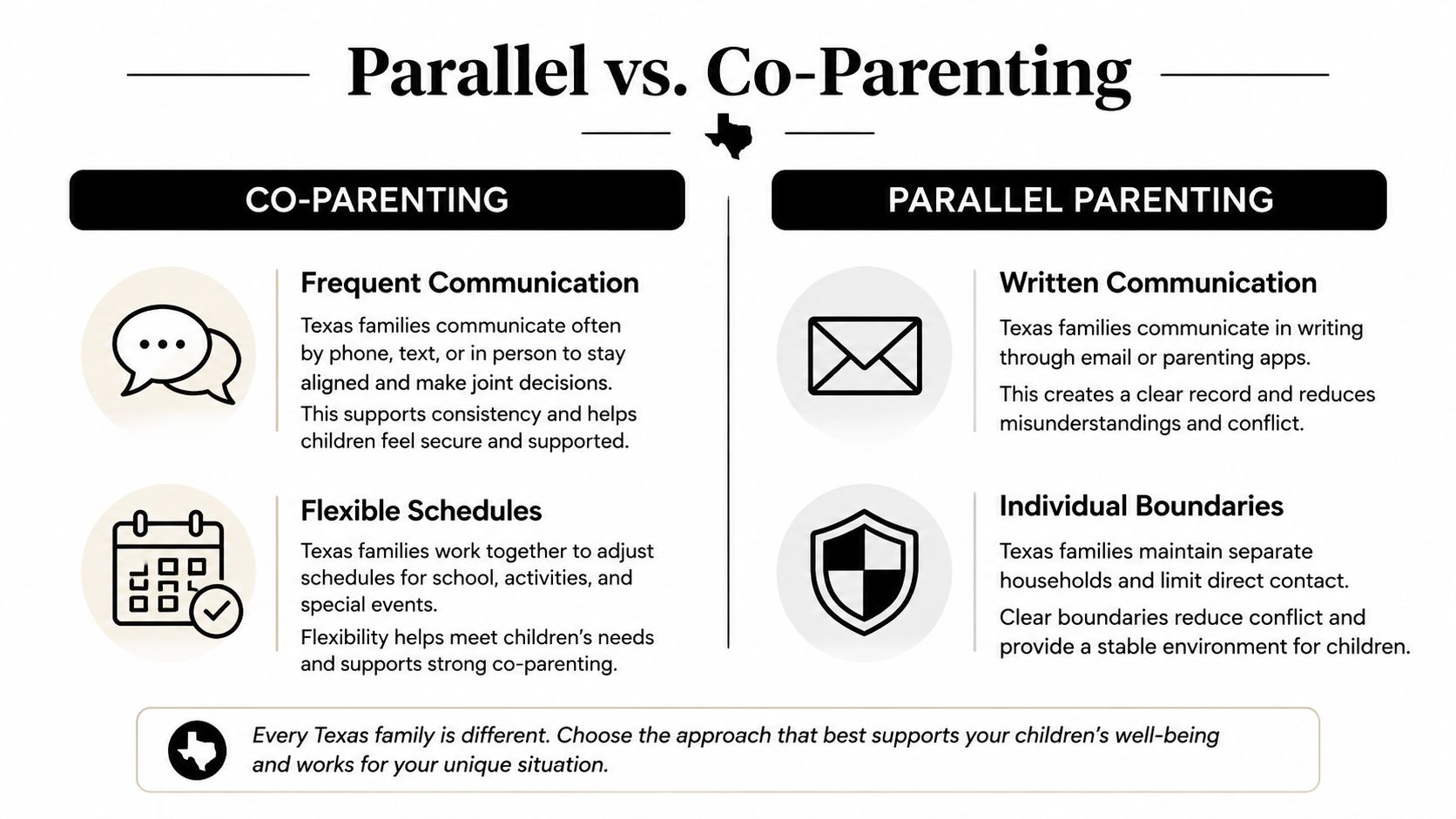
Co-parenting works like two adults sharing a calendar and a set of priorities for the same child. The parents communicate directly, pass along information, and cooperate on bigger issues such as school, medical care, counseling, and activities.
In real life, that may mean both parents can attend a parent-teacher conference, discuss a change in medication, or agree to swap a weekend because one parent has to work. The focus stays on solving the problem in front of them.
This model usually fits families where parents can do a few things consistently:
- Communicate respectfully: Conversations stay child-centered.
- Share updates promptly: School notices, doctor information, and schedule changes are passed along without unnecessary delay.
- Work through disagreements: They may not agree on every point, but they can still reach decisions without repeated blowups.
Texas courts often support arrangements that allow both parents to stay actively involved when the parents can manage that involvement responsibly.
What parallel parenting means
Parallel parenting is built for a different situation. It works more like two households running on the same court order instead of constant discussion between parents.
The goal is simple. Reduce direct contact so the child is not exposed to ongoing conflict.
A parallel parenting plan often includes:
- Limited communication: Usually written, brief, and only about the child
- Detailed schedules: Exchanges, holidays, pickup times, and school breaks are spelled out clearly
- Separate day-to-day control: Each parent handles routine choices during that parent's own time
- Clear boundaries for major decisions: The order states who decides what, and how information is shared
Parents sometimes hear “parallel parenting” and assume it means one parent is being cut out. That is not the idea. In many Harris County cases, it is a pressure-release valve. If every phone call turns into an argument, less direct contact can create more peace for the child.
Some families also use a mixed approach. They may keep communication tightly structured for schedules and exchanges, while still sharing responsibility for major school or medical decisions.
How this plays out in Harris County
Local courts tend to look less at labels and more at function. A judge in Harris County is not awarding points because a parent says, “We co-parent well,” or “We need parallel parenting.” The central question is whether the proposed setup lowers conflict, protects the child's routine, and gives both parents workable rules.
That is why details matter so much. A parenting order should answer practical questions before they become arguments. Who picks up from school? How are extracurricular costs handled? What happens if a child gets sick during one parent's time? How are schedule changes requested?
If those answers stay vague, families often end up back in conflict. If the order is specific, it gives both homes a map to follow. Our guide to a child visitation schedule in Humble can help you see how those possession terms are commonly structured in Texas orders.
For many Humble families, that is the key difference between these two models. Co-parenting asks for more shared communication. Parallel parenting asks for better boundaries. Under Texas law, either can be the right fit if it gives your child more stability and less exposure to conflict.
A Detailed Comparison for Your Family's Needs
A lot of Humble parents come into my office with the same question: “Aren't co-parenting and parallel parenting just two names for getting along better or worse?rdquo; I understand why it feels that way. But the better comparison is this. Co-parenting works like two people sharing the same steering wheel. Parallel parenting works like two drivers following the same map in separate lanes.
Both can serve a child well. The right fit depends on how decisions, communication, and exchanges work in your family.
| Issue | Co-parenting | Parallel parenting |
|---|---|---|
| Communication | Frequent, direct, collaborative | Limited, structured, usually written |
| Decision-making | More joint discussion | More independent day-to-day decision-making |
| Schedule changes | Flexible when both parents agree | Strict and detailed to avoid conflict |
| Household rules | Often coordinated | Often separate within each home |
| Best fit | Lower-conflict parents | Higher-conflict parents |
| Goal | Teamwork | Reducing conflict exposure for the child |
How the day-to-day rhythm feels
The biggest difference often shows up in the ordinary moments.
In a co-parenting arrangement, parents usually talk often because they can do it without every message turning into a fight. One parent may text about a band concert, a school project, or a change in pickup time. The other responds, the issue gets handled, and the child is not pulled into the middle.
In a parallel parenting arrangement, contact is narrower on purpose. Messages are shorter. The topic stays limited to the child. Parents may use email or a parenting app so there is less room for side arguments, sarcasm, or pressure. For families dealing with repeated conflict, that structure can significantly reduce decision-making conflict and protect the child from adult tension.
That does not mean the parents care less. It means the plan uses distance to create peace.
How Texas orders usually divide authority
Texas family law often separates big decisions from everyday decisions, and that distinction matters a great deal in Harris County cases.
Big decisions may include school choice, non-emergency medical care, counseling, or certain extracurricular commitments with a serious time or cost impact. Everyday decisions are the smaller calls each parent makes during that parent's possession time, such as bedtime, meals, homework routine, and ordinary discipline.
That division helps parents avoid arguing over every detail. If your child is with you in Humble on a Tuesday night, you generally do not need a committee meeting to decide dinner or lights-out. If someone wants to change schools or approve a major medical procedure, the order may require shared input or give one parent the final right to decide after consultation.
This is one of the places parents get tripped up. They assume “joint” means every topic must be debated together. Usually, it does not. A well-written order draws a line between household management and major life choices.
Flexibility and predictability are both useful. The question is which one your home can handle.
Co-parenting gives more room for casual adjustments. If a cousin's birthday party pops up in Atascocita or a school event runs long, parents may trade time informally and keep things simple. That can work well if both parents respond in good faith and stick to the child's needs.
Parallel parenting depends more on clear rails. Exchange times, holiday schedules, makeup periods, transportation duties, and communication rules need to be spelled out. A detailed plan is less about being rigid for the sake of rigidity. It is about preventing the same argument from happening every Friday at 6 p.m.
Harris County courts tend to appreciate that difference. In higher-conflict cases, a judge is often more interested in a schedule people can follow than in a hopeful promise that everyone will “work it out later.”
How each model handles disagreements about activities
This issue comes up all the time. A child wants to join a travel team in Northeast Houston, start counseling, or take on an activity that affects money, transportation, and weekends.
With co-parenting, the expectation is usually discussion and compromise. Parents compare calendars, costs, and school demands, then make a shared call.
With parallel parenting, the answer usually comes from the wording of the order. If the activity falls inside one parent's routine authority and does not interfere with the other parent's time, that parent may be able to proceed. If the order treats the activity as a joint decision, the parents must use the process already set out in the plan.
Clear rules matter here. If nobody knows who decides, even a soccer signup can turn into a legal problem.
A practical way to compare your options
One helpful test is to look at what happens after a simple child-related message is sent.
If one parent sends, “The teacher asked for a conference next week,” and both adults stay focused on solutions, co-parenting may be realistic. If that same message triggers blame, threats, or ten old grievances, parallel parenting may be the safer structure for now.
Some families fall in the middle. They can share authority over school and medical issues, but they need tight boundaries for exchanges, reimbursement requests, and schedule changes. That blended approach is common, and it often fits real life better than a label does.
If that sounds familiar, our guide on handling a difficult co-parent in Texas walks through communication habits and boundaries that often support a more workable parenting plan.
The goal is not to pick a model that sounds nicer. The goal is to choose one your family can live with, then build enough structure that your child knows what to expect in both homes.
Which Model is Right for You? Key Indicators
No parent needs a perfect relationship with an ex to raise a healthy child. But you do need a parenting structure that matches the level of conflict you are living with, not the level you wish you had.

Signs co-parenting may fit
Co-parenting is usually workable when both parents can stay in the present and focus on the child.
A few green lights:
- You can discuss school issues without revisiting the breakup.
- You both share information without hiding details or creating an unfair advantage.
- Schedule changes don't automatically become accusations.
- Your child isn't carrying messages between homes.
If your child brings home a report card from a school in Humble and you can both talk about tutoring, homework, and teacher follow-up without the conversation exploding, that's a strong sign co-parenting may be workable.
Signs parallel parenting may be safer
Parallel parenting often fits when contact itself creates instability.
Watch for patterns like these:
- Every exchange becomes tense or hostile
- One parent uses texts to insult, control, or provoke
- There's a history of boundary violations
- Routine decisions become power struggles
- The child seems anxious before handoffs or after parent communication
If every message feels like a trap, more communication usually won't solve the problem. Better structure often does. Parents facing that pattern may also find this resource on dealing with a difficult co-parent in Texas useful as they think through what boundaries need to look like.
A short self-check
Ask these questions:
| Question | More likely fit |
|---|---|
| Can we talk about the child without arguing about the past? | Co-parenting |
| Do we regularly accuse each other or bait each other in writing? | Parallel parenting |
| Can we make changes informally and trust each other to follow through? | Co-parenting |
| Do we need everything in writing because verbal agreements fail? | Parallel parenting |
If your current system depends on one parent “just being the bigger person,” it isn't stable enough. A parenting model should work on hard days too.
Some families in Atascocita and Northeast Houston move back and forth over time. A model that fits during the first year after separation may not fit three years later. What matters is matching the legal structure to the family reality.
Building Your Parenting Plan in Harris County
A parent in Humble leaves mediation thinking, "We agreed on everything." Two months later, pickup is late, spring break is disputed, and both parents read the same order in two different ways. That is a common Harris County problem. The issue usually is not the goal. It is the missing detail.
Texas courts do not enforce good intentions. They enforce written orders. If you are choosing co-parenting or parallel parenting, your plan has to translate that model into clear rules a judge can recognize and, if needed, enforce.
In Harris County, that usually starts with the possession schedule. A standard schedule works for some families. Others need custom language because their work hours, school routine, distance between homes, or conflict level make a basic order too loose. A parenting plan works like a set of road signs. If the signs are clear, everyone knows where to turn. If they are vague, every intersection becomes an argument.
Put the routine on paper
The schedule needs more than weekends and Thursdays. It should answer the questions parents end up texting about at 9:30 p.m.
For many Humble and Atascocita families, that means spelling out:
Exchange details
List the exact time, location, and who provides transportation. If face-to-face contact tends to cause conflict, school pickup or drop-off often lowers friction. In some cases, a public exchange spot makes the handoff calmer for everyone, especially the child.Holiday and summer terms
Thanksgiving, Christmas break, spring break, birthdays, and extended summer possession need precise language. "We'll work it out later" sounds friendly in mediation and turns expensive in December.Notice rules
If a parent must give notice for travel, camps, medical appointments, or school events, the order should say how notice is sent and how much lead time is required.
Separate major decisions from everyday parenting
This part trips up many parents because daily life and legal authority are not the same thing.
A useful order usually draws a line between the big calls and the routine ones. Big calls often include education, non-emergency medical care, counseling, and other long-term issues. Routine calls include homework time, meals, bedtime, and household rules during each parent's period of possession. That separation matters because co-parenting asks for more shared decision-making, while parallel parenting often works better when each parent has more room to handle day-to-day life without constant approval from the other.
It also helps to name a backup process. If parents disagree about a school change or treatment recommendation, what happens next? Do they mediate first? Does one parent have the right to decide after consultation? A court order should answer that before the disagreement arrives.
Match the communication rules to the family you actually have
Parents often want an order that reflects the family they hope to become. Harris County courts care more about whether the order fits the family that exists right now.
If communication is generally respectful, the plan can leave more room for informal problem-solving. If every message tends to spiral, the plan should narrow the channel and the subject matter. That may include:
- approved methods such as email, text, or a co-parenting app
- limits to child-focused, factual communication
- response times for non-emergency issues
- rules against sending messages through the child
- a requirement to share school, medical, and activity information in a consistent format
Parents preparing for mediation often benefit from reviewing a co-parenting plan for Texas parents before they start negotiating details.
Use local court practice to your advantage
Harris County judges see the same problems over and over. Vague exchange language. Holiday terms that conflict with the regular schedule. Orders that say parents will "agree" without saying what happens if they do not.
That local reality matters. A workable plan in Humble should account for school calendars, commute patterns, extracurricular schedules, and the practical fact that many parents live close enough to share a school zone but not close enough for endless last-minute changes. In a lower-conflict co-parenting setup, some flexibility may make sense. In a parallel parenting setup, tighter wording often protects the child from repeated conflict.
Some families also need extra structure from neutral professionals. Depending on the case, that may include mediation, a parenting facilitator, or a parenting coordinator if the court approves that support. Attorneys, mediators, and family court professionals each serve different roles. The Law Office of Bryan Fagan is one option Humble families use for custody and parenting plan guidance when they need proposed order language, negotiation support, or court representation.
The better parenting plan is the one your family can follow on an ordinary Tuesday, not just the one that sounds good in mediation.
Review the draft like a problem-solver
Before signing a parenting order in Harris County, read it with one question in mind: where could this go wrong?
Look closely at common trouble spots:
- Unclear exchange wording: terms like "reasonable time" often create preventable fights.
- Activities and transportation: say who approves extracurriculars, who pays, and who drives.
- School information: include access to report cards, teacher communication, and event notices.
- Medical updates: state how appointment information and records are shared.
- Dispute process: include a step for major disagreements so every conflict does not head straight to court.
Parents often feel more settled once the order becomes specific. The conflict may not disappear overnight. But a clear plan gives the child a steadier routine and gives both parents a structure they can use.
Can You Transition From Parallel to Co-Parenting?
It is a Tuesday in Humble. One parent needs to swap a pickup time because of a school program at an elementary campus near Atascocita. A year ago, that message might have turned into three pages of accusations. Now it gets a short reply: “That works. Please send the updated time.” That kind of small moment is often where parents start asking whether a more cooperative model is possible.
For many families, the answer is yes. Parallel parenting does not have to be permanent. Sometimes it works like a cast on a broken arm. It holds things steady while conflict is high. If communication improves and routines become dependable, some parents can shift toward co-parenting over time, as discussed in this Texas family law article on co-parenting versus parallel parenting.

What a healthy transition actually means
A transition is not a label change. It is a behavior change.
That distinction matters in Harris County courts. Judges are usually less interested in whether parents say they are “ready” and more interested in whether daily conduct shows less conflict, better follow-through, and a child who benefits from more direct coordination. If the child still gets caught in arguments, the family may still need the guardrails of parallel parenting.
Parents sometimes ask me if a few calm weeks are enough. Usually, no. A better question is whether the new pattern holds under stress. School events, schedule changes, illness, holidays, and extracurricular conflicts tend to show whether cooperation is stable or only temporary.
Signs your family may be ready for the next step
There is no magic checklist, but several patterns tend to matter:
- Messages stay child-focused. Parents exchange information about school, health, or logistics without adding blame.
- The current order is being followed. A parent who regularly ignores exchange times or notice requirements is usually not ready for greater flexibility.
- Small problems get solved calmly. For example, a makeup period is handled in writing and resolved without threats.
- Your child now needs more coordination. This often comes up as children get older and have tutoring, sports, counseling, or more complicated medical scheduling.
- The child is not acting as the messenger. Parents communicate directly, even if the communication is brief and structured.
One warning sign is easy to miss. Parents may be polite in front of other adults but still send hostile texts after exchanges. That usually means the foundation is not there yet.
Here's a helpful video overview on thinking about post-divorce parenting dynamics:
A practical framework for making the shift
In Humble and the rest of Harris County, the safest transition is often gradual. Families usually do better with a trial run than with a sudden jump from low contact to full collaboration.
A workable framework often looks like this:
- Keep the existing structure in place. Continue using written communication, set exchange procedures, and the current possession schedule.
- Add one area of cooperation. Start with something narrow, such as sharing school updates directly or agreeing on one extracurricular activity.
- Test flexibility in low-risk situations. A minor pickup adjustment or agreement about a doctor follow-up can show whether each parent can communicate without reigniting conflict.
- Watch for consistency over time. One good week proves very little. Several months of steady behavior means much more.
- Expand only after success. If school decisions are going smoothly, parents may try more direct discussion about activities or routine scheduling issues.
- Match the court order to reality. If the family is functioning differently from the written order, it may be time to consider a formal modification.
This is often easier to understand with a simple comparison. Parallel parenting is a house with separate rooms and clear doors. Co-parenting asks parents to share more of the same space. You do not remove the walls until everyone can move through the house without crashing into each other.
A move toward co-parenting should be based on a track record, not optimism alone.
What Harris County judges usually want to see
If you want the legal order to reflect a more cooperative arrangement, the court will still focus on the child's best interest. In practical terms, that often means showing a pattern of improved communication, reliable compliance with the current order, and some reason the child benefits from increased coordination.
In Harris County, agreed modifications are often simpler than contested ones. If both parents are on the same page, the process can be more straightforward. If one parent objects, the parent requesting change should be prepared to show specific examples of progress. School communication logs, calm written exchanges, and a history of successful schedule adjustments may matter more than broad promises about “doing better.”
Some families also learn that the answer is “not yet,” not “never.” That is frustrating, but it can still be progress. A parenting model should fit your family as it exists today, not the version everyone hopes to have six months from now.
A Trusted Partner for Your Humble Family's Future
After a divorce is finalized, daily life presents more difficult challenges. What happens when one parent can manage a sudden schedule change while the other cannot? What if school pickup remains peaceful one week but becomes strained the next? In Humble and across Harris County, families often require more than a simple label. They need a parenting structure that fits the way their home works.
That is why this decision deserves a practical, local approach. A parenting plan is less like a promise and more like a set of traffic rules. If the roads between parents are clear and respectful, co-parenting may work well. If every exchange turns into a collision, parallel parenting usually gives a child more peace because it limits unnecessary contact and spells out what happens next.
For many parents in Atascocita, Kingwood, and Northeast Houston, the goal is stability first. Cooperation can grow later. Harris County courts tend to respond better to plans that are specific, realistic, and built around the child's daily routine, not around what adults hope will happen under stress.
Good legal guidance should help you answer practical questions. Who handles school notices? How are medical updates shared? What happens if one parent wants to trade weekends? Clear answers in the first order can prevent repeated arguments and reduce the chance of having to return to court.
Families here also need room to adjust over time.
A parallel parenting plan does not mean your family is stuck there forever. In some cases, it is the safer starting point. If communication improves and each parent follows the order consistently, the structure can be revised later to allow more shared decision-making. If conflict stays high, stronger boundaries may continue to protect the child better than forced cooperation.
If you need help creating or modifying a parenting plan, Law Office of Bryan Fagan offers free consultations for families in Humble, Atascocita, Kingwood, and across Northeast Houston. We can talk through your current conflict level, your child's needs, and what kind of Texas order may fit your family best.