Skip to content

For parents in Humble, Atascocita, and Kingwood, creating a child visitation schedule is one of the most emotional and important steps following a separation or divorce. In Texas, the legal term for this is a possession order. Think of it not just as a legal document, but as your family's new playbook, designed to bring stability and consistency to your child’s life by ensuring they have meaningful, quality time with both parents.
At The Law Office of Bryan Fagan, we know that navigating this process can feel overwhelming. Our goal is to provide our neighbors in the Humble community with clear, empathetic guidance to create a plan that truly works for your family.
Understanding Child Visitation in Humble, Texas
When a relationship ends, your shared role as parents continues. A well-crafted possession order creates a clear, predictable routine that everyone can rely on. It specifically lays out when your child will be with each parent, which helps remove the daily guesswork and potential for conflict. For a child navigating the significant change of a family separation, this stability is crucial.
If you are a parent in the Humble area facing this, please know you are not alone. Across the U.S., nearly 13 million custodial parents are managing similar co-parenting logistics. Your first step is understanding how Texas law and the local Harris County court procedures work. The law provides a solid foundation for these agreements, ensuring they are not just fair to you but, most importantly, serve the best interests of your child. You can learn more about the broader picture by reviewing national child custody trends.
The Two Main Types of Possession Orders
Here in Texas, possession orders generally fall into two categories. Understanding the difference is the key to determining what will work best for your family’s unique circumstances.
The Standard Possession Order (SPO): This is the default schedule that Texas courts presume is in a child’s best interest (for children aged three and up). It's a pre-set calendar created by the Texas Legislature that clearly defines weekends, holidays, and summer vacation. In a typical SPO, the non-primary parent has possession on the first, third, and fifth weekends of a month.
A Modified Possession Order: This is where you and your co-parent can create a customized schedule. A modified order allows you to build a plan from the ground up that fits your actual lives. It's an excellent solution for families with non-traditional work schedules, a child’s demanding extracurricular activities, or parents who wish to have a true 50/50 possession split.
A possession order is more than just a legal requirement; it's a tool for building a stable and loving environment for your child after a separation. Whether you follow the standard Texas framework or design a custom schedule, the goal is always the same: to provide predictability and peace of mind for your children.
Standard vs. Modified Possession Orders in Texas
To help you see the differences more clearly, here’s a quick comparison of the two main types of schedules we commonly see in Harris County courts. This can help you, as a Humble parent, start thinking about which path makes the most sense for your family.
| Feature | Texas Standard Possession Order (SPO) | Modified Possession Order |
|---|---|---|
| Structure | Pre-defined, formulaic calendar set by Texas law. | Flexible and customized by the parents to fit their needs. |
| Weekend Possession | Typically gives the non-primary parent the 1st, 3rd, and 5th weekends of a month. | Can be any arrangement, including alternating weeks, 2-2-3 splits, or other custom schedules. |
| Holiday Schedule | Major holidays (like Christmas and Thanksgiving) are alternated annually based on a set formula. | Parents can create their own holiday schedule that works for their family traditions and travel plans. |
| Best For | Families with traditional 9-to-5 work schedules and who live within 100 miles of each other. | Families with irregular work hours, parents who live far apart, or those seeking a 50/50 split. |
Ultimately, the choice between an SPO and a Modified order depends entirely on your family’s circumstances. While the SPO provides a reliable starting point, many local families find that a custom schedule simply works better for their day-to-day reality.
At The Law Office of Bryan Fagan, we've seen firsthand that every family's story is different. The Standard Possession Order is a great framework, but our passion lies in helping Humble parents design Modified Possession Orders that truly reflect their lives, always keeping the child's stability at the forefront.
Our Humble-based team is here to walk you through your options and help you make the right call. If you'd like to talk about your specific situation, we invite you to schedule a free, no-obligation consultation with our experienced attorneys.
How the Texas Standard Possession Order Works
For most Humble families navigating a divorce or separation, the first term you'll likely hear regarding your kids' schedule is the "Standard Possession Order," or SPO. It’s the starting point for Harris County courts because it offers a clear, predictable routine for children over three. Think of it as the default template the court uses to avoid reinventing the wheel for every family, removing a lot of the daily guesswork and potential for conflict.
The core principle behind the SPO is simple: to ensure the non-primary parent has consistent and meaningful time with their children. For parents who live within 100 miles of each other—which covers nearly everyone in the Humble, Atascocita, and Kingwood area—the schedule is very specific. Understanding its structure is the first step toward figuring out if it’s the right fit for your family.
This timeline gives you a bird's-eye view of the journey from separation to a finalized, court-ordered schedule.
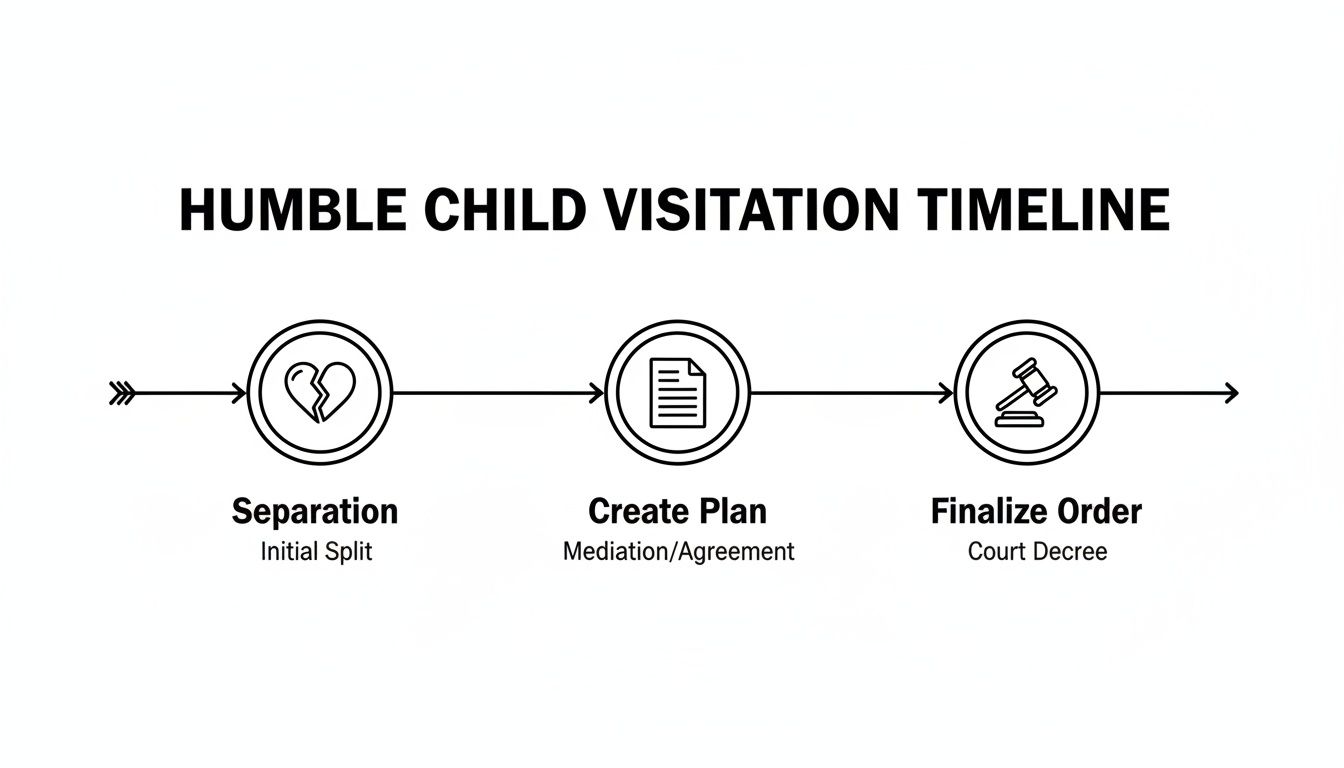
As you can see, creating the plan and getting it finalized are two very different but equally important steps in bringing stability to your child's life.
Weekend and Holiday Schedules Under the SPO
So, what does this actually look like on a calendar for a family here in Northeast Houston? The most well-known part of the SPO is its "first, third, and fifth" weekend rule.
- Weekend Possession: The non-primary parent almost always gets the children on the first, third, and fifth weekends of any given month. A "weekend" is typically defined as starting when school lets out on Friday and ending when the child goes back to school on Monday morning.
- Holiday Division: Major holidays are split to ensure both parents can create important memories. Thanksgiving and Christmas are usually alternated each year. For instance, the non-primary parent might have the children for Thanksgiving in even-numbered years, while the primary parent has them for Christmas. The next year, it flips.
- Summer Vacation: The non-primary parent is generally given 30 days of possession during the summer. This can be used all at once or broken into smaller visits, as long as they provide the other parent with proper written notice.
This highly structured calendar is designed to be fair and predictable. By setting clear ground rules from the start, the SPO helps reduce arguments and allows everyone to plan their lives with certainty.
It’s also important to understand the common reality of custody designations. Even as we see a trend toward more shared parenting, mothers are still named the primary parent in 79.3% of custody cases across the country. For families in our community, this often means the non-custodial parent's time is built around the SPO framework. This reality has financial implications, too. As you can discover in these detailed child custody statistics, the average custodial parent only receives about $3,431 in child support annually, which makes having a clearly defined and enforceable schedule even more essential.
Is the SPO Always the Right Answer?
While the SPO is the default, it is by no means a one-size-fits-all solution. It's built for families with traditional Monday-to-Friday, 9-to-5 work lives. If you're a parent who works weekends, has a rotating shift schedule, or lives more than 100 miles away, the standard order can be completely impractical.
This is exactly why Texas law allows parents to create their own arrangements. If the SPO doesn't work for your family, you and the other parent can work together to craft a custom schedule. The only legal requirement is that whatever you agree on must be in the child's best interest.
The SPO offers a reliable, court-approved foundation to build upon. By understanding its ins and outs, Humble parents are in a much better position to either adopt it or advocate for a modified plan that truly serves their children’s needs. If you're unsure how the SPO might apply to your unique situation, our team in Humble is here to walk you through it with compassion and clarity.
Creating a Custom Schedule for Your Humble Family
The Texas Standard Possession Order (SPO) is a solid starting point, but for many families here in Humble, Kingwood, and across Northeast Houston, a one-size-fits-all schedule just doesn't align with the realities of modern life. This is where a Modified Possession Order becomes a powerful tool, giving you and your co-parent the ability to design a custom plan that genuinely fits your family.

Think of the SPO as the standard floor plan for a new house. A modified order is what lets you move walls, add a home office, or design an open-concept kitchen. It's about taking the strong legal foundation the state provides and customizing it to match how your family truly lives.
Why Your Family Might Need a Custom Plan
In our community, life rarely fits into a neat 9-to-5 box. Many Humble and Atascocita residents work in Houston's dynamic energy sector or its world-class medical centers, which often means non-traditional hours, rotating shifts, or on-call duties. For these families, the SPO's rigid weekend structure can be unworkable.
A custom child visitation schedule in Humble often becomes necessary for a few common reasons:
- Irregular Work Schedules: Parents working as first responders, healthcare professionals, or in industrial roles simply can't guarantee they'll be free every first, third, and fifth weekend.
- A Child's Activities: If your child is a rising star on a travel sports team with weekend tournaments or a dedicated performer with evening rehearsals, the standard schedule might force them to miss out.
- Desire for 50/50 Possession: Many parents today are aiming for a more equal split of parenting time. A modified order is the only way to put popular 50/50 schedules into a legally binding format.
- Logistical Challenges: Even something as simple as coordinating pickups and drop-offs around I-69 traffic can be managed more smoothly with a custom plan that works for both households.
When you're designing a custom visitation schedule for your family in Humble, it's also smart to think about school breaks and local activities well in advance. Planning ahead for camps and other events makes the year run smoother for everyone, especially your child. For instance, there are some fantastic local options, like these February break camps in Humble, that can be built right into your annual calendar.
Examples of Alternative Schedules
Once you move beyond the standard order, a world of possibilities opens up. The real goal is to find a rhythm that gives your child consistency while remaining practical for both parents. Here are a few popular alternatives we often help Humble-area families put into place:
- Week-On / Week-Off: This is a very straightforward 50/50 schedule where the child spends one complete week with Parent A, then the next full week with Parent B. It's easy to track and minimizes exchanges, which is often great for older children and teens.
- The 2-2-5-5 Schedule: In this rotation, the child is with Parent A for two days, Parent B for two days, then back with Parent A for a five-day stretch. The following week, the pattern flips. This setup ensures neither parent goes more than a few days without seeing their child, making it a good choice for younger kids.
- The 2-2-3 Schedule: This plan has the child spending two days with Parent A, two with Parent B, and then the three-day weekend with one parent. The parent who has the weekend rotates each week, creating a predictable pattern that kids can easily follow.
The most effective possession orders are born from collaboration, not conflict. By focusing on creative problem-solving, you can build a plan that prioritizes your child's well-being and fosters a healthy co-parenting relationship for years to come.
The Power of Mediation and Legal Guidance
You don't have to battle in a courtroom to get a custom schedule. Mediation is a powerful tool that allows you and your co-parent to sit down with a neutral third party and negotiate an agreement together. It's a confidential, less stressful process that keeps you in control of the outcome. We've seen countless local clients who were initially at an impasse find common ground and cooperative solutions through mediation.
Once you have an agreement, having an experienced Humble attorney is crucial. We can help you craft a detailed and unambiguous legal document that a Harris County judge will approve. A vague or poorly written order is a recipe for future arguments, but a clear, enforceable plan gives everyone peace of mind.
Your family is unique, and your possession order should be, too. Our team at The Law Office of Bryan Fagan is here to help you create a schedule that truly works for your family and provides the stability your child deserves.
Sample Visitation Schedules for Different Ages
When it comes to creating a child visitation schedule in Humble, one size definitely does not fit all. Just as you wouldn’t give your teenager the same bedtime as your toddler, a possession schedule must be adaptable, growing and changing right alongside your child.
What works for a two-year-old who needs frequent contact will look completely different from the schedule for a 16-year-old juggling school, friends, and a part-time job. The goal is to create a rhythm that supports your child's specific developmental stage, giving them the stability to build strong, healthy relationships with both parents.

Let's walk through some practical examples that families here in Humble, Atascocita, and Kingwood often use as a starting point. These are not rigid templates but flexible frameworks you can tailor into a Modified Possession Order. A well-thought-out plan always takes child emotional development into account, as their needs will evolve dramatically over the years.
Table of Contents
- Age-Appropriate Visitation Schedule Examples
- Visitation Schedules for Infants and Toddlers (Ages 0-3)
- Visitation Schedules for School-Aged Children (Ages 4-12)
- Visitation Schedules for Teenagers (Ages 13-18)
- Handling Long-Distance and 50/50 Possession Schedules
Age-Appropriate Visitation Schedule Examples
The following table provides a high-level look at how visitation schedules can be adapted for a child’s specific age and developmental needs.
| Child's Age Group | Primary Goal | Sample Schedule |
|---|---|---|
| Infants (0-3) | Foster secure attachment with both parents and minimize separation anxiety. | Several short, frequent visits during the week (e.g., 2-3 hours each) plus a longer weekend visit. Overnights are gradually introduced. |
| School-Age (4-12) | Provide consistency and predictability that works with school and activities. | 2-2-5-5 rotation (parents split weekdays and alternate weekends) or a simple week-on/week-off schedule. |
| Teens (13-18) | Balance parental time with the teen’s growing need for independence and social life. | Week-on/week-off or a Standard Possession Order, but with built-in flexibility for activities, jobs, and social events. |
These examples are designed to be starting points for a conversation, helping you and your co-parent focus on what truly matters at each stage of your child’s life.
Visitation Schedules for Infants and Toddlers (Ages 0-3)
With infants and toddlers, the most important goal is consistency and fostering secure attachment. At this tender age, a child’s primary need is to build a secure bond with their caregivers. Long separations can be stressful, which is why the Standard Possession Order is often not the best fit for children under three.
Instead of long weekends away, the focus should be on frequent, shorter periods of possession. This helps your little one understand that both parents are a constant, reliable presence in their life.
- What It Looks Like: The non-primary parent might have several shorter visits during the week—think two to three hours on a Monday, Wednesday, and Friday. This could be coupled with a longer, four-to-six-hour visit on a Saturday or Sunday.
- A Note on Overnights: Many parents choose to introduce overnights gradually. You might start with one overnight visit per week around age two, increasing the frequency as your child grows more comfortable with the routine.
Visitation Schedules for School-Aged Children (Ages 4-12)
Once your child starts school, their life gains a new structure. The possession schedule needs to work with their school calendar, not against it. For kids attending Humble ISD or other local schools, predictability is a huge comfort. They need to know where they’ll be sleeping on a school night and who will be helping with homework.
This is the age where schedules like the 2-2-5-5 or a week-on/week-off plan can be highly effective.
The best schedule for a school-aged child is one they can easily remember. Consistency is their anchor, helping them feel secure and confident as they move between two loving homes.
- Example: 2-2-5-5 Schedule: Parent A has the child Monday and Tuesday, Parent B has them Wednesday and Thursday, and you simply alternate the long weekend (Friday through Sunday). The benefit of this plan is that the child never goes more than a few days without seeing each parent.
- Example: Week-On/Week-Off Schedule: This is a classic 50/50 possession schedule where the child spends one full week with Parent A, then switches to Parent B for the next week. Exchanges often take place on Sunday evenings, helping everyone get settled and prepared for the school week ahead.
Visitation Schedules for Teenagers (Ages 13-18)
If you have a teenager, you know their world is expanding rapidly. Their lives are a whirlwind of classes, extracurriculars, friendships, and maybe even a part-time job. A rigid, inflexible visitation schedule can feel like a cage, often leading to frustration and resentment. The key here is to build in flexibility.
Your goal is to balance their growing independence with the need to ensure they have quality time with each parent.
- What It Looks Like: A basic week-on/week-off or even a Standard Possession Order can serve as a great foundation, but with an important addition: language allowing the schedule to be modified by mutual agreement. This allows for last-minute changes to accommodate a school dance, a weekend sports tournament, or extra hours at their job.
- Communication is Everything: While you and your co-parent still make the final decisions, involving your teen in the conversation can make a world of difference. When they feel heard and respected, they are far more likely to embrace the schedule.
Handling Long-Distance and 50/50 Possession Schedules
What happens when one parent lives outside the Humble area? Or when you're both committed to a true 50/50 split? These situations require a more creative and intentional approach to scheduling.
- For Long-Distance Parents: The schedule naturally shifts to maximize holidays and school breaks. The non-local parent typically has the child for most of spring break, a large portion of the summer, and alternates major holidays. Weekend visits might happen once a month but would be for the full weekend to make the travel worthwhile.
- For a Practical 50/50 Schedule: The week-on/week-off plan is by far the most popular and straightforward way to achieve a true 50/50 split. The success of this plan hinges on clear communication and a solid plan for exchanges so that school projects, sports equipment, and important information don’t fall through the cracks.
Remember, these are just ideas to get you started. The perfect child visitation schedule in Humble is the one you and your co-parent thoughtfully create with your child's best interests as the top priority. Here at The Law Office of Bryan Fagan, we specialize in helping families turn these concepts into clear, enforceable, and effective possession orders.
How to Finalize and Enforce Your Visitation Order
All the hard work you’ve put into crafting a visitation schedule for your child isn't finished until a judge signs off on it. Whether you've settled on a Standard Possession Order or a completely custom plan, this final step is what gives it legal authority. An informal, handshake agreement is merely a suggestion, but a finalized court order is a powerful legal document you can rely on.
Here in Humble, getting that order signed by a Harris County judge is what truly matters. It transforms your plan from a hopeful agreement into a solid, enforceable framework. This gives your family the security and predictability that is so essential for co-parenting successfully.
From Agreement to Official Court Order
So, how do you make your possession order official? Once you and your co-parent have an agreement—whether you reached it through mediation or simply by working together—it needs to be written into a formal legal document. This isn't just a calendar; it’s a detailed order that must use specific language that meets the requirements of the Texas Family Code to get a judge's approval.
An experienced family law attorney knows how to draft these orders with the precision required to prevent problems down the road. After it's drafted and both parents have signed it, the order is submitted to a judge. Once the judge signs, it gets filed with the court and becomes a legally binding order.
Think of a court-ordered possession schedule as your child's bill of rights for their time with each parent. Finalizing it provides the stability and predictability they need to thrive after a separation.
Without that judge's signature, you have very few options if the other parent suddenly decides not to follow the schedule. This final step is absolutely critical for your peace of mind and your child's stability.
What Happens When Your Co-Parent Doesn’t Follow the Order
It is one of the most frustrating situations a parent can face. You show up for your scheduled weekend, ready to see your child, only to be denied. Or perhaps your co-parent is constantly late for drop-offs, throwing your life and your child’s routine into chaos. These are not just minor annoyances—they are violations of a court order.
The good news is that Texas law gives parents in Humble and Kingwood powerful tools to enforce their rights. You are not powerless. The first, most important thing you must do is meticulously document every single violation.
- Keep a detailed log with dates, times, and a clear description of what happened.
- Save every text message, email, or other communication related to the missed visit.
- Note any costs you incurred, such as non-refundable tickets for an event you planned with your child.
This documentation is your evidence. A single missed visit might be excused, but a clear pattern of violations is something a judge will take very seriously.
Taking Legal Action to Enforce Your Rights
When your attempts at communication are not changing the other parent's behavior, it's time to take formal legal action. You can file a Motion for Enforcement with the same Harris County court that issued your original order. This is your official request for a judge to step in and compel the other parent to comply.
A judge has several powerful remedies if they find a parent has been denying possession time without a valid reason:
- Order Make-Up Time: The judge can require the non-compliant parent to give you additional time with your child to make up for the time you lost.
- Require Reimbursement: The parent who violated the order may have to pay for your attorney's fees and any other costs you incurred because of the missed visitation.
- Hold Them in Contempt: For serious or repeated violations, a judge can hold the other parent in contempt of court, which can lead to significant fines and even jail time.
The law provides strong protections for your parental rights. You have a right to every minute of time laid out in your child visitation schedule in Humble. If that right is being denied, our team at The Law Office of Bryan Fagan is ready to fight for you. Contact our Humble office for a free consultation to discuss your situation and get the strong advocacy you need.
Ready to Talk to a Humble Family Law Attorney?
Trying to figure out a child visitation schedule in Humble by yourself can feel like you're walking through a maze blindfolded. It’s complicated, it’s emotional, and it’s easy to feel completely lost. But you don’t have to do this on your own. Getting guidance from an experienced local lawyer isn't just a good idea; it can be the single most important step you take for your family's future.
Here at The Law Office of Bryan Fagan, we're not just familiar with the Harris County family courts—we’re in them day in and day out. We know the local procedures, the judges, and what they expect to see in a possession order. More importantly, we are dedicated to serving our neighbors right here in Humble, Atascocita, and Kingwood. Our commitment is to cut through the legal jargon and give you clear, practical advice you can actually use.
Your Neighbors in Family Law
We believe the best legal support comes from someone who understands your community and your concerns. Our attorneys aren't just commuting to an office in Humble; we are part of this community. This gives us a real-world perspective on the challenges families in Northeast Houston face. We are your neighbors, and we are passionate about helping local families find a path to stability and peace.
When you work with us, you're getting more than just a lawyer. You're getting a dedicated team that will listen to your story, develop a smart strategy, and advocate for you from start to finish. We help families with all kinds of situations:
- Building a New Possession Order: We'll work with you to create a schedule from scratch that is practical, fair, and puts your child’s well-being first.
- Modifying an Existing Schedule: Life changes. A new job, a move, or a child's evolving needs can make an old schedule unworkable. We’ll guide you through the legal process of updating it.
- Enforcing Your Visitation Rights: If the other parent isn't honoring the agreement, we can take swift, effective legal action to protect your court-ordered time with your child.
A good possession order should bring peace and predictability to your child's life. If it's a source of constant fighting, it isn't working—and we can help you fix that.
Let's Talk—Schedule Your Free Consultation
You shouldn't have to make these life-altering decisions while feeling confused or overwhelmed. The first step toward gaining clarity and confidence is simply having a conversation.
We invite you to reach out to our Humble office and set up a completely free, no-pressure consultation with one of our family law attorneys. This is your opportunity to share your story, ask your questions, and learn about your legal options. Your family's future is too important to leave to chance—let us help you protect it.
Your Humble Visitation Questions, Answered
When we sit down with parents in our Humble office, a few key questions about visitation schedules seem to come up time and again. We've heard it all, and we want to share some straightforward answers to the concerns we hear most often from families right here in our community.
What Is the "Right of First Refusal"?
Think of the "right of first refusal" as a common-sense agreement between co-parents. It's a clause we often help families build into their custom possession orders, and it's incredibly effective.
Basically, it means if you need childcare for a specific amount of time—say, for a work trip or even just a long evening out—you have to offer that time to the other parent first before calling a babysitter, grandparent, or friend. It's a fantastic way to give both parents more time with their kids and keep everyone involved.
Can My Child Decide Who They Live With?
This is a big one, especially for parents with pre-teens and teenagers in the Kingwood and Atascocita areas. In Texas, once a child turns 12, a judge is allowed to talk with them privately, away from both parents, to hear their preference about where they want to live.
But here’s the crucial part: a child's wish is just one piece of the puzzle. The judge’s final decision must always be based on the child's overall "best interest." While an older teen's opinion carries significant weight, the court still has to consider everything else, from the stability of each home to the child's emotional and physical needs. The child doesn't get the final say, but their voice will absolutely be heard.
How Can We Handle Disagreements Without Going Back to Court?
Even with the best-laid plans, disagreements are bound to happen. The first and best tool you have is open communication. Many parents we work with have found success using co-parenting apps, which act as a neutral ground for discussing schedules and keeping conversations civil and documented.
But what happens when you're truly at a standstill?
Before you even think about heading back to court, consider mediation. It's a fantastic, low-conflict alternative. A neutral third-party mediator helps you and your co-parent find a middle ground you can both live with, saving you a ton of stress and money.
If you reach a new agreement through mediation, our firm can then help you get it formalized by the court. This makes it a legally binding order and helps prevent the same issue from popping up again down the road.
At The Law Office of Bryan Fagan, we know the local courts and understand what Humble families are going through. We’re here to give you clear answers and the strong representation you deserve. If you have more questions or need to create or modify a child visitation schedule, schedule a free consultation with our team. You can find us online at https://humbletxlawyers.com.